
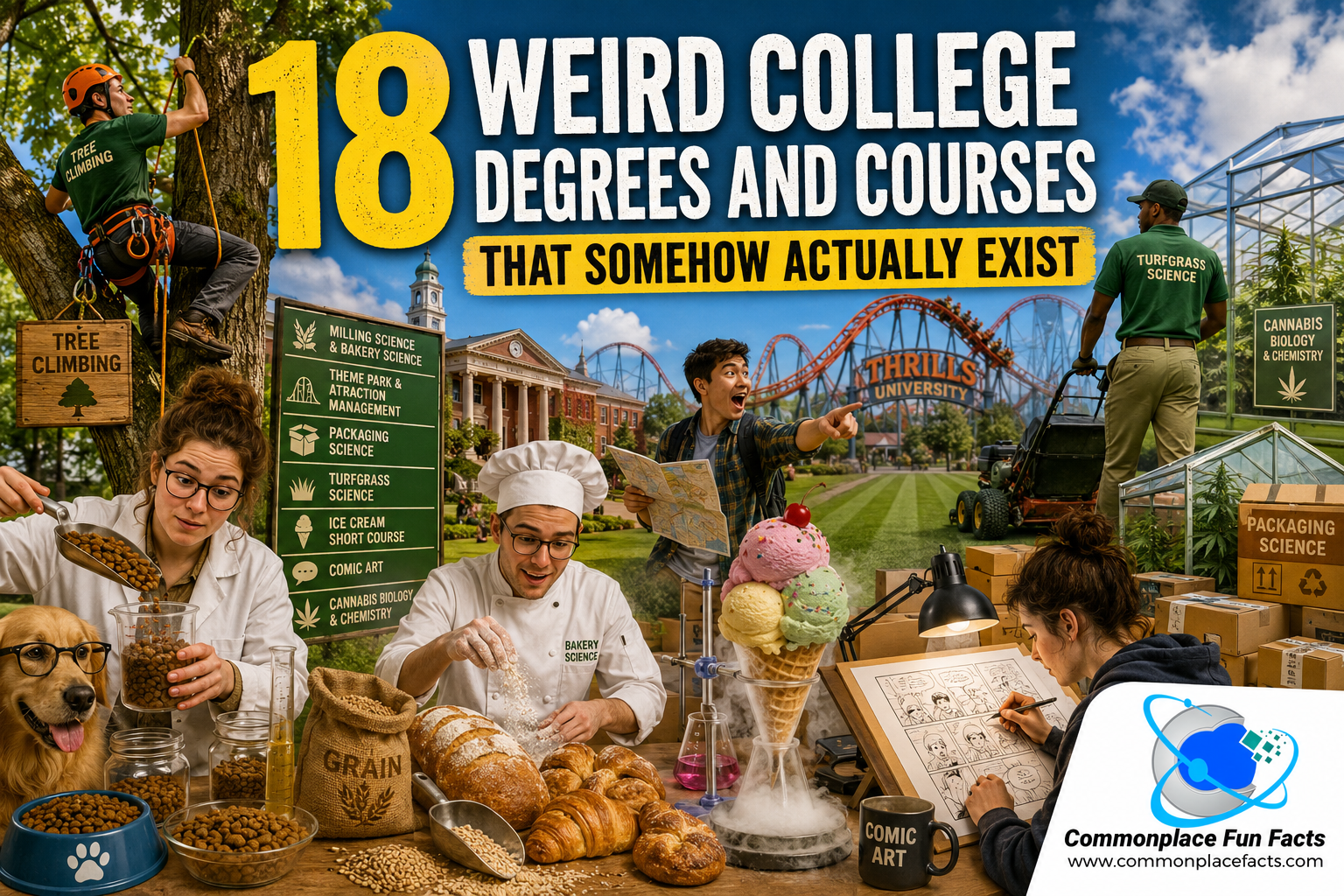

College has always been about expanding the mind, opening doors, and occasionally convincing an eighteen-year-old that incurring educational debt greater than the national debt of some developing countries is a reasonable price for three credits in “The Cultural Semiotics of Snack Foods.”
Some time ago, we looked at 22 of the most unusual college courses, a thrilling journey through higher education’s more eyebrow-raising offerings. We encountered David Beckham Studies, Puppet Arts, The Science of Harry Potter, Philosophy of Phish, Getting Dressed, and a course on how to watch television, which presumably involved advanced work in “sitting” and “looking forward.”
That should have been enough. But academia, like a haunted copier in the basement of the humanities building, is never truly finished surprising us.
It turns out the world of unusual college courses and weird college degrees is much larger than one article can contain. Some of these programs sound like fake majors invented by a sitcom writer. Others sound completely useless until you think about them for nine seconds and realize, with some annoyance, that society actually does need people who understand pet food, grass, ice cream, roller coasters, comic books, cannabis chemistry, and how to put a box inside another box without destroying civilization.
So let us return to the ivy-covered halls of higher learning, where dreams are pursued, tuition bills are generated, and somewhere a student is explaining to Grandma that yes, “Theme Park and Attraction Management” is a real degree and no, that does not mean he gets to ride Space Mountain for midterms.
Contents
The Problem With Calling These “Useless Degrees”
Before we begin, a confession: not every strange-sounding degree is useless. In fact, several of them are almost aggressively useful, which is terribly inconvenient for anyone trying to maintain a proper level of snark.
A degree in Packaging Science may sound like majoring in cardboard, but everything from pharmaceuticals to potato chips has to be packaged safely, efficiently, legally, attractively, and in a way that does not cause the product to explode in a warehouse. A degree in Turfgrass Science may sound like four years of staring at a lawn, but professional sports fields, golf courses, public parks, and large campuses all require people who know the difference between “healthy athletic surface” and “lawsuit waiting to happen.”
Still, there is a special joy in seeing a formal university catalog treat these subjects with the solemn dignity usually reserved for cardiology, constitutional law, and whatever economists are pretending to understand this week.
So here they are: more obscure, unusual, and allegedly useless college courses and degrees that somehow exist — and, in many cases, may be more practical than majoring in “general studies,” which is academic code for “we are all hoping this sorts itself out.”
1. Feed and Pet Food Science — Kansas State University
Let us begin with the majestic field of kibble scholarship.
Kansas State University offers a Bachelor of Science in Feed and Pet Food Science. According to the university, it is the only institution in the world offering a four-year degree in this particular field, which means somewhere there is a young person who can proudly say, “I am attending the Harvard of dog food,” and be technically correct.

The program covers grain handling, regulatory compliance, feed formulation, quality and safety, and pet food processing. In other words, it is not simply “How to Pour Something Brown Into a Bowl 101.” This is actual science, involving animal nutrition, manufacturing, food safety, and the kind of industrial processes most of us never think about because we are too busy asking the dog why he is barking at nothing.
On one hand, a pet food degree sounds ridiculous. On the other hand, Americans spend staggering amounts of money on their pets, many of whom eat better than college freshmen. Someone has to make sure Princess Wigglebottom’s salmon-and-sweet-potato dinner meets regulatory standards.
That someone needs a diploma.
2. Milling Science and Management — Kansas State University
If pet food science does not satisfy your appetite for unexpected Kansas-based practicality, consider Milling Science and Management, also at Kansas State University.
This degree prepares students for careers in flour milling, grain processing, quality control, research and development, equipment manufacturing, and other fields where grain stops being something in a field and starts being something that will eventually become toast.
At first glance, “milling science” sounds like something from the Middle Ages, possibly taught by a man named Obadiah who owns three donkeys and distrusts zippers. But modern milling is a massive industrial enterprise. Flour does not magically appear in five-pound paper bags because a cheerful cartoon chef willed it into existence. It is the end result of agriculture, engineering, chemistry, logistics, food safety, and machinery that could probably flatten a Buick.
So yes, students can major in milling. And yes, this is one of those programs that sounds like a punchline until civilization runs out of bread for 48 hours and everyone becomes very supportive of the grain sciences.
3. Bakery Science and Management — Kansas State University
At this point, Kansas State deserves some sort of national award for turning the contents of a pantry into a career fair.
The university also offers Bakery Science and Management, a four-year degree devoted to the science, production, and business of baked goods. It includes food chemistry, cereal science, bakery operations, product development, management, and all the other things standing between “raw dough” and “I will eat six of these and pretend it was one serving.”
This is another one that sounds silly only because we have become spoiled by the miracle of modern abundance. Bread, crackers, cookies, pastries, and snack foods show up on shelves so reliably that we forget somebody has to design, test, manufacture, package, and distribute them.
In other words, Bakery Science may sound like a degree in muffins, but it is really applied chemistry wearing an apron.
Also, if a person graduates college and immediately gets paid to think about cake, perhaps that person has beaten the system and we should all be quiet out of respect.
4. Theme Park and Attraction Management — University of Central Florida
Some degrees prepare students to enter traditional professions: medicine, law, engineering, accounting. Others prepare students to answer the eternal question, “Why has this animatronic pirate been blinking sideways since 1997?”

The University of Central Florida offers a Bachelor of Science in Theme Park and Attraction Management. Located in Orlando, UCF is not exactly guessing about where theme parks might be useful. This is a university surrounded by attractions, hotels, tourists, mouse ears, roller coasters, and adults wearing lanyards with the seriousness of military command.
The program includes subjects such as park operations, guest experience design, leadership, marketing, innovation, and global attraction strategies. In short, students learn how to run the places where families spend thousands of dollars so Dad can spend forty-seven minutes trying to fold a stroller while holding a churro.
It sounds like a fake major. It is not. Theme parks are enormous logistical machines. They require crowd control, safety systems, hospitality, food service, entertainment, maintenance, marketing, security, and the delicate art of convincing people that waiting in line for 90 minutes is part of the magic.
There are easier jobs, but few require such a precise blend of joy, engineering, and human traffic management.
5. Cannabis Biology and Chemistry — Colorado State University Pueblo
Once upon a time, the idea of earning a college degree in cannabis would have sounded like something your roommate announced after three weeks of skipping economics.
Today, Colorado State University Pueblo offers a Bachelor of Science in Cannabis Biology and Chemistry. The program focuses on the biological and chemical principles related to cannabis science, including plant physiology, growth, pharmaceutical implications, and practical industry applications.
This is not, despite what your uncle may assume, a degree in “sitting on a couch and explaining Pink Floyd.” It is chemistry, biology, agriculture, lab work, testing, regulation, and product development tied to a fast-changing industry that has moved from back alleys to storefronts with sleek branding and suspiciously relaxed cashiers.
Of course, this does raise a new problem. For generations, parents worried that college students were experimenting with cannabis. Now the student can respond, “I have to. It’s for my major.”
That is either educational progress or the most expensive excuse ever invented.
6. Packaging Science — Clemson University
Packaging Science sounds, at first, like majoring in “box.”
Clemson University, however, offers a Bachelor of Science in Packaging Science, and it is far more serious than the name suggests. Students study design, engineering, science, innovation, research, and business as they relate to packaging. Clemson points out that everything from lunch to laptops to knee replacements can be packaged, which is not a sentence most of us expected to encounter today.
This is the sort of degree that sounds absurd until you receive a shattered bottle of shampoo in the mail and immediately develop strong feelings about packaging science.
Packaging has to protect products, preserve food, survive shipping, satisfy regulators, reduce waste, communicate branding, and somehow open without requiring bolt cutters, a prayer candle, and the upper-body strength of a Viking.
So yes, students can study packaging. And based on the number of products currently sealed in plastic clamshells apparently designed by escaped prison architects, we need them.
7. Turfgrass Science — Penn State
There are people who mow lawns. Then there are people who understand turf.
Penn State offers a Bachelor of Science in Turfgrass Science, including online options through Penn State World Campus. The program prepares students for work related to golf courses, sports fields, grounds management, pest control, soil science, turfgrass systems, and the endless human quest to make grass behave.

To the untrained eye, this may look like a degree in “lawn.” But professional turf is serious business. A badly maintained athletic field can affect performance, cause injuries, ruin events, and turn a stadium into something resembling a Civil War battlefield after a rainstorm.
Golf courses, meanwhile, are not just patches of grass. They are living, chemical, biological, hydrological, heavily manicured landscapes that exist so people can spend four hours being angry at a tiny white ball.
So while “Turfgrass Science” may sound like the punchline to a joke about college debt, it is a real field with real jobs. It may also be the only major where a parent can ask, “When are you going to touch grass?” and receive the answer, “Professionally.”
8. Farrier Science and Business — Hocking College
For those who want a degree that sounds like it should be taught next to a forge by a man with forearms the size of fence posts, Hocking College offers Farrier Science and Business.

A farrier specializes in horse hoof care, including trimming, shoeing, corrective work, and the kind of hands-on equine maintenance that makes most office workers suddenly grateful for spreadsheets. Hocking’s program combines farrier training, blacksmithing, hoof care, therapeutic shoeing, and business education.
This is not useless. It is extremely useful if you own horses, work with horses, treat horses, ride horses, race horses, or have ever stood near a horse and realized it is basically a thousand-pound toddler with hooves and opinions.
Still, “Farrier Science and Business” has a delightfully old-world sound. It feels like a degree you could earn while wearing a leather apron, reciting Chaucer, and muttering darkly about the latest rumors of the Black Death in the next village.
Modern college may have changed, but somewhere, somehow, higher education still knows how to produce a person qualified to nail metal to a horse.
9. Comic Art — Minneapolis College of Art and Design
There was a time when drawing comic books in class was considered evidence that a student was not paying attention. Today, that student may simply have been assembling a portfolio.
The Minneapolis College of Art and Design offers a BFA in Comic Art, focusing on storytelling, imagery, traditional and digital comic craft, graphic novels, comic strips, visual narratives, and professional practice.
This will seem ridiculous to anyone who still thinks comic books consist entirely of capes, sound effects, and men in tights standing heroically on gargoyles. To be fair, there is a lot of that, and thank goodness. But comics are also a major storytelling medium, with applications in publishing, advertising, education, gaming, animation, journalism, and visual communication.
Sequential art requires composition, pacing, design, writing, character development, typography, perspective, and the ability to make a reader understand that three panels of silence are either heartbreaking or an awkward elevator ride.
Besides, if film studies can be respectable, comic art deserves a seat at the table. Preferably one drawn with dramatic shadows and a speech bubble saying, “At last, accreditation!”
10. Mortuary Science — Cincinnati College of Mortuary Science
Some academic programs prepare students for life. Others prepare them for what happens after everyone is done with it.
The Cincinnati College of Mortuary Science offers a Bachelor of Mortuary Science program through an accredited institution devoted to funeral service education. Students in the field study embalming, restorative art, funeral service management, law, ethics, pathology, grief counseling, and all the solemn practicalities that most of us prefer to avoid thinking about until absolutely necessary.
This is not a useless degree. It is a deeply necessary profession. It is also one of those majors that makes freshmen orientation conversations more interesting.
“What are you studying?”
“Business.”
“Psychology.”
“Communications.”
“Mortuary science.”
At which point the group goes silent, and everyone suddenly remembers they have somewhere else to be.
The program may be obscure, but it has one advantage over many fashionable degrees: there will always be customers. Admittedly, customer satisfaction surveys are a challenge.
11. Tree Climbing — Cornell University
Cornell University, an Ivy League institution founded in 1865, offers physical education courses in tree climbing.

This is not the childhood version of tree climbing, where the curriculum consists of “go up,” “get scared,” and “yell for Dad.” Cornell’s tree climbing program teaches rope systems, technical climbing gear, hazard assessment, ascending, descending, moving through the canopy, and climbing safely in ways that are useful for recreation, education, and research.
Still, there is something wonderfully funny about attending an Ivy League university and earning credit for climbing a tree. Generations of children have done this for free, usually while wearing muddy sneakers and ignoring a mother shouting, “You get down from there right now.”
Of course, Cornell’s version involves equipment, technique, safety, and probably fewer broken collarbones. That is the difference between “childhood memory” and “course catalog.”
Also, if society is going to spend this much time telling young people to aim higher, we should not complain when they take us literally.
12. Ice Cream Short Course — Penn State
Every so often, higher education gets it exactly right.
Penn State offers an Ice Cream Short Course, described as a program that teaches the science and technology of ice cream manufacturing “from cow to cone.” This is the kind of phrase that proves someone in university marketing deserved a raise and possibly a frozen treat with sprinkles.
The course covers ice cream production, ingredients, quality, formulation, manufacturing processes, and the many ways dairy science can be used to produce happiness in frozen form.
This is not a useless course. This is civilization. We can argue about politics, economics, philosophy, and whether pineapple belongs on pizza, but a university course devoted to making better ice cream is one of the strongest arguments that humanity still has redeeming qualities.
There are people who mock unusual college courses. Those people should be handed a sad, icy, flavorless grocery store dessert and asked whether they still oppose academic specialization.
Suddenly, the value of dairy science becomes clear.
13. Competitive Pokémon and Game Theory — Rice University
Rice University has offered a course using competitive Pokémon to explore game theory, strategy, and decision-making under limited information.
On the surface, this sounds like a course designed by someone who did not want to put away his Nintendo. But the premise is not as absurd as it first appears. Competitive Pokémon involves probability, prediction, risk management, resource allocation, strategic planning, hidden information, and anticipating an opponent’s choices. In other words, it is a surprisingly useful miniature battlefield, except instead of generals, armies, and supply lines, you have electric rodents and emotionally complex dragons.
Game theory asks how people make decisions when outcomes depend on what others do. Pokémon asks whether your opponent is about to switch, attack, bluff, stall, or ruin your afternoon with a move you forgot existed. The overlap is more real than anyone over forty wants to admit.
Of course, this does mean a student could one day say, “My college education taught me how to defeat Charizard through rational choice theory.”
This is not the only example of a video game helping researchers understand human behavior. Read The World of Warcraft Pandemic That Taught Scientists About Real Ones for the details on that chapter where the digital world and analog world overlapped.
14. PokeMath: The Mathematics of Pokémon GO — University of Iowa
Not to be outdone in the great academic Pokémon migration, the University of Iowa developed a general education course called PokeMath: The Mathematics of Pokémon GO.

The course uses the popular mobile game Pokémon GO to make mathematical concepts more approachable. This is either a brilliant way to teach math through familiar technology or a sign that algebra finally admitted it needed better branding.
To be fair, math has always suffered from a public relations problem. Ask students whether they want to study probability, geometry, optimization, and data analysis, and many will suddenly develop urgent medical appointments. Tell them they can use those same concepts while catching imaginary creatures on a phone, and suddenly the room gets more cooperative.
Education often works best when it sneaks through a side door. If Pokémon GO can help students understand math, that is probably a win. A strange win, yes, but still a win.
Besides, after years of teachers telling students to put their phones away, there is poetic justice in a course that says, “Take out your phone. We’re doing math with monsters.”
15. Writing About Taylor Swift — Southern Utah University
There are few forces in modern culture powerful enough to affect music, economics, politics, friendship bracelets, NFL camera coverage, and the emotional stability of ticketing websites. Taylor Swift is one of them.
Southern Utah University offered a Spring 2026 course called Writing About Taylor Swift. The syllabus describes a course focused on Swift’s rise to fame, development as an artist, albums, rhetoric, persona, and cultural influence.
At first, this sounds like academia chasing pop culture with a butterfly net. But celebrity studies can reveal a great deal about media, gender, economics, fandom, identity, storytelling, and the strange modern power of a person with a guitar, a breakup narrative, and a highly organized fan base.
Still, there is something delightful about imagining students opening a syllabus and discovering that the week’s assignment involves rhetorical analysis of Red. Somewhere, an English professor who once assigned Milton is trying to look supportive.
The course may not be for everyone, but it does answer one important question: yes, it is now possible to discuss Taylor Swift in college without pretending it is just a phase.
16. Taylor Swift’s Lyrics as Literature — Stanford University
Stanford University has also entered the Swiftian academic arena, offering student-initiated courses exploring Taylor Swift’s lyrics as literature and storytelling.
According to Stanford, students in one course examine Swift’s evolution as a lyricist, her storytelling, and her literary allusions. This includes references to writers such as F. Scott Fitzgerald, William Wordsworth, and Pablo Neruda, which means students may now study Taylor Swift and still use phrases that sound impressive at dinner parties.
This is not as strange as it sounds. Universities have long studied popular songs, folk music, oral tradition, protest music, blues, hip-hop, and the cultural meaning of performance. Swift simply arrives with more sequins and better ticket demand.
The real question is not whether pop lyrics can be analyzed. Of course they can. The real question is whether students will someday complain that their professor “totally misread the bridge,” thereby proving that literary criticism has survived into the era of stadium tours.
Higher education adapts. Sometimes it adapts in tweed. Sometimes it adapts in glitter.
17. The Art of Walking — University of San Francisco
Walking has been around for quite some time. Early humans used it to hunt, migrate, explore, and avoid being eaten by things with larger teeth. Most of us mastered the basics as toddlers and have been coasting ever since.
The University of San Francisco, however, lists a course called The Art of Walking. The course examines how people map urban identities through bodily experience, movement, neighborhoods, cities, and individuals.
In other words, this is not merely “left foot, right foot, repeat until destination.” It is a course about movement, space, identity, place, and the way bodies experience the city. That is a legitimate academic subject.
Still, the title is doing a lot of comedic work. “The Art of Walking” sounds like the first class offered at a university founded entirely by cats. One imagines the final exam consisting of crossing campus without falling into a fountain.
But perhaps that is unfair. Walking is something we do constantly and rarely examine. Universities exist, at least in theory, to make us think more deeply about ordinary things.
Even if the ordinary thing is going to lunch.
18. Fandoms, Gamers, Football, and K-Pop — University of Missouri Honors College
The University of Missouri Honors College has explored fandom through a course titled “Fandoms: Gamers, Football, and K-Pop, Oh My!”
This course looked at the nature of fandom, including sports, gaming, music, collectibles, and pop culture communities. That may sound frivolous, but fandom is a major social force. It shapes identity, spending habits, online behavior, media production, tourism, politics, and the emotional stability of adults during playoff season.
We often treat fandom as silly because it involves costumes, chants, rankings, message boards, and people arguing about fictional canon as if national borders were at stake. But replace “fictional canon” with “college football rivalry,” and suddenly half the country has to stop laughing.
Fandom studies can teach us how communities form, how brands build loyalty, how people signal belonging, and why otherwise sensible adults spend money on limited-edition plastic objects with dead eyes and resale value.
Also, any college course that places K-pop, football, and Beanie Baby-style collecting under one intellectual umbrella deserves credit for bravery, if nothing else.
So Are These Degrees Useless?
Some of these courses sound absurd. Some are absurd. Some merely suffer from unfortunate naming. And some are probably more connected to real employment than a suspicious number of respectable-sounding majors that mostly prepare students to say, “I’m thinking about grad school.”
That is the great twist in the world of weird college degrees: the ones that sound silly are sometimes the ones with the clearest path to a paycheck.
Feed and Pet Food Science points toward a real industry. Milling Science points toward food production. Bakery Science points toward manufacturing and product development. Theme Park Management points toward hospitality and tourism. Turfgrass Science points toward sports fields and golf courses. Packaging Science points toward every product that has ever needed to survive shipping. Mortuary Science points toward a profession with, let us say, persistent demand.
Meanwhile, a student with a vague degree in “interdisciplinary leadership narratives” may still be trying to explain what that means during a job interview while the Bakery Science graduate is already thinking about purchasing a vacation home.
The real lesson may be that usefulness is not always obvious from the name. A degree that sounds like a punchline may lead to a job. A degree that sounds impressive may lead to a LinkedIn headline full of fog.
The University Catalog Is a Strange and Wonderful Place
Universities are easy to mock, and we should do so whenever reasonably possible. They are expensive, bureaucratic, jargon-filled, and somehow able to turn “watch a movie” into “visual media analysis in a late-capitalist framework.”
But they also preserve expertise in corners of the world most of us never think about. Someone has to understand turf disease. Someone has to design packaging that keeps medicine sterile. Someone has to manage a theme park crowd before ten thousand overheated tourists turn into a sociology experiment. Someone has to know why your dog’s food is shaped like tiny brown asteroids.
And yes, someone will inevitably write a paper about Taylor Swift.
That is academia: part noble search for truth, part employment pipeline, part cultural archive, and part very expensive machine for giving formal names to things humans were already doing.
We may laugh at these unusual college courses and obscure degrees, but perhaps the joke is on us. The world is weird. The economy is weird. Human interests are weird. It follows that education would eventually become weird enough to keep up.
Still, if any university begins offering a graduate certificate in “Advanced Remote Control Management: Streaming Platforms, Battery Replacement, and Household Dispute Resolution,” we reserve the right to investigate.
For research purposes, of course.
You may also enjoy…

Thomas Jefferson vs. the Department of Education: The Original Throwdown Over Who Gets to Teach the Kids
Discover Thomas Jefferson’s bold and often misunderstood plan for public education—focused on local control, talent-based advancement, and a fierce opposition to centralized government mandates.

22 of the Most Unusual College Courses You Won’t Believe Exist
Explore 20 of the most unusual college courses offered worldwide, from David Beckham Studies to the Science of Harry Potter. Find out which degrees might leave you scratching your head.

The University of Chicago Scavenger Hunt: A Legendary Event of Absurdity and Brilliance
Explore the wild, quirky, and competitive world of the University of Chicago Scavenger Hunt, a four-day marathon of bizarre tasks, academic overachievement, and community spirit






Leave a Reply