
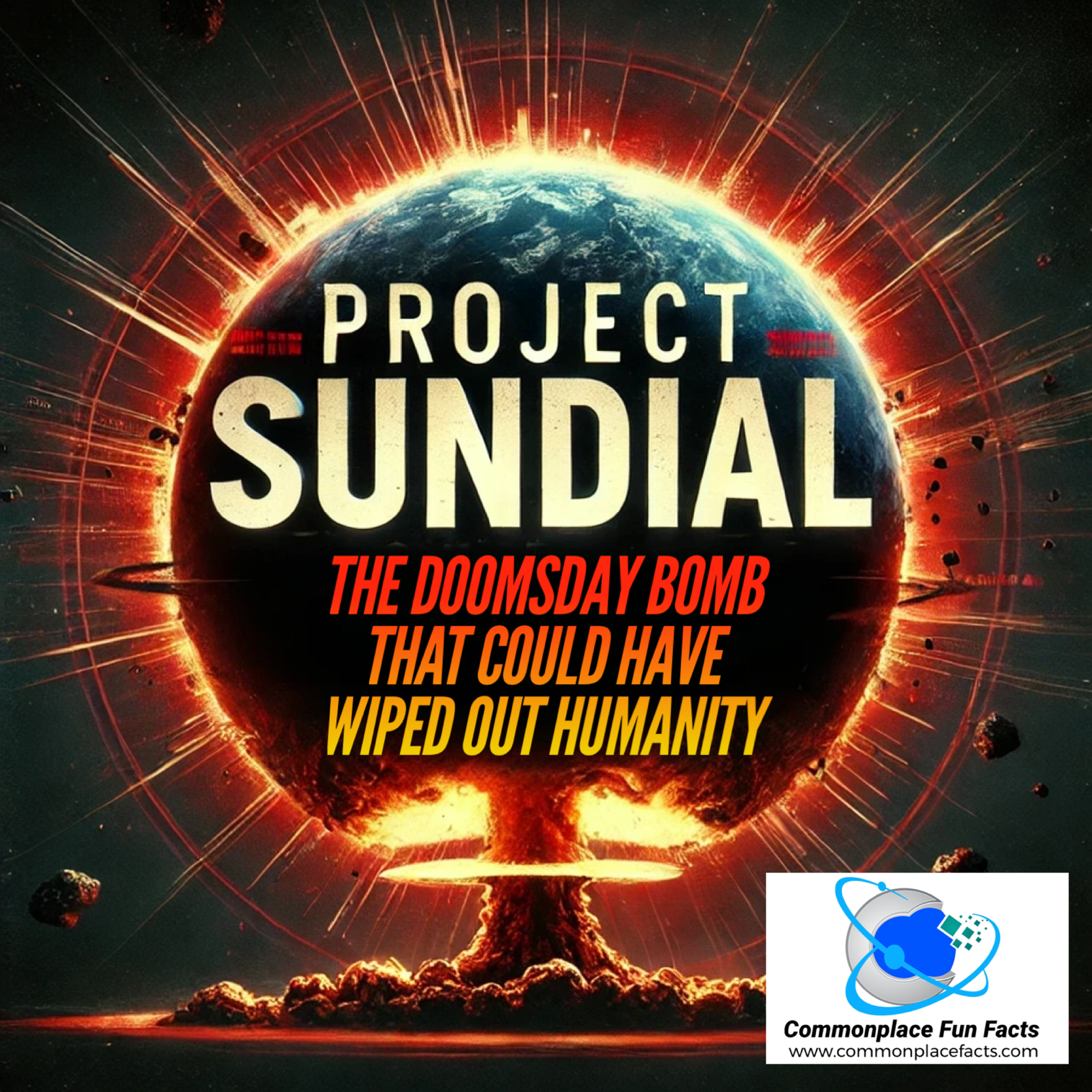

Somewhere in the fever-dream depths of Cold War logic, someone apparently said, “You know what would really secure peace on Earth? One nuclear bomb so massive it could end Earth.” And instead of being promptly escorted out of the room by security and given a stern talking-to by someone with a psychology degree, they got funding. Welcome to Project Sundial, America’s charming little brainstorm to build a single doomsday bomb big enough to erase humanity like a typo in a Word doc.
Contents
Everything Changed Forever
Let’s play “what if you were born in 1908.” You’d enter a world with more horses than cars, where “streaming” meant a babbling brook and not a backlog of unwatched Netflix. Fast-forward to 1945 and you’d witness two world wars, the invention of television, jet propulsion, and—oh yes—atomic bombs. Small, glowy harbingers of doom that made traditional warfare look quaint.
Hiroshima and Nagasaki didn’t just end a war—they redefined what “winning” even meant. Suddenly, world leaders had to play nuclear chess, where every pawn could vaporize a city. Naturally, this meant everyone wanted their own shiny new atomic toy. Enter the Cold War arms race: brought to you by paranoia and physics.
The Race to Oblivion
In 1946, in a brief moment of clarity (or maybe guilt), the U.S. floated the Baruch Plan: give up nukes, share tech, save humanity. Predictably, the idea was shot down harder than a weather balloon in restricted airspace. By 1949, the Soviet Union had joined the Nuclear Club, and the only thing more powerful than the bombs was the ego-fueled competition to make them bigger.
By 1950: 300 nuclear weapons. By 1960: 20,000. Humanity, ever resourceful, managed to channel its brilliance into building enough firepower to destroy itself—several times over. Enter Edward Teller, a man whose idea of “too far” simply didn’t exist.
But What If We Destroy Humanity More Efficiently?

Edward Teller didn’t just want to improve the atomic bomb—he wanted to create the supervillain version. He pushed hard for the hydrogen bomb, which makes atomic bombs look like party poppers. By 1952, the U.S. tested its first H-bomb, and Pacific geography was never the same. Teller, satisfied but never quite finished, said: “Why stop at islands when you can erase continents?”
This led us to Project Sundial, the nuclear equivalent of rage-quitting Earth. The plan: one bomb to end them all. Not metaphorically. Literally.
The Final Bomb: Sundial
Sundial was the brainstorm to end all brainstorming—mostly because it aimed to end all humans. With an estimated yield of 10 billion tons of TNT, this wasn’t a bomb; it was the universe’s worst birthday candle. It dwarfed Hiroshima like a sumo wrestler sitting on a Lego set.
The idea wasn’t to drop it on the enemy. No, that would be too… normal. Instead, it would sit cozily on U.S. soil as a last resort. Think of it as a “You hit me, I delete the planet” kind of thing. Like building a booby-trapped doormat that takes the whole house—and block—down if someone steps on it wrong.
What Would Sundial Do?

Here’s a short list of what the Sundial bomb would’ve unleashed if ever used:
- A fireball 31 miles wide, igniting everything within 250 miles. Yes, you read that right. You wouldn’t see the horizon—you’d see fire.
- A magnitude 9 earthquake across the U.S., just to make sure you weren’t bored.
- Nuclear winter that drops global temperatures by 18°F, tanks agriculture, and ends life as we know it. But on the plus side, you’d never have to mow the lawn again.
Good News! (Wait, No, Bad News)
The good news? Sundial never got off the ground. Even Cold War strategists—whose job was literally to think of ways to win nuclear war—blinked at this one. Cooler heads (relatively speaking) prevailed.
The bad news? Instead of one super-mega-doomsday button, we got 70,000 smaller ones. Today, about 12,000 nuclear weapons remain, still more than enough to turn our planet into a low-budget sci-fi wasteland. Sundial may not have happened, but its spirit lives on in every warhead chilling in a silo somewhere, waiting for humanity’s next really bad idea.
More bad news? The automatic Doomsday device that was fictional in the movie Doctor Strangelove is real and is probably still functioning.
Are We Okay?
Short answer? Not really. The long answer includes trillion-dollar nuclear modernization projects, a China nuke boom, and increasingly fragile geopolitics. We’re still playing Russian roulette with a fully loaded revolver, but now we’re doing it while juggling and blindfolded.
For a look at times we nearly vaporized ourselves by accident, check out this delightful article of accidental Armageddon close calls.
Maybe it’s time we traded in our global death machines for something a bit less extinction-y. Like therapy. Or a really good group hug. Or, you know, functioning diplomacy.
You may also enjoy…

Dead Hand: The Real-Life Soviet Doomsday Machine Dr. Strangelove Warned Us About
Read about the chilling true story of Dead Hand, the Soviet Union’s real-life doomsday machine designed to launch nukes automatically—even after national annihilation. It wasn’t fiction then, and it’s not retired now.

The Doomsday Vault to Save Oreos
We have reported on various initiatives to preserve humanity if we should encounter an apocalyptic event. Among these have been the government doomsday shelter hidden in plain sight, the global seed vault, a monument with instructions for rebuilding humanity, and even the IRS’s ambitious plans to collect your taxes after nuclear armageddon. Admittedly, none of…

It’s the End of the World As We Know It…. And We’re Still Waiting
Throughout history, numerous prophets have predicted the end of the world, with notable claims spanning over 2,000 years. Despite these predictions, none have occurred. The text highlights significant dates and figures associated with various apocalyptic forecasts, illustrating humanity’s persistent fascination with doomsday scenarios, extending even millions of years into the future.





Leave a Reply to Commonplace Fun FactsCancel reply