
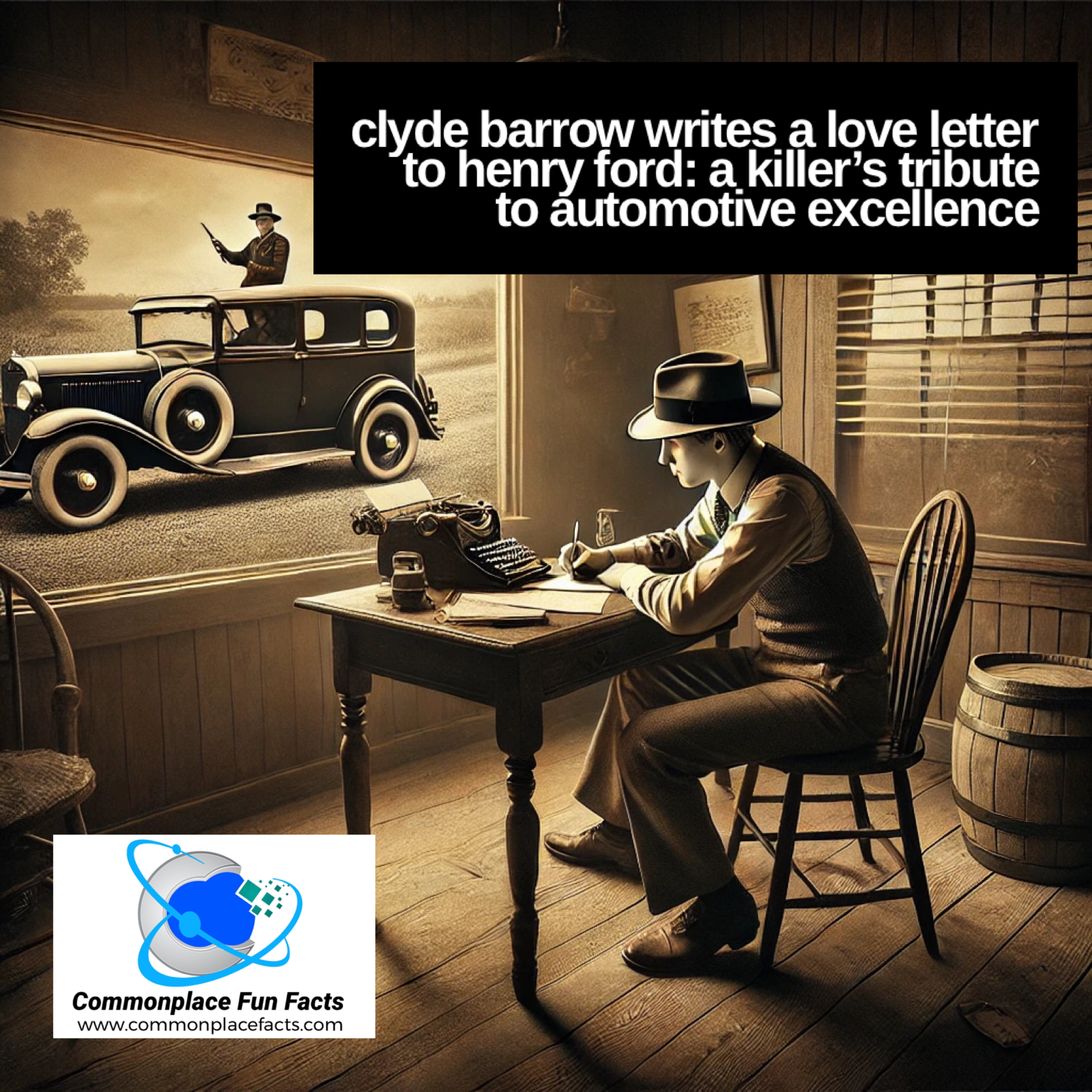

The 1930s is remembered for larger-than-life personalities, epic love stories, fast cars, and headline-grabbing crime sprees. There is no better example of all of these coming together than Clyde Barrow’s love affair with his favorite getaway car.
Contents
A Killer’s Two Big Loves
Yes, we’re talking about that Clyde Barrow — one half of the infamous Bonnie and Clyde duo, whose steamy love story was wrapped around a wild spree of murder and bank robbery.

As much as Barrow loved Bonnie Parker, it seems he also had room in his criminal heart for another sweetheart: their getaway car. The lovebirds’ preferred mode of transportation was the Ford Model 40 B Fordor Deluxe, leather-seat sedan. The 1934 model was powered by Ford’s ground-breaking, mass-produced 3.6-litre Flathead V8 engine and had a three-speed sliding-mesh manual transmission.
The Ford V8, as it was commonly known, was a symbol of 1930s automotive innovation, celebrated by motorists and bootleggers alike. Introduced in 1932 by the Ford Motor Company, this gem of engineering brilliance quickly became the darling of American drivers.
While the rest of the nation was marveling at the V8’s affordability and power, Barrow was busy giving it the ultimate field test. From 1932 to 1934, Barrow and Parker embarked on a high-octane spree of robberies across Texas and the Midwest with their trusty Ford V8. Its powerful engine, combined with his prodigious driving skills, made it the perfect getaway car—so perfect, in fact, that law enforcement might as well have been chasing them in a horse and buggy.
A Love Letter from the Road

Barrow’s appreciation for the Ford V8 ran so deep that he put pen to paper in April 1934 to express his gratitude directly to the source—Henry Ford himself. The letter, mailed from Tulsa, Oklahoma, reads:
Mr. Henry Ford
Detroit, Mich.
Dear Sir:
While I still have got breath in my lungs I will tell you what a dandy car you make. I have drove Fords exclusively when I could get away with one. For sustained speed and freedom from trouble the Ford has got every other car skinned, and even if my business hasn’t been strictly legal it don’t hurt anything to tell you what a fine car you got in the V8.
Yours truly,
Clyde Champion Barrow
The letter’s postmark confirms it was mailed on April 10, 1934, and it reached Ford’s Detroit office three days later. While Henry Ford’s response—a polite “thank you”—never made it to Barrow (owing to his hasty departure from Tulsa), the correspondence has lived on in infamy. Today, it’s displayed at the Henry Ford Museum, serving as both a peculiar piece of automotive history and a testament to the enduring appeal of the V8.
Authenticity in Question
Of course, not everyone believes Barrow actually wrote the letter. Handwriting comparisons have led some to suggest that Bonnie Parker, the gang’s poet laureate, might have been the true author. Some have pointed out that while the letter’s tone and errors align with Clyde’s limited education and mischievous humor, its signature—“Clyde Champion Barrow”—raises eyebrows. Barrow’s middle name was actually Chestnut, and the “Champion” moniker was an inside joke from his prison days.
Adding to the skepticism, Barrow’s sister Marie vehemently denied the letter’s authenticity, as well as that of another missive supposedly penned by her brother around the same time. Sent to Amon Carter, editor of the Fort Worth Star-Telegram, this second letter critiqued the paper’s portrayal of Parker. However, its timing and postmark suggest the gang was elsewhere when it was mailed.
An Imitator Emerges
As if Barrow’s letter wasn’t enough, another automotive fan letter surfaced a month later, allegedly penned by none other than Public Enemy Number One: John Dillinger. This one, postmarked from Detroit and dated May 16, 1934, sang similar praises for the Ford V8:
“Hello Old Pal. Arrived here at 10:00 AM today. Would like to drop in and see you. You have a wonderful car. Been driving it for weeks. It’s a treat to drive one. Your slogan should be, drive a Ford and watch the other cars fall behind you. I can make any other car take a Ford’s dust!”
Unlike the Barrow letter, this one was swiftly debunked. Handwriting analysis confirmed it was a forgery, likely concocted by someone erroneously linking Dillinger to a recent Michigan bank robbery.
The Last Ride

Both Barrow and Dillinger met their ends shortly after their supposed letters to Henry Ford. Dillinger, known for his Houdini-like escapes, was gunned down by the FBI outside Chicago’s Biograph Theater in July 1934. Barrow, fittingly, met his demise at the wheel of a stolen Ford V8 just six weeks after his alleged letter, alongside Parker in a Louisiana police ambush.
While we may never know for certain if Barrow’s tribute to the Ford V8 was genuine, the car’s legacy as the outlaw’s chariot endures. Ford may have marketed it as a car for the everyman, but for Clyde Barrow, it was nothing short of a partner in crime—a testament to its speed, reliability, and, dare we say, criminal charm.
You may also enjoy…

How Henry Ford Helped Make Backyard BBQ Easier for Everyone
Henry Ford was famous for promoting his game-changing Model T automobile, telling consumers they could have the car in any color, as long as it was black. There was another game-changing innovation for which he was responsible. Like the car that made him famous, it, too, was available only in black. The Model T car…

The Two Deaths of John Dillinger
Public Enemy Number One. There are few titles that carry more notoriety than being labeled as the #1 threat to society. Those who have been so branded are among the worst of the worst. The names of Al Capone, Pretty Boy Floyd, Baby Face Nelson, and El Chapo are forever seared in the public’s memory…

The Al Capone Cherry Tree: A Blossoming Tale of Crime, Compassion, and Caponettes
Discover the fascinating story of the Al Capone cherry tree gift, blending crime, compassion, and a blooming legacy in Baltimore.






Leave a Reply to Author Jan SikesCancel reply