How Melissa Goings Avoided the Gallows When Abraham Lincoln Suggested She Get Water From Tennessee
Discover the bizarre true story of Abraham Lincoln, a 70-year-old widow accused of murder, and a mysterious courtroom escape through an open window. Was it justice—or just clever lawyering? Explore the curious case of Melissa Goings.
By the same token, Lincoln knew there were some people who had acted honorably but were still guilty in the eyes of the law. What is a lawyer’s duty to a client such as this?
Case in point: the strange and ethically-questionable vanishing act of one Melissa Goings.
Contents
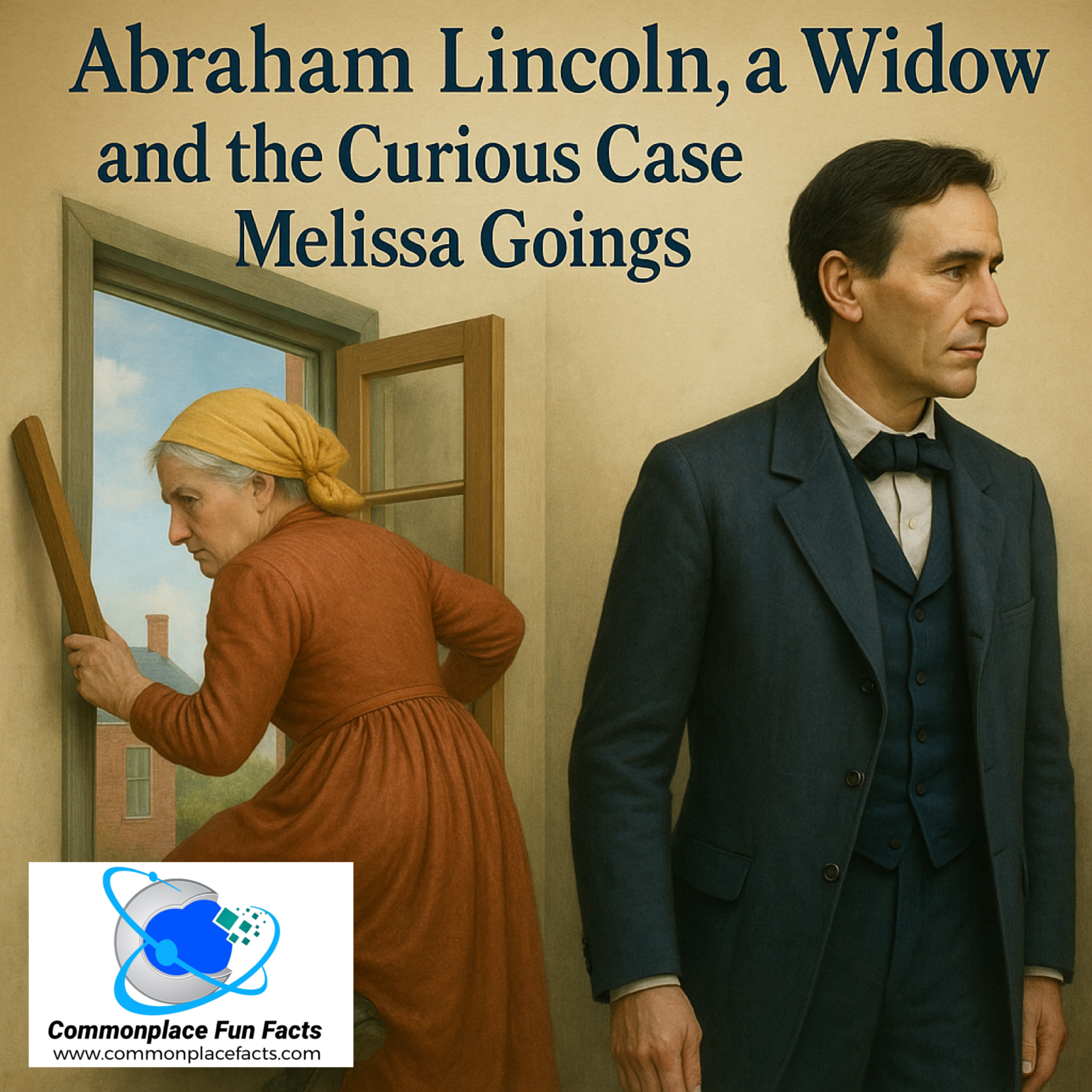
A Widow, a Window, and a Whack With a Stovewood
The year was 1857. Metamora, Illinois — a quaint little town that was, in those days, the county seat of Woodford County. The laws and the culture emphasized rough justice and tended to cast a blind — or at least indifferent — patriarchal eye toward certain practices.
“I expect she has killed me…If I get over it I will have revenge.”
— Roswell Goings on his deathbed.
Melissa Goings was 70 years old and on trial for the murder of her husband, Roswell Goings. Although no witnesses were present, the subsequent coroner’s inquiry reported the following:
An argument between Goings and his wife over the opening of a window at their home led to a violent quarrel on April 14, 1857. Although no other person was present some details of the quarrel and its tragic ending were gained from witnesses who appeared at the inquest conducted by Coroner Benjamin Kindig.
It was shown that Mrs. Goings struck her husband with a heavy piece of stovewood, inflicting a head injury from the effects of which he died four days later. Testimony indicated Goings was choking his wife when she broke away and defended herself with the stovewood.
No mention is made of the arrest of Mrs. Goings but she was “summoned” on a coroner’s warrant to appear at a preliminary hearing on April 23 and was held to bail of $1,000. Armstrong Goings and Samuel W. Beck were the defendant’s sureties. Mrs. Goings signed the bail bond with her mark. Two justices of the peace, Joseph Morley of Worth Township and Robert T. Cassell of Metamora, presided at the hearing.
It appears that Goings had been buried before the coroner and a twelve-man jury held the inquest. Coroner Kindig issued a summons directing Constable John Lane to disinter the body. The officer engaged two men to perform that task and the inquest was held on April 21 at the Goings residence “where the dead body was lying.”
James Brady told the coroner’s jury that he saw Goings shortly after the old man was struck down. “I expect she has killed me,” said Goings to Brady, adding, “if I get over it I will have revenge.” The old man soon lost the power of speech. Josephus Goings said his father “did not speak to me after he was hurt. He would answer by shaking or nodding his head.”
Other witnesses at the inquest were Samuel W. Beck, Benjamin Grove, J. H. Whitmire, Roswell Hibbs, Joshua Van Vilson and “Dr. Wood,” the latter of Tazewell County. The jury found that Goings came to his death by violence from wounds “inflicted by Melissa Goings, wife,” and that a fracture of the skull was the cause of death.
Now, before anyone clutching a gavel of 21st-century jurisprudence starts reciting Miranda rights in their head, let’s take a moment to appreciate just how stacked the deck was against Melissa.
What about her right of self defense? Roswell Goings had been abusing her for years. This was not exactly a mystery or up for debate. As for her response? Even the court record — such as it was — noted that she struck her husband only twice. Admittedly, twice was enough to send her husband to meet his Maker, but it isn’t as if she was driven by homicidal rage to flatten his skull after he was down.
Statues of Melissa Goings and Abraham Lincoln outside the Metamora Courthouse in Metamora, Illinois.
So yes, we can be sympathetic toward her, but her decision to defend herself took place in an age when women couldn’t vote or own property without a male co-signer. On top of that, the self-defense claim was still underdeveloped in Illinois jurisprudence. It existed, but its application was uneven and very difficult to predict.
It would be easy to assume Judge Harriott and the prospective jurors wouldn’t be exactly a model of compassion toward a woman in Melissa’s situation. If Lady Justice was wearing a blindfold in this courtroom, it was because someone had sucker-punched her and tied her to a chair.
That’s when Abraham Lincoln got involved in the case.
Enter Honest Abe (With a Drafty Escape Plan?)
Yes, that Lincoln. He hadn’t yet grown the iconic beard, but his legal prowess throughout Illinois was legendary. He had a legal mind sharp enough to slice through complicated legal concepts like a hot knife through sashimi. As if that weren’t enough, he was widely regarded as the legal community’s reigning oral advocate and could make even the most hostile jury see things his way.
His sympathy didn’t change the sober fact that the courtroom wasn’t likely to give Melissa the outcome she deserved. Instead, she could be going from there to the gallows. This was very much on his mind as he met with his client in a small first-floor room.
They met for some time, discussing Melissa’s options, none of which were particularly cheerful. The future president then left the room, giving her some time to compose herself. When it was time to begin the proceedings, the deputy entered the room to retrieve her. Much to his astonishment, there was no one there. The open window provided the only clue as to what had happened.
When told about the escape, Judge Harriott was furious. He demanded an explanation from Lincoln. The lawyer professed surprise that his client had fled.
A quaint version of Mrs. Goings’ disappearance on the day of her scheduled trial is preserved in a Woodford County Circuit Court record made sixty-four years after she took French leave. The story is based on the recollection of Robert T. Cassell, one of the justices who held Mrs. Goings on a murder charge, and court bailiff on the day of the defendant’s disappearance.
Cassell said:
Mrs. Goings was brought into court that Lincoln might talk to her. After a while I was told by the state’s attorney to bring her up for trial, but she could not be found. I asked Lincoln about her and he said he did not know where she was.
I replied, “Confound you, Abe, you have run her off.”
“Oh, no, Bob,” replied Lincoln. “I did not run her off. She wanted to know where she could get a good drink of water, and I told her there was mighty good water in Tennessee.”
The Aftermath: Charges Dropped and Bonds Repaid
Did Lincoln knowingly assist his client in becoming a fugitive from justice? We will likely never know. It is clear that he was not disciplined in any way. The judge forfeited Melissa’s bond and issued a warrant for her arrest. One year later, however, Lincoln was back in town and met with the State’s Attorney. Shortly thereafter, the prosecutor dropped the charges and had the county repay the forfeited bond.
Melissa Goings was never seen in Woodford County again. It appears that she resettled in California (perhaps finding its water preferable to Tennessee’s?) where she lived for the remainder of her life. Her attorney, of course, went on to become President of a war-torn nation, and ultimately, a murder victim himself at the end of that struggle.
Some modern scholars have had the audacity to clutch their pearls and declare Lincoln’s actions unethical. They cite legal codes that weren’t written until decades later, tut-tutting that Lincoln should’ve upheld “justice,” which, in this case, apparently meant seeing a 70-year-old domestic abuse survivor hanged by a unjust system. After all, nothing says “ethical” like assisted execution.
We should also mention that we really don’t know what role, if any, Lincoln really had in his client’s escape. Although we hear Lincoln telling the story himself in Lincoln, it was, after all, a movie. There is no solid evidence that he ever told the story himself.
Did Honest Abe bend the letter of the law to uphold the spirit of justice — the kind that says maybe, just maybe, a battered elderly woman doesn’t deserve to swing from a noose for daring to survive? Was it a calculated move? Maybe. Was it ethically questionable by modern standards? Possibly. Was it the right thing to do in that moment, in that courtroom, under those circumstances? We’ll let you be the judge of that.
In the preamble to today’s Illinois Rules of Professional Conduct, there’s a line about how lawyers are supposed to “challenge the rectitude of official action.” Abraham Lincoln — lawyer, legend, and possibly part-time escape room architect — quite possibly was doing just that, about a hundred years ahead of schedule.
The journey of Abraham Lincoln’s body from Washington, DC to Springfield, Illinois took 13 days and was witnessed by hundreds of thousands of mourners. Solemn observers lined the tracks as the funeral train passed by. In several cities, the President’s coffin was removed from the train so residents could pass by and show their respects.…
Discover Abraham Lincoln’s struggle with depression and suicidal thoughts, how he faced personal tragedies, and his journey to becoming the “Great Emancipator.”
Used to determine whether a user is included in an A / B or Multivariate test.
18 months
_ga
ID used to identify users
2 years
_gali
Used by Google Analytics to determine which links on a page are being clicked
30 seconds
_ga_
ID used to identify users
2 years
_gid
ID used to identify users for 24 hours after last activity
24 hours
_gat
Used to monitor number of Google Analytics server requests when using Google Tag Manager
1 minute
_gac_
Contains information related to marketing campaigns of the user. These are shared with Google AdWords / Google Ads when the Google Ads and Google Analytics accounts are linked together.
90 days
__utma
ID used to identify users and sessions
2 years after last activity
__utmt
Used to monitor number of Google Analytics server requests
10 minutes
__utmb
Used to distinguish new sessions and visits. This cookie is set when the GA.js javascript library is loaded and there is no existing __utmb cookie. The cookie is updated every time data is sent to the Google Analytics server.
30 minutes after last activity
__utmc
Used only with old Urchin versions of Google Analytics and not with GA.js. Was used to distinguish between new sessions and visits at the end of a session.
End of session (browser)
__utmz
Contains information about the traffic source or campaign that directed user to the website. The cookie is set when the GA.js javascript is loaded and updated when data is sent to the Google Anaytics server
6 months after last activity
__utmv
Contains custom information set by the web developer via the _setCustomVar method in Google Analytics. This cookie is updated every time new data is sent to the Google Analytics server.






Leave a Reply to Commonplace Fun FactsCancel reply