
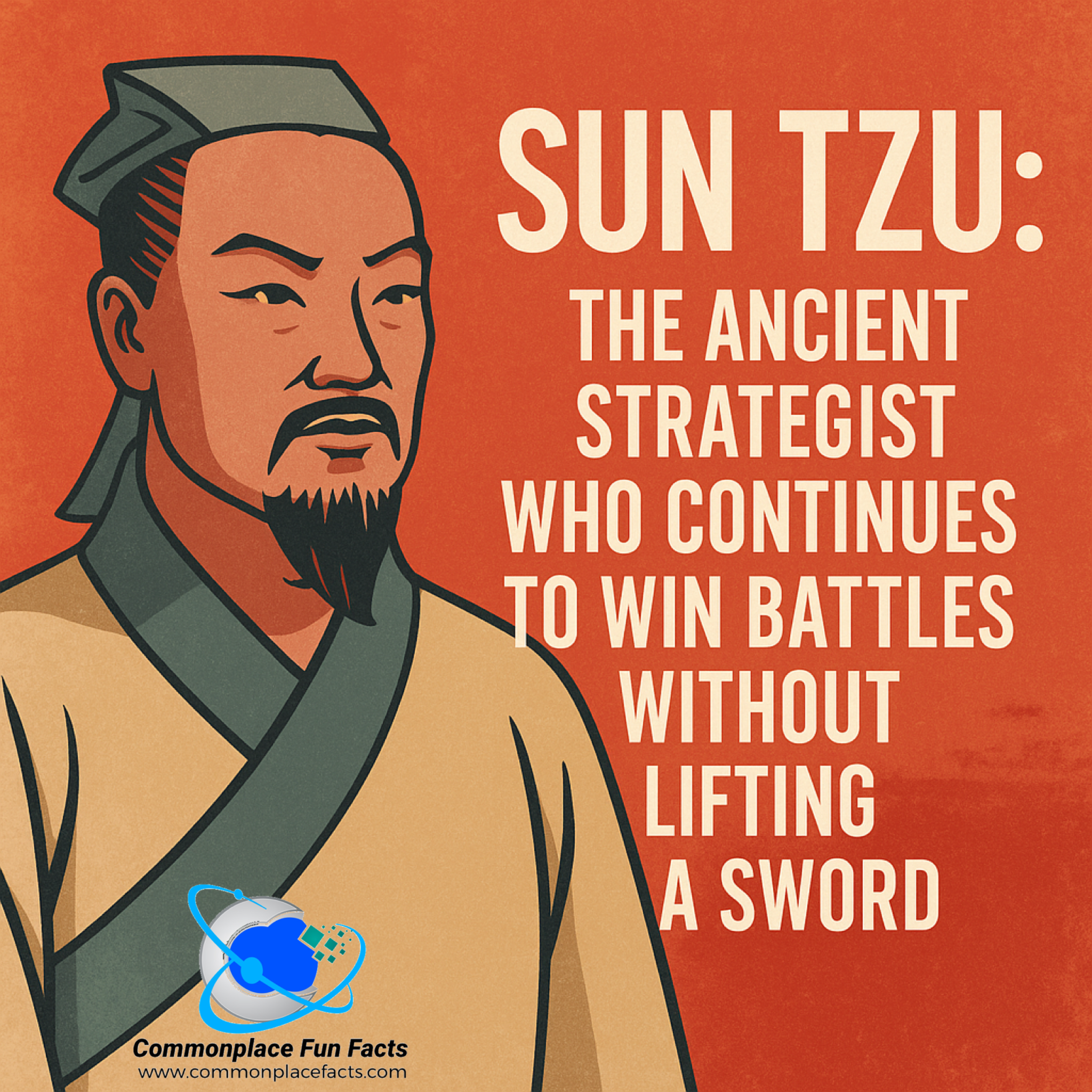

Long before TikTok life coaches and corporate team-building retreats started quoting “strategy” like it was a new religion, there was Sun Tzu: a man so legendary, we’re not 100% sure he even existed. But if he did, he was the kind of person who could win a war with a glare, a scroll, and an impeccably timed quote about water.
Contents
Sun Tzu: The Man, the Myth, the Mystery
Let’s get one thing out of the way: historians argue over whether Sun Tzu was a real person, a group of people, or a very persuasive pseudonym used by someone who didn’t want to do battle but really wanted to write about it.
The traditional account says he lived during the Eastern Zhou period (around 544–496 BC), specifically in the Spring and Autumn era of ancient China. He was supposedly born in the state of Qi but made his name in Wu, where he allegedly served as a general and military strategist for King Helü. And while we can’t carbon-date the man, his ideas have certainly aged better than most reality TV plotlines.
War and Peace (Mostly War): Sun Tzu’s Real-Life Contributions
If the ancient historians are to be believed (which, admittedly, is a bit like believing your uncle’s fishing stories), Sun Tzu helped the state of Wu rise to military prominence using cunning, discipline, and a strong distaste for unnecessary conflict. Ironically, his ultimate lesson was that the best battles are the ones you never have to fight. It’s a little like telling your boss the best meetings are the ones you never have — wise, but not always easy to pull off.
His biggest flex? Allegedly defeating the state of Chu using brilliant tactics, even though Wu was the underdog. Think David vs. Goliath, but with more scrolls and fewer slingshots.
The Art of War: Ancient Wisdom, Modern Weapon
If Sun Tzu had a LinkedIn profile, The Art of War would be both his resume and his TED Talk. This slim volume of 13 chapters is the literary equivalent of a multi-tool: good for battles, boardrooms, breakups, and baseball games. It’s the book that launched a thousand business seminars and at least one startup founder’s personal brand.
Each chapter tackles a different aspect of warfare — from strategic planning to battlefield deception. What’s impressive is how many of these ancient insights are disturbingly relevant today—on and off the battlefield. Highlights include:
- “All warfare is based on deception.” (Also the unofficial motto of used car salesmen.)
- “In the midst of chaos, there is also opportunity.” (Which is basically venture capitalism in a nutshell.)
- “The supreme art of war is to subdue the enemy without fighting.”
Despite being 2,500 years old, The Art of War has been translated into dozens of languages and adapted for nearly every human conflict short of high school prom. (Although, “In the midst of chaos, there is also opportunity” might come in handy.)
Five Constant Factors
Sun Tzu begins The Art of War by identifying what he calls “five constant factors” that should be considered in every conflict:
The Moral Law
The MORAL LAW causes the people to be in complete accord with their ruler, so that they will follow him regardless of their lives, undismayed by any danger. (NOTE: He seems to be referring to a principle of harmony, so that this might be better understood as “morale” instead of “moral law”.)
Heaven
HEAVEN signifies night and day, cold and heat, times and seasons.
Earth
EARTH comprises distances, great and small; danger and security; open ground and narrow passes; the chances of life and death.
The Commander
The COMMANDER stands for the virtues of wisdom, sincerity, benevolence, courage and strictness.
Method and Discipline
By METHOD AND DISCIPLINE are to be understood the marshaling of the army in its proper subdivisions, the graduations of rank among the officers, the maintenance of roads by which supplies may reach the army, and the control of military expenditure.
These five heads should be familiar to every general: he who knows them will be victorious; he who knows them not will fail.
Therefore, in your deliberations, when seeking to determine the military conditions, let them be made the basis of a comparison, in this wise:
(1) Which of the two sovereigns is imbued with the Moral law?
(2) Which of the two generals has most ability?
(3) With whom lie the advantages derived from Heaven and Earth?
(4) On which side is discipline most rigorously enforced?
(5) Which army is stronger?
(6) On which side are officers and men more highly trained?
(7) In which army is there the greater constancy both in reward and punishment?
By means of these seven considerations I can forecast victory or defeat.
The Long Shadow of a Wise General
Sun Tzu’s influence extends far beyond the battlefield. His teachings have been applied to modern military strategy (Douglas MacArthur was a fan), corporate strategy (Jack Welch, anyone?), and even sports (yes, Bill Belichick reads him — probably in Mandarin).
But it doesn’t stop there. His quotes have found their way into self-help books, motivational posters, and that one weird guy’s dating profile who insists that “winning without fighting” also applies to getting your date to pay for dinner.
If you’ve ever heard someone smugly say “Know thy enemy,” you can thank Sun Tzu for starting that trend — even if they don’t remember the rest of the sentence. (Spoiler: it also involves knowing yourself.)

Misconceptions, Misquotes, and Misguided Instagram Wisdom
Like any historical figure who dabbles in pithy wisdom, Sun Tzu has suffered from what we call “Pinterest Disease” — the tendency to have inspirational quotes slapped on sunset photos and misattributed with reckless abandon. (For more examples, see this article.)
Here are a few lines that are often credited to him but probably never crossed his ink brush:
- “Keep your friends close and your enemies closer.” – That was actually Michael Corleone in The Godfather Part II, not Sun Tzu.
- “Victorious warriors win first and then go to war.” – Sounds close, but it’s a paraphrase of “The victorious strategist only seeks battle after the victory has been won.”
- “He who knows others is wise; he who knows himself is enlightened.” – That’s Lao Tzu, different wise guy entirely.
Also, while many imagine Sun Tzu as a stern, sword-wielding warrior-poet, there’s zero historical evidence he ever personally led armies into battle. His power was strategy, not swordplay — more chessmaster than champion.
The Quotable Sun Tzu: Real Quotes to Strategize By
To wrap things up, here are some of Sun Tzu’s best verifiable mic drops — the kind you can actually quote without being corrected by a history major:
- “The greatest victory is that which requires no battle.”
- “He will win who knows when to fight and when not to fight.”
- “Supreme excellence consists of breaking the enemy’s resistance without fighting.”
- “In the midst of chaos, there is also opportunity.”
- “The supreme art of war is to subdue the enemy without fighting.”
- “Appear weak when you are strong, and strong when you are weak.”
- “If you know the enemy and know yourself, you need not fear the result of a hundred battles.”
- “Let your plans be dark and impenetrable as night, and when you move, fall like a thunderbolt.”
- “Opportunities multiply as they are seized.”
- “He who is prudent and lies in wait for an enemy who is not, will be victorious.”
- “Victorious warriors win first and then go to war, while defeated warriors go to war first and then seek to win.”
- “To know your Enemy, you must become your Enemy.”
- “Strategy without tactics is the slowest route to victory. Tactics without strategy is the noise before defeat.”
- “Engage people with what they expect; it is what they are able to discern and confirms their projections. It settles them into predictable patterns of response, occupying their minds while you wait for the extraordinary moment — that which they cannot anticipate.”
- “There is no instance of a nation benefiting from prolonged warfare.”
- “Build your opponent a golden bridge to retreat across.”
- “Know yourself and you will win all battles.”
- “Great results can be achieved with small forces.”
- “All warfare is based on deception.”
- “A leader leads by example, not by force.”
So next time you’re in a tough spot — whether it’s a negotiation, a chess match, or trying to decide whether to reply to that passive-aggressive email — just ask yourself: What would Sun Tzu do? Other than write about it, of course.
You may also enjoy…

Kolberg: The Movie That Tried (and Failed) to Save the Third Reich and Probably Shortened the War
Discover the story behind Kolberg, Nazi Germany’s most expensive propaganda film. Learn how Goebbels’ ambitious WWII project became an epic failure.

Why Does the U.S. Have a Secret Strategic Chicken Stockpile?
The content discusses a fictional and humorous narrative about a secret U.S. strategic chicken stockpile intended for pandemic preparedness. It highlights the importance of chicken eggs in vaccine production, necessary for combating ailments like the Spanish Flu and COVID-19. The narrative ends with a light critique of government slow responses and planning.

Michelangelo and the Foul Footwear
Michelangelo, despite being a legendary creative genius, had poor personal hygiene habits. His biographer Ascanio Condivi described how he often slept in his clothes and boots due to cramp, leading to skin issues. Giorgio Vasari remarked that his long-worn dog-skin buskins were so bonded to his legs they became part of him.



Leave a Reply