
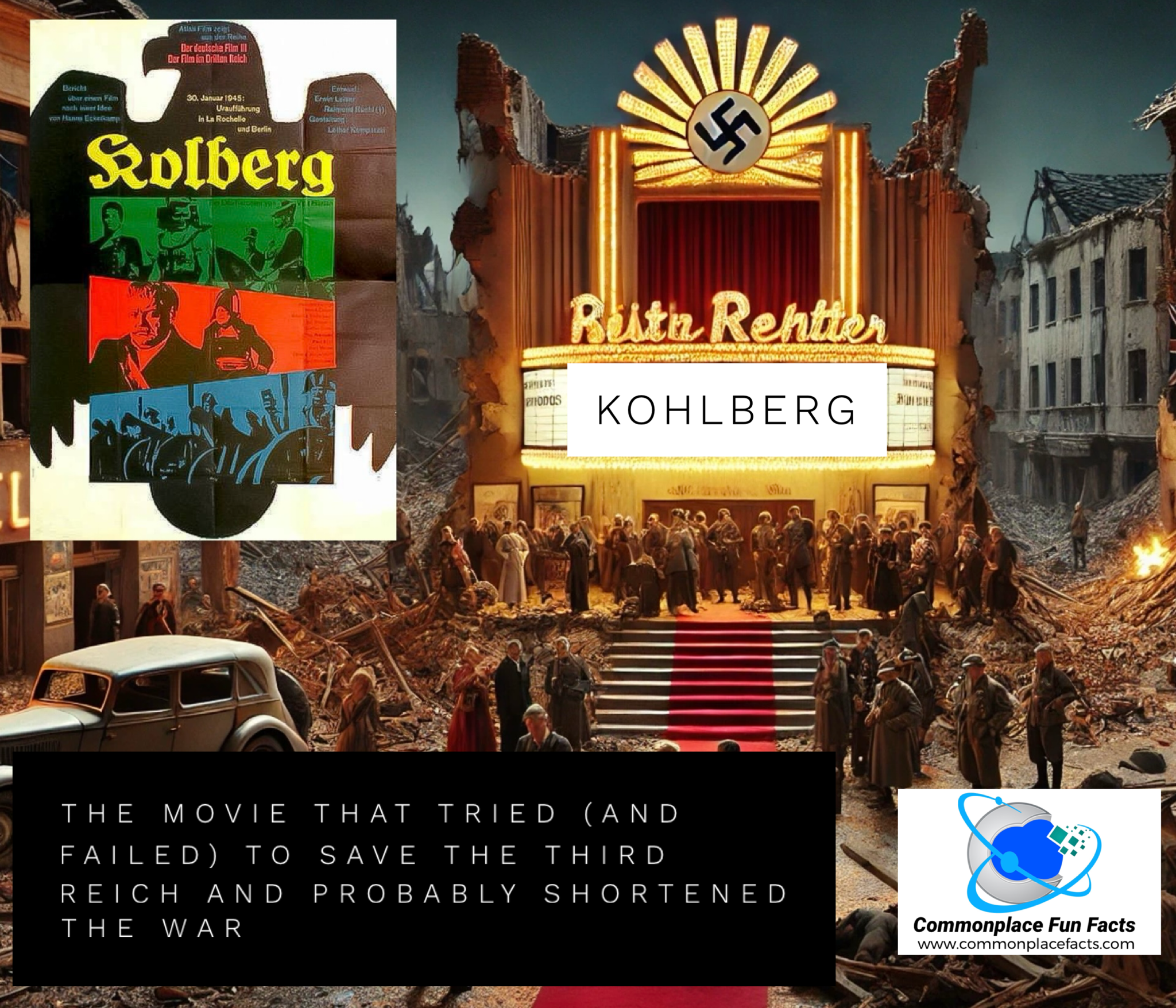

When you think of cinematic blockbusters that were epic flops and hastened the demise of society, probably Cats (2019) is the first movie to come to mind. As justifiable as that may be, allow us to introduce you to Kolberg. It was a massive beyond-big-budget Nazi propaganda film that was so epic that it drained Germany’s resources at just the time that it needed them the most.
Directed by Veit Harlan and funded with the fervor of a totalitarian government running on fumes, this “masterpiece” was Josef Goebbels’ desperate attempt to boost morale among a population more concerned with not dying than catching a flick. Spoiler alert: it didn’t work.
Contents
What’s Kolberg About Anyway?

Kolberg dramatizes the 1807 defense of a Prussian town against Napoleon’s army. The star-studded (well, Goebbels-approved, anyway) cast features Heinrich George as Joachim Nettelbeck, the grumpy yet heroic mayor, and Horst Caspar as Field Marshal August Neidhardt von Gneisenau, the dashing military savior. The plot, in all its ham-fisted glory, was basically a 104-minute allegory for Nazi Germany’s own doomed stand against the Allies.
The film oozes patriotic fervor, with townsfolk valiantly shoveling dirt, building barricades, and sticking it to the French. As expected, the Prussian defenders triumph in the end, proving that nothing is impossible with pluck, perseverance, and a script written by a propaganda ministry.
Unfortunately for the filmmakers, they couldn’t exactly pop out for celebratory schnitzels when the movie was released. Everyone was too busy living in bombed-out ruins, dodging Allied forces, and running out of potatoes.
A Titanic Production for a Sinking Ship
You’d think a government teetering on the brink of collapse might rein in its spending. Not the Third Reich. Kolberg came with a price tag of 8.5 million Reichsmarks—roughly $30 million today—making it the most expensive film of Nazi Germany. Goebbels, ever the visionary, envisioned Kolberg as the Nazi answer to Gone with the Wind. The reality? More like Gone with the Reich.
Learn how Disney is responsible for tricking us into thinking lemmings commit mass suicide
The production spared no expense. Need snow for a winter battle scene in the middle of summer? Import 100 trainloads of salt! Need extras? Yank 50,000 soldiers from the front lines (because who needs a functioning army when you’ve got cinematic glory?). Two extras even died during filming, cementing Kolberg’s legacy as a production cursed from the start.
Given the Third Reich’s desperate need for soldiers, supplies, and cash, there’s a pretty good argument to be made that Koberg actually shortened the war by further weakening a dying regime.
The Most Expensive Movie Nobody Saw
Kolberg premiered on January 30, 1945, marking the 12th anniversary of Hitler’s rise to power. Timing is everything, and this timing was… unfortunate. By then, most Germans were a little busy. Between the Allied bombings and food shortages, they weren’t exactly queuing up to catch the latest war epic.
Goebbels made a valiant effort to distribute the film anyway. It was shown in select locations and even parachuted into La Rochelle, France, where German troops were holed up in a port city under siege. Imagine being surrounded by Allied forces, desperate for supplies, and getting a movie night instead. Truly inspiring.
Despite all this effort, Kolberg failed to reach the masses. By March 1945, the real-life Kolberg fell to the Red Army, its buildings flattened in the process. Within months, the Third Reich was dust, and Kolberg disappeared into obscurity.
Post-War Legacy: A Fascinating Flop
In the rubble of post-war Germany, Kolberg was little more than a curiosity—a relic of Nazi delusion. Over the decades, the film reemerged as a bizarre historical artifact, more interesting for its backstory than its content. In 1995, a 50th-anniversary reissue came with a documentary explaining the madness behind the production. Today, it’s owned by the Friedrich Wilhelm Murnau Foundation, ensuring this cinematic oddity remains preserved for historians and film buffs alike.
So, What Can We Learn from Kolberg?
• Focus on priorities: If your audience is starving, homeless, and dodging bombs, maybe skip the big-budget extravaganza.
• Reality trumps propaganda: You can write all the happy endings you want, but when your real-life “heroes” are losing battles left and right, it’s a tough sell.
• Delusions are expensive: Pulling soldiers from the front lines to film a war movie while losing the actual war is the kind of decision that belongs in the history books—under the “what not to do” chapter.
Kolberg isn’t just a movie; it’s a case study in hubris, denial, and the ultimate failure of propaganda. As a film, it’s a fascinating glimpse into a crumbling empire’s desperation. As history, it’s a reminder that no amount of salt (or cinematic flair) can save a doomed cause.
You may also enjoy…

Zyzzyx Road: The Dreadful Journey to the Lowest-Grossing Movie in History
Discover the horrible history of Zyzzyx Road — the lowest-grossing movie of all time.

Why Do Movies Insist that Similarities to Real People Are Purely Coincidental?
Why do movies always insist that similarities to real people are purely coincidental? Learn about the movie and the controversy that started it all.

Make Plans to Watch the Movie That Won’t Be Released Until 2115
As a result of COVID-19, moviegoers have had to deal with the delay of a number of long-awaited films. If you are one of those who struggle to have the patience to endure a few months of delay, just remember that it could be worse. There is one movie that is completed but won’t grace…


Leave a Reply