
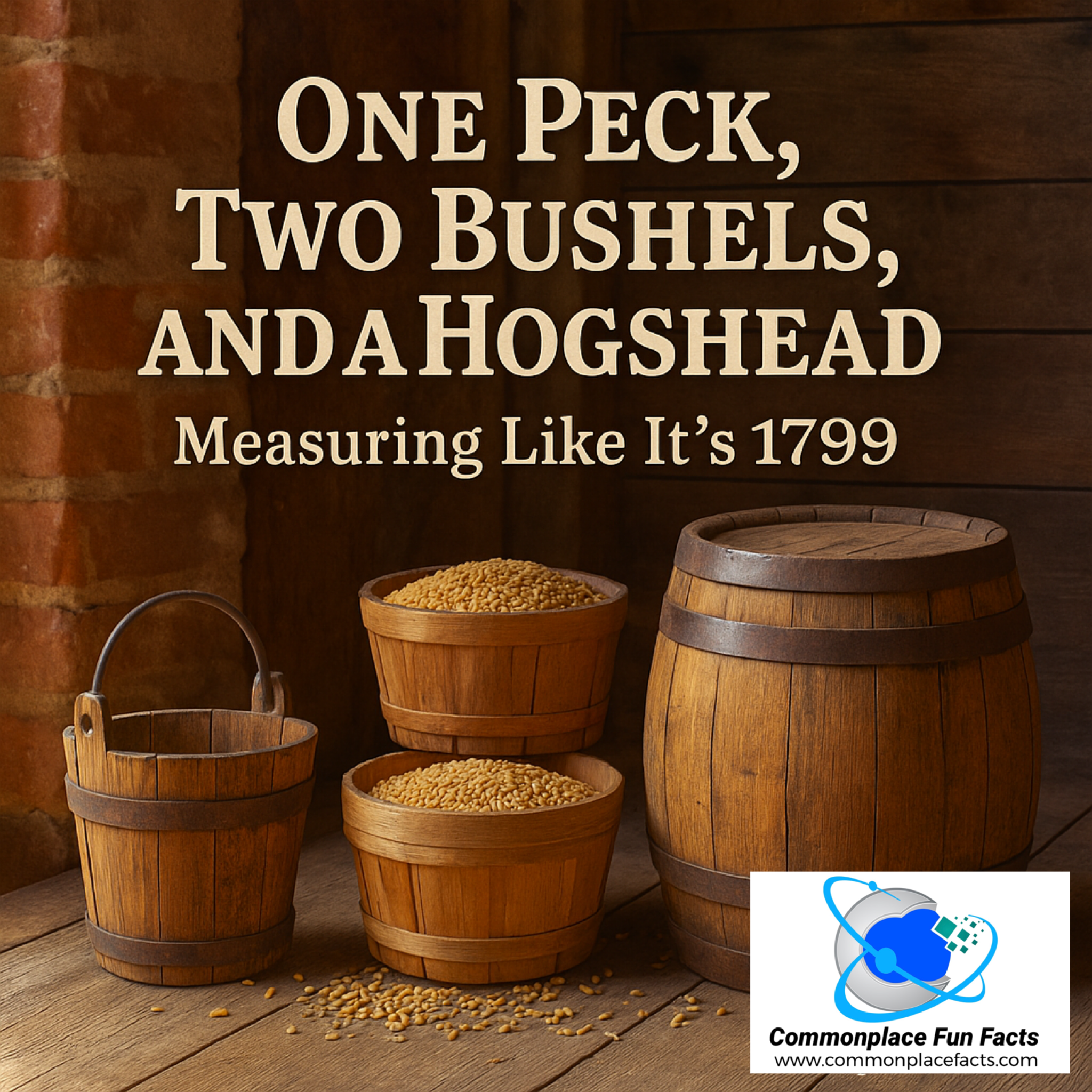

The Forgotten World of Obsolete Units of Measurement
Long before rulers came with centimeters and grocery labels boasted grams, the world measured itself with a whimsical assortment of units that sound like characters from a Dickens novel. A firkin wasn’t a creature from folklore, but a way to measure beer. A cord wasn’t just for tying things—it was how you quantified firewood. And if someone said they weighed 12 stone, they weren’t admitting to carrying medieval building materials. These now-nearly-obsolete units once ruled everything from land to wool to ale, and they did it with unapologetic inconsistency and charm.
Join us as we unpack the curious world of forgotten measurements—where nothing was base 10, everything had local variations, and your success as a trader might depend on knowing exactly how many pecks make a bushel. (Spoiler: it’s four.)
Contents
The Firkin & the Hogshead: Old-Timey Units of Beer Math
Once upon a pub crawl, long before the metric system reared its sober head, the world of liquid measurement was delightfully inebriated. Two of the greatest hits from that era:
- Firkin: Equal to 9 gallons of ale or beer (and the amount your college roommate “totally could’ve handled” before making a complete disaster of the bathroom).
- Hogshead: Equal to 54 gallons (i.e., a party barrel for your medieval fraternity)
So how many firkins are in a hogshead? That’s easy math even without an abacus: 6 firkins = 1 hogshead (6 × 9 = 54). But these weren’t just arbitrary numbers; they were part of a cunning binary system where units were doubles or halves of each other. That made it easier to split barrels, calculate taxes, or settle drunken bets without relying on something as newfangled as “decimal points.”
While we’re on the subject, we’d be remiss if we didn’t point out that a “buttload” is an actual unit of measurement.
Dry Goods and the Art of the Peck
You might be familiar with a “bushel,” “peck,” “barrel,” and “heap” as units of love in the song “Bushel and a Peck” from Guys and Dolls. Before Perry Como crooned about these obscure terms, they were used to measure things much more tangible than emotion.
When it came to measuring flour, grain, salt, and other dry goods (including oysters, because why not), people turned to the good ol’ dry volume system:
- Peck: 2 dry gallons (that’s a lot of love)
- Bushel: 8 dry gallons (4 pecks per bushel)
- Coomb: 4 bushels
This system was especially popular among traders who didn’t have the luxury of standardized bags or digital scales. Sure, it was confusing, but if it worked for measuring both apples and oysters, who are we to judge?
Firewood and the Cords That Binds

Firewood wasn’t sold in mystery bundles or loosely defined “heaps.” Nay! It came in cords—the unit of measure that still technically exists but is largely misunderstood by anyone not living in a log cabin or starring in a lumberjack competition.
One cord = 128 cubic feet of stacked wood. Picture a pile that’s 4 feet high, 4 feet wide, and 8 feet long. Or, if you’re bad with spatial reasoning, picture roughly enough firewood to heat your cabin through one Game of Thrones-length winter.
Wool and Trade: The Tod and the Stone

Britain, never one to pass up a chance for confusing measurements, gave us these soft and cuddly entries into the unit hall of fame:
- Tod: Roughly 28 pounds of wool, although the actual weight varied from shire to shire because consistency is for amateurs.
- Stone: 14 pounds. Still used in the UK today for body weight. As in, “He lost 3 stone!” which sounds way more dramatic than “42 pounds.”
Mass Confusion: When a Hundredweight Isn’t 100
Now we come to that magical place where logic goes to take a nap: weight.
- Hundredweight (cwt): 112 pounds. That’s not a typo. It’s called a hundredweight, but it weighs 112 pounds because medieval England couldn’t count without throwing in a curveball.
- Tun: 252 gallons of liquid, typically wine or oil. Imagine a barrel so big it had to be rolled by oxen and blessed by a cleric.
Pro tip: Do not attempt to convert tuns to firkins while under the influence of strong medication. Really, just avoid it altogether.
Other Gloriously Forgotten Units
- Rod: 16.5 feet. A favorite of surveyors and cranky landowners from the 17th century who didn’t want to walk too far to measure property lines.
- Chain: 66 feet. Typically used for land measurement. Fun fact: There are 80 chains in a mile, and not one of them holds ghosts or prisoners.
- Furlong: 660 feet. From the words “furrow” and “long.” Yes, it’s the length a team of oxen could plow before needing a snack.
- Scruple: About 1/24 of an ounce. Not to be confused with one’s conscience, although neither are used very often in Washington, D.C.
Why Did These Units Disappear?
As much as we’d love to still measure things in firkins and scruples (because, admit it, it sounds cooler), these units fell victim to progress. Specifically:
- Standardization: The 1824 Weights and Measures Act tried to clean things up with the Imperial system, like a mom reorganizing your junk drawer.
- Industrial Revolution: Global trade and standardized shipping made quirky local units less charming and more annoying.
- Metric System: Adopted in much of the world because it’s based on powers of ten, not how far Farmer Giles’s mule can plow before tea time. This didn’t help much in the United States, however, because the metric system was stymied by pirates.
But even though these units are mostly gone, they live on in trivia nights, pub names, and the occasional lawsuit over how much firewood actually fits in a cord.
And don’t think for a moment that just because we have “standardized” units of measurement that we have done away with confusion. Take a look at this explanation of why a “cup” and a “tablespoon” are different sizes, depending on the country.
So next time you’re faced with a boring measurement—like liters or meters—just remember: you could be sipping from a firkin, measuring your lawn in rods, and buying wool by the tod. And honestly? The world might be a little more fun that way.
You may also enjoy…

Measuring By the Meter, Foot, and Smoot
If you are accustomed to the metric system, imperial units can be perplexing. There is logic in the fact that there are 1,000 meters in a kilometer or ten centimeters in a meter. How are you supposed to remember that there are 5,280 feet in a mile, and why are there 12 inches in a…

NASA Measures Space Sickness With the Garn Scale
One of the biggest honors a person can receive is to become the namesake of a unit of measurement. Daniel Fahrenheit, Andres Celsius, and Charles Richter are just a few individuals whose names have been immortalized by being applied as a label to the thing that is being measured. Just such an honor was bestowed…

When Is a Cup Not a Cup and a Tablespoon Not a Tablespoon?
The definitions of a cup and tablespoon can vary by country, even within national borders, leading to confusion in recipes. For example, a US legal cup and a UK metric cup have different measurements. Understanding the author’s intended measurements is essential for successful baking.





Leave a Reply to Herald StaffCancel reply