
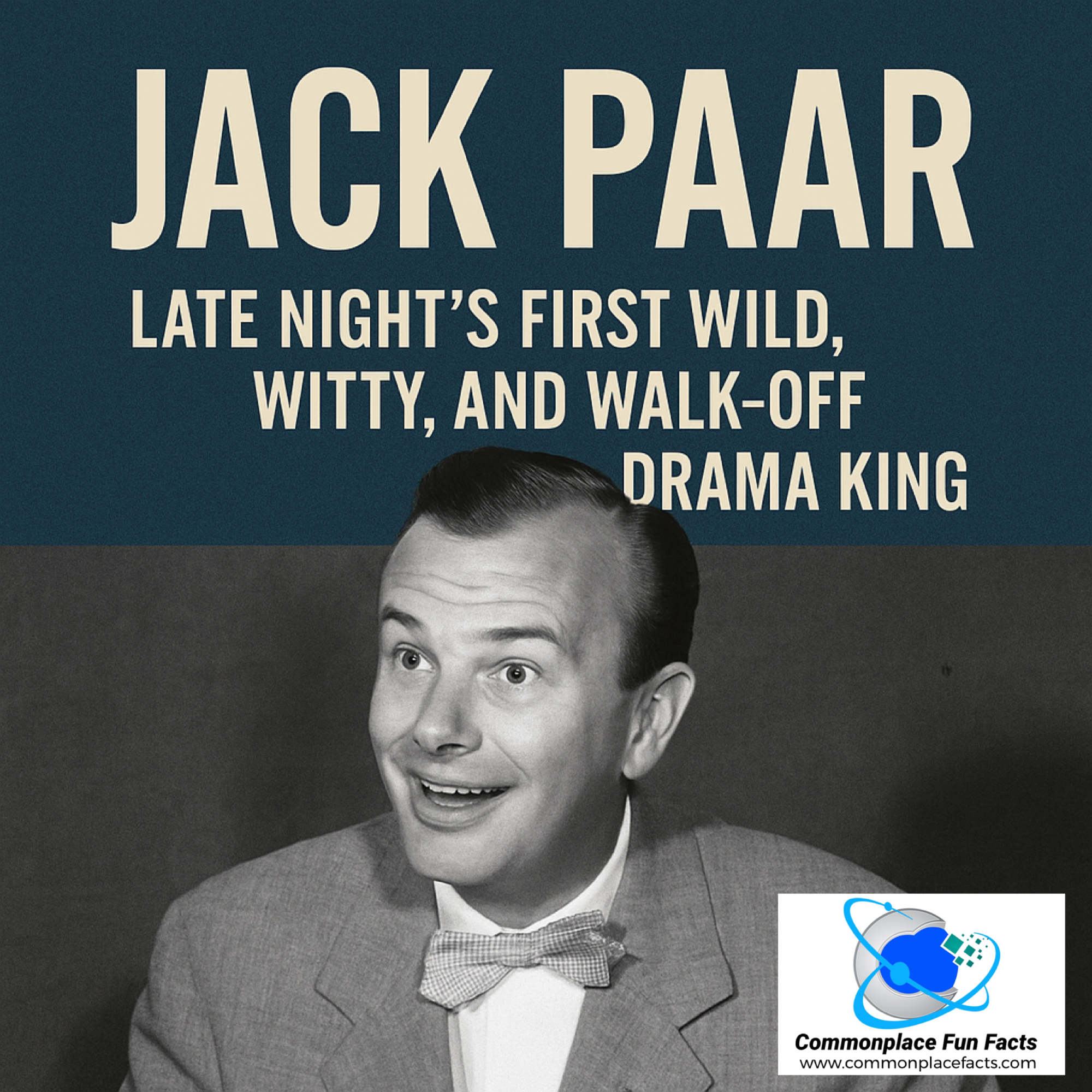

Before there was Johnny Carson’s cool, Letterman’s irony, or Fallon’s relentless game-playing, there was Jack Paar — the man who brought emotional depth, actual tears, and one gloriously indignant walk-off to late-night television. Paar didn’t just host The Tonight Show; he turned it into a nightly cocktail of unpredictability, charm, and the occasional censorship scandal.
If you’ve ever dreamt of rage-quitting your job, congratulations — you’ve spiritually channeled Jack Paar. He did it first. He did it better. And he did it on live national television. Over a toilet joke.
Contents
Before He Was Paar-fectly Famous
Jack Paar was born in 1918 in Canton, Ohio — long before television was anything more than a wild sci-fi fever dream. As a kid, he developed a stutter, which he later turned into a superpower: his speech patterns became part of his charming, stammering delivery. You could say he made hesitating an art form. Before Bob Newhart made us laugh through stuttered syllables, Jack Paar showed that it could be done with class.
Paar’s early career was a patchwork of Great American Hustles. He was a radio announcer, a disc jockey, and a master of ceremonies for everything from local events to military shows during WWII. While serving with the USO in the South Pacific, he cracked wise for the troops — often doing bits that made the brass sweat. Somewhere between jokes and jungle humidity, Paar got noticed. And not just by the troops.
It was 1945, and Paar was entertaining the troops in the sweltering heat of the Pacific. His style mixed self-deprecating charm and nervy wit — basically, a verbal cocktail of “I’m not sure I belong here, but let’s all pretend I do.” In the audience? None other than radio legend Jack Benny, who instantly saw potential in the twitchy young comic with the nervous laugh and instinct for timing. Benny did more than laugh — he promoted Paar, produced his show, and even teed him up with a guest spot on his own program as a glowing handoff.
That handoff came in 1947 with The Jack Paar Show, created as a summer replacement for Benny’s own hit series. Benny pulled the strings and Paar stepped into the spotlight — but not everyone was buying what Paar was selling. His style leaned more toward classic Benny/Fred Allen-style comedy — thoughtful, ironic, conversational — and less toward the fast-talking, pie-throwing variety that was becoming all the rage. Sponsors like Lucky Strike were less than thrilled, presumably because Paar refused to hawk cigarettes with pratfalls and whoopee cushions. His radio career fizzled faster than a lit match in a wind tunnel.
Fortunately, television was just around the corner, and so was destiny.
The Tonight Show: Now with Feelings
Paar would go on to revolutionize late night as host of The Tonight Show, where his gift for gab and gloriously unpredictable emotional swings gave rise to a new kind of television.

In 1957, Paar inherited the host chair from Steve Allen. The Tonight Show at that time was still figuring out what it wanted to be — part news, part comedy, part circus, part jazz concert. Paar transformed it into something groundbreaking: a place for honest conversation, emotional vulnerability, and spontaneous chaos. Like a cocktail party with a piano and occasional weeping. In so doing, he created the late night television talk show format.
He helped launch the careers of Carol Burnett, Liza Minnelli, and Woody Allen — proving that even if radio didn’t know what to do with him, TV audiences were more than ready. In time, Paar became one of the most imitated figures in broadcasting. Which makes sense. After all, how do you improve on a host who could make you laugh, cry, and think — all before the first commercial break?
He wasn’t like his successor Johnny Carson — slick, composed, perfectly timed. No, Paar was twitchy, chatty, and deeply human. He interviewed everyone from Fidel Castro to Judy Garland and wasn’t afraid to go off-script. His secret sauce? He treated celebrities like people and people like guests worth listening to.
He also turned his sidekick, announcer Hugh Downs, into a national figure. (This was back before “sidekick” meant “talks once per episode and laughs at your jokes.”)
The Great Toilet Uprising of 1960
And now, the moment you’ve all been waiting for — the walk-off heard ’round the world. On February 10, 1960, Paar shared a story that had been told to him by his uncle:
An English lady, while visiting Switzerland, was looking for a room, and she asked the schoolmaster if he could recommend any to her. He took her to see several rooms, and when everything was settled, the lady returned to her home to make the final preparations to move.
When she arrived home, the thought suddenly occurred to her that she had not seen a “W.C.” [water closet, a euphemism for toilet] around the place. So she immediately wrote a note to the schoolmaster asking him if there were a “W.C.” around. The [Swiss] schoolmaster was a very poor student of English, so he asked the [Swiss] parish priest if he could help in the matter. Together they tried to discover the meaning of the letters “W.C.,” and the only solution they could find for the letters was “Wayside Chapel.” The schoolmaster then wrote to the English lady the following note:
Dear Madam:
I take great pleasure in informing you that the W.C. is situated nine miles from the house you occupy, in the center of a beautiful grove of pine trees surrounded by lovely grounds. It is capable of holding 229 people and it is open on Sunday and Thursday only. As there are a great number of people and they are expected during the summer months, I would suggest that you come early: although there is plenty of standing room as a rule. You will no doubt be glad to hear that a good number of people bring their lunch and make a day of it; while others who can afford to go by car arrive just in time. I would especially recommend that your ladyship go on Thursday when there is a musical accompaniment. It may interest you to know that my daughter was married in the W.C. and it was there that she met her husband. I can remember the rush there was for seats. There were ten people to a seat ordinarily occupied by one. It was wonderful to see the expression on their faces. The newest attraction is a bell donated by a wealthy resident of the district. It rings every time a person enters. A bazaar is to be held to provide plush seats for all the people, since they feel it is a long felt need. My wife is rather delicate, so she can’t attend regularly. I shall be delighted to reserve the best seat for you if you wish, where you will be seen by all. For the children, there is a special time and place so that they will not disturb the elders. Hoping to have been of service to you, I remain,
Sincerely,
The Schoolmaster
Funny? That’s for you to decide. After all, humor is in the eyes of the beholder. Scandalous? By today’s standards, certainly not. For the NBC censors of 1960, well, that was a different matter. They cut the joke. Without telling Paar. Who promptly lost his very public cool.
The next night, Paar sat at his desk, looked into the camera, and dropped the professional equivalent of a mic:
“I am leaving The Tonight Show. There must be a better way of making a living than this.”
And just like that, he walked off. Hugh Downs was left blinking into the spotlight like a deer caught in a very awkward improv exercise.
The Comeback Cometh
After his dramatic on-air walk-off in February 1960, Jack Paar didn’t just vanish — he disappeared. While he traveled abroad to cool off (and possibly hunt for humor in more censorship-free zones), his absence turned into a full-blown media event. Newspapers speculated, viewers worried, and NBC executives probably chewed through more antacids than cue cards. One Memphis station, WMCT, had the foresight to record the entire broadcast on audio — bless them — while grainy video footage of the infamous episode finally surfaced online in 2024, courtesy of a 16 mm kinescope and the eternal magic of internet archaeology.
It took some coaxing from his good friend and fellow comedy genius Jonathan Winters, but Paar eventually agreed to return. And on March 7, 1960, he did just that — casually strolling back onto his set like he’d just gone out for a pack of smokes. Striking a theatrical pose, he opened with the now-legendary line:
“As I was saying before I was interrupted…”
The audience went wild. Applause thundered. And then Paar, never one to pass up a perfectly timed follow-up, delivered his second zinger:
“I believe my last words were that there must be a better way of making a living than this. Well, I’ve looked… and there isn’t.”
More laughter. Applause. And then came the self-aware explanation, classic Paar — part confession, part performance:
“Leaving the show was a childish and perhaps emotional thing. I have been guilty of such action in the past and will perhaps be again. I’m totally unable to hide what I feel. It is not an asset in show business, but I shall do the best I can to amuse and entertain you and let other people speak freely, as I have in the past.”
It was peak Paar: vulnerable, honest, and just a bit theatrical. And it worked. America forgave him. The show went on. And late-night TV got just a little more unpredictable — in the best way possible.
It was the kind of self-aware wit that made Paar beloved. He stayed until 1962, then left on his own terms, paving the way for Johnny Carson to take over and reign supreme for the next thirty years.
Beginning September 19, 1960, The Tonight Show under Jack Paar made a big, colorful leap — literally. It became one of the first regularly scheduled programs to be videotaped in color, which was a big deal back when most Americans still had black-and-white sets and the closest thing to a color broadcast was watching Ed Sullivan through a stained-glass window. The show was recorded earlier in the evening, then broadcast from 11:15 P.M. to 1 A.M. Eastern time — because late-night drama clearly deserved a prime slot for insomniacs and swing-shift factory workers.
Sadly, none of those glorious color broadcasts survived. The tapes were either lost, wiped, or sacrificed to mid-century network storage policies. What we have now are just a handful of surviving episodes — all in black-and-white kinescope format, which is tech-speak for “we pointed a camera at a TV screen and hit record.” So while Paar’s legacy is technicolor in impact, the footage we have looks like it was shot through a gauze curtain during a lunar eclipse.
After Hours: The Paar Years
After leaving the show, Paar continued hosting prime-time specials and interviews. He wasn’t interested in sticking around for the fame treadmill. He once said he wanted to spend more time with his family and less time chasing ratings. He got his wish, fading from the spotlight gracefully — a rare trick in showbiz.
He wrote several books, occasionally popped back into the public eye, and maintained a reputation as the man who brought emotional honesty to late night TV, much like the time Jackie Gleason apologized to the public for a horrible TV show. He also remained curmudgeonly about modern television. In his later years, Paar referred to many talk shows as “moronic” — which, coming from the man who fought a network over a toilet joke, feels somehow… justified?
Jack Paar’s Last Laugh
Paar passed away in 2004 at the age of 85, survived by his wife and daughter. By the time he left this world, his influence had quietly soaked into every fiber of late-night television. He was the bridge between the stilted politeness of the 1950s and the irreverent intimacy we now expect from our hosts. He walked so Colbert, Kimmel, and Fallon could sprint through awkward sketches in Halloween costumes.
And let’s be honest — in an era of pre-scripted bits and ad-sponsored spontaneity, we kind of miss the guy who stormed off over a censored pun about a bathroom. Jack Paar: television’s original emo king of late night.
As he was saying, before he was interrupted…
You may also enjoy…

When Jackie Gleason Apologized For a Bad Show
Jackie Gleason: Comedian and Apologist Game shows are not at all unique in the history of television. Neither is there any shortage of bad game shows. There is one bad game show, however, that deserves special attention. It is memorable not so much because it was bad but because it was so horrible that its…

Final Answer… or Final Scam? The Wildest Game Show Cheating Scandals in History
Explore the bizarre and brilliant history of game show cheating—from Charles Ingram’s infamous coughing scandal to an underground syndicate that gamed the system. A trivia-rich, laugh-out-loud look at TV’s most audacious frauds.

The Rise and Fall of the Laugh Track: Television’s Most Annoying Invention
Discover the fascinating history of the laugh track, from its ancient origins to its rise in classic TV sitcoms. Learn how Charles Douglass’ “laff box” changed television, debunk the I Love Lucy myth, and explore why canned laughter has (mostly) faded away.




Leave a Reply to Herald StaffCancel reply