
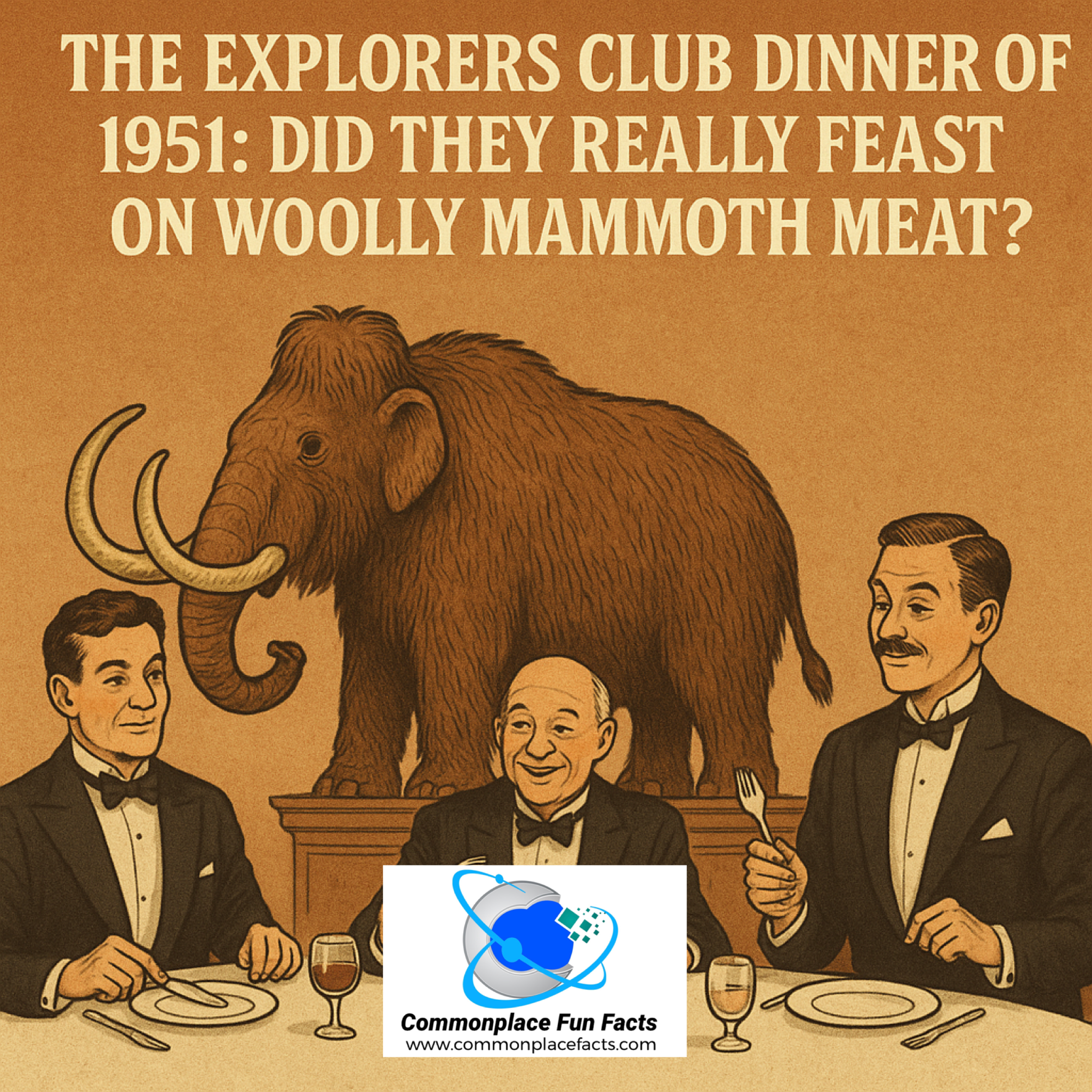

It was a black-tie event like no other. On January 13, 1951, the New York Explorers Club—an exclusive boys-only playground for the kind of guys who thought Everest was just a brisk morning hike—served up what they claimed was a prehistoric dinner course. Not prehistoric as in “expired last week.” No, this meat allegedly dated back to the Ice Age. As in 250,000 years ago. As in, “Oh hey, you dropped your saber-toothed tiger.”
Contents
The Explorers Club: Where Dinner Comes with a Side of Adventure (and Possibly Turtle)
If you’re imagining the Explorers Club as a bunch of khaki-clad gentlemen sitting around a mahogany table swapping stories about how they once arm-wrestled a crocodile in the Congo, you’re not entirely wrong. Founded in 1904 in New York City, the Explorers Club was established to promote scientific exploration of land, sea, air, and—you guessed it—whatever else hadn’t already been poked, prodded, or mapped by the early 20th century. Think National Geographic, but with better dinner parties and worse liability insurance.
The club’s founding members were a veritable League of Extraordinary Gentlemen: archaeologists, ethnographers, anthropologists, mountaineers, and naturalists who believed that the best way to understand the world was to go out and risk malaria to see it firsthand. Their goal? To advance field research, promote the scientific method, and occasionally terrify their dinner guests with “exotic” entrees.
Over the decades, the Explorers Club has boasted some seriously impressive members: Sir Edmund Hillary (first to summit Everest), Roald Amundsen (first to reach the South Pole), Neil Armstrong and Buzz Aldrin (first to take a lunar stroll), and Sylvia Earle (underwater explorer and general oceanic rockstar). Basically, if you’ve ever discovered something while wearing a pith helmet or a space suit, this club probably sent you a Christmas card.
And yes, it’s still around today. The Explorers Club remains headquartered in Manhattan, in a brownstone that looks exactly like the kind of place where you’d expect a shrunken head collection to be cataloged alphabetically. It continues to support exploration, science, and—occasionally—gastronomic experiments that test the limits of both the palate and the penal code for endangered species.
A Dinner Fit For a Woolly Mammoth
Given their globe-trotting resume and fondness for turning survival situations into cocktail party anecdotes, it’s no surprise that the Explorers Club eventually asked themselves the question no one else dared: “How about dinner… but make it prehistoric?” After all, these were people who thought serving goat eyeballs was a perfectly acceptable appetizer. So when the 1951 annual banquet rolled around, they decided to up the ante—not with foie gras or caviar, but with something that allegedly hadn’t been on a menu since the last Ice Age. Enter: the most legendary mystery meat in culinary history.

The main course? According to the menu, a chunk of woolly mammoth allegedly unearthed from the icy grip of the Aleutian Islands, delicately marinated in mystery, and seasoned with exactly zero peer-reviewed evidence. This was the culinary flex of the century, brought to you by Father Bernard Hubbard, also known as the “Glacier Priest”—because nothing screams “reliable sourcing” like a Catholic priest with a pickaxe and a fondness for frozen meat.
But wait, there’s more! The event also featured delicacies like giant spider crab claws and bison steaks, just in case anyone thought the club was settling for a Costco charcuterie board. The guests—adventurers, scientists, and possibly one or two cryptozoologists on their lunch break—dined and wined under the impression that they were chewing history, literally. And they were. Just… not the history they thought.
This is the sort of meal that would have appealed to William Buckland, who famously claimed to have eaten his way through the entire animal kingdom — and possibly the heart of Louis XIV.
The Mystery Meat Melts Under Scrutiny
Fast-forward to 2016, when a small vial labeled “Megatherium” (aka giant sloth) was unearthed from the bowels of Yale’s Peabody Museum. Apparently, someone thought it was a good idea to keep leftovers from a 1951 dinner party in a science museum. Because, of course.
DNA testing was conducted by the Yale Molecular Anthropology Lab—because no story involving frozen mystery meat is complete without a twist ending involving PCR analysis. The results? Drumroll please: green sea turtle.
That’s right. Not woolly mammoth. Not giant sloth. Just a perfectly modern, relatively un-mythical green sea turtle. Turns out, the only thing extinct about that dinner was the credibility of the menu.
Hoax? Hype? Or Just an Elaborate Practical Joke That Got Way Out of Hand?
The mastermind behind this culinary hoax was Commander Wendell Phillips Dodge, a former Hollywood promoter who apparently decided his next act would involve swapping out Mae West for mastodon meat. He hyped the event to the press, made vague claims about prehistoric preservation, and after the fact, suggested it might’ve all been an “elaborate joke.”
According to one researcher who cracked the DNA case, this was less of a deliberate deception and more of a slow-burn dad joke: “It’s like a Halloween party where you put your hand in spaghetti, but they tell you it’s brains.” Only in this case, you were told it was mammoth roast, and it turned out to be soup turtle with an identity crisis.
Flavor Notes: Prehistoric or Just… Funky?
Eyewitness accounts from the meal itself describe the meat as tasting “like putrefied beef jerky.” Which is exactly how we imagine a quarter-million-year-old steak would taste, assuming it didn’t file a restraining order first.
But the kicker is this: none of the club members who attended seemed particularly bothered that they were potentially eating an extinct species or being served a fossil flambé. In true mid-century explorer fashion, they were more concerned with whether it paired well with a Manhattan and if there was enough sauce on the side.
The Takeaway: Check the DNA Before You Chew
This whole affair is a juicy reminder (pun absolutely intended) that just because something is served with a side of theatrical flair and a dash of pseudo-scientific jargon doesn’t mean it’s authentic. The Explorers Club dinner of 1951 may have gone down in history as the world’s most ambitious potluck hoax, but at least it gifted us with one of the most bizarre intersections of archaeology, cuisine, and old-school PR spin.
So next time someone offers you mammoth meat at a dinner party, ask for a second opinion—and maybe a lab test. Or just politely decline and stick to the cheese tray.
Fun Facts You Probably Didn’t Ask For
- The Explorers Club also once served piranha and roasted goat eyeballs. We suspect the leftovers were bought up by the lunch ladies at our high school cafeteria.
- Father Hubbard, the “Glacier Priest,” once claimed to have found the remains of Noah’s Ark.
- DNA sequencing on ancient meat is a thing now. That’s a sentence we never thought we’d write, but here we are.
Stay skeptical, stay saucy, and remember: if your dinner needs carbon dating, maybe just order takeout instead.
You may also enjoy…

Dinosaur Hunting License: For the Fanatical Big Game Hunters
Interested in hunting REALLY big game? Head over to Vernal, Utah and get an official dinosaur hunting license.

Marie Curie’s Deadly Legacy—and the Leftovers That Launched Modern Medicine
Marie Curie’s family changed the world—and then slowly died glowing. Meet the Nobel-winning dynasty undone by radiation and a Hungarian scientist’s meat prank.

Having 80-100 Close Friends Over For Dinner? Try This Recipe for Stuffed Camel
Having a lot of family and friends over for the holiday? Looking for a dish that is big enough to feed even your hungriest teenagers? Why don’t you try “Stuffed Camel”? The traditional Bedouin dish is frequently referred to as “Camel Turducken.” Whatever you call it, it will feed a crowd of 80 – 100.…






Leave a Reply to Herald StaffCancel reply