
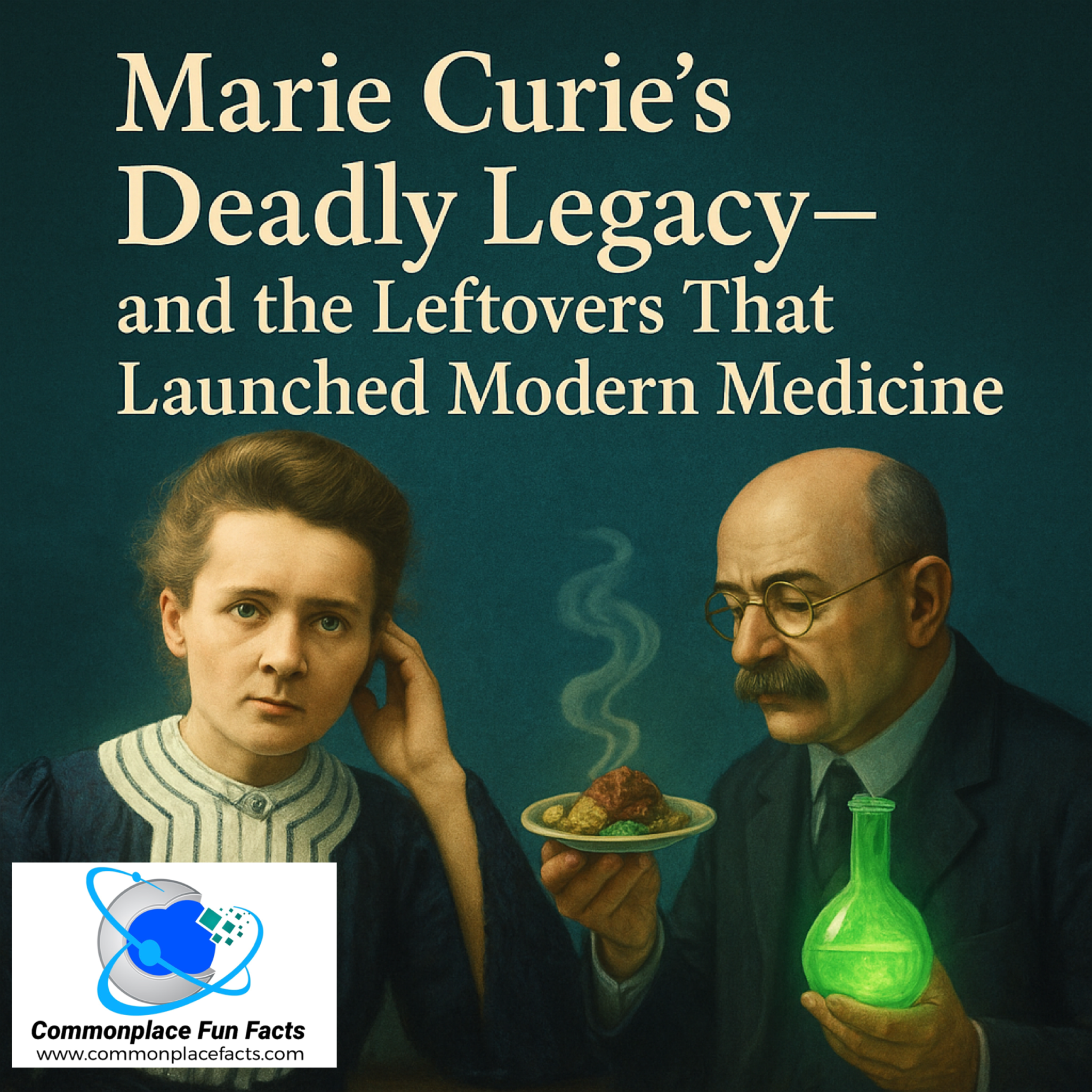

Some families pass down grandma’s cookie recipe. Others, a vintage set of china or a nice genetic predisposition to strong cheekbones. The family of Marie Curie? They left behind a legacy of Nobel Prizes, glowing lab notebooks, and a tragically recurring tendency to die from radiation exposure. And weirdly enough, their radioactive misfortunes have something to do with reheated meatloaf and a very petty Hungarian scientist.
Grab your lead-lined apron, check the batteries in your Geiger counter, (and the dates of the leftovers in your refrigerator), and join us on this tale that is tangled with radioactive regret and historical hilarity.
Contents
Marie Curie: Breaking Barriers and Probably Her Own DNA
Marie Curie was the first woman to win a Nobel Prize—and then she went ahead and did it again, becoming the first person to win two Nobel Prizes. As if that weren’t enough, she was the first (and thus far, the only) person to win Nobels in two different scientific fields: Physics and Chemistry. She shared one of those Nobels with her husband, making them the first married couple to be awarded a Nobel Prize.
She isolated two new elements—polonium and radium—and in true trailblazing form, named the first after her homeland, Poland. Except, at the time, Poland didn’t actually exist. It was a partitioned dream, and she hoped naming an element “polonium” would draw international attention to the cause. The world responded with a polite shrug and said, “But wait, who is she dating?”

Marie’s personal life sparked more radiation than her lab samples. After her beloved husband Pierre Curie was flattened by a horse-drawn carriage in 1906 (a rare instance in this story of someone dying not from radiation–although all the evidence indicates that would have happened if the carriage had missed him), she found herself the subject of a public scandal over an affair with fellow physicist Paul Langevin. The French press devoured their love letters like they were dipped in radium glaze. Langevin fought duels to defend her honor; his wife fought him with a chair. Welcome to France, where romance and assault can frequently be spotted walking hand-in-hand down the Champs-Élysées.
Through it all, Marie continued to do science in a glowing haze of radioactivity. She carried vials of radium in her coat pocket, stored samples in her desk drawer, and thought protective equipment was something for cowards. She died of aplastic anemia in 1934, almost certainly caused by long-term exposure to radiation. Her notebooks are still radioactive to this day and stored in lead-lined boxes. No, really. Want to read them? Hope you brought a lead apron. And a Geiger counter. And maybe a signed waiver.
Irène Joliot-Curie: Like Mother, Like Irradiated Daughter
Marie’s daughter, Irène Joliot-Curie, inherited her mother’s brilliance, her Nobel-worthy scientific ambition, and unfortunately, her comfort with radioactive substances. Irène and her husband Frédéric picked up where her mother left off and pioneered artificial radioactivity. Much like the children of the 1950s who could play with uranium, this scientific power couple had lots of fun with fissionable material. They made tame atoms go rogue with subatomic particles. It was all very impressive. Their work earned them the Nobel Prize in Chemistry in 1935, making them the second married couple to share the high honor. Sadly, that’s not the only thing they shared with Irène’s parents.
In 1946, a capsule of polonium exploded in Irène’s lab. She inhaled it. Not long afterward, she developed leukemia and died in 1956, just like her mother—glowing on the inside and tragically noble in every sense of the word. Frédéric died in 1958 from liver disease, likely caused by overexposure to radiation.
So yes, four members of the Curie family won three Nobel Prizes. But they also racked up three radiation-related deaths (and only avoided a fourth because of a near-sighted carriage driver), several radioactive artifacts, and a household Geiger counter reading that was high enough to turn Bruce Banner into the Hulk.
The Petty Hungarian and the Glowing Goulash, and the Birth of Tracer Science
And now, for something completely ridiculous—and, naturally, radioactive. In other words, made to order for Commonplace Fun Facts.
While Irène Joliot-Curie was pioneering artificial radioactivity—and unwittingly inhaling her own mother’s legacy—another scientist was carrying the Curie torch in a slightly different (and more passive-aggressively petty) direction. Allow us to introduce you to George de Hevesy, Hungarian aristocrat, brilliant chemist, and accidental food safety inspector.
Hevesy didn’t belong to the Curie family by blood, marriage, or unfortunate polonium exposure. He worked under Ernest Rutherford (a close collaborator of the Curies) and became a colleague and friend of Irène Joliot-Curie. In the ever-expanding glow of early nuclear chemistry, if Marie Curie lit the match, Hevesy figured out how to trace where the sparks flew.
While in England in the 1910s, Hevesy was tasked with the impossible: separating radium-D from lead. He didn’t know yet that radium-D was lead—just radioactive lead. After two years of failure and frustration, Hevesy found a new problem closer to home: the increasingly suspicious meals being served in his boarding house. He suspected his landlady was repurposing old meat into “fresh” dinners. She denied it. So Hevesy, as any brilliant chemist would, sprinkled a bit of radioactive lead (radium-D) over his leftovers and waited.
He returned the next evening with a little device borrowed from his lab buddy Hans Geiger. The moment he waved it over the goulash, the counter went full click-click-click frenzy. He confronted the landlady with the evidence. And instead of outrage, she was reportedly charmed—because nothing says “caught red-handed” like a radioactive stew. The meal may have been stale, but the science was fresh: Hevesy had just demonstrated the potential of tracer science.

This discovery, born of culinary revenge, soon revolutionized medicine. Tracers—tiny amounts of radioactive material introduced into living systems—allowed scientists to observe organs, tissues, and chemical processes with unprecedented precision. Hospitals around the world now use this technology daily.
And in the grand tradition of ironic footnotes, Hevesy, unlike nearly every Curie, did not die from radiation-related illness, although he did snag his own Nobel Prize for Chemistry in 1943. He lived to the age of 84 and passed away from natural causes in 1966—having safely traced, outlived, and outlasted his glowing peers. Truly, the only scientist in this story who seasoned his dinner with radiation and survived to talk about it.
Truly, irony’s radiation half-life is infinite.
Bonus Radiation Nuggets To Make Your IQ Glow
- Radium was marketed as a health tonic. People drank it, rubbed it on their faces, and yes, even inserted it where the sun don’t shine. By all accounts, it worked just great — until the patient’s jaw fell off.
- Marie Curie’s lab notebooks are still radioactive. So are some of her clothes and furniture. They require lead boxes for storage and special precautions for handling.
- Only Russia manufactures polonium today. Ask Alexander Litvinenko. Oh wait…
The Glowing Legacy
In the end, the Curies gave the world groundbreaking science and glowed proudly doing it. They paid the price with their lives, but their work changed the world—sometimes in tragic, sometimes in hilarious ways. And somehow, nestled in this legacy of cancer and courage, sits one gloriously petty Hungarian who just wanted fresh food. Science, as it turns out, is full of radioactive surprises.
You may also enjoy…

Quaker Oats and the Chilling Truth Behind Its Radioactive Oatmeal Experiments
The Walter E. Fernald State School in Massachusetts was involved in a dark chapter of American medical research in the 1950s and 60s. Unknowingly, children became part of a covert Quaker Oats and MIT-funded study, ingesting radioactive oatmeal and milk intended to track nutrient absorption. This unethical experimentation was part of a broader trend during…

Radioactive Boy Scout
When the Boy Scouts of America approved the Atomic Energy Merit Badge in 1963, they probably did not envision the lengths future members would go in furtherance of their knowledge of atomic energy. They certianly did not anticipate David Hahn, who, in 1994, would attempt to earn his merit badge by building a breeder reactor in…

How “Herbie Goes Bananas” Unintentionally Caused a Radioactive Disaster in Brazil
Discover how the movie ‘Herbie Goes Bananas’ played an unexpected role in one of Brazil’s worst radioactive disasters—the Goiânia incident.



Leave a Reply