
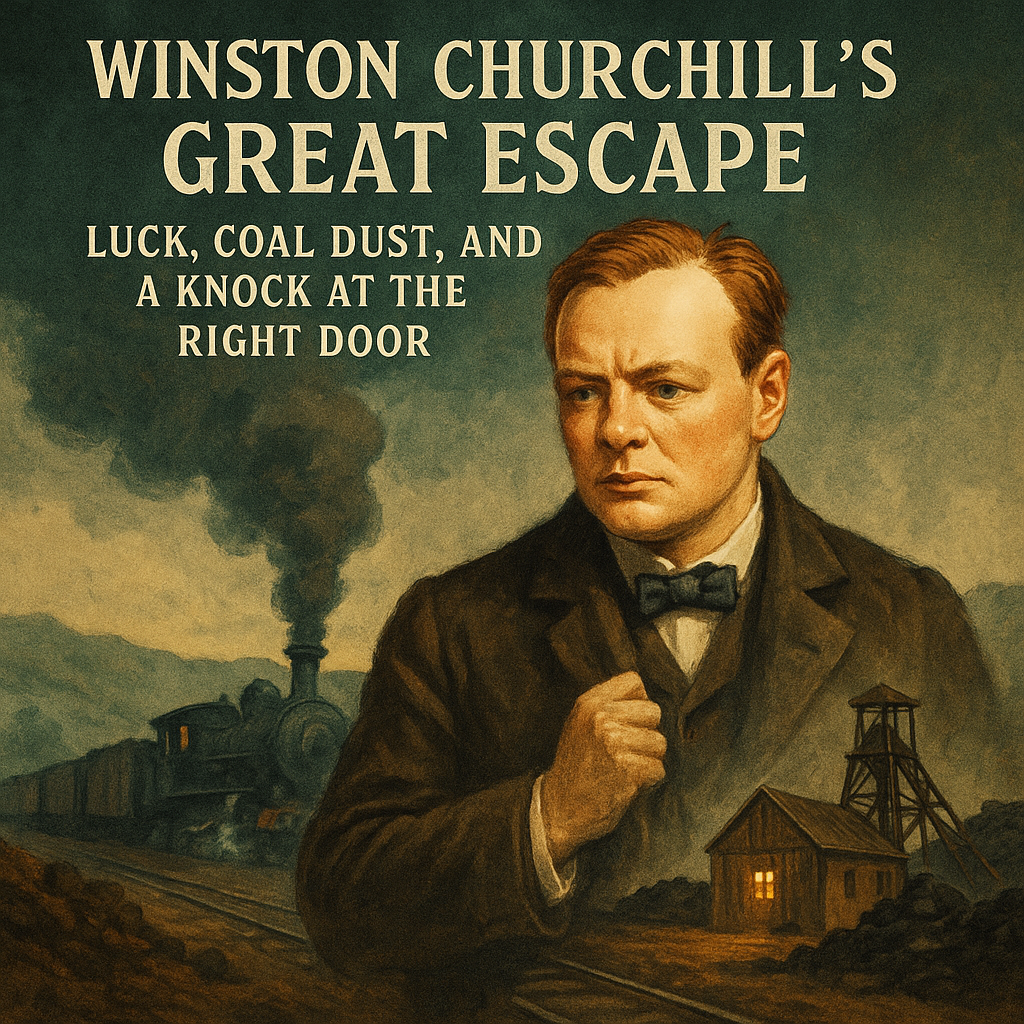

Before the bulldog jowls, the V-sign, and the speeches that rattled dictators, there was a 25-year-old war correspondent in South Africa who believed destiny favored the bold—and that timetables were optional. Winston Churchill’s path to early celebrity did not begin with a parliamentary speech. It began with a broken railway, a prison wall, a coal mine, and the sort of front-door knock that either launches a career or ends a life.
Contents
Winston Churchill: A Correspondent with a Taste for Trouble
In the autumn of 1899, Churchill was on assignment for the Morning Post, chasing the Second Boer War the way some people chase trains—in his case, rather literally. North of Estcourt, an armored train offered a front-row seat to danger, so naturally he climbed aboard. Boer commandos obliged on November 15 with a textbook ambush, derailing carriages, splintering plans, and creating the kind of chaos Churchill secretly considered a networking opportunity. He helped clear the line and shepherd the wounded, which won him admiration, and then he lost his freedom. The Boers took him prisoner and sent him to Pretoria.
Pretoria’s Model Prisoner (Who Had Other Ideas)

The State Model Schools in Pretoria, hastily repurposed as a prison for officers and high-profile detainees, was tidy enough to be respectable and secure enough to be discouraging. Churchill found neither quality compelling. He studied guard patterns, tested routines, and floated an escape plan with fellow captives. The scheme looked more like wishful thinking than engineering, but it had one crucial ingredient: impatience. On the night of December 12, 1899, he slipped through a gap in the sentry’s watch, scaled a wall, and dropped into the unknown. His companions were forced to abort. Churchill stood alone with a few coins, a bar of chocolate (fortunately, not the exploding kind that was proposed for him a few years later), no map, no compass, and not a single word of Afrikaans. What he did have was momentum—and a firm belief that fortune adored him.
Into the Dark: A Night Ride to Nowhere
Railway lines, he decided, were a good enough compass. He followed them until a freight train came roaring past and, because self-preservation has never been Churchill’s strong suit, he scrambled aboard. Coal dust soon disguised him as just another lump of cargo. As the train rattled through the veld, he had no idea where it was headed. The direction felt right. Sometimes survival is less about skill and more about rolling dice with confidence.
When the train slowed near a patch of lights, Churchill jumped off and trudged toward them. The cluster turned out to be Witbank, a coal mining settlement some 50 miles east of Pretoria. There he gambled everything on a single knock at the nearest door. Had it opened to a patriotic Boer, his story might have ended with a bullet and a £25 bounty slip. Instead, it belonged to John Howard, the English manager of the Transvaal & Delagoa Bay Colliery—and, conveniently, the only Brit for miles around.
Coal Dust and Providence
Howard did not turn him in. Instead, he ushered the fugitive into his home, listened to his improbable tale, and hid him in the mine. For several days Churchill lived underground, literally, as Howard plotted his onward escape. Eventually, another freight train was arranged, this one carrying him further east toward Portuguese East Africa, where British protection awaited. The £25 reward for his capture—dead or alive—went unclaimed, and Churchill added another story to the growing legend of his indestructibility.
The Making of a Celebrity
When Churchill finally made it back to Durban and then home to Britain in July 1900, he returned not as a correspondent but as a celebrity. The newspapers feasted on the tale of the daring young man who had outwitted his captors, ridden the rails through enemy country, and trusted fortune to open the right door. His growing celebrity made it necessary to write to the American author Winston Churchill to propose a way for the two men to differentiate between themselves in their writings.
Three months after his return, he parlayed his fame into a seat in Parliament at the age of just 25. His escape was equal parts courage, recklessness, and outrageous luck—but in the Churchill brand of mythmaking, those ingredients were indistinguishable. The Boer War had given him a story, and he would spend the rest of his life proving it was only the first act.
You may also enjoy…

Winston Churchill’s Letter to Winston Churchill
Of course, everyone knew who Winston Churchill was. His command of the English language and masterful writing made him a true celebrity. He was well on his way to becoming one of the best-known American authors of his day. Wait… American author? That’s right. We’re talking about the Winston Churchill who was born in 1871…

The Ingenious WWII POW Escape Attempt By Building an Airplane Inside a Nazi Fortress
Discover the daring WWII POW escape attempts from Colditz Castle. From ingenious disguises to the iconic Colditz glider, these stories defy belief.

The Time Churchill Got Stood Up By Hitler
Winston Churchill did not appreciate being kept waiting. Even worse, he despised being stood up. As this great man sat and looked with irritation at the clock, he realized he was about to be stood up for the second time in as many days. This was confirmed when Churchill received a message, telling him that…





Leave a Reply to Herald StaffCancel reply