
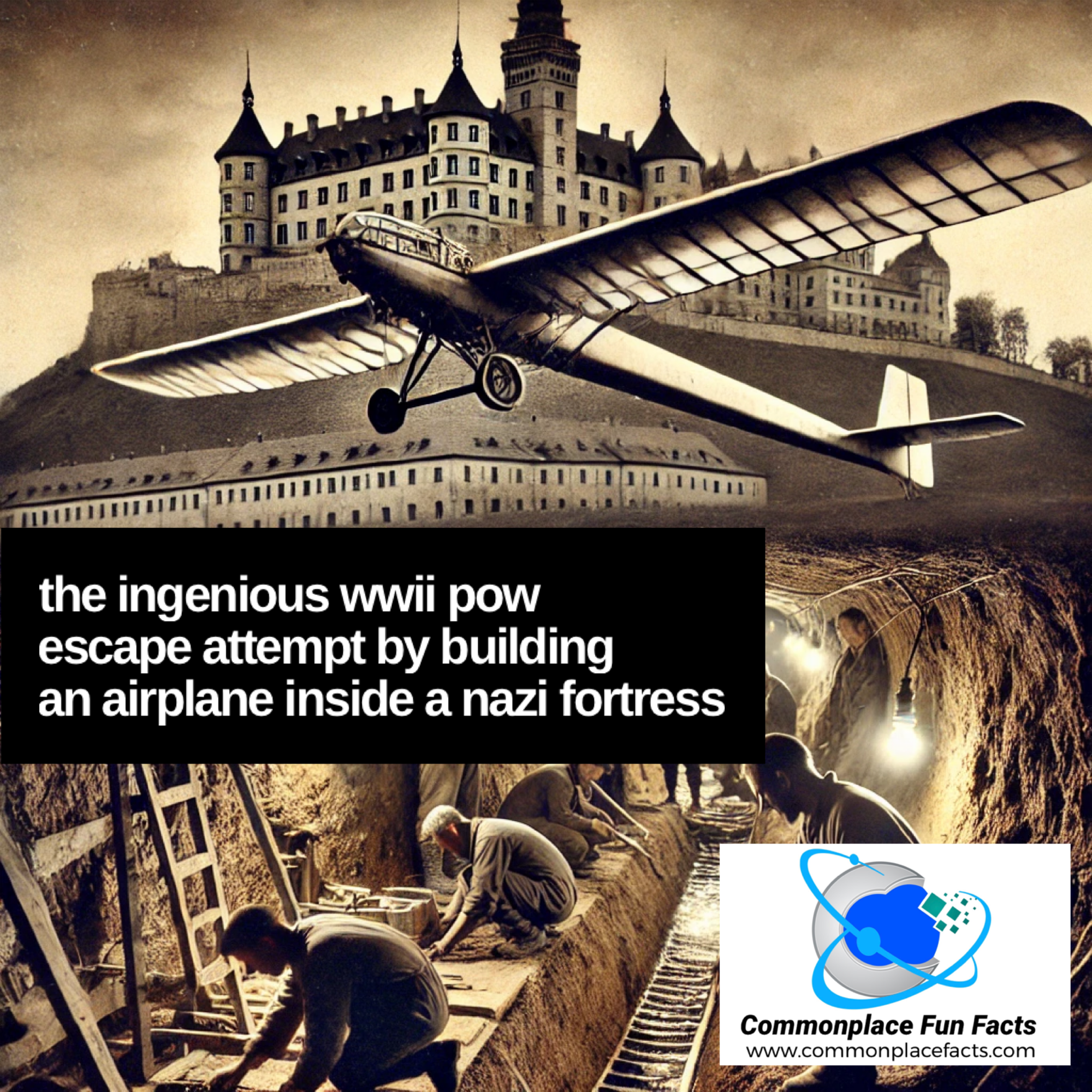

Colditz Castle: The Last Place For a POW Escape Attempt
If you ever find yourself paying a visit to the German state of Saxony, you’ll notive a striking edifice that screams “good luck getting out of here.” Welcome to Colditz Castle. Perched precariously on sheer cliffs that dive 75 meters into the Mulde River, and surrounded by two-meter-thick stone walls, Colditz is the very embodiment of “nope, you’re staying put.”
Built in 1506, this medieval fortress has worn many hats over the centuries. It’s been a noble residence, a hunting lodge, a zoo (because who doesn’t want lions in their castle?), a mental hospital, and even a tuberculosis sanatorium—just to round out the “creepy old building” vibes. In 1939, the Nazis designated Colditz Castle as a prisoner of war camp, the ominously named Offizierslager IV-C (Oflag IV-C). After all, when your castle looks like it could hold King Kong, you might as well turn it into a place to hold some of the most escape-prone Allied soldiers of World War II.
A Basket of Escape-Prone Rotten Eggs

The Nazi’s masterstroke in POW housing strategy was simple: “Let’s stick all the rotten eggs in one basket!” And so they did, concentrating every Houdini-wannabe in one spot. The logic? If you can’t trust someone to stay put in their cell, put them somewhere where escape seems impossible. Located a full 640 kilometers from the nearest friendly border, Colditz was the perfect spot. Well, almost perfect.
What the Nazis didn’t realize was that filling a medieval fortress with dozens of enterprising escape artists was like hosting a convention of professional pickpockets at a wallet factory. In no time at all, Colditz became ground zero for some of the most audacious, bizarre, and jaw-dropping escape attempts in World War II.
Escape Attempts: The “Nope, Still Not Done” Chronicles
If you’ve seen The Great Escape and thought, “Wow, that was pretty clever,” let us introduce you to the inmates of Colditz. Not only did these men make escape attempts a national pastime, but they also did so with a flair that would make any action movie director weep with jealousy.
One of the early attempts came from French Lieutenant Alain Le Ray, who decided he didn’t want to be at Colditz any longer. He became the first successful escapee by simply hiding during an outdoor activity and slipping away into the night. Classic, simple, and effective. But soon, the attempts would get a bit more… creative.
Take British Flight Lieutenant Dominic Bruce, for instance. He was the smallest man in the camp. He used his size to his advantage and stuffed himself into a one-meter-square Red Cross packing crate. The box was stored in an unguarded room overnight, where Bruce escaped. He used a bedsheet rope to shimmy down a window, and vanished. His note left on the crate simply read: “The air in Colditz no longer pleases me. Auf Wiedersehen.” Kudos for audacity, but his freedom was short-lived. He was caught a week later in Danzig trying to stow away on a ship.
Then there was Lieutenant Anthony Allen, who was—get this—sewn into a mattress. Once the Germans helpfully disposed of it outside the camp, he cut himself free, decked out in a homemade Hitler Youth uniform, and casually hitched a ride with an SS officer.
A Zoo of Disguises
If there was one thing the prisoners of Colditz knew, it was the value of a good costume. French Lieutenant André Perédo tried walking right out the front door disguised as the camp electrician, Willie Ponert. In fact, he was doing so well that he might have made it, had it not been for the Germans’ recent policy of giving tokens to outside workers. Without one, Perédo’s brilliant escape fizzled out.

And let’s not forget François Boulet, who thought outside the box—way outside the box—by donning full drag and trying to walk out of the castle disguised as a woman. The plan might have worked, too, if it hadn’t been for the tell-tale drop of a pocket watch and a fellow British prisoner calling out to him. When Boulet didn’t respond and hastily scurried off, guards got suspicious, and that was the end of that grand scheme.
Tunnel Vision: Digging Towards Freedom
Of course, no good prison break story is complete without a few tunnels, and Colditz saw its fair share. The most ambitious was led by nine French officers who, starting in 1940, began digging from the castle’s clock tower. The tower’s attic, sealed off from the rest of the castle, provided the perfect secret hideout for their tunneling operations.
Using the cellar as a base, the tunnel stretched horizontally until it hit bedrock, then made a vertical detour toward the chapel floor, before heading another 44 meters outside the castle walls. All along the way, they lit the tunnel with stolen electric lamps, powered by the chapel’s electricity—because why not? But alas, after nearly two years of hard digging (and wine drinking—they replaced the cellar’s wine bottles with urine), the Germans finally heard the tell-tale sounds of scraping and discovered the tunnel. So, the French didn’t get out, but hey—they did clean out the wine cellar, so… victory?
The Glider That (Almost) Was

If you thought the previous escapes were a bit too ordinary, let’s talk about the pièce de résistance: the Colditz glider. By 1944, things were getting desperate for the prisoners, especially after the infamous murder of 50 escapees from Stalag Luft III. So, British Lieutenant Tony Rolt came up with a daring new plan: build a glider in secret, and fly out of the castle.
This sounds like an outrageous and unlikely plot from Hogan’s Heroes, but this is one example of truth being stranger than fiction. With the chapel roof conveniently out of view from any German sentry post, it became the perfect spot for their launch. The glider, led by Flight Lieutenants Bill Goldfinch and Jack Best, was crafted out of floorboards, bed slats, and cotton blankets. For extra ingenuity, grain rations were boiled into a starchy paste to coat the fabric, sealing it for flight. To launch the thing, the resourceful POWs built a 30-meter ramp on the roof, assisted by a falling bathtub filled with concrete.

The glider was intended to carry two men and glide the 200 meters across the Mulde River to freedom. Unfortunately (or maybe fortunately, depending on how you view bathtub-powered gliders), by the time the glider was ready, the American forces had arrived to liberate the camp. World War II came to a close before the Colditz Glider had a chance to fly.
Thankfully, modern tests have since proven that it could have worked. In 1999, a full-scale replica was built and successfully flown for a Channel 4 documentary. In 2012, another replica, this time radio-controlled, made a perfect flight off the very roof of Colditz Castle. So, in spirit, the Colditz glider finally soared.
Colditz Castle and the Legacy of World War II POW Escape Attempts
By the time the Americans liberated Colditz Castle in April 1945, a total of 36 prisoners had successfully escaped and made it back to Allied lines. Hundreds of others, though unsuccessful, tied up German resources and kept the guards on their toes. The goal wasn’t just to make it home—it was to boost morale, fight idleness, and harass the enemy from behind bars.
In fact, by turning Colditz into their own personal escape hatch, the Allied prisoners there made sure to do their part in bringing about the end of the war. If the Nazis had hoped Colditz Castle’s impregnable walls would thwart the efforts of the very best escape artists of the war, well, let’s just say that’s just one more thing the Nazis got wrong.
You may also enjoy…

Better Days: The Secret Code That Was Hidden in a Pop Song
Learn about the secret Morse Code message hidden in the pop song “Better Days”.

Escape From POW Camp? It Might Be In the Cards
Escape maps were printed on Bicycle playing cards and distributed to Allied prisoners of war during World War II. The deck of cards was created specifically to help Allied prisoners of war escape from German POW camps. This deck of cards became known as the “map deck.” It was made by hiding maps of top-secret…

Sir Evelyn Wood: The Unstoppable, Unbreakable, Accident-Prone Hero of the British Empire
Do you like adventure stories? If so, this has the makings of being your lucky day. Who needs fictional figures such as Indiana Jones, Crocodile Dundee, or Allan Quartermaine, when we have a real-life hero whose exploits leave those fictional guys in the dust? Gather ’round and join us on a wild ride through the…

Leave a Reply