
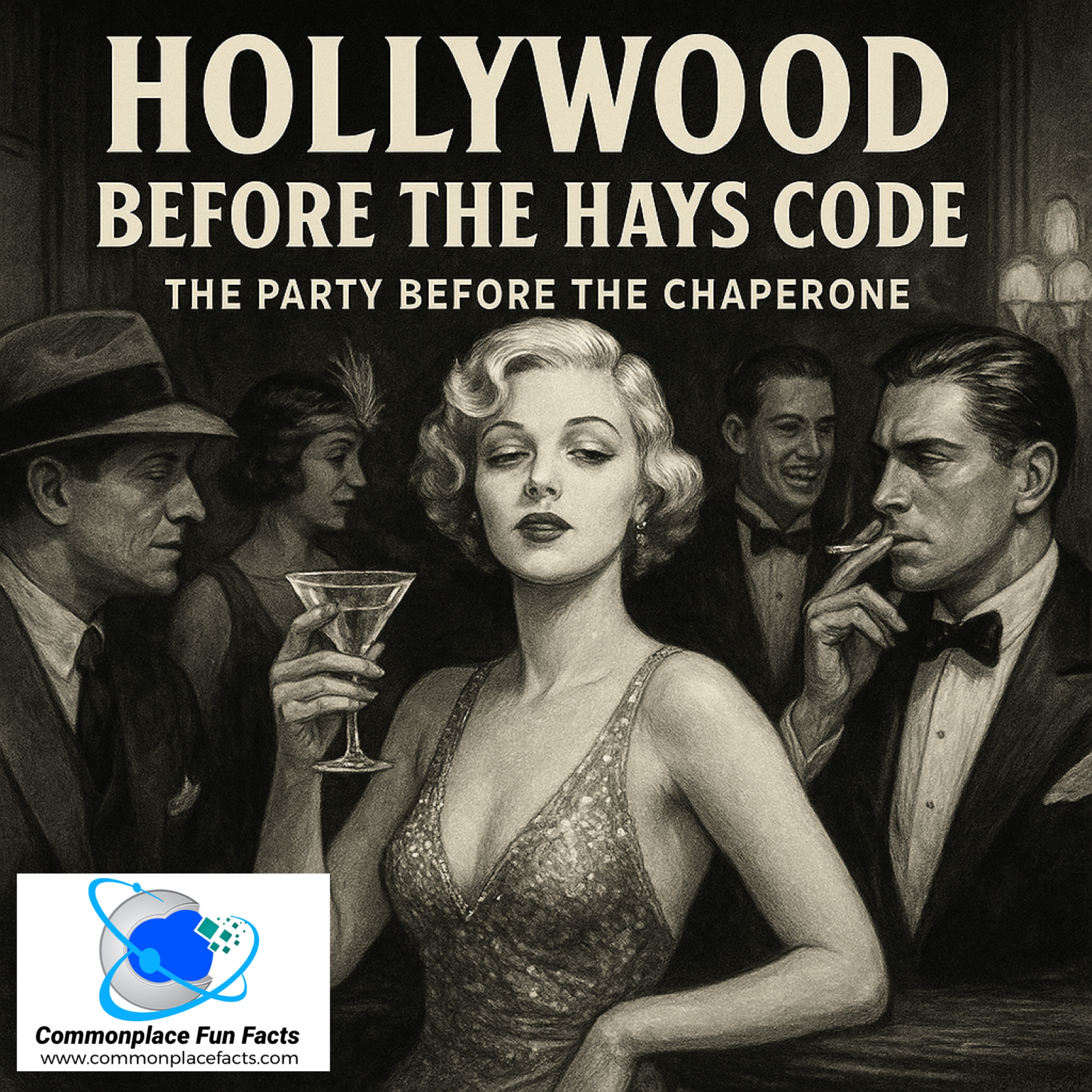

Imagine the movie industry throwing a lavish party, complete with wisecracking gangsters, champagne-fizz musicals, and heroines who made corporate ladders look like gym equipment. That was Hollywood from the dawn of sound through mid-1934—the rollicking little window now known as the Pre-Code era.
Join us as we dive into Hollywood before the Hays Code — a world as glamorous as it was morally ambiguous.
Contents
What Is the Hays Code?
Good question. The Hays Code—officially the Motion Picture Production Code—was Hollywood’s attempt to prove it could play nice without having the federal government step in with actual censorship. Think of it as a self-imposed curfew: the studios swore they’d behave, so Congress wouldn’t have to ground them. It was very much like the Comics Code Authority, which was the comic book version of self-imposed censorship.
Drafted in 1930 by Jesuit priest Daniel A. Lord and publisher Martin Quigley, the Code spelled out what was forbidden on screen: profanity, nudity, “excessive and lustful kissing” (which sounds like a jealous ex wrote it), ridicule of the clergy, and any story where crime or sin paid off in the end.

It was named after Will H. Hays, the former Postmaster General turned Hollywood’s moral babysitter, who was hired in 1922 to rehabilitate the industry’s image after a string of lurid scandals. Ironically, while Hays’s name was on the Code, he didn’t exactly enforce it with an iron fist. Studios treated the rules more like optional guidelines—until 1934, when Joseph Breen and the newly created Production Code Administration gave the Code teeth. From then on, no PCA seal meant no wide release, and Hollywood’s days of unfiltered mischief were over… at least until the ratings system arrived in the 1960s to take its place.
So… What Exactly Counts as “Pre-Code”?
Pre-Code Hollywood spans the late-1920s talkie boom through the strict enforcement of the Motion Picture Production Code in 1934.
The crackdown coincided with organized pressure outside the studios, especially from Catholic leaders who launched the National Legion of Decency to rate, condemn, and boycott films deemed immoral. A movie without the PCA’s seal suddenly had distribution problems; a movie with a Legion boycott had revenue problems. Hollywood noticed.
What They Put On Screen (While They Still Could)
Pre-Code filmmakers let fly with subjects that would soon be trimmed to fit: frank sexuality and adultery, prostitution, drug and alcohol abuse, sympathetic criminals, blasphemy, graphic violence for the time, and even interracial romance. The Code would later forbid or heavily constrain many of these themes, including “miscegenation,” explicit crime instruction, and any happy endings for sin.
Musicals turned spectacle into sly innuendo. Busby Berkeley’s kaleidoscopic camera made geometric art out of chorus lines and double entendres, proving that clever choreography could say what dialogue could not.
The Women Who Broke the Mould (and Sometimes the Rules)
Pre-Code films let women drive the plot—and the getaway car. Barbara Stanwyck’s Baby Face (1933) follows Lily, who weaponizes charm and savvy to climb from speakeasy to skyline; early cuts even rewarded her, until censors insisted on a moral come-down. Jean Harlow’s Red-Headed Woman (1932) does social mobility like a contact sport; Mae West made her imprint on the industry with She Done Him Wrong (1933), where she purred, joked, and got what she wanted through her feminine guiles. (Read this article for more about Mae West). These weren’t subtle winks at power; these were neon signs. After 1934, the same stories tended to end with repentance, punishment, or a fade-out that implied nothing happened.
Some titles rattled the cage so loudly they became exhibit A for the crackdown. The Story of Temple Drake (1933), adapted from Faulkner’s Sanctuary, tackled sexual violence and moral collapse in ways that made guardians of virtue reach for the smelling salts—and the enforcement machinery.
Bad Men, Great Cinema: Gangsters as Headliners
Gangster pictures of the early ’30s practically invented the modern anti-hero. Little Caesar, The Public Enemy, and Scarface showed charismatic crooks rising fast and falling hard—sometimes not quite hard enough to satisfy censors. Scarface ran a gauntlet of reshoots and alternate endings before many boards signed off, a preview of the PCA’s coming muscle.

Pre-Code didn’t live on titillation alone. Studios mined the Great Depression for social realism. I Am a Fugitive from a Chain Gang (1932) excoriated the brutality of Southern penal labor and helped spark public debate; it landed in the National Film Registry decades later for a reason.
William Wellman’s Night Nurse (1931) gives Barbara Stanwyck and Joan Blondell a tour of bootleggers, corrupt doctors, and an unforgettable villainous chauffeur named Clark Gable. The movie tackles child endangerment and class rot with a gallows grin—yet still finds room for locker-room banter that would vanish under the Code.
Employees’ Entrance (1933) takes the department-store melodrama and spikes it with predatory management and coercion; Warren William’s tyrant would be declawed a year later. The Library of Congress now preserves it for its cultural bite.
Horror, Jungle Heat, and the Censors’ Headache
Horror films stretched boundaries in a different key. Island of Lost Souls (1932) scandalized censors with vivisection, beast-men, and blasphemy; bans followed in several countries and cuts followed in parts of the United States.
Adventure went bare-knuckle. Tarzan and His Mate (1934) famously featured a nude underwater sequence for Jane in its original release—one of those “you saw what you think you saw” moments that made the Code’s timing feel less like coincidence and more like cause.
Even King Kong (1933) had material removed in later reissues once the Code had its say, including bits of sexual menace and extra-gnarly violence. The 1933 release slipped in before the net tightened; subsequent releases trimmed the fur.
The Hays Code: How the Curtain Finally Dropped
The industry had reasons—moral crusades, state-by-state patchworks of local censors, and a desire to avoid federal regulation—to make enforcement real. The PCA, led by Joseph Breen, began granting or withholding the all-important seal. Without it, nationwide distribution became risky business. By mid-1934, producers learned to re-write endings, add comeuppance, or imply rather than show.
The Code’s reach would last for decades, ebbing only as television, foreign films, daring directors, and a changing legal climate eroded its authority. A formal ratings system finally replaced the Code in 1968, leaving the Pre-Code years to gleam like a particularly spicy time capsule.
Why These Films Still Feel Fresh
Pre-Code movies race along with crackling dialogue and a startling modernity. Women grab agency with both hands. Men misbehave in frighteningly familiar ways. Musicals wink, crime dramas snarl, and social melodramas punch up. The era shows how the studio system, unshackled by strict enforcement, could be gloriously messy, surprisingly progressive, and occasionally jaw-dropping. That mix of boldness and rough edges remains part of the charm—and the lesson. The audience did not need help finding the subtext; the audience needed permission to see it in the first place.
Where to Start: A Pre-Code Sampler
- Baby Face (1933) — the archetypal “climb the ladder” shocker.
- The Public Enemy (1931) — James Cagney’s star-making turn as a gangster, complete with the infamous grapefruit-to-the-face scene that summed up the era’s mix of shock and swagger.
- Red-Headed Woman (1932) — Harlow weaponizes wit and lipstick.
- She Done Him Wrong (1933) — Mae West at her most Mae West; also a case study in why the gatekeepers panicked.
- Scarface (1932) — censorship cat-and-mouse with an alternate ending.
- I Am a Fugitive from a Chain Gang (1932) — searing social critique with staying power.
- Island of Lost Souls (1932) — the horror film that triggered bans and edits around the world.
- Tarzan and His Mate (1934) — Exhibit A for “this would never fly a year later.”
- King Kong (1933) — the great ape whose later reissues demonstrate the Code’s scissors.
The Last Reel
Pre-Code Hollywood wasn’t some quaint detour before the “real” Golden Age—it was the proving ground where filmmakers tested how far they could push before the grown-ups yanked the plug. Sure, the Code came down like a blackout curtain in 1934, but those wild few years left us with films that still shock, amuse, and feel startlingly modern. Watch them now and you realize the joke’s on anyone who thought audiences of the 1930s needed to be shielded from grown-up stories. If anything, it shows us that Hollywood has always been at its most interesting when it’s just a little bit out of control—and if art is supposed to imitate life, isn’t that the way it should be?
You may also enjoy…

The Comics Code Authority: When Good Must Triumph Because It’s In the Rules
Discover the strange history of the Comics Code Authority, the censorship rules that shaped Spider-Man, Batman, and beyond. From banned werewolves to Marvel’s rebellion, here’s how comic book censorship rose and fell.

Mae West Went to Jail in Silk Underwear—and Came Out a Star
Discover how Mae West turned scandal into stardom—writing risqué plays, defying censors, and becoming the highest-paid woman in Hollywood. From jail time to radio bans, her legacy is anything but quiet.

Amos ‘n’ Andy: The Comedy Hit That Changed Broadcasting—and Sparked Debate
Discover the legacy of Amos ‘n’ Andy, the groundbreaking radio and television show that captivated millions. Explore its origins, impact, cast, controversy, and lasting influence on American media.



Leave a Reply to Commonplace Fun FactsCancel reply