
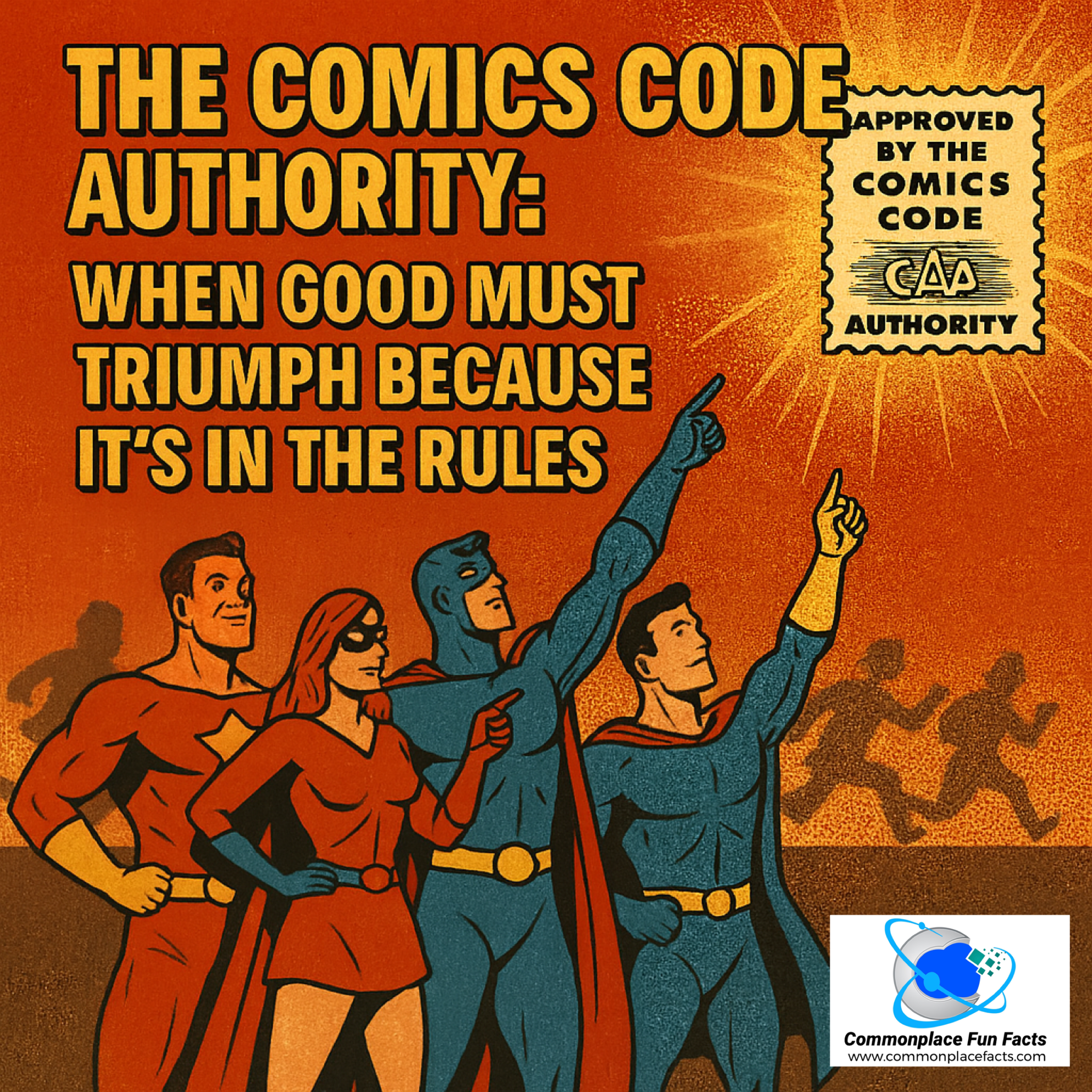

Good triumphs over evil. That’s not just the optimistic pep talk of motivational posters or Saturday morning cartoons; it’s a fundamental law of comic books. No matter how many radioactive reptiles, alien overlords, or overcaffeinated mad scientists our heroes faced, readers knew that Spidey would swing out on top, Batman would brood victoriously, and Superman would deliver truth, justice, and the occasional lecture about farm values.
Why such confidence? Sure, superpowers help. But for decades, the main reason good always won was because it was literally against the rules for it not to. Enter: the Comics Code Authority.
Contents
The Birth of the Comics Code Authority

In 1954, worried parents, pearl-clutching moral crusaders, and one particularly vocal psychiatrist named Fredric Wertham blamed comic books for juvenile delinquency. His book Seduction of the Innocent basically accused Batman and Robin of leading children into crime and moral ruin (and possibly awkwardly-decorated living rooms). Faced with potential government regulation, publishers decided to avoid an all-out congressional smackdown by policing themselves. Thus was born the Comics Code Authority (CCA).
No comic could land in the major distributors’ magazine racks unless it wore the little CCA seal of approval—a badge of squeaky-clean wholesomeness that made sure junior wasn’t corrupted by capes and cowls.
The Rules of the Game
The CCA came with a whole playbook of dos and don’ts. Among them: heroes had to win, criminals could never look glamorous, policemen and judges had to be shown as paragons of justice, and crime had to look about as appealing as cleaning out the litter box. The goal was simple: nobody should finish a comic book and think, “You know, being a jewel thief sounds like a fun career path.”
The rules could get oddly specific. For example: absolutely no werewolves. Vampires, ghouls, and other creatures of the night were persona non grata, too. Which led to the delightfully ironic moment when DC’s House of Secrets #83 got flagged—not because of its content, but because the author was named Marv Wolfman. The CCA sniffed, “Inappropriate!” and DC had to negotiate just to print the poor guy’s byline.
Spider-Man vs. the Code

The Code’s rigidity really showed in 1971 when the U.S. Department of Health, Education, and Welfare asked Marvel to help with an anti-drug campaign. Stan Lee crafted a three-part Spider-Man arc (The Amazing Spider-Man #96–98) where Peter Parker’s best friend nearly dies from drug use. A perfect cautionary tale, right? Not according to the CCA. They rejected it flat-out: “You can’t mention drugs. Period.”
Lee was baffled. “But it’s an anti-drug story,” he argued. “The government asked us to write this!” The CCA shrugged. Rules were rules. Marvel, in a rare moment of superheroic defiance, published the issues without the Code’s seal. And shockingly, the kids of America didn’t all immediately descend into lawless anarchy. In fact, the issues sold well—and history quietly noted that the Code’s days were numbered.
The Slow Death of the Authority
After Spider-Man’s victory, publishers began to test the boundaries. By 2001, Marvel walked away entirely, inventing its own ratings system. By 2011, every other publisher had followed suit. The CCA, once the mighty arbiter of decency, had become about as relevant as a rotary phone at a TikTok convention.
Good Still Wins—But Not by Mandate
Today, comic book writers can (and often do) tell darker, more complex stories. Heroes don’t always win. Villains sometimes get sympathy arcs. And occasionally, werewolves can safely roam the panels without Marv Wolfman having to carry a note from his publisher. Yet despite the absence of an official rulebook, good still usually triumphs over evil. Not because the CCA demands it, but because—even in our most cynical moments—readers still want to believe it will.
CODE OF THE COMICS MAGAZINE ASSOCIATION OF AMERICA, INC.
Adopted October 26, 1954
PREAMBLE
The comic-book medium, having come of age on the American cultural scene, must measure up to its responsibilities.
Constantly improving techniques and higher standards go hand in hand with these responsibilities.
To make a positive contribution to contemporary life, the industry must seek new areas for developing sound, wholesome entertainment. The people responsible for writing, drawing, printing, publishing, and selling comic books have done a commendable job in the past, and have been striving toward this goal.
Their record of progress and continuing improvement compares favorably with other media in the communications industry. An outstanding example is the development of comic books as a unique and effective tool for instruction and education. Comic books have also made their contribution in the field of letters and criticism of contemporary life.
In keeping with the American tradition, the members of this industry will and must continue to work together in the future.
In the same tradition, members of the industry must see to it that gains made in this medium are not lost and that violations of standards of good taste, which might tend toward corruption of the comic book as an instructive and wholesome form of entertainment, will be eliminated.
Therefore, the Comics Magazine Association of America, Inc. has adopted this code, and placed strong powers of enforcement in the hands of an independent code authority.
Further, members of the association have endorsed the purpose and spirit of this code as a vital instrument to the growth of the industry.
To this end, they have pledged themselves to conscientiously adhere to its principles and to abide by all decisions based on the code made by the administrator.
They are confident that this positive and forthright statement will provide an effective bulwark for the protection and enhancement of the American reading public, and that it will become a landmark in the history of self-regulation for the entire communications industry.
CODE FOR EDITORIAL MATTER
General standards—Part A
(1) Crimes shall never be presented in such a way as to create sympathy for the criminal, to promote distrust of the forces of law and justice, or to inspire others with a desire to imitate criminals.
(2) No comics shall explicitly present the unique details and methods of a crime.
(3) Policemen, judges, Government officials and respected institutions shall never be presented in such a way as to create disrespect for established authority.
(4) If crime is depicted it shall be as a sordid and unpleasant activity.
(5) Criminals shall not be presented so as to be rendered glamorous or to occupy a position which creates a desire for emulation.
(6) In every instance good shall triumph over evil and the criminal punished for his misdeeds.
(7) Scenes of excessive violence shall be prohibited. Scenes of brutal torture, excessive and unnecessary knife and gunplay, physical agony, gory and gruesome crime shall be eliminated.
(8) No unique or unusual methods of concealing weapons shall be shown.
(9) Instances of law-enforcement officers dying as a result of a criminal’s activities should be discouraged.
(10) The crime of kidnapping shall never be portrayed in any detail, nor shall any profit accrue to the abductor or kidnaper. The criminal or the kidnaper must be punished in every case.
(11) The letters of the word “crime” on a comics-magazine cover shall never be appreciably greater in dimension than the other words contained in the title. The word “crime” shall never appear alone on a cover.
(12) Restraint in the use of the word “crime” in titles or subtitles shall be exercised.
General standards—Part B
(1) No comic magazine shall use the word horror or terror in its title.
(2) All scenes of horror, excessive bloodshed, gory or gruesome crimes, depravity, lust, sadism, masochism shall not be permitted.
(3) All lurid, unsavory, gruesome illustrations shall be eliminated.
(4) Inclusion of stories dealing with evil shall be used or shall be published only where the intent is to illustrate a moral issue and in no case shall evil be presented alluringly, nor so as to injure the sensibilities of the reader.
(5) Scenes dealing with, or instruments associated with walking dead, torture, vampires and vampirism, ghouls, cannibalism, and werewolfism are prohibited.
General standards—Part C
All elements or techniques not specifically mentioned herein, but which are contrary to the spirit and intent of the code, and are considered violations of good taste or decency, shall be prohibited.
Dialogue
(1) Profanity, obscenity, smut, vulgarity, or words or symbols which have acquired undesirable meanings are forbidden.
(2) Special precautions to avoid references to physical afflictions or deformities shall be taken.
(3) Although slang and colloquialisms are acceptable, excessive use should be discouraged and, wherever possible, good grammar shall be employed.
Religion
(1) Ridicule or attack on any religious or racial group is never permissible.
Costume
(1) Nudity in any form is prohibited, as is indecent or undue exposure.
(2) Suggestive and salacious illustration or suggestive posture is unacceptable.
(3) All characters shall be depicted in dress reasonably acceptable to society.
(4) Females shall be drawn realistically without exaggeration of any physical qualities.
NOTE.—It should be recognized that all prohibitions dealing with costume, dialog, or artwork applies as specifically to the cover of a comic magazine as they do to the contents.
Marriage and sex
(1) Divorce shall not be treated humorously nor represented as desirable.
(2) Illicit sex relations are neither to be hinted at nor portrayed. Violent love scenes as well as sexual abnormalities are unacceptable.
(3) Respect for parents, the moral code, and for honorable behavior shall be fostered. A sympathetic understanding of the problems of love is not a license for morbid distortion.
(4) The treatment of live-romance stories shall emphasize the value of the home and the sanctity of marriage.
(5) Passion or romantic interest shall never be treated in such a way as to stimulate the lower and baser emotions.
(6) Seduction and rape shall never be shown or suggested.
(7) Sex perversion or any inference to same is strictly forbidden.
CODE FOR ADVERTISING MATTER
These regulations are applicable to all magazines published by members of the Comics Magazine Association of America, Inc. Good taste shall be the guiding principle in the acceptance of advertising.
(1) Liquor and tobacco advertising is not acceptable.
(2) Advertisement of sex or sex instruction books are unacceptable.
(3) The sale of picture postcards, “pinups,” “art studies,” or any other reproduction of nude or seminude figures is prohibited.
(4) Advertising for the sale of knives or realistic gun facsimiles is prohibited.
(5) Advertising for the sale of fireworks is prohibited.
(6) Advertising dealing with the sale of gambling equipment or printed matter dealing with gambling shall not be accepted.
(7) Nudity with meretricious purpose and salacious postures shall not be permitted in the advertising of any product; clothed figures shall never be presented in such a way as to be offensive or contrary to good taste or morals.
(8) To the best of his ability, each publisher shall ascertain that all statements made in advertisements conform to fact and avoid misrepresentation.
(9) Advertisement of medical, health, or toiletry products of questionable nature are to be rejected. Advertisements for medical, health, or toiletry products endorsed by the American Medical Association, or the American Dental Association, shall be deemed acceptable if they conform with all other conditions of the Advertising Code.
You may also enjoy…

How Did the Hindenburg Disaster Nearly Destroy Marvel Comics?
What was the unlikely connection between the Hindenburg disaster and Marvel Comics? Find out in this amazing tale.

Meet the Phantom: the World’s First Superhero
Editor’s Note: Subsequent to the publication of this article, we were made aware of The Golden Bat, who possibly has a better claim on the distinction of being the world’s first superhero. Be sure to read Unveiling the Golden Bat: The First Superhero? While many people assume Superman was the first superhero, fandom actually owes…

The Shadow: The Fedora-Wearing Phantom Who Paved the Way for Superheroes
Discover the mysterious legacy of The Shadow—radio’s original dark avenger who laid the foundation for modern superheroes. From pulp fiction roots to influencing Batman, this vigilante knew what evil lurked in the hearts of men.


Leave a Reply