
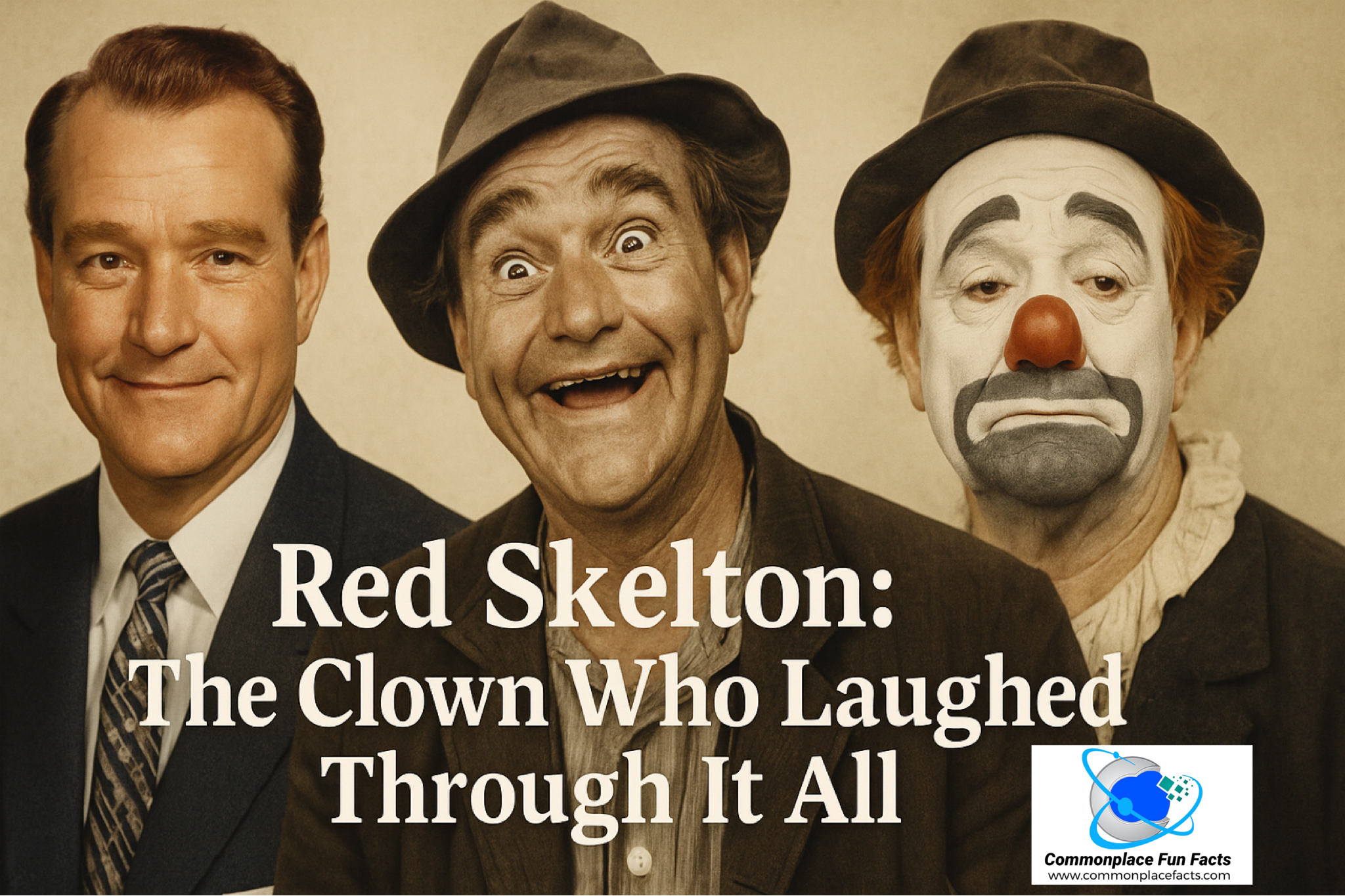

There’s an art to making people laugh without making anyone feel small. Few mastered it like Richard “Red” Skelton—the rubber-faced redhead who somehow balanced slapstick chaos, homespun decency, and moments of disarming sincerity. He spent a lifetime wearing funny hats, mangling words, and falling off imaginary horses, yet behind the painted grin was a man who saw laughter as a holy vocation. His world was one where mean widdle kids, dim-witted bumpkins, and silent tramps could speak to the best—and the worst—in us.
Contents
The Boy Who Couldn’t Stop Performing

Red Skelton was born in Vincennes, Indiana, in 1913, the youngest of four children. His father, a clown with the Hagenbeck-Wallace Circus, died before Red was born. That’s one way to start an autobiography—“Hi, I’m the son of a dead clown.” By age ten, Red was selling newspapers to help his family. Legend has it he met Ed Wynn, the cigar-chomping comedian, who bought a paper and slipped him a ticket to a vaudeville show. Young Skelton watched the audience roar and thought, “That’s it. That’s what I’m doing with my life.” Some kids want to be firemen. Red wanted to be the fire.
He joined a traveling medicine show before his voice even cracked, learning timing, pratfalls, and the delicate art of being hit in the head with a rubber mallet. Vaudeville, burlesque, and the circus were his training grounds. By his late teens, he was performing across the Midwest, making people laugh for a few nickels and the occasional sandwich. He’d found his calling—though at the time, it mostly paid in applause and bus fare.
Red Skelton on the Air: From Static to Stardom

Radio turned Skelton from a regional act into a national name. He first appeared on shows like The Fleischmann’s Yeast Hour and The Rudy Vallée Show, delivering vaudeville routines to invisible audiences who, had to use their imaginations if they wanted to see him fall off his chair. By 1939, he had his own program, Avalon Time. He soon moved on to The Raleigh Cigarette Program, where his goofy, innocent humor found its home.
Red wasn’t just telling jokes—he was building a universe. His old time radio sketches birthed a family of characters that Americans came to love: Junior, the Mean Widdle Kid, whose favorite phrase “If I dood it, I get a whippin’… I dood it!” became a national catchphrase; Clem Kadiddlehopper, the blissfully brainless hayseed who somehow predicted the future of cable news; Cauliflower McPugg, the punch-drunk boxer whose brain was on permanent vacation; and Sheriff Deadeye, whose law enforcement methods could make a Keystone Cop look like Eliot Ness. These weren’t just caricatures—they were reflections of small-town absurdity and human folly, served with a wink. (Listen to radio episodes of The Red Skelton Show here.)
Classic Television’s Crowned Clown
When television arrived, Skelton didn’t so much adapt as explode. The Red Skelton Show premiered in 1951 and ran for two decades, making it one of TV’s longest-running variety shows. In a world of canned laughter, Red didn’t need a laugh track—he had the real thing. Every week he trotted out familiar friends like Clem, Junior, Cauliflower, Sheriff Deadeye, San Fernando Red, and—perhaps most beloved of all—Freddie the Freeloader, the pantomime hobo whose wordless kindness and quiet dignity could reduce an audience to tears.
His show was a blend of slapstick, sincerity, and chaos. Skelton would regularly break character to laugh at his own mistakes, sometimes collapsing into giggles mid-sketch. The audience adored it. When comedians were going for shock value and the networks wanted to modernize the format, Skelton—ever the stubborn Hoosier—refused. “I don’t need blue jokes,” he said. “My audience is red, white, and blue.” It was an old-fashioned stance even then, but that was the charm. He wasn’t trying to be cutting-edge. He was trying to be funny, and maybe kind, in a world that didn’t always reward either.
His insistence on clean humor persisted throughout his career. He knew that laughter gained by shocking the audience’s sensibilities would eventually fade as society became sensitized to salaciousness. On the other hand, humor that appealed to the intellect and the situations that everyone could understand would endure forever.
The Silent Spot: Where Laughter Turned Sacred
Some of the best moments in the classic television show could be seen in “The Silent Spot,” a pantomime sketch in which Skelton, without dialogue, conjured stories of heartbreak, hope, and human absurdity. These sketches were Chaplinesque in their humanity. Freddie the Freeloader, his best-known silent character, wasn’t a punchline; he was a sermon in greasepaint. The hobo with the broken smile and tattered dignity said more about the world than a thousand political monologues ever could.
Skelton’s gift was that he could make you laugh, abruptly become introspective, then laugh again even harder. He understood that laughter was not the opposite of sorrow but its twin. He lost his teenage son, Richard Jr., to leukemia in 1958, and poured that grief into his art. In the years that followed, Freddie’s smile seemed a little sadder, the laughs a little softer, but they still came.
Legacy: The Last Laugh of a Gentleman Clown

By the 1970s, variety shows were fading. The networks wanted edge, not innocence. Skelton’s brand of clean, heart-on-his-sleeve humor looked quaint next to disco and Watergate. He still commanded the ratings; his show was in the top 10 for 17 of the 20 years he was on the air. Nevertheless, CBS canceled his show in 1971—right before launching All in the Family. The times had changed, but Red hadn’t, and that was both his curse and his triumph.
He toured the world performing one-man shows, painted clowns (thousands of them), and composed music. He was honored with stars on the Hollywood Walk of Fame, inducted into the Television Academy Hall of Fame, and even had a performing arts center named for him at Vincennes University. But honors weren’t what drove him. It was the laughter—pure, shared, and unsullied by cynicism. He once said, “If some of my humor offends you, it’s only because it’s about you.” That line basically diagnoses so much of modern popular culture and how easily people seem to take offense.
The Wit and Wisdom of Red Skelton
Red Skelton had a knack for saying the sort of things that made you laugh out loud—and then realize, uncomfortably, that he might’ve just described you. His humor wasn’t about cruelty; it was about the quiet absurdity of being human. Here’s a mix of his best quips and reflections, equal parts giggle and gospel truth.
- “I dood it.” (America’s favorite confession of guilt and mischief since 1941.)
- “No matter what your heartache may be, laughing helps you forget it for a few seconds.”
- “I don’t have to be funny; I just have to be real.”
- “I don’t want to be called ‘great,’ because then I’d be the greatest at being humble.”
- “Live by this credo: have a little laugh at life and look around you for happiness instead of sadness.”
- “If you’re old enough to remember me, you’re old enough to need a nap after reading this.”
- “God’s children and their happiness are my reasons for being.”
- “I stopped drinking once. It was the worst fifteen minutes of my life.”
- “My doctor told me to watch my drinking, so now I drink in front of a mirror.”
- “Television is a medium—because it’s neither rare nor well done.”
- “If you ever find happiness, snap your fingers before it disappears.”
- “Today’s audience knows the price of everything and the value of nothing—except maybe popcorn.”
- “All men make mistakes, but married men find out about them sooner.”
- “I married Miss Right. I just didn’t know her first name was Always.”
- “Mom always said I’d never amount to anything because I was too busy trying to make her laugh. Guess who’s laughing now?”
- “I just want to be remembered as a clown.”
Skelton’s humor showed that beneath the jokes was a philosophy: laughter wasn’t just entertainment, it was medicine for the human condition. And if you weren’t laughing, you probably needed a bigger dose.
Final Curtain
When Red Skelton took his final bow in 1997, the world didn’t just lose a comedian—it lost one of the last true craftsmen of an all-but-forgotten era. He made people laugh without cruelty, made them cry without manipulation, and made them believe, if only for thirty minutes on a Tuesday night, that goodness was still fashionable.
In his own words: “I personally believe that each of us was put here for a purpose — to build not to destroy. If I can make people smile, then I have served my purpose for God.”
Mission accomplished, sir. Mission accomplished.
You may also enjoy…

Charlie Chaplin: The Superstar Who Made the World Laugh (Then Got Himself Kicked Out of America)
Discover the extraordinary life of Charlie Chaplin — from global fame as the world’s most beloved silent film star to political scandal, exile from the United States, and even a posthumous grave robbery. Explore how The Tramp conquered hearts, mocked dictators, and left a legacy that still shapes comedy and cinema today.

Jackie Coogan: The Child Star Who Lost It All and Crawled Back to Fame
Jackie Coogan, the world’s first child superstar, experienced the highs of fame and the lows of loss. From performing as a child in Vaudeville to starring in classic films, he faced financial exploitation and personal tragedy. Despite this, he found a second wave of fame as Uncle Fester in The Addams Family, leaving a lasting…

Amos ‘n’ Andy: The Comedy Hit That Changed Broadcasting—and Sparked Debate
Discover the legacy of Amos ‘n’ Andy, the groundbreaking radio and television show that captivated millions. Explore its origins, impact, cast, controversy, and lasting influence on American media.




Leave a Reply to Herald StaffCancel reply