
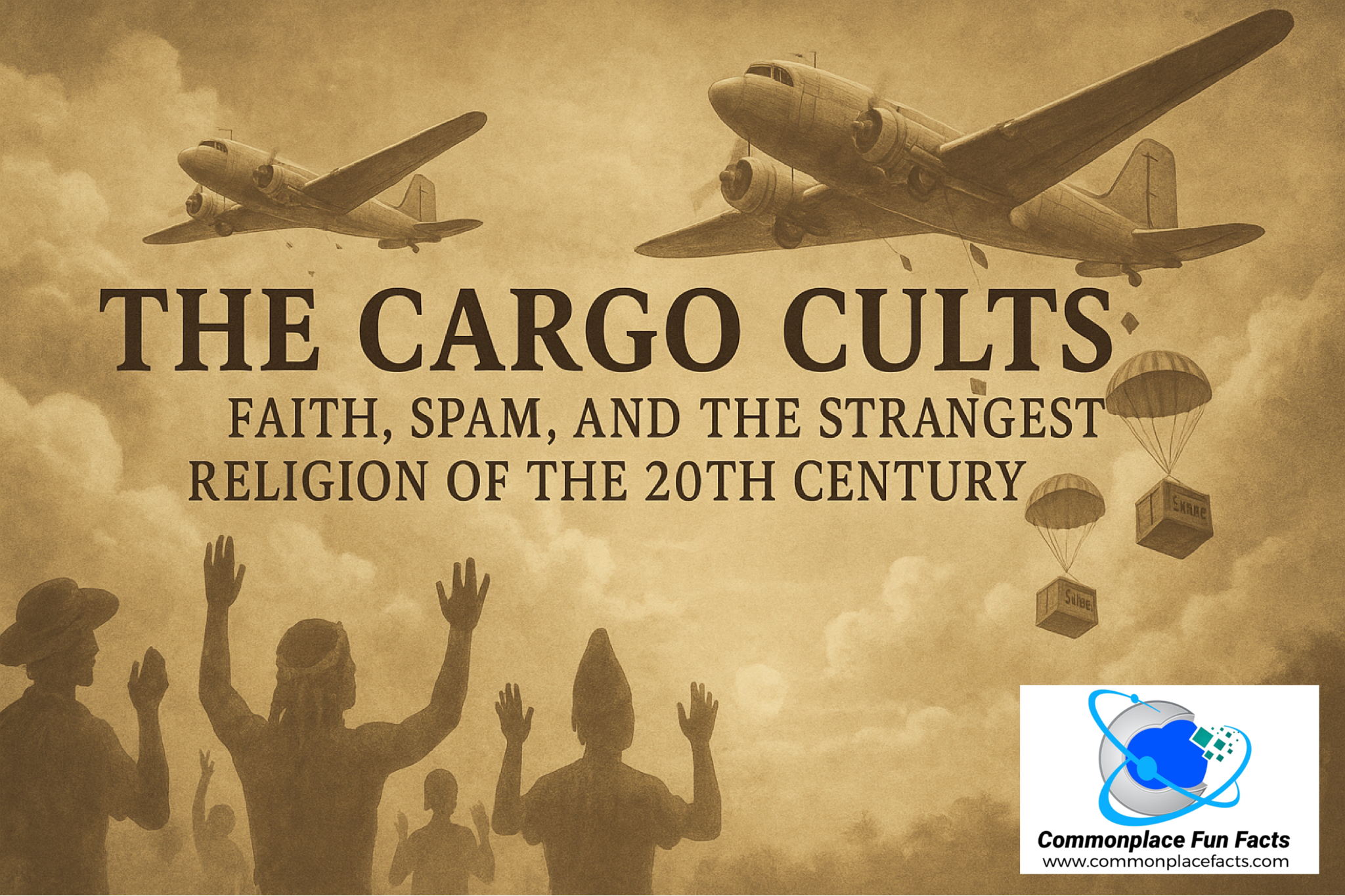

It’s one thing to have faith. It’s another to build a full-scale imitation of an airport in the middle of the jungle because you think heaven runs a cargo delivery service. Odd as that may seem, that’s precisely what happened across the South Pacific in the mid–20th century, when thousands of islanders started worshiping the sky — or, more accurately, the planes that flew through it.
Welcome to the world of cargo cults: movements born from the collision of colonialism, capitalism, and confusion, with just enough spiritual enthusiasm to make anthropologists both fascinated and slightly alarmed.
Contents
The Day the Heavens Dropped Food Rations
During World War II, remote islands in the South Pacific such as Espiritu Santo, Guadalcanal, and Efate suddenly became some of the most strategic regions on Earth. Allied forces swarmed the islands, transforming quiet communities into bustling military bases. With them came something the locals had never seen before: cargo — mountains of it. Crates full of tinned meat, chocolate, radios, tents, and clothing appeared overnight. To islanders whose economies were based on fishing and subsistence farming, this was nothing short of a miracle.
Then, just as suddenly, the war ended. The troops packed up, the planes stopped coming, and paradise was — quite literally — out of stock. To those left behind, it seemed the gods of abundance had abandoned them. Unless, perhaps, they could be persuaded to return.
Thus were born the cargo cults. Followers began to imitate the rituals they’d seen the Americans and Australians perform, convinced that these ceremonies had summoned the sky-gods and their heavenly goods. They built bamboo control towers. They carved wooden airplanes. They marched in formation and wore makeshift “U.S. Army” uniforms. Some even fashioned headphones out of coconut shells and pretended to talk into radios, awaiting divine instructions on the next airdrop.
Honestly, if you’d just watched giant metal birds drop refrigerators from the heavens, you might start rethinking your theology too.
John Frum Will Return
The most famous of these movements began on Tanna Island in what’s now Vanuatu. Sometime around the 1930s or early 1940s, word spread of a prophetic figure named John Frum — or possibly “John from America.” No one’s entirely sure if he was a real person, a myth, or a very confused visiting sailor, but the legend stuck: John Frum promised that if the islanders rejected European missionaries and colonial control, their traditional gods would reward them with unimaginable riches — cargo from the heavens.

When American soldiers arrived in 1942, bringing exactly that — jeeps, radios, and crates marked “USA” — the prophecy seemed fulfilled. Once the war ended and the soldiers departed, the islanders were determined to keep the magic alive. To this day, the John Frum faithful still celebrate John Frum Day every February 15, donning hand-painted uniforms and parading beneath American flags. Their motto: “John Frum, He Will Come.”
They even formed a John Frum political party following Vanuatu’s independence in 1980. Imagine trying to explain that platform: “Our core policy objective is the eventual return of a possibly mythical American with a promising cargo plan.” Actually, come to think of it, that’s not too different from some political platforms in the USA.
It’s quite possibly the only religious movement founded on the holy trinity of Spam, cigarettes, and canned peaches.
The Prince Philip Movement: Royal Deliveries

The John Frum devotees weren’t alone in their skyward aspirations. Another cult on Tanna Island concluded that John Frum’s brother — or at least his divine colleague — was none other than Prince Philip, Duke of Edinburgh. The story went that Philip, husband to Queen Elizabeth II, was the son of a mountain spirit who had traveled across the sea to marry a powerful woman and would one day return to his people. When British officials mentioned this to Philip, he leaned into it with the dry amusement of a man used to bizarre dinner conversation. He even sent the islanders an autographed photo, which, naturally, confirmed everything.
Decades later, a delegation of Tanna elders traveled to London to meet their divine figure in person. Philip, ever the professional, reportedly received them with grace and handed over more signed photos for their shrine. (One suspects he’d been briefed to avoid mentioning that, in his version of heaven, they probably served cucumber sandwiches.)
Faith by Form, Not Function
Anthropologists call cargo cults “millenarian movements,” meaning they’re based on the expectation of an impending transformation — the dawn of a new, abundant age. But the real fascination lies in how these movements mistook symbols for systems. They copied the outward signs of power — uniforms, drills, control towers — without understanding the industrial infrastructure and global supply chains behind them.
It’s easy to laugh, but not too hard, because we do the same thing. Corporations hold “innovation summits” that involve chanting buzzwords in conference rooms. Influencers perform ritual unboxings in hopes of algorithmic blessings. Somewhere right now, a tech startup is probably burning venture capital in a symbolic gesture to attract celestial investors. The bamboo headset lives on — it just has Bluetooth now.
Echoes of Empire
There’s something poignantly human about the cargo cults. They were the product of cultural collision — when people who’d never seen mass-produced goods or mechanized warfare suddenly witnessed both dropped from the sky. The result was a theology of misunderstanding: sincere, creative, and tragic all at once. For those islanders, the Western world’s technology and wealth were inseparable from the spiritual realm. It wasn’t foolishness; it was logic adapted to a world that no longer made sense.
And honestly, who can blame them? We might not build runways to summon gods, but plenty of us still think happiness, meaning, and fulfillment can be delivered overnight — with free shipping.
The Last Airlift
Today, a few cargo cults still survive, mainly on Tanna Island, where John Frum’s followers continue to await his return. Their ceremonies blend tradition, irony, and devotion in equal measure. They’ve seen journalists and anthropologists come and go, but the faith remains: one day, the planes will return, the crates will fall, and paradise will reopen for business.
Maybe that’s the real takeaway. Whether it’s an islander carving a bamboo radio or a modern human refreshing a tracking page for the fifth time, we all build our little runways — hoping that somewhere above the clouds, something good is finally on its way.
You may also enjoy…

Bizarre Royal Family Supernatural Conspiracy Theories
Discover the wildest royal conspiracy theories—updated for the post-Elizabeth era. From Queen Elizabeth II’s alleged immortality to King Charles III’s supposed vampirism, explore the bizarre, hilarious, and enduring myths about Britain’s royal family.

The Mango Cult: The Curious Story of How a Tropical Fruit Became a Symbol of Mao’s China
Discover the bizarre true story of Mao Zedong and the Mango Cult—how a simple fruit became a sacred symbol in China during the Cultural Revolution, sparking nationwide devotion, propaganda, and even tragedy. Read the full story now!

How Nauru Went from Riches to Ruin: The Bizarre Story of a Bad Musical and National Economic Collapse
Discover how Nauru, once the world’s richest country, fell into financial ruin through poor economic choices, corruption, and an ill-fated musical investment.






Leave a Reply to Herald StaffCancel reply