
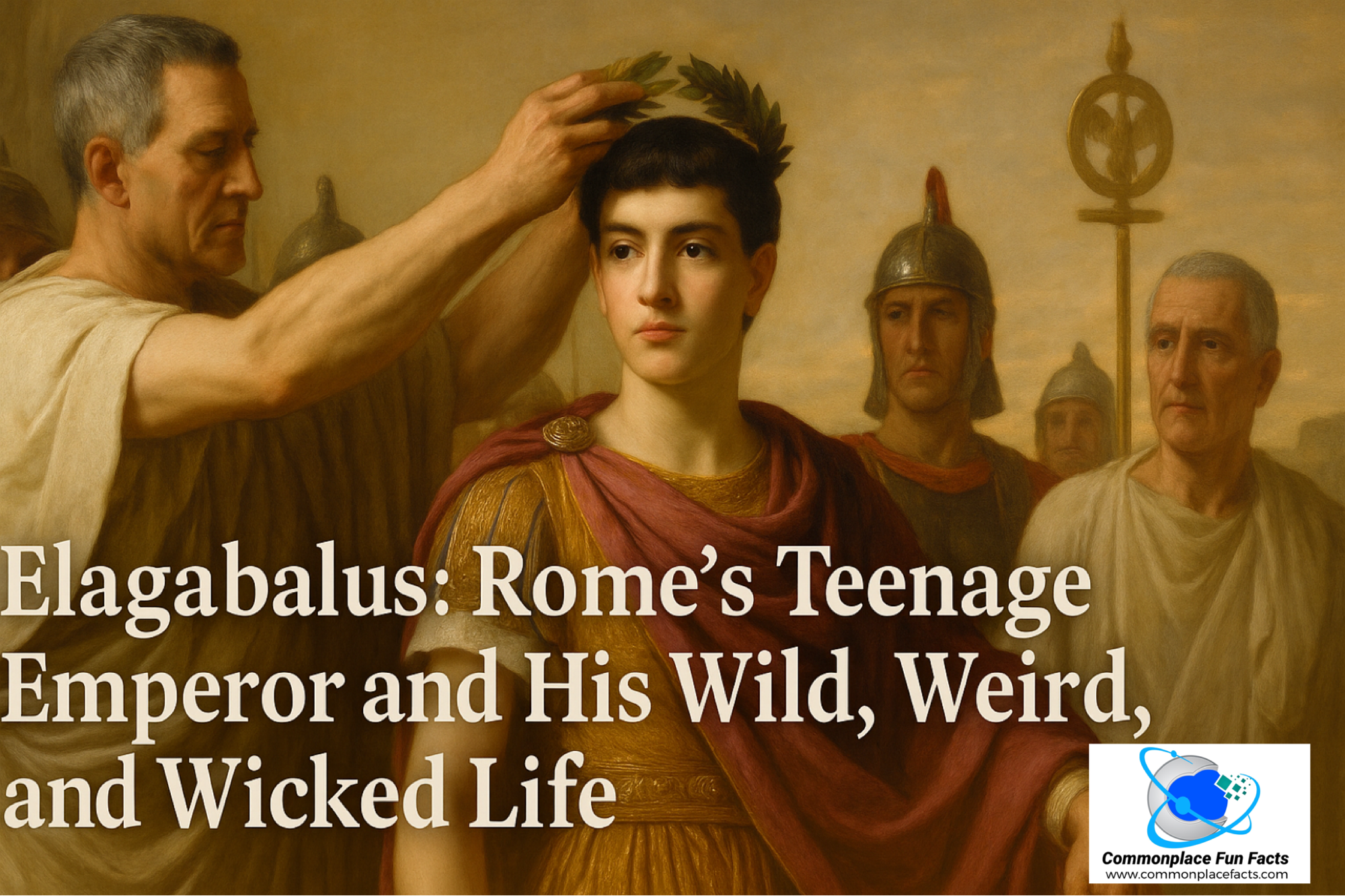

Every now and then, history coughs up someone so spectacularly strange that even Rome — the empire that gave us Nero, Caligula, and gladiator games — had to stop and say, “What in Jupiter’s name is happening?” Enter Emperor Elagabalus, a teenage sun priest from Syria who somehow ended up ruling the world’s greatest empire equipped with nothing but a meteorite, a flair for extremes, and zero self-control.
From AD 218 to 222, Elagabalus treated the imperial throne less like a seat of power and more like a front-row ticket to his own divine variety show. He built temples for space rocks, threw dinner parties where the menu doubled as a death trap, and redefined “Roman tradition” by ignoring all of it. To the Senate, he was a cosmic embarrassment; to gossip-hungry historians, he was a gift that kept on giving and is frequently listed as being among the worst Roman emperors.
What follows isn’t a tale of noble conquest or stoic virtue. It’s the story of an emperor who tried to outshine the sun—literally—and nearly blinded Rome in the process. Buckle up, because this is what happens when you put the fate of an empire in the hands of a teenage boy who had the wisdom and self control of — well — a teenage boy.
Contents
Syrian Beginnings

Before Rome had a chance to regret it, a boy named Sextus Varius Avitus Bassianus was born around AD 204 in Emesa, Syria. His hometown wasn’t exactly the kind of place you’d expect to spawn the supreme leader of the Roman Empire—it was more famous for a black meteorite that locals claimed was a god. The young Bassianus happened to be the high priest of that cosmic rock’s cult, which worshipped the sun-god El-Gabal. Think of it as ancient Rome’s version of a one-man space religion—equal parts astronomy, mysticism, and overconfidence.
The kid took his job seriously. Picture a teenager in gold robes performing daily rituals to a hunk of space debris, convinced he was the divine middleman between heaven and Earth. To the Syrians, this was holy. From our perspective, it seems like the world’s strangest internship for absolute power. Come to think of it, though, at least he actually had a job before entering into politics, which is more than we can say for a few folks currently in power.
Grandma’s Scheme & Elevation to Emperor

When Emperor Caracalla was assassinated in AD 217 —reportedly while taking a roadside bathroom break—the empire was up for grabs. Enter Julia Maesa, Bassianus’s grandmother, who had the political instincts of a mob boss and the subtlety of one, too. She spread the rumor that her charming, sun-worshipping grandson was secretly Caracalla’s illegitimate son. It didn’t matter that the math—or the geography—didn’t add up; the army wanted a familiar name and a steady paycheck, and Julia provided both.
With bribes, gossip, and celestial branding, the teenager was suddenly “Emperor Elagabalus.” He was fourteen, a high priest of a foreign god, and now in charge of the world’s largest military machine. Rome had gone from stoic marble to glitter and incense overnight. The Senate was not amused, but at least the incense helped cover the smell from the public toilets.
If you’re wondering what could possibly go wrong when you give unlimited power, endless money, and no adult supervision to a fourteen-year-old boy — and since you don’t know Elagabalus, feel free to picture literally any fourteen-year-old boy you’ve ever met — congratulations. You’re already smarter than the Roman Senate, which made a decision right up there with “Let’s invade Russia in winter.”
First Alarms: The First Pet Rock
The Senate’s first clue that this might not end well came when Elagabalus arrived in Rome, dragging his meteorite behind him like an emotional-support asteroid. He preferred priests to generals, parties to policies, and had the audacity to smile while doing it. The empire braced itself. The adults had clearly left the room, and a teenager was now redecorating it in gold and bad ideas.
Rome had seen cults before—snake gods, fertility rites, mystery religions—but never anything quite like this. Elagabalus brought his beloved meteorite to the capital, paraded it in a chariot drawn by six white horses, and built a new temple on the Palatine Hill to house it. The stone was said to have fallen from the heavens, and the emperor treated it like the physical embodiment of divinity. Senators were required to attend festivals in its honor. Skipping them was about as safe as skipping a mob boss’s wedding.
The ceremonies were lavish: incense clouds, cymbals, and the emperor himself dancing in golden robes before the celestial rock. He insisted other gods—including Jupiter—come pay their respects. The Romans, used to stern marble statues, were now expected to worship what looked suspiciously like a lump of cosmic coal. They all imagined Jupiter glaring and lowering his attack eyebrows.
Flouting Roman Tradition
For Romans who prized tradition almost as much as conquest, Elagabalus’s sun cult felt like a cosmic middle finger. The Senate had tolerated eccentric emperors before—Nero played music, Commodus wrestled gladiators—but replacing Jupiter with a meteorite from Syria? That was pushing it. The aristocracy muttered that Rome’s divine order had been upended by an over-perfumed teenager in eyeliner. They weren’t entirely wrong. When your emperor insists that the gods of Rome line up behind his personal rock, “cultural tension” is putting it politely.
Dress, Identity, and Gender Boundaries
To what should have been the surprise of literally no one, the teenage Elagabalus was more than a wee bit preoccupied by sex. What was surprising was the extent and the form that it occupied his thoughts, actions, and political policies.

Elagabalus didn’t just blur gender lines; he threw them out the window, waved goodbye, and redecorated the Senate floor with silk. He dressed in dazzling purple and gold robes studded with gems, wore makeup, and preferred diadems to laurel wreaths. His wardrobe alone gave traditionalists palpitations. The Roman elite had tolerated decadence before, but they weren’t ready for an emperor who looked more like a empress.
Ancient historian Cassius Dio claimed Elagabalus sought surgeons willing to give him female anatomy—though, considering Dio wrote to please those who ruled after Elagabalus, we might file that under “possible exaggeration.” Still, the emperor openly identified in ways that confounded the strictly binary Romans. He asked to be addressed as “Lady,” allegedly married both men and women, and appointed a male lover as “husband.”
Whether these accounts were literal, symbolic, or malicious gossip, they revealed how threatening the young ruler’s fluid concept of gender seemed to an empire obsessed with control. To his supporters, Elagabalus embodied divine androgyny; to his critics, he was proof the world had lost its moral compass. Two millennia later, historians still debate where authenticity ends and rumor begins. Either way, he made Rome’s most powerful men question what “manhood” meant—and that, more than his meteorite, might be his real revolution.
Cruelty, Chaos, and Creative Sadism
For all his silk and incense, Elagabalus also had a dark streak that could make Caligula look like a poetry professor. Ancient writers claim the teenage emperor treated human life the same way he treated a dinner party—something to be improved with a little chaos. His reign wasn’t just strange; at times, it was downright sadistic. Cassius Dio and others painted him as a boy who discovered power before empathy, and then decided empathy was overrated.

At one infamous feast, Elagabalus allegedly lashed several dinner guests to a water wheel. As it turned, his victims were slowly drowned while their horrified companions tried to enjoy the dessert course. At another, he waited until everyone had eaten, then released a few lions and leopards into the banquet hall. It raised questions about whether the guests or the animals were intended to emerge from the feast with full bellies.
He didn’t stop at dinner parties. During gladiatorial games, Elagabalus reportedly unleashed venomous snakes into the crowd, just to see what would happen — as if there were any real question. And in an act of generosity gone murderously wrong, he once tossed gold and silver from a tower, then watched with delight as citizens crushed one another trying to collect his “gifts.” It was a twisted experiment in economics—proof that trickle-down wealth, in his version, mostly trickled down to the undertakers.
As if all of this weren’t enough, Elagabalus was also accused of torturing aristocrats, dissecting boys for magical rituals, and other creative ways of killing people for fun. If these sound suspiciously like pulp fiction scripts, possibly they were — written by senators with grudges and plenty of ink. Character assassination didn’t begin with twenty-first century presidential politics. Rome had a long tradition of turning unpopular emperors into bedtime monsters. Elagabalus’s eccentricities made him the perfect target.
Even if only half the stories are true, he had a flair for shock that bordered on performance art. Whether villain, visionary, or chaotic neutral, Elagabalus made sure nobody in Rome ever got bored. If Nero fiddled while Rome burned, Elagabalus probably choreographed the fire. He wasn’t just the emperor who wore makeup and worshipped a rock—he was the cautionary tale parents probably used to make Roman children eat their vegetables. “Be good,” they’d say, “or Elagabalus will invite you to dinner.”
Radical Court Politics
While the Senate got its collective toga in a bunch, Elagabalus filled high offices with freedmen, eunuchs, and former slaves. The old aristocracy called it sacrilege; he called it variety. His logic was blunt: these people owed him loyalty, not lineage. Rome’s nobles, suddenly demoted below a manicurist and a palace doorkeeper, were not amused.
He renamed key positions after the sun-god and forced senators to attend elaborate rituals. When they balked, he called them “slaves in togas.” In the hierarchy of Roman insults, that was somewhere between “used car dealer” and “personal injury lawyer.” The emperor had turned the empire’s ruling class into extras in his personal pageant, and the audience was growing restless.
Excess, Spectacles, Scandals
Elagabalus loved giving gifts — though “gift” might be too generous a word. His banquets were legendary for their surprise lotteries. Guests would receive spoons engraved with prizes like “ten camels,” “ten pounds of gold,” or “ten flies.” You could leave a feast a millionaire or the proud owner of several confused insects. He was hosting Let’s Make a Deal millenia before the Monty Hall Problem became a thing. He was known to send a surprise gift of a live bear to a person’s house. To Elagabalus, it was divine whimsy; to everyone else, it was chaos with catering. He once showered the crowd at the games with coins, jewels, and even livestock. The line between philanthropy and pandemonium blurred when half of Rome was trampled trying to pick up dinner. Somewhere in that madness, he may have invented the world’s first game show — complete with deadly audience participation.
Spectacular Spectacles
Rome had always loved its public entertainment, but Elagabalus took “bread and circuses” as a personal challenge. He hosted naval battles on lakes filled not with water, but with Falernian red wine — because why not sink ships in something drinkable? He raced elephants up Vatican Hill, flattened a few tombs along the way, and swapped out horses for camels in the Circus Maximus. The audience didn’t know whether to cheer or check if they’d accidentally wandered into a prophecy about the apocalypse.
He was obsessed with shock value. His banquets featured ceilings that rained flower petals — delightful until guests realized they couldn’t breathe under several feet of roses. He served peas with pearls, beans with amber, and dishes so rich that the servers probably had to carry them with an insurance indemnity policy. If subtlety was an art form, Elagabalus was painting with fireworks.
Sexual Life, Identity & Rumours

Historians had a field day with Elagabalus’s private life — mostly because it gave them so much scandal to work with. Cassius Dio claimed he “never slept with the same woman twice,” though this was less a fact and more a symptom of Dio’s flair for melodrama. Other accounts insist he preferred men, including his charioteer lover Hierocles, whom he allegedly called his husband. One can imagine more than a couple of senators reflecting that they probably should have been a wee bit more discerning before entrusting all of that power to a teenage boy.
He married at least five times — twice to the same woman, once to a Vestal Virgin (a capital offense for anyone else, by the way), and once purely to make a political point. In one version of events, he appointed men to high-ranking positions based purely on — well, in the interest of maintaining our family-friendly content policy, let’s just say that he was very keen on making sure that all of the men measured up, and we’re not talking about their political skills. While wildly unverified, it has to be history’s most unconventional hiring process and is the sort of thing that causes H.R. officers everywhere to have nightmares.
It’s unclear how much of this is true, but the Roman gossip machine never missed a chance to turn discomfort into outrage. Were the stories slander from conservative writers or glimpses of someone genuinely out of control centuries before language existed for it? Either way, his defiance of norms has made him a reluctant icon for gender history. Two thousand years later, Elagabalus remains the emperor who refused to stay in any one box — political, religious, or otherwise.
The Downfall – Murder in the Latrine

By AD 222, even Elagabalus’s grandmother had run out of excuses for him. His once-loyal Praetorian Guard, tired of being stagehands in his ongoing cosmic cabaret, began whispering about replacing him. Julia Maesa, ever the political survivor, quietly promoted his mild-mannered cousin, thirteen-year-old Severus Alexander. We know — no one seems to have learned a lesson about entrusting physically and emotionally immature teenage boys to high positions of power, but he at least had the advantage of not being Elagabalus. The emperor tried to push Alexander aside, but Rome had reached its limit. It turns out even the most glittering autocracy can’t run on incense and chaos forever.
The finale came with grim irony. Cornered by his own guards, Elagabalus hid in the palace latrine — perhaps not the most dignified place for a god-king to make a last stand. The Praetorians dragged him out, killed him, and dumped his body into the Tiber. It was an inglorious end to a reign that had been anything but dull. For a man who thought himself divine, being flushed from history quite literally down Rome’s sewer system was poetic, if a bit on the nose.
Damnatio Memoriae and Source Problems
Rome wasted no time deleting him, proving the whole Cancel Culture thing is nothing new. His statues were melted, his name chiseled off inscriptions, and his memory officially cursed — the imperial version of hitting “delete account.” Yet even damnatio memoriae (the Roman practice of erasing someone from the records) couldn’t scrub away the fascination. Our main sources — Cassius Dio’s historical accounts, Herodian, and the Historia Augusta — despised him, so their stories read more like revenge fantasies than biographies. They painted him as a degenerate lunatic, the final proof that the empire had gone mad. Maybe they weren’t entirely wrong, but they were hardly neutral either. History, after all, is written by the survivors — and occasionally by the traumatized dinner guests.
Legacy and Why We’re Still Talking About Him
Elagabalus ruled for only four years, yet his legend refuses to fade. To some, he was a depraved child-emperor whose antics nearly wrecked Rome. To others, he was a misunderstood iconoclast — a gender-nonconforming visionary crushed by an empire that couldn’t handle difference. His reign exposed how fragile Rome’s order really was: one eccentric teenager could shake the world in less than four years.
He reminds us that history doesn’t just remember conquerors and builders. It remembers the beautifully bizarre — those who turn power into theater and make their enemies sputter in disbelief. Elagabalus may not have left behind monuments or reforms, but he did leave behind a story so wild that twenty centuries later, we’re still asking, “Did that really happen?” Spoiler: yes, and Rome is still recovering from the glitter.
You may also enjoy…

Did Emperor Julianus Buy His Title at an Auction?
Did Roman Emperor Julianus buy his imperial title at an auction? Find out the strange facts here.

How Many Gladiators Were Killed in the Gladiator Games?
Gladiator games, originating before Romans, evolved into popular public spectacles characterized by brutal battles and high fatalities. Initially honoring the dead, they transformed into entertainment, often resulting in significant deaths. Just how many gladiators were killed in the gladiator games? Explore the fascinating history in this intriguing article.

Handguns, Hot Sauce, Board Games, Testosterone and Aggression: Discover the Intriguing Link
Explore how handguns and hot sauce impact testosterone and aggression in men. A fascinating study on male behavior.







Leave a Reply