
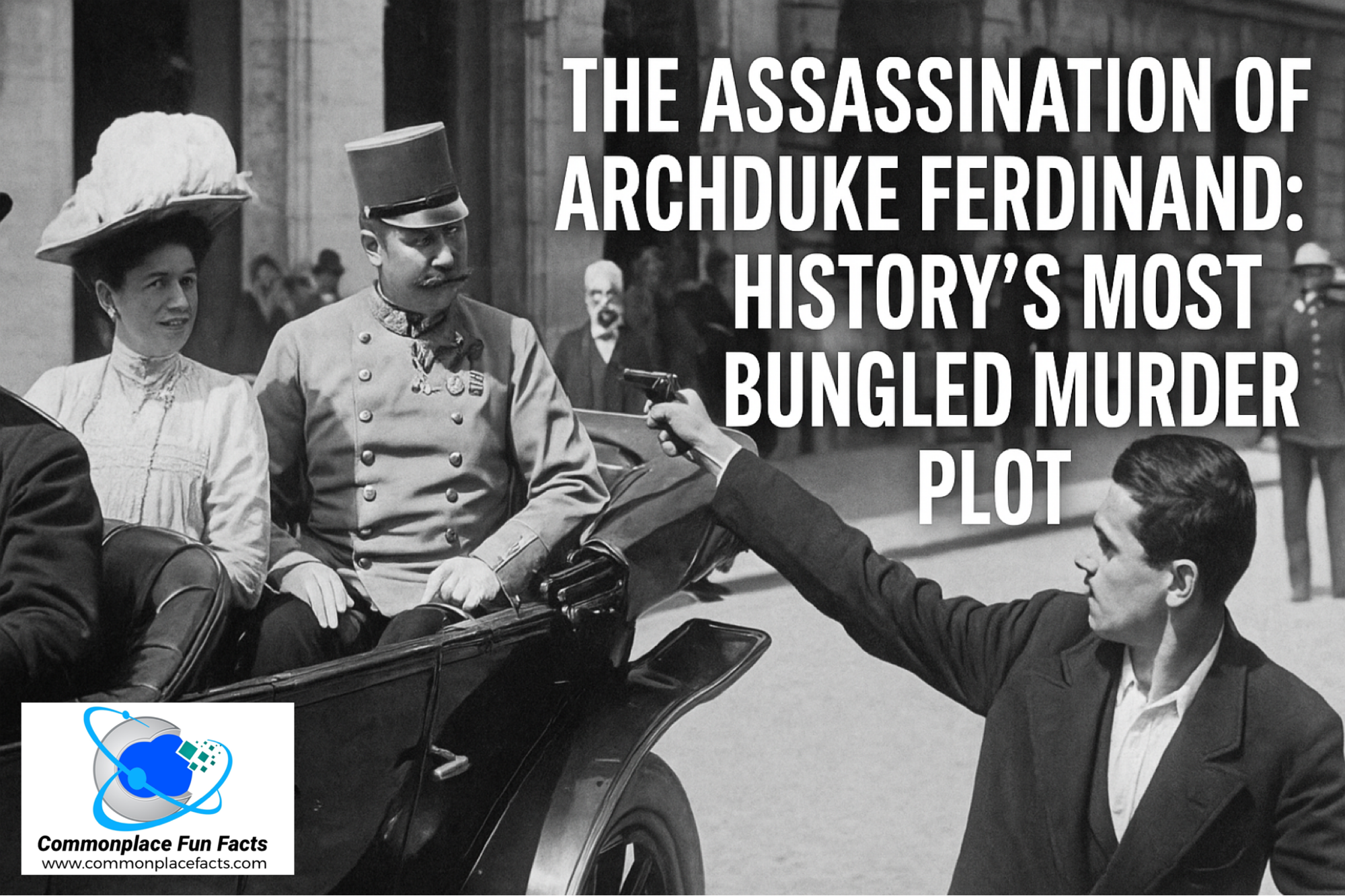

The Assassination of Archduke Franz Ferdinand: Horribly Bungled and Horrible Outcome
Every great tragedy needs a prelude of comedy. In the summer of 1914, Europe was a tinderbox of alliances, egos, and mustaches so large they could’ve provided spacious housing for hobos. This is the background for Archduke Franz Ferdinand—heir to the Austro-Hungarian Empire, world-class grouch, and, as history would have it, the man whose death jump-started World War I. The twist? His assassination was less a masterclass in espionage and more a poorly-written episode of “Keystone Cops Go to the Balkans.”
Contents
The Stage: Sarajevo, June 28, 1914

Sarajevo was in a celebratory mood that morning. Archduke Ferdinand and his wife, Sophie, were visiting to inspect military maneuvers and show off the Empire’s goodwill—a gesture received about as warmly as a meat-lovers pizza at a vegan convention. Still, the crowds turned out, waving flags and shouting greetings, while a half-dozen young nationalist conspirators from the group Young Bosnia waited along the motorcade route, armed with grenades, pistols, and a fatal combination of inexperience and caffeine jitters.
The Six Who Couldn’t Shoot Straight
Here’s the roster for the world’s least efficient hit squad: Muhamed Mehmedbašić, Nedeljko Čabrinović, Gavrilo Princip, and a few others whose names sound like the beginning of a Balkan folk song. Their plan was simple: line the parade route, wait for the Archduke’s car, and attack. What could possibly go wrong? (Spoiler: everything.)
The first assassin froze. Maybe nerves. Maybe he just realized he hadn’t packed lunch. The second also failed to act. The third, Čabrinović, finally threw his grenade—but it hit the folded-down convertible roof of the Archduke’s car, bounced off, and exploded under the following vehicle instead. Two officers were wounded, the crowd screamed, and Čabrinović… Well, he demands special attention.

Nedeljko Čabrinović, realizing his grand moment of revolutionary glory had gone about as well as Genghis Khan’s TED Talk on conflict resolution and how to win people over with woo, decided to make his exit in style. He popped his cyanide capsule like a man expecting to meet his heroic end—and then hurled himself into the river. Unfortunately, Sarajevo’s Miljacka River was less “raging torrent” and more “urban drainage ditch.” Instead of vanishing into the depths like a tragic legend, he belly-flopped into roughly four inches of tepid water, surrounded by floating trash and the collective disappointment of his ancestors.
To add insult to injury, the cyanide was expired—cheaply made, diluted stuff that would’ve struggled to kill a hamster. Instead of dying nobly for the cause, Čabrinović spent the next several minutes violently vomiting in a puddle of refuse while angry locals fished him out and beat him for good measure. If there were a medal for “Most Theatrical Yet Utterly Ineffective Assassination Attempt,” history would have to name it the Čabrinović Cross.
Meanwhile, the rest of the assassins just stood there. Some froze, others ran, and one reportedly fainted. The Archduke, miraculously unhurt, shouted something that roughly translates to “So this is how they greet visitors in Bosnia?” The motorcade sped away to the governor’s mansion, shaken but intact. Plot: foiled. History: spared. Or so everyone thought.
The Wrong Turn Heard ’Round the World

After the bombing attempt, Franz Ferdinand insisted on visiting the wounded officers at the hospital—proof that even grumpy aristocrats can have moments of decency. A new route was planned to avoid the city center. Unfortunately, the driver, Leopold Lojka, didn’t get the memo. Instead of turning onto the new road, he drove straight down Franz Josef Street—right past a small café where one of the conspirators, Gavrilo Princip, was sulking over a sandwich and contemplating his poor life choices.
Seeing the Archduke’s car roll toward him like a divine do-over, Princip jumped up. The driver realized he had made a wrong turn and stopped to reverse, placing the car—no joke—right in front of the assassin. Princip stepped forward and fired two shots. One hit Franz Ferdinand in the neck. The other struck Sophie in the abdomen. Both died within minutes. One wrong turn, two bullets, and the entire world’s balance of power teetered on the edge.
How a Comedy of Errors Sparked a World War
The assassination was the kind of fiasco that would’ve been rejected as “too unbelievable” in a screenplay. The plan failed, the assassins panicked, and success came courtesy of coincidence. Yet those two fatal shots triggered a cascade of ultimatums, mobilizations, and declarations that became the Great War—a name that fails to do justice to what amounted to four years of trench warfare and 20 million deaths.
In the aftermath, Europe’s rulers managed to outdo the assassins in poor decision-making. Austria-Hungary blamed Serbia, Russia backed Serbia, Germany backed Austria-Hungary, France backed Russia, and Britain backed its tea schedule before realizing everyone else was at war. Within weeks, the world was locked in a conflict born not of grand strategy, but of one badly thrown grenade and a driver who couldn’t follow directions.
What Happened to the Conspirators?
After the smoke cleared and the Archduke lay dead, the assassins who had set out to change the world found themselves discovering that, yes, actions do have consequences—especially when those actions involve regicide, grenades, and spectacular incompetence. What followed was less the triumphant birth of a new nation and more a grim episode of World’s Dumbest Revolutionaries.

Nedeljko Čabrinović—he of the shallow river dive—was dragged from his watery humiliation by furious locals who apparently felt that vomiting in a city waterway didn’t count as patriotic martyrdom. Tried along with the others, he escaped the noose because he was under twenty. The Austro-Hungarian judges sentenced him to 20 years in prison. Tuberculosis and bad prison food took care of the rest; he died in 1916, two years into his sentence and well before the empire itself met a similar fate.
Gavrilo Princip, the man who actually pulled off the assassination, didn’t live to bask in revolutionary glory either. Too young for the death penalty, he received the same 20-year sentence. Life in prison was cruel, his health crumbled, and tuberculosis reduced him to a skeletal shadow before claiming him in 1918. He died at age twenty-three—just months before Austria-Hungary itself disintegrated. History may not have a sense of humor, but irony clearly does.
Trifko Grabež joined his fellow conspirators in confinement, where he too succumbed to tuberculosis (it was practically a group activity by this point) in 1916. It’s hard to say what he accomplished during his two years in prison besides coughing in solidarity with Čabrinović.
Danilo Ilić, the mastermind behind the plot, was old enough to qualify for capital punishment. The empire wasted no time making an example of him. He was hanged in 1915 along with two accomplices, Veljko Čubrilović and Mihajlo Jovanović. If nothing else, he proved that planning the assassination was the most efficient way to die from it.
Vaso Čubrilović, the youngest of the bunch at just seventeen, earned a lighter sentence of 16 years. He was released after the war and improbably reinvented himself as a university history professor. Curiously, his doctoral dissertation had nothing to do with World War I and instead focused on the Bosnian uprising of 1875–1878. We think he missed out on an opportunity, but perhaps he felt he had done enough in that particular piece of history. He also served as a government minister in Yugoslavia. He lived until 1990, long enough to see his country rise, fall, and fall again—a kind of extended cosmic punchline.
Cvjetko Popović also survived. Sentenced to 13 years, he was freed after the war and went on to become a museum curator in Sarajevo. Imagine showing tourists the exact spot of the assassination and having to resist the urge to add, “I was there, you know.” He lived until 1980, which, for this group, practically makes him immortal.
In the end, only two of the conspirators lived long enough to see the Yugoslavia they’d dreamed of creating. The rest were executed or died in prison, victims of disease, despair, and what could generously be described as karma. None of them could have predicted that their bungled plot—born from youthful zeal, poor planning, and industrial-grade bad luck—would end up rewriting world history. It’s one of those moments that makes you wonder whether fate has a dark sense of humor, or if the universe simply appreciates a good farce.
Farce, Fate, and the Fragility of History
So, was the assassination of Archduke Franz Ferdinand a well-executed plot or a tragic accident of luck and poor navigation? Yes. It was both. The conspirators were deadly serious but disastrously inept; the empire was arrogant and brittle; the car took the wrong street. And somehow, from that absurd sequence, came four years of devastation that reshaped the planet.
When people say “history turns on small hinges,” this is what they mean—except in this case, the hinge was attached to a 1911 Gräf & Stift automobile taking a left turn it shouldn’t have. If the Archduke’s driver had been better with directions, maybe there’d be no trenches, no Somme, no “All Quiet on the Western Front.” Then again, it’s likely someone would’ve found another way to light the fuse. Humans are nothing if not reliable when it comes to creating conflict.
This is far from the only example of curious coincidences. World War I might have been avoided altogether, for example, if one physician had done a better job of diagnosing his patient. (Read “Was World War I Caused By a Missed Cancer Diagnosis?”) Sometimes the smallest of details can prevent a tragedy; less than twenty years after the assassination of Archduke Franz Ferdinand, history hinged upon nothing more significant than an assassin’s choice of what to stand on. (Read “How a Wobbly Chair Saved FDR’s Life.”)
The assassination of Archduke Franz Ferdinand wasn’t just the match that lit the fire; it was a spark struck by accident, from a hand that missed its mark, in a world doused in gasoline. And that, dear readers, is how a comedy of errors became the opening act for one of humanity’s darkest tragedies.
For more fascinating stories about World War I, visit the website for The National World War I Museum. Better yet, if you are in Kansas City, visit it in person.
You may also enjoy…

The Glorious Folly of the Battle of the Somme: A Million Casualties for Six Miles
Discover the tragic absurdity of the Battle of the Somme, where over a million casualties gained just six miles of ground. A darkly humorous look at one of WWI’s deadliest—and most baffling—offensives.

The 1918 Kiel Mutiny: The Revolt that Ended World War I
The 1918 Kiel Mutiny: how German sailors refused a suicidal naval order, sparked a revolution, toppled the Kaiser, and ended a world war — all before lunch.

Cher Ami: The Heroic Pigeon of WWI Who Saved Nearly 200 Lives
Learn about Cher Ami, the heroic pigeon who saved 200 people during World War I.





Leave a Reply to Commonplace Fun FactsCancel reply