
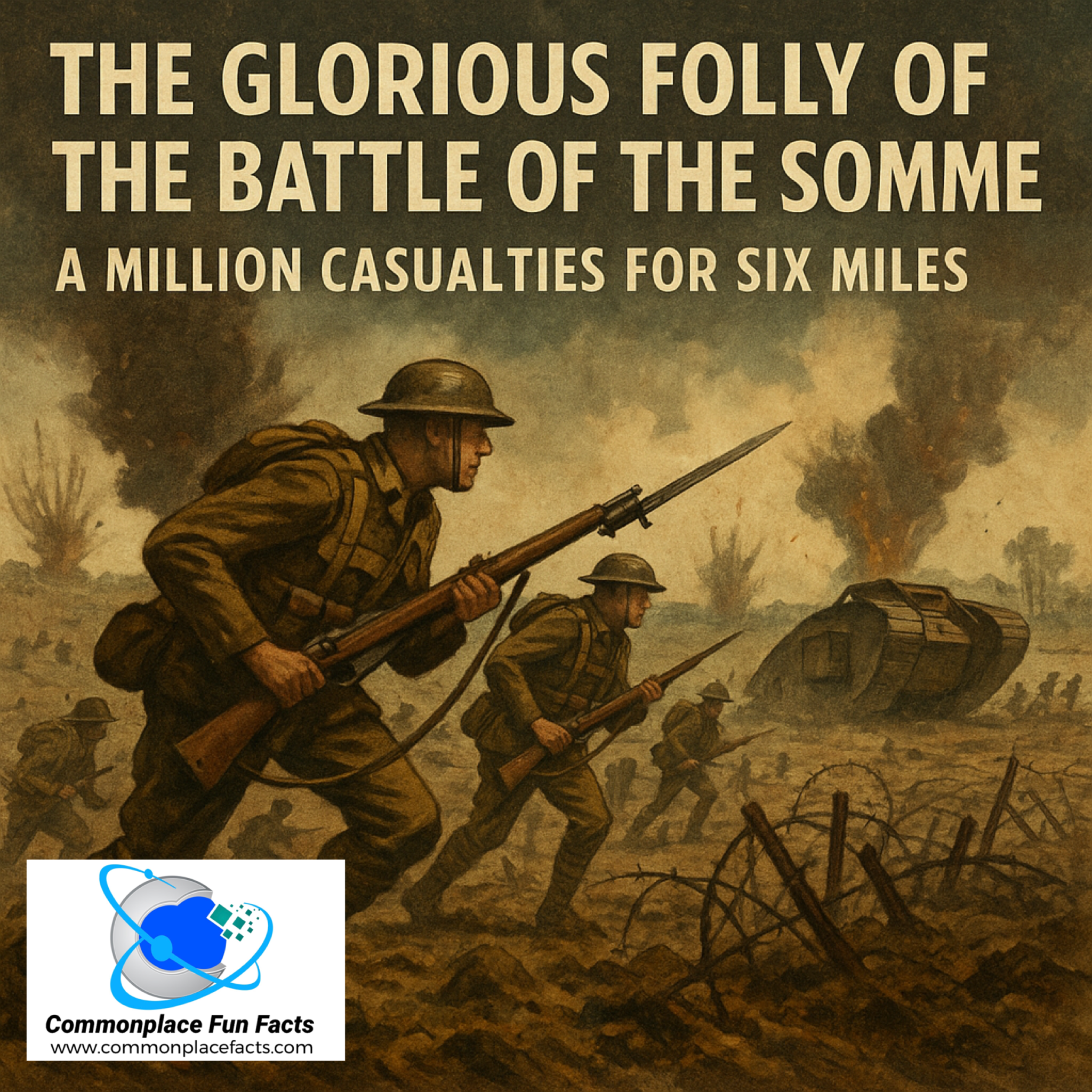

Picture this: it’s 1916. Europe is locked in a war so senseless it makes your last office team-building exercise seem downright productive. Trench warfare has turned the Western Front into a muddy, lice-infested, gas-soaked stalemate, and the generals have decided it’s time for something bold, something decisive, something… incredibly ill-advised. Welcome to the Battle of the Somme—a five-month masterclass in how not to conduct a military offensive.
Contents
The Great Plan: What Could Possibly Go Wrong?
By mid-1916, Allied commanders were desperate to break the deadlock. The Germans were pounding away at Verdun, the French were bleeding manpower, and someone somewhere had the bright idea: “Let’s stage a major offensive along the River Somme. We’ll shell them into submission, then walk right over and collect our victory medals.”

That someone was British General Sir Douglas Haig, a man whose mustache had its own zip code and whose optimism could have powered a small nation. The French were supposed to take the lead, but thanks to Verdun, the job fell squarely on the British—many of whom had never before been involved in a battle that didn’t involve pub trivia.
July 1, 1916: A Date That Will Live in Infirmary
After a week-long artillery bombardment involving 1.7 million shells—enough to make the Earth think it was under attack from Mars—the British soldiers climbed out of their trenches at 7:30 a.m. on July 1st. They were told the shelling had cleared the way. It had not.

In just one day, the British suffered 57,470 casualties, including 19,240 deaths. It was the single worst day in British military history. Soldiers were mowed down by German machine guns before they could even reach no-man’s-land. In some places, men advanced shoulder to shoulder—because nothing says “invincible” like presenting a unified target to a wall of bullets.
By nightfall, the plan was already less “decisive push” and more “muddy catastrophe.”
Meanwhile, in the Trenches…
If you thought the battlefield was bad, you should’ve seen the living conditions. Trenches were a charming combination of sewage, shrapnel, and despair. Soldiers endured trench foot, lice infestations, and rats so large they probably qualified for the cavalry.
New technology joined the horror lineup: chlorine and mustard gas, flame throwers, creeping barrages, and—for the first time in history—tanks. Yes, tanks. Mechanical monsters that broke down roughly every 17 feet and frightened both friend and foe alike. Still, it was the thought that counted.
The Long Slog: July to November
The battle raged on for four more months. Ground was gained in inches and paid for in lives. Weather turned the battlefield into a swamp. Officers adjusted their strategies by switching from “send everyone over the top” to “send everyone over the top, but later.” Progress!
Along the way, the Somme became the crucible for some notable names. J.R.R. Tolkien served in the battle, and some say the wastelands of Mordor owe more than a little to the barbed wire and smoke of the Western Front. War poets like Wilfred Owen and Siegfried Sassoon were shaped by its horror—and in turn shaped how we remember it.
When the Mud Finally Settled
By the time the Battle of the Somme ended in November 1916, more than one million men had become casualties. British and French forces had advanced… six miles. That’s right—five months, a million casualties, and the kind of territorial gain a toddler could achieve with a tricycle and a sugar high.
Did it accomplish anything? Historians still argue. It relieved pressure on Verdun. It wore down German forces. It introduced tanks to the battlefield. But it also shattered illusions. The Somme marked the point where enthusiasm gave way to grim endurance. The “war to end all wars” had become the war no one could end.
The Somme’s Legacy: Glorious Futility
Today, the Battle of the Somme stands as a monument to industrial-age warfare’s brutal efficiency and bureaucratic blindness. Its cemeteries stretch for miles, and its poetry still echoes through classrooms. It’s a cautionary tale written in mud and blood—proof that progress doesn’t always look like victory and that strategy sometimes means learning from your own disaster.
And for what it’s worth, it also gave us this timeless lesson: when planning a surprise attack, maybe don’t announce it with a week-long fireworks display first.
You may also enjoy…

Cher Ami: The Heroic Pigeon of WWI Who Saved Nearly 200 Lives
Learn about Cher Ami, the heroic pigeon who saved 200 people during World War I.

Was World War I Caused By a Doctor’s Misdiagnosis?
Could a British doctor’s error have changed the course of history? Discover how a misdiagnosed sore throat helped pave the way for World War I.

The Battle of Los Angeles: America’s WWII UFO Mystery
Discover the bizarre true story of the Battle of Los Angeles: when WWII-era panic, anti-aircraft guns, and possibly a weather balloon caused chaos over California. Mass hysteria, mystery, and UFO theories await!


Leave a Reply