


Charles Hatfield: Rainmaker, Wizard, or Conman?
History never disappoints when it comes to people who look at an impossible challenge and confidently announce, “I can fix that.” Whether it’s alchemists turning lead into gold, medieval doctors treating plagues with pocket frogs, or modern influencers promising financial freedom through magnetic wristbands, the human species has never been shy about overselling its skillset.
That brings us to Charles Hatfield, a self-proclaimed rainmaker. Not metaphorically. Not poetically. Literally. Using a secret chemical brew and a wooden tower, Hatfield claimed he could coax moisture from the heavens like a cosmic maître d’ waving clouds toward a reserved table.
And he did it, spectacularly.
Or maybe not.
It is a story that involves drought, civic desperation, meteorology, chemistry, impressive salesmanship, and one very unfortunate dam that most definitely did not sign up for this plotline. It also gives us the rare chance to use the phrase “accidental amphibious sewing machine salesman,” which is exactly the sort of opportunity that gets us out of bed some mornings.
Buckle up, grab your umbrella, and join us as we explore the stormy story of Charles Hatfield, the Rainmaker of San Diego.
Contents
Meet Charles Hatfield: The Cloud Whisperer of Los Angeles
Charles Mallory Hatfield was born on July 15, 1875, in Fort Scott, Kansas, but eventually made his way to Southern California. There, he lived the sort of tidy, respectable life that involves selling sewing machines and absolutely not meddling with regional weather systems. At least not yet.

By his late twenties, Hatfield had become engrossed with the idea of generating rainfall through chemical evaporation. Depending on which account you trust—each written with the hushed awe normally reserved for wizards, monks, or that one uncle who claims he can “fix any car by listening to it”—Hatfield developed a secret blend of 23 chemicals. It sounds impressive until you remember Colonel Sanders achieved immortality with only 16 herbs and spices.
The precise formula was never written down, which is what tends to happen when a “scientific breakthrough” lives exclusively in its inventor’s head and is refined through equal parts trial, error, and whatever mood the sky happened to be in that week.
Hatfield’s technique, christened the “smell-maker system” by early newspapers, bore no resemblance to the fellow in high school literature class whose daily lunch of microwave burritos could have felled a rhinoceros. Instead, Hatfield climbed a tall wooden tower, uncorked his 23-chemical concoction, and released it into the air. This, he explained, did not make rain—heaven forbid. “I do not make rain,” he insisted. “I simply attract clouds, and they do the rest.”
In other words, he took full credit for the outcome while carefully distancing himself from the responsibility. A strategy we traditionally associate with politicians, not amateur chemists.

By the end of 1904, Hatfield was open for business. His standard pitch was simple: pay him $50, and he guaranteed results—rain within three hours to five days of releasing the vapors. Payment was due only if it worked. Reports of early successes rolled in, supported by enthusiastic testimonials. One man later described Hatfield’s concoction this way: “The gases smell so bad it rains in self-defense.” If nothing else, the atmosphere did seem motivated to get away from him.
Newspapers loved him. In December 1904, several papers praised the results of his work in Pasadena. The Pomona Daily Review quoted Hatfield declaring, “This is the twentieth test of my system and has proved a perfect success… I think that it has been clearly demonstrated that I can bring rain.” Perhaps not peer-reviewed, but excellent for marketing.
And Hatfield did what any entrepreneur does after generating hype: he raised his rates. By 1905, the price for a successful rainmaking session had jumped from $50 to a commanding $1,000 per shower—roughly the cost of a small house, a large horse, or a very enthusiastic weekend at the Hotel del Coronado.
For the next decade, business was good. Hatfield traveled anywhere his services were wanted, accompanied by his brothers, who helped build towers, haul equipment, and maintain the important illusion that they were not, in fact, a roving band of weather-obsessed stage magicians. Together they erected Hatfield’s signature towers, mixed his secret blend, made their pitch, and—whenever chance weather cooperated—claimed victory.
Little did Hatfield know that his biggest test was coming. And this time, the sky would take his “cloud attraction” a little too seriously.
San Diego’s Big Problem: An Empty Reservoir and a Thirsty City
By 1915, San Diego was desperate. The Morena Reservoir was barely one-third full. The Sweetwater Dam was low. The city was dry enough that local politicians began looking around for answers. Over a thousand years ago, people believed a guy named Eric Anundsson could control the weather with his hat, so they made him their king. San Diego’s city fathers took a more subdued approach. Rather than waiting for nature or building different infrastructure or performing a very long rain dance, they decided to talk to a man who mixed chemicals on a tower and promised to solve everything.
Hatfield offered a bold proposal: he would fill the Morena Reservoir for a fee of $10,000. At the time, that was roughly equivalent to a house with indoor plumbing, a car, and enough spare money for a celebratory steak dinner. But Hatfield sweetened the deal by insisting he only wanted payment if he succeeded. If he didn’t bring the rain, no charge. That kind of confidence tends to get noticed, even by city governments.
San Diego accepted. Sort of. They didn’t sign an actual written contract—because who needs legal documentation when you’re commissioning a one-man weather system?—but they did shake hands, nod meaningfully, and agree that if the reservoir filled, Hatfield would get his money.
A spokesman for the Commonplace Fun Facts Legal Department offered this comment before retreating to his coffin ahead of sunrise: “Municipal leaders and aspiring weather wizards should note that handshakes are not, in any legal universe, contracts. There are very good reasons these things get written down.” The aforesaid absence of a written contract would come back to haunt Hatfield, as we shall see.
The Great San Diego Flood: Hatfield’s “Success” Arrives With a Vengeance
On January 1, 1916, Hatfield constructed his evaporation tower near the Morena Reservoir. Witnesses reported rising vapors, metallic odors, and the unmistakable impression that this man was either making rain or summoning something that belongs in a fantasy novel involving hobbits and elves.
Five days after Hatfield lit up his chemical cocktail on that lonely tower above the Morena Reservoir, it began—just a sprinkle at first. The kind of hesitant drizzle that makes Californians congratulate themselves for owning umbrellas they never remember to use. Then the rains strengthened. By mid-January, it wasn’t simply raining; it was as if the clouds had enrolled in an intensive, citywide fire-hose certification course.
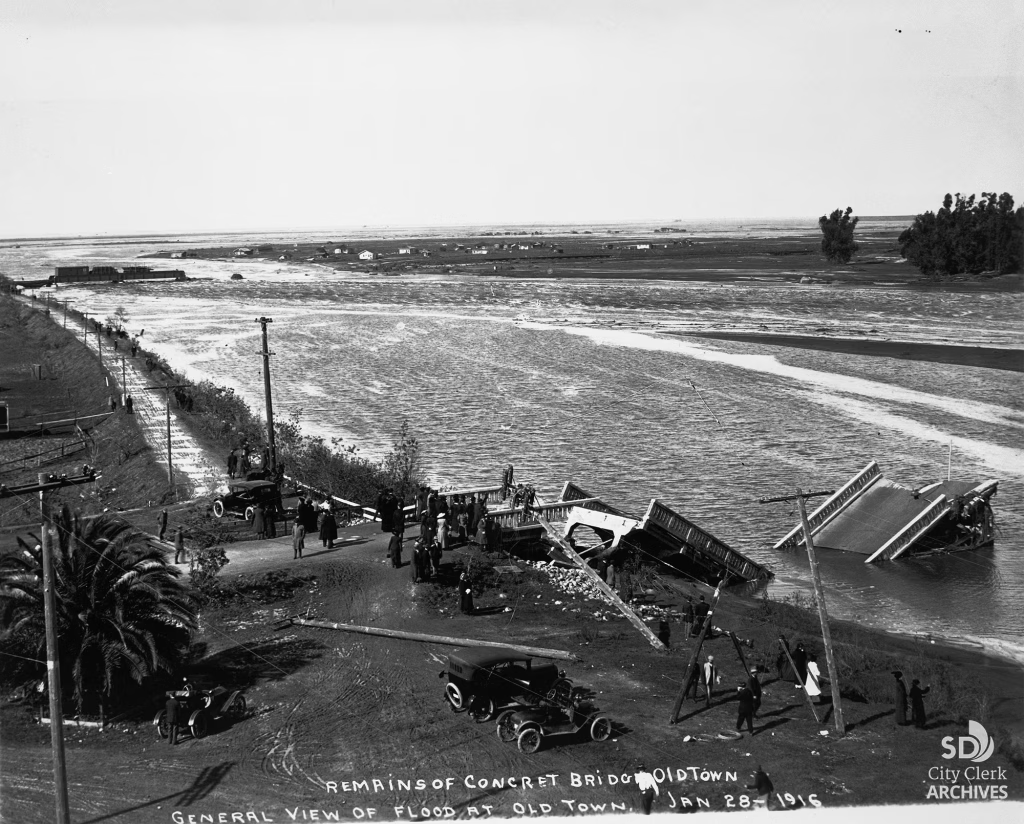
And on January 27, 1916, San Diego learned what it truly meant to get everything you asked for and several things you did not.
“Dams and reservoirs filled beyond capacity and burst,” Jeff Smith wrote in the San Diego Reader in 2003. “Flash floods barraged every canyon and arroyo. They carried off barns and houses, some rolling head over heels on the rapids. The concrete bridge at Old Town collapsed. At 5:30 p.m., the rock-fill dam on Otay Lake disintegrated. Backed by 50-mile-an-hour winds from the east, an estimated three billion gallons of water made a gigantic spillway down through Cottonwood Creek, the Tia Juana River, and finally out to sea.”
It was destruction on a scale the region had never seen.
The official death toll was 22, though later estimates put the number closer to 50. Agricultural lands were shredded, leaving behind an estimated $1.5 million in damage. Highways and bridges added another $650,000 to the tally. And worst of all for a water-starved city—several of the very reservoirs San Diego depended upon were now catastrophically empty, their stored water swept into the Pacific in one furious, muddy rush.
Through it all, Hatfield remained blissfully unaware. His tower was perched far enough from the city that he didn’t see the washed-out roads, the ruined farms, the broken bridges, or the bodies recovered from the torrent. He also didn’t hear the locals muttering that this catastrophe had one obvious culprit, and he happened to be standing on a wooden scaffold surrounded by suspicious-smelling vapors.
When word finally reached him that San Diegans now considered him roughly as welcome as a swarm of hornets at a church picnic—and that death threats were arriving faster than the storm fronts—Hatfield sensibly fled.
But Hatfield didn’t stay gone.
No, in his mind, he had not only fulfilled the contract—he had exceeded expectations. He had promised to fill the reservoir. Instead, he’d filled every reservoir, burst multiple dams, and demonstrated rainmaking abilities so dramatically destructive that the sky itself might have considered filing a restraining order.
He still wanted his $10,000.
Hatfield’s Flood, as the disaster came to be known, left San Diego with wrecked infrastructure, deep losses, and a very complicated question: did they owe money to the man they now blamed for their misery?
The Debate: Scientific Genius, Lucky Charlatan, or Accidental Flood Fabricator?
Hatfield, unsurprisingly, claimed responsibility for the rain. He maintained that his chemical vapors attracted clouds, and the clouds handled the rest. San Diego, on the other hand, quickly recalculated the price of “success” when they realized they were now facing millions of dollars in damages and a growing stack of irate citizens wondering why the city’s first option was not “better water management” but “hire that guy with the fumes.”
Meteorologists of the day—and modern ones who don’t dabble in magical thinking—offered a far less mystical explanation. A major Pacific storm system was already barreling toward Southern California, and Hatfield just happened to be waving his chemical concoctions at the sky when it arrived. The timing lined up, sure, but that’s coincidence, not causation. Plenty of people swear it always rains right after they wash their car; that doesn’t mean their bucket and sponge control the atmosphere.
San Diego’s Legal Options: Pay the Man, Sue the Man, or Pretend Nobody Saw Anything

Hatfield, confident in his victory, asked for his payment. San Diego refused—unless he agreed to accept liability for the flood damage. Hatfield, whose chemical mixture did not include “legal immunity,” politely declined. He escalated by having his attorney send a letter (read it here). Thus began an extended legal battle — and by “extended,” we mean twenty years— before landing on a final ruling: the rain was considered an “act of God.”
That phrase is usually reserved for lightning strikes, volcanoes, and the occasional bird ruining your freshly washed car, but it also makes an excellent legal buffer when you’ve commissioned a freelance meteorological artisan and don’t want to pay him.
The Science (or Lack Thereof): Could Hatfield’s Methods Have Worked?
To be fair to Hatfield, cloud seeding is a real practice today. Modern programs use aircraft, silver iodide, and a level of atmospheric science that would have made Hatfield’s head spin. Today, China has an official Weather Modification Office and even used large-scale cloud-seeding operations to control rain in the lead-up to the 2008 Beijing Olympics, firing rockets of silver iodide into the sky to keep the opening ceremonies dry. What Hatfield used was… let’s call it “aspirational chemistry.” No one ever confirmed that his 23-chemical cocktail could actually induce rainfall, and given the lack of controlled experiments, peer review, or even a decent lab notebook, scientists remain skeptical.
But Hatfield wasn’t entirely a fraud. He understood wind patterns. He knew Southern California’s seasonal rhythms. And he had impeccable timing. Nature did most of the work, but Hatfield positioned himself where weather was likely to happen—and when it did, he claimed credit with the energy of a man who has absolutely memorized his elevator pitch.
The Aftermath: From Local Legend to Footnote in Weather Folklore

After the legal storm settled (significantly drier than the meteorological one), Hatfield continued offering his services elsewhere, though never again with such dramatic results. He worked on rainmaking projects in Canada, the Pacific Northwest, and Central America. Some communities claimed modest success. Others claimed absolutely nothing happened except an invoice.
By the 1920s, interest in Hatfield’s methods had cooled. Scientific weather modification efforts had begun taking more serious, research-based forms. Hatfield attempted to secure patents for his secret mixture, but without revealing its contents, the patent office found itself in the rare position of rejecting something for being too mysterious.
Hatfield eventually returned to his earlier trade, selling pumps and other mechanical equipment. He lived a quiet life with none of the drama of his rain-making days and died in 1958, still convinced he had truly harnessed the sky. His brother later claimed he knew the formula, but no documents ever surfaced, leaving the world deprived of both the recipe and the opportunity to accidentally flood San Diego again.
San Diego’s Long Memory: How the City Remembers the Rainmaker
San Diego has never entirely forgotten Charles Hatfield. The 1916 flood remains one of the city’s most dramatic natural disasters, and Hatfield’s role—real, imagined, or embellished—gives it a narrative flair rarely found in infrastructure failures. Museums and local historians periodically revive the story, and Hatfield has become a folk figure: part scientist, part salesman, part tragicomic footnote.
Was he a genius? A fraud? A well-intentioned tinkerer caught in the wrong atmospheric moment? A man who got really lucky and even more unlucky at the same time?
The answer is probably yes, to all of the above. But he remains one of the few people in history who was once asked by a city government to please stop making rain because things were getting out of hand. That alone earns him a place in our Hall of Fame for Historical Oddities.
Did Charles Hatfield Actually Cause the 1916 Flood?
This brings us to the question that hovers over Hatfield’s legacy like a suspiciously well-timed cumulonimbus: did he actually make it rain, or was he simply the beneficiary of theatrical timing and enthusiastic publicity?
To start, there’s the matter of how much Hatfield believed in his own powers. And the answer appears to be: quite a lot. Hatfield saw himself not as a showman but as a scientist—or at least as a man engaged in something resembling science if you squinted hard enough and ignored the fumes. He experimented, refined his mixtures, took notes, built specialized towers, and proudly followed the tradition of his fellow pluviculturists (the official term for someone who claims to be a rainmaker) by refusing payment until he produced results. In his mind, he wasn’t conjuring rain; he was coaxing nature along with a little nudge and a nose-wrinkling chemical bouquet.
But here’s where later scholarship complicates the story in a way Hatfield himself might have appreciated. For all their mystical branding and secret formulas, early rainmakers weren’t just peddling atmospheric snake oil. Many were, in fact, remarkably skilled meteorologists. They studied climate patterns. They knew seasonal rhythms. They consulted weather reports—rudimentary by modern standards, yes, but still useful. And they learned to show up at the right place at the right time, looking very industrious just before nature planned to drop precipitation anyway.
As Richard W. Katz put it in Nature in 1981: “Aided by weather forecasts and information on local meteorological patterns, the pluviculturists depended on occasional coincidences with the occurrence of natural precipitation to demonstrate the viability of their rainmaking operations.”
In other words, they were experts at surfing weather patterns—and even better experts at taking credit for them.
Their knack for timing made them immensely popular with the public, who desperately wanted to believe in their “weather cures.” But the scientific establishment was not nearly as enchanted. Katz notes that “the scientific community, including the US Weather Bureau, remained steadfast in opposition to nearly every rainmaking scheme,” though this skepticism did nothing to slow the rainmakers’ success. As Katz dryly observed, “scientific expertise was no match for expert salesmanship.”
So… Did Hatfield do it?
Meteorologically speaking, probably not. The storms that slammed San Diego in 1916 were almost certainly the result of natural Pacific weather systems already moving toward the coast, oblivious to whatever Hatfield was simmering on his tower.
But did Hatfield believe he did it? That seems far more likely.
And did thousands of San Diegans believe he did it? Absolutely.
Perhaps that’s the real secret behind Hatfield’s rainmaking: not chemistry, not meteorology, but the powerful force of human conviction—the same force that lets people claim, with a straight face, that their freshly washed car is fully responsible for the sudden downpour.
Conclusion: Charles Hatfield, Rainmaker in Myth if Not in Fact
Charles Hatfield occupies one of those strangely delightful corners of history where ambition, curiosity, and questionable science collide like mismatched air masses. His tale reminds us that city governments will try almost anything once, that nature has a darkly comedic sense of timing, and that the difference between hero and scapegoat can shift dramatically depending on reservoir levels.
Did he make it rain? Maybe. Probably not. Did he believe he did? Absolutely. And did San Diego learn that the sky is not to be trifled with, especially when dams are involved?
Let’s hope so.
In the end, Hatfield’s legacy survives not because he controlled the weather, but because he represents that enduring human spark of optimism that whispers, even in the middle of drought, “Hang on. I know a guy.”
You may also enjoy…

The Epic Legend of Eric Weatherhat: The King Who Controlled the Weather With His Hat
Explore the fascinating legend of Eric Weatherhat, a semi-mythical Viking king of Sweden, his weather-controlling hat, and his clash with Harold Fairhair. Uncover history, folklore, and daring escapes!

Bad Weather Really Does Make the Days Longer
The post discusses the perception that bad weather makes days feel longer, a sentiment backed by scientific observations on Earth’s rotational changes due to various factors, including weather and geological events. It mentions historical perspectives on time and emphasizes a desire to eliminate Daylight Saving Time while humorously suggesting compensation for longer rainy days.

Frog Rain Phenomenon: The Science Behind Amphibians Falling from the Sky
Did frogs really fall from the sky in Kansas City and Dubuque? Discover the science behind the bizarre frog rain phenomenon and why it happens.


Leave a Reply to ScottCancel reply