
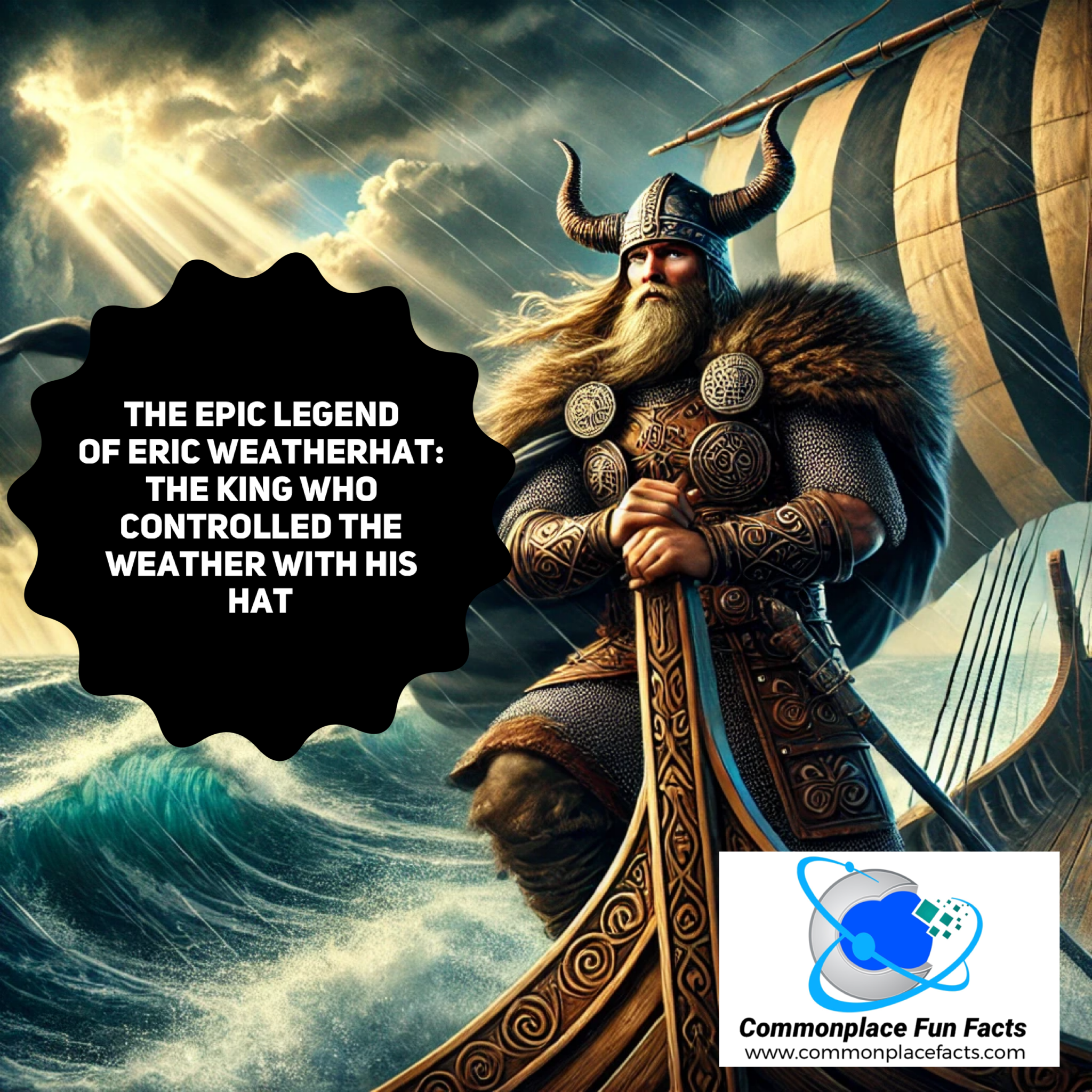

Hats Off to the Legend of Eric Weatherhat
We at Commonplace Fun Facts are certainly no slaves to fashion. The truth of this can be seen by the plethora of t-shirts owned and worn by our staff that look like they came from a Comicon clearing house. Although we don’t particularly care about the latest fashion trends, we do lament the departure of men’s hats from the expected daily wardrobe.
Once, not so long ago, men’s hats were everywhere, and they were snazzy. Fedoras, bowlers, newsboy caps, and countless other styles made even the dorkiest guy look a wee bit more sophisticated as a result.
In short, friends, hats are no small matter. A good one can elevate a person’s standing, keep their head warm, or, if you’re H.G. Wells, become a souvenir. We refer to the time Wells swiped hat from the mayor of Cambridge. The apparel also triggered the appropriately-named “Straw Hat Riots” in New York City.
Not all hat stories, however, are as whimsical. Some venture into the realm of legend—and magic. Take, for instance, the tale of Eric Anundsson, better known by his much cooler moniker, Eric Weatherhat.
The Making of a Viking Legend
This semi-legendary 9th-century king of Sweden is remembered not for his political savvy or daring deeds alone, but for a hat so marvelous it warranted a spot on a cliffside pole for centuries. Buckle up; we’re going on a whirlwind tour through Viking raids, magical headgear, betrayal, and daring escapes.
Eric Anundsson, or Eric Weatherhat, was a king whose lineage is as murky as the waters of Lake Mälaren. Depending on which medieval Icelandic saga you consult (with the obligatory grain of salt), Eric was either the son of King Anund of Uppsala or the legendary Viking Ragnar Lothbrok. The former is the more accepted version, but let’s not rule out the idea of a little Viking flair in the family tree.
Eric’s story appears across various sagas and texts, including Saxo Grammaticus’ Deeds of the Danes and Snorri Sturluson’s Heimskringla. While details vary, a common thread emerges: Eric was a mighty king, known for his conquests in the east. He was said to have led successful campaigns across Finland, Estonia, and beyond, leaving behind ramparts and earthworks still visible in his day.
But what truly set Eric apart wasn’t his sword or ships—it was his hat. According to local legend, this was no ordinary hat. It was magical.
The Magical Hat of King Eric
Eric’s legendary hat allegedly granted him the power to control the weather. Need a favorable wind for your Viking fleet? Just give the hat a jaunty turn. Storm clouds threatening your outdoor feast? A quick adjustment, and voilà—sunshine. In an age when maritime success hinged on the whims of the elements, this hat was nothing short of revolutionary. It wasn’t long before Eric earned the nickname “Weatherhat,” a title as practical as it was intimidating.
Armed with his trusty hat, Eric amassed wealth and power through plundering and subjugating the eastern territories. However, as so often happens in stories like these, success went to his head (or his hat). Ambition swelled, and Eric turned his sights westward, dreaming of ruling lands in modern-day Norway. This would bring him into conflict with a rival whose legendary hair was as iconic as Eric’s headwear: Harold Fairhair, the first king of Norway.
By the way, as cool as these Norse names are, we can’t help but be grateful that society has moved on from them. Not everyone is fortunate enough to be born with the characteristics that earn a name like “Fairhair.” If we still got our names from that old convention, your typical trip to Walmart would bring you in contact with individuals bearing names such as “Jimmy Blubberbottom,” “Claudia Swollenjowels,” “Marty Greasyhair,” and “Chloe Cannot-be-bothered-to-change-out-of-her-pajamas.”
Clash of Kings: The Hat vs. The Hair

Eric’s western campaign started strong. He conquered regions in western Sweden and southern Norway, forcing locals to accept him as their overlord. But his triumphs did not go unnoticed. Harold Fairhair, busy uniting Norway under his rule, quickly learned of Eric’s advances. Harold rushed south, reclaiming lost territories and punishing those who dared to betray him.
The two kings’ rivalry came to a head at a feast hosted by a wealthy farmer named Åke in Värmland. Åke, either a diplomatic genius or a chaos enthusiast, invited both kings to his table. To accommodate such esteemed guests, he built a new, grand longhouse for Harold and relegated Eric to the old, less glamorous one. To make matters worse, Åke later offered his son to Harold as a servant, further solidifying his allegiance to the Norwegian king.
Learn how a 10th century Viking king is responsible for Bluetooth technology.
Eric, understandably miffed, confronted Åke. When the farmer dared to suggest that Harold was in his prime while Eric was past his glory days, the Swedish king responded with the diplomacy of a Viking: he beheaded Åke and left his body in the forest. This act of rage would cost Eric dearly.
Downfall and Desperation
Harold, incensed by the murder of his loyal subject, launched a campaign to oust Eric from Värmland. The once-mighty King Weatherhat found himself on the defensive, retreating back to the heartland of Sweden. His troubles, however, were far from over.

According to legend, Harold Fairhair’s men secretly followed Eric to a small forested island in Lake Mälaren, now known as Kungshatt (King’s Hat). One day, while Eric was out riding without any guards—a decision that seems ill-advised in retrospect—his enemies closed in. Surrounded on all sides, Eric faced a choice: surrender or leap from the island’s steep cliffs into the waters below.
In a moment that would solidify his place in legend, Eric spurred his horse forward and jumped. Miraculously, both king and steed survived the fall and swam to safety. Unfortunately, in the chaos of his daring escape, Eric’s magical hat was lost to the depths of the lake.
Presumably, Harold’s hair remained eternally fair.
The Legacy of the Lost Hat
Eric’s fortunes never recovered after losing his hat. Without its weather-controlling powers—or perhaps its symbolic prestige—he was unable to reclaim his former glory. By the time of his death around 895 CE, Eric had lost most of the territory he’d gained in his wars. His son, Björn, succeeded him and eventually earned his own place in history as Eric the Victorious.

But what of the hat? According to local tradition, the cliff from which Eric made his fateful leap became known as Kungshatt. In the early 17th century, the people of the area erected a large hat on a pole atop the cliff, commemorating the legendary king and his magical accessory. Over the centuries, this hat has been replaced multiple times, but it remains a fixture to this day. Visitors passing by are encouraged to tip their hats in salute, a gesture said to bring good weather.
Myth, History, and a Hat’s Magic
So, was Eric Weatherhat a real king? The evidence is tantalizing but inconclusive. His name appears in multiple medieval sources, suggesting he wasn’t entirely the stuff of folklore. His exploits in the east align with the power struggles of the Viking Age, when Swedish kings vied for control of trade routes and territories. The magical hat, however, is likely a later embellishment, a bit of folklore spun around a historical figure.
What makes Eric Weatherhat’s story endure isn’t just the question of whether it’s true. It’s the sheer audacity of it: a king wielding a weather-controlling hat, battling a rival known for his flowing locks, and making a literal cliffhanger escape. It’s the kind of tale that sticks in the mind—and reminds us that even in the face of defeat, a good hat can make all the difference.
For that matter, so can a fine, thick mane of hair.
The next time you’re donning your favorite headgear, spare a thought for Eric Weatherhat. And if you ever find yourself passing Kungshatt, don’t forget to tip your hat. You never know when you might need a little extra sunshine.
You may also enjoy…

Hastein’s Epic Fail: The Viking Who Invaded the Wrong City (and Faked His Funeral)
Discover the hilarious true story of Hastein, the Viking chieftain who set out to sack Rome but accidentally raided the wrong city. Explore how one navigational blunder became one of history’s most entertaining legends.

Harald Bluetooth: The Intriguing Story of How a 10th-Century Viking King Is Responsible for Technology You Use Today
Bluetooth technology originated from efforts in the late 1980s by Nils Rydbeck and his team at Ericsson to develop wireless headsets. Named after 10th-century Viking king Harald Bluetooth Gormsson, it symbolizes the unification of devices. The name stuck due to its popularity, leaving a lasting legacy of innovation in connectivity.

Explore the Scottish New Year Tradition of Quaaltagh: The First-Foot Custom
Discover the unique Scottish New Year tradition of Quaaltagh, where the first visitor of the year determines your fortune. Learn the customs and history behind this intriguing practice.





Leave a Reply