
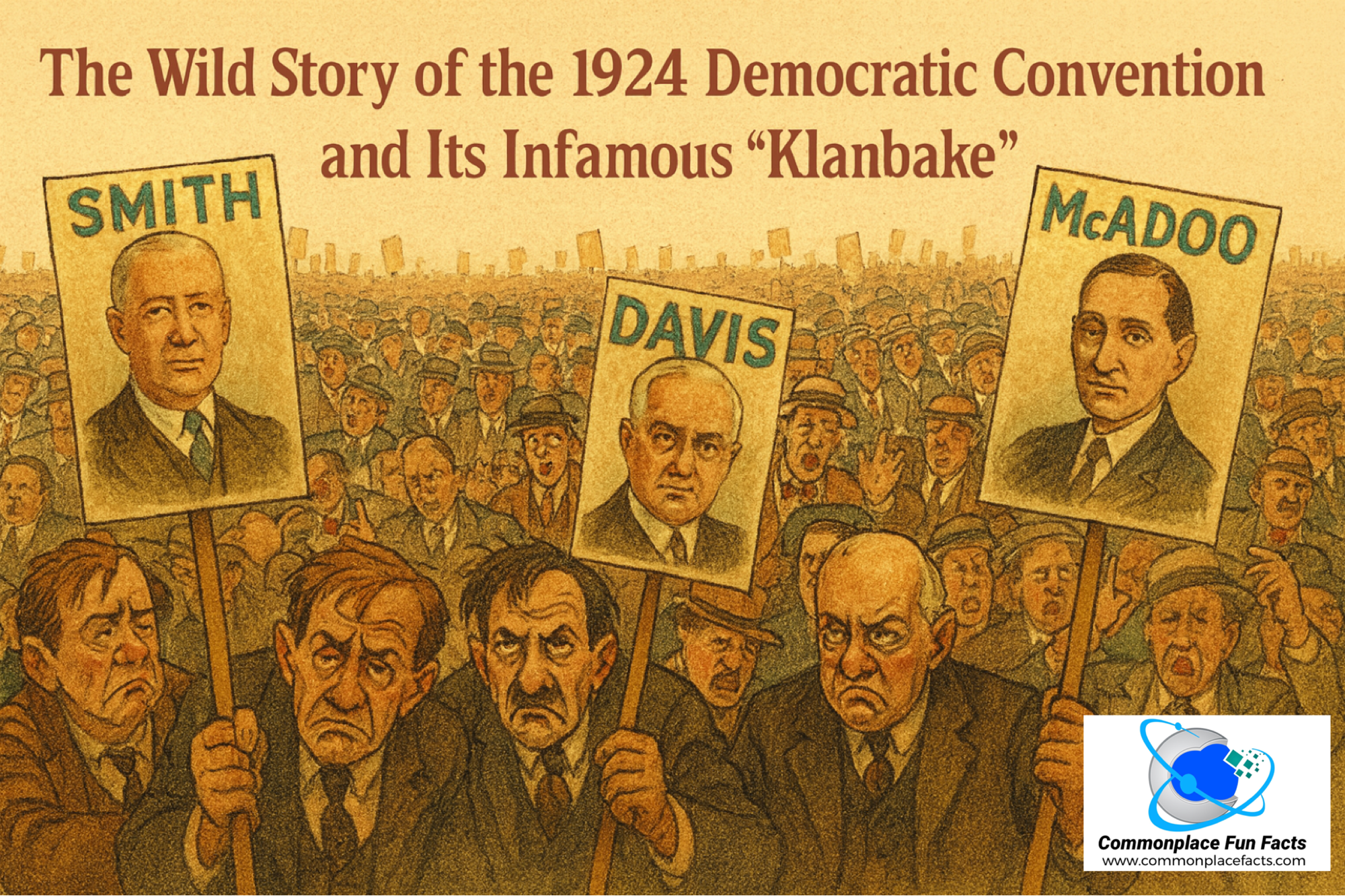

Every so often, American democracy decides to test its own limits, just to see how much chaos the system can absorb without actually exploding. The 1924 Democratic Convention was one of those experiments. It lasted more than two weeks, took a record 103 ballots to choose a presidential nominee, and featured a very public, very ugly fight over whether the party should condemn a violent white supremacist organization by name. Spoiler: they did not cover themselves in glory.
The convention was held in New York City’s Madison Square Garden from June 24 to July 9, 1924. By the time it was over, delegates had sweated through their clothes, shouted themselves hoarse, nearly come to blows, and finally nominated a “compromise” candidate so forgettable that you could be forgiven for not remembering Cyrus T. Schlepperman.
No, that’s not the guy they nominated, but do you remember who was?
We rest our case.
Contents
A Party, a Pressure Cooker, and an Uninvited Menace
The Democratic Party of 1924 was less a coalition and more a group therapy session that nobody was running. Inside the hall you had urban immigrant communities and old-stock rural Protestants, dry crusaders and wet big-city machines, Southern conservatives and Western progressives, all trying to pretend they were in the same political family.

Lurking behind much of the tension was the Ku Klux Klan, in its ugly, early 20th-century “second wave” form — not to be confused with its ugly all-the-rest-of-the-time forms. This was not a fringe group operating out of a single state; this was a nationwide movement built on racism, religious bigotry, and political intimidation. It had millions of members and real clout in both parties. In some places, it helped elect governors. In others, it showed up as a handy reminder that terrorism can, in fact, wear a suit and carry a delegate credential.
Plenty of Democrats wanted nothing to do with it. Others were quite happy to benefit from its support, provided they did not have to say its name out loud. This is the moral level we are working with here: people who wanted equality and people who wanted the votes of people who opposed it, crammed together in one very hot building with nothing but a gavel and parliamentary procedure standing between them.
McAdoo vs. Smith: Culture War in Human Form

The convention’s main drama centered on two men who could not have been better designed as opposites if a political cartoonist had invented them.
William Gibbs McAdoo, former Treasury Secretary and son-in-law of Woodrow Wilson, spoke for rural, Protestant, pro-Prohibition America. He had support in the South and West, plenty of “dry” friends, and a remarkable talent for not saying anything too clear about the Klan, which some of his supporters considered a feature, not a fault.

Al Smith, governor of New York, was the walking embodiment of everything the Klan and its sympathizers loathed: Catholic, urban, pro-immigrant, and opposed to Prohibition. He represented the bustling, noisy, modern city. He also represented the terrifying idea that maybe American politics should include people who were not white Protestants from small towns. Shocking behavior.
Delegates did not just disagree about which man should be president. They disagreed about what country they thought they were living in. That is a lot to cram into one convention hall, especially one without air conditioning.
The Fight Over Naming the Problem
The most explosive issue was not the nomination itself. It was a proposed platform plank that would have explicitly condemned the Ku Klux Klan by name.
On one side were delegates, led by Senator Oscar Underwood of Alabama, who believed that a national party should probably not be coy about distancing itself from an organization built on violence, intimidation, and bigotry. On the other side were delegates who either supported the Klan, depended on its voters, or just wanted it all to go away without forcing anyone to take a public stand.
The debate was as bitter as you would expect. Pro- and anti-Klan delegates clashed, tempers flared, and the convention came close to literal physical confrontation. The platform vote that followed was painfully close. The anti-Klan plank failed by a narrow but unmistakable margin — not a literal single vote, but close enough that newspapers of the day kept calling it “a one-vote loss,” meaning that the switch of even one state delegation could have changed the outcome. It was a technical defeat with the emotional sting of a coin toss.
In terms of political blunders, this ranks right up there with the prime minister who called a snap election because he was drunk. In practical terms, the party had just announced to the world that it could not quite bring itself to condemn a terrorist organization by name. It was like watching someone stare at a burning building and say, “We are prepared to issue a strong statement that we are very generally opposed to arson, in theory.”
The “Klanbake” Outside the Hall
The convention earned its notorious nickname from the toxic mix of heat, hostility, and the unmistakable shadow of Klan influence hovering around it. Newspapers and commentators seized on the term “Klanbake” to capture both the sweltering conditions inside Madison Square Garden and the political pressure coming from a movement that had no business shaping national policy but very much intended to.
While delegates in New York argued over whether the party should denounce the Klan by name, the organization’s supporters staged their own display across the river in Elkwood Park, on July 4. The Keyport Weekly reported several thousand attendees gathered for a “tri-state konklave.” It was billed as a patriotic rally, but which resembled, in practice, a hate rally with picnic logistics. Participants appeared in robes, lobbed baseballs at an effigy of Al Smith, shouted antisemitic insults at the “Jew York” convention, and ended the event with the familiar, chilling theatrics of a cross burning. It was a pointed show of strength and contempt, a reminder that the debates inside the Garden were more than abstract platform disputes.
To its lasting shame, the convention failed to meet that moment with a clear repudiation. The story of 1924 is not simply that bigotry was present; it is that a major national party looked directly at it and decided the safer option was to look away.
61 Ballots, 99 Ballots, and the Slow Death of Optimism
While all this was happening, the convention still had a small logistical matter to address: picking an actual nominee. That part did not go smoothly either.

Balloting began June 30. From the very first round, McAdoo and Smith locked into a stalemate: one had the rural dry vote, the other had the urban wet vote, and neither had the two-thirds majority required under party rules. Favorite sons and dark-horse candidates soaked up stray delegates like political sponges, making it even harder to reach a decision.
By the 61st ballot, the convention was completely deadlocked. Delegates were exhausted. The galleries were restless. The band had probably memorized every bar of every march it had ever played in its life. McAdoo’s supporters floated procedural tricks; Smith’s allies tried to drag things out until the other side’s hotel bills broke them. It was less a nominating process and more a hostage situation with credentials.
By the time the convention reached its 90s in ballot age, everyone could see that neither McAdoo nor Smith could win. The Klan issue had poisoned McAdoo’s chances with Catholics, Jews, and urban voters. Smith’s religion and anti-Prohibition stance made him unacceptable to a large swath of the South and West. The two-thirds rule, beloved by Southern delegations as a kind of veto power, finished the job of gridlock.
At last, after the 99th ballot, both major contenders effectively stood aside, and the delegates staggered toward the only thing they could still agree on: their own need to go home someday.
John W. Davis: When Everyone Settles for “Fine, Whatever”

Enter John W. Davis of West Virginia, former congressman, solicitor general, and ambassador to Britain. He was respected, competent, and about as emotionally stirring as a well-organized filing cabinet. In other years he might have been a respectable second-tier candidate. In 1924 he was the political equivalent of room-temperature lemonade: nobody’s first choice, but unlikely to trigger a riot.
On the 103rd ballot, the convention finally landed on Davis as the compromise nominee for president. Delegates who had traveled to New York to fight for a vision of America’s future ended up rallying behind a man whose main selling point was that the two warring factions disliked him less than they disliked each other.
Even the vice-presidential pick, Charles W. Bryan of Nebraska (brother of William Jennings Bryan), felt like a consolation prize, a familiar name bolted to the ticket in hopes that someone, somewhere, might feel mildly enthusiastic about voting for it.
Cameos, Radio Waves, and the One Guy Who Really Benefited
For all its misery, the convention did produce a few lasting moments. This was the first Democratic convention broadcast on radio, which meant listeners across the country could follow the drawn-out drama in real time, probably while reconsidering their support for the two-party system.
It was also a milestone in another way: Franklin D. Roosevelt returned to the national stage. Still recovering from the paralytic illness that had struck him in 1921, Roosevelt appeared in Madison Square Garden to place Al Smith’s name in nomination. His “Happy Warrior” speech not only branded Smith with an enduring label, it reminded the party that Roosevelt himself had not vanished from public life. A few years later, Al Smith would be governor of New York; a few more, and Roosevelt would be president.
So in the middle of this disaster, the future of the Democratic Party quietly cleared its throat and tested the microphone.
The Election Nobody Really Loved
If this had been a movie, all that sweat and fury might have produced a triumphant upset in November. Instead, the Democrats walked away divided, demoralized, and stuck with a nominee who did not excite much beyond polite applause.
Republican President Calvin Coolidge, presiding over a booming economy and personifying quiet stability in a decade that liked its presidents mostly invisible, defeated Davis handily. Many progressives abandoned the Democratic ticket entirely in favor of Robert La Follette’s third-party campaign. Many others stayed home, deciding that none of the available options justified leaving the house.
The convention had dragged on for fifteen days, burned through 103 ballots, and torn open deep divisions over religion, race, and identity. The result was not a great leap forward, but a painful lesson in how a party can reach a moment of moral clarity and then refuse to take it.
What the “Klanbake” Really Left Behind
If the 1924 Democratic Convention feels strangely familiar, it isn’t because anyone today is reenacting it with vintage hats and wooden placards. It’s because the deeper story is the same one we keep telling ourselves in slightly updated outfits: a political family forced into the same room, loudly insisting it’s unified while half its members glare at the other half over issues no one wants to touch without oven mitts. The delegates of 1924 didn’t just fight over candidates; they fought over identity, belonging, morality, and what kind of country they thought they were building. Take away the cigar smoke and the two-thirds rule, and you’re left with arguments that could have been lifted from a modern party meeting, minus the hashtags.
The most uncomfortable echo is the moral ambiguity. In 1924, a national party confronted an ugly force influencing its ranks and chose caution over clarity. It wasn’t the last time a political calculation beat out a moral conviction, and it certainly wasn’t the first. Today’s headlines come packaged differently—cleaner fonts, better lighting—but the underlying tension remains painfully recognizable: how far will a party bend to avoid alienating a bloc of voters, and at what point does bending turn into breaking?
If the “Klanbake” teaches us anything, it’s that history does not reward parties that try to tiptoe around moments demanding courage. It also doesn’t offer much sympathy to politicians who confuse avoiding conflict with solving it. The 1924 convention is a reminder that the fault lines we navigate now have been with us for a very long time, and that the future tends to belong to the people who eventually choose a side, rather than the ones who spend their days studying their shoes.
In the end, the story isn’t really about 1924. It’s about what happens every time a democracy finds itself at a crossroads and has to decide whether “safe” is good enough. History’s verdict on that answer has never been subtle.
Democracy survived it. That does not mean it should repeat it.
You may also enjoy…

The Practical Joke that Resulted in the First Woman Mayor
When Susana Salter’s name appeared on the ballot on April 4, 1887, it was all supposed to be a late April Fools Day gag. As it turned out, the joke was on those who pulled the prank when she won the election and became the first woman elected as mayor in the United States. The…

Meet Vermin Supreme and Ride Your Pony Into a Zombie-Powered Future
Vermin Supreme, a perennial presidential candidate since 2004, is known for his humorous and bizarre political platform promising free ponies, mandatory toothbrushing, and zombie apocalypse readiness. Although his ideas seem absurd, he has garnered notable votes in past elections and aimed for the Libertarian nomination in 2020, advocating for traditional political issues.

A Silly Candidate With a Silly Name for Silly Times
Most candidates for political office have lofty goals for the betterment of society. They put themselves through the ordeal of a campaign with aspirations of influencing policy and making a difference. John Desmond Lewis had somewhat different goals. When he stood as a candidate for the British Parliament, he changed his name to Tarquin Fintimlinbinwhinbimlim…




Leave a Reply to cat9984Cancel reply