
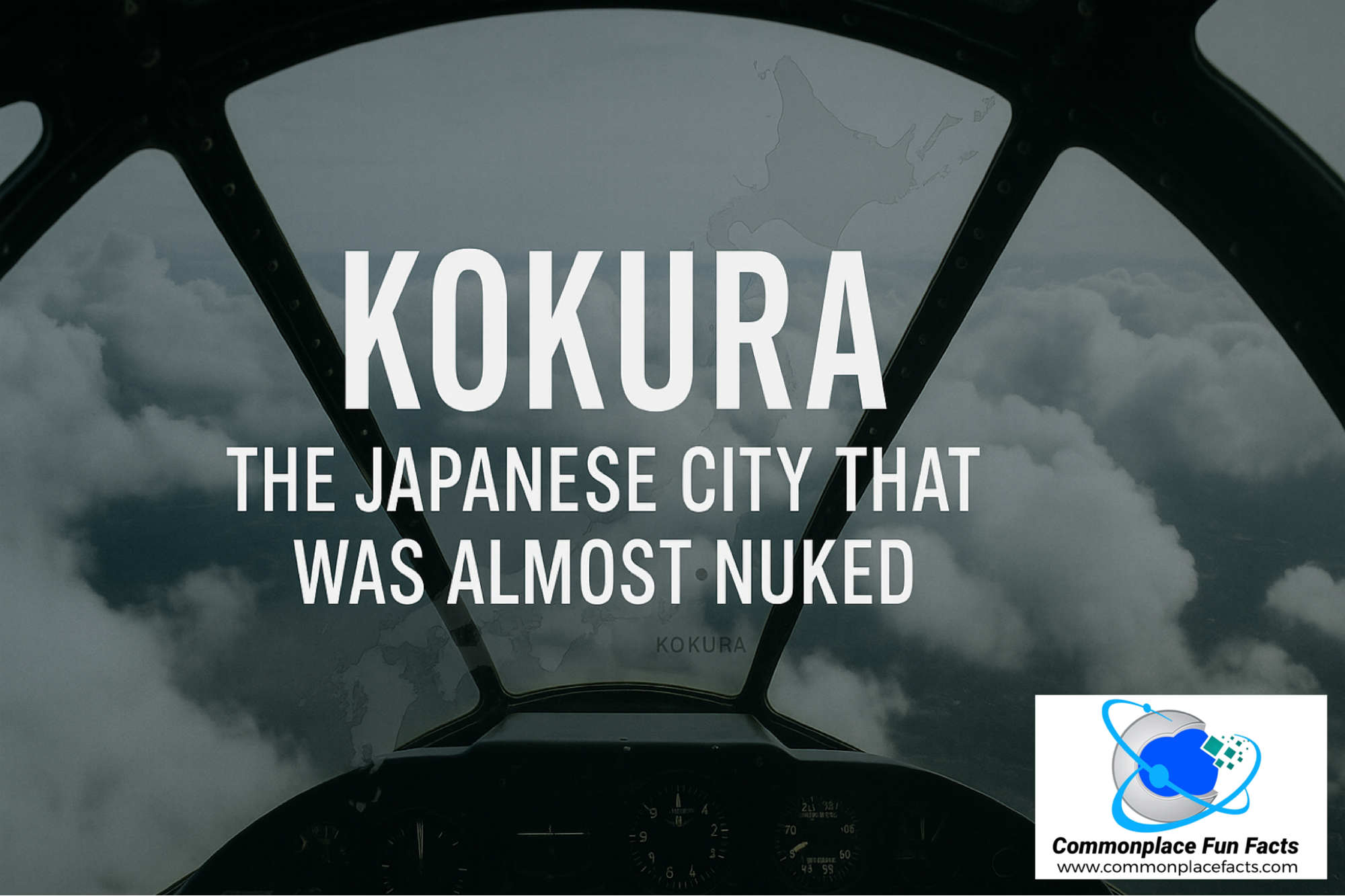

History loves a clean story. One decision, one dramatic speech, one hero moment, one neat ending where the camera pulls back and the credits roll. Unfortunately, history is usually less “screenplay” and more “group project,” with a supporting cast of fog banks, malfunctioning equipment, and people making irreversible decisions while squinting through cloud cover.
If you want a single moment that captures that vibe, consider Kokura. Chances are it’s a city you may not have heard of, or at least one you’ve never had much reason to think about. You have, however, heard of Hiroshima and Nagasaki, names now permanently fused to radioactive mushroom clouds and the sobering dawn of the Nuclear Age. If the weather on August 9, 1945, had been even slightly more cooperative, it would be Kokura—rather than Nagasaki—whose name would forever carry that association.
If you live in Kokura, that’s not a comforting thought. It is, however, a very honest one.
Contents
The Target List: The World’s Most Chilling To-Do List
By the summer of 1945, American planners had a shortlist of potential targets for atomic bombs—cities chosen not because the universe has a poetic sense of symmetry, but because they offered the right mix of military and industrial value and the ability to “measure” the bomb’s effects. When you put it that way, it sounds exactly as clinical as it was.

Among the cities that appear in that conversation: Hiroshima, Kokura, Nagasaki, and Niigata. Kokura mattered because it was associated with major military industry. Niigata mattered because it was a port city with growing industrial importance. None of this was mystical. It was grimly practical.
Modern readers sometimes assume this list was destiny. It wasn’t. It was planning. Planning is what you do right before reality shows up and begins uninviting itself from your schedule.
Kokura: The City That Won a Lottery No One Wants to Enter
On August 9, 1945, the B-29 Bockscar took off carrying “Fat Man,” the plutonium implosion bomb. The primary target was Kokura. The secondary target was Nagasaki. This was not a vague suggestion. It was a checklist.
Then the mission began doing what missions often do: developing personality.

The aircraft had a fuel problem—an inoperative fuel-transfer pump that made part of its fuel supply unusable. The mission could still proceed, but it sharply limited how long the crew could circle and improvise. This is not ideal when you are trying to visually identify a city from altitude.
When the bomber reached Kokura, it found the city obscured by clouds and drifting smoke, much of it from earlier conventional bombing in the region. The crew made multiple passes, trying to get a clear visual fix on the aiming point. Visual targeting was required for this mission.
After repeated attempts and growing fuel concerns, the situation became brutally simple: they could not reliably see the target, and they could not afford to keep trying.
So they diverted to Nagasaki.
So why was Kokura not bombed? In the end, it missed out on being the second atomic bombing not because it was spared in mercy, not because someone changed their mind at the last second, but because weather and smoke turned the city into an unusable aiming problem on that particular morning.
Since then, “Kokura’s luck” (小倉の幸, Kokura no sachi) has become a Japanese idiom meaning to narrowly escape catastrophe without knowing it. It sounds almost pleasant, which is impressive given the circumstances.
Niigata: The Target That Was Always a “Maybe”
Niigata often appears in retellings of the atomic bomb story as the “next city on the list,” the place that would have been destroyed if the war had lasted just a little longer. That framing is tidy, ominous, and not quite right.
Niigata did appear in early discussions of potential targets, largely because it was a port city with oil facilities and growing industrial importance. On paper, it checked some of the same grim boxes as the other candidates. That much is true.
What tends to get lost is how weak Niigata’s position actually was once planning moved from abstract lists to real-world constraints. It was far from the launch bases, pushing aircraft range and fuel margins. Its weather was often poor. Its urban layout made it a less-than-ideal candidate for the kind of visual bombing the missions required. In short, it looked better in a memo than it did from 30,000 feet.
As the atomic campaign narrowed, Niigata quietly slid out of serious contention. Kokura and Nagasaki were closer, clearer, and more practical. Niigata remained technically imaginable, but not especially likely.
This matters because it reframes what “Niigata was next” really means. Niigata was not standing in line, nervously checking its watch. It was sitting in the waiting room, reading outdated magazines, while other cities were called ahead.
Niigata survived the war not because it narrowly escaped destruction at the last second, but because the combination of distance, weather, and practicality kept it from ever rising to the top of the list. The war ended before anyone needed to find out whether those obstacles would have been overcome.
Which is a different kind of luck than Kokura’s—and a useful reminder that not every historical “almost” was actually poised on the edge of happening.
The Part People Forget: None of This Was the Only Plan
The atomic bombings dominate how we remember the war’s end for obvious reasons. They are singular, horrifying, and historically decisive. But in 1945, planners were not waiting on a single lever to be pulled. They were preparing multiple endings at once.
One of those endings was called Operation Downfall.
Operation Downfall: The Ending Everyone Was Quietly Preparing For
The atomic bombings tend to dominate how we remember the end of World War II in the Pacific, which makes sense. They were unprecedented, terrifying, and definitive. But they were not the only ending American planners were preparing for. While the bomb was being built and tested, an entirely different conclusion to the war was being drafted, revised, and grimly refined.
That alternative ending was called Operation Downfall, and it assumed—quite reasonably, based on everything that had come before—that Japan might not surrender at all.

Downfall was not a single invasion but a two-stage plan of extraordinary scale, designed to force a conclusion by occupying Japan’s home islands directly. It was, in effect, the backup plan to end all backup plans.
The first phase, Operation Olympic, was scheduled for November 1, 1945. It envisioned massive amphibious landings on southern Kyushu, supported by forces staged through Okinawa. The goal was not to conquer Japan outright, but to seize airfields and territory that could support the second phase. Think of it less as “the invasion” and more as “preparing the invasion of the invasion.”
The second phase, Operation Coronet, was planned for the spring of 1946. This was the main event: landings near Tokyo on the Kanto Plain, aimed directly at Japan’s political and industrial heartland. Coronet assumed that Olympic had succeeded, that air superiority was firmly established, and that the war had somehow not already consumed everyone involved.
Together, Olympic and Coronet would have constituted the largest amphibious operation in human history. The scale was staggering: millions of Allied troops, thousands of ships, and an industrial mobilization that made Normandy look like a warm-up exercise.
Crucially, Japanese planners were not oblivious to this logic. They anticipated an invasion of Kyushu and prepared accordingly under their own defensive strategy. The expectation was not victory in the conventional sense, but inflicting such enormous casualties that the Allies would be forced to reconsider their demands. The strategy assumed mass mobilization, including civilians, and an acceptance of losses on a scale that is difficult to absorb even in retrospect.
This is where casualty estimates begin to appear in the historical record, and also where debates begin. The numbers varied wildly depending on assumptions, optimism, pessimism, and the particular moment someone was asked to make a projection. What matters is not the exact figures, but the shared understanding behind them: everyone involved expected the invasion to be catastrophic.
By the time Operation Downfall was being seriously planned, no one involved was under any illusion that an invasion of Japan would be cheap. American military estimates varied widely, but even the lower-end projections anticipated hundreds of thousands of Allied casualties, with some internal planning documents contemplating figures well over a million when wounded were included. Japanese losses were expected to be far higher. Japanese planners assumed that an invasion would mean national mobilization, including civilians, and accepted casualty levels that effectively blurred the line between military defense and societal collapse. Both sides were extrapolating from recent experience—Okinawa in particular—where fierce resistance, mass civilian deaths, and suicidal tactics produced casualty ratios that deeply alarmed Allied commanders. The disagreement was not over whether Downfall would be catastrophic, but over just how catastrophic it would be, and how long either side could endure it before something finally broke.
Downfall was not a plan anyone liked. It was a plan people prepared because their job required them to imagine what would happen if nothing else worked.
Seen in this light, the atomic bombings do not replace Operation Downfall so much as they erase it. They close off a future that had already been mapped, staffed, and scheduled. When Japan surrendered, Downfall did not end in cancellation—it ended in irrelevance.
Which is why Downfall belongs in the same conversation as Kokura and Niigata. It is the largest near-miss of them all: not a city spared by clouds or distance, but an entire invasion that never happened because history took a different turn first.
Conclusion: The Universe Is Run by Weather and Paperwork
It is tempting, looking back, to treat the end of World War II as a sequence of inevitabilities. The bombs were built, the targets were chosen, the war ended. The story feels cleaner that way, as though history itself had made up its mind and merely waited for the paperwork to catch up.
What Kokura, Niigata, and Operation Downfall reveal instead is something messier and far more human. Outcomes were not fixed. They were conditional. They depended on weather reports, fuel-transfer pumps, visibility requirements, flight ranges, and assumptions drawn from recent battles that had already horrified everyone involved.
Kokura did not become a byword for the Nuclear Age because clouds and smoke made it unseeable on a single morning. Niigata was never quite close enough, clear enough, or convenient enough to rise from theoretical target to immediate reality. Operation Downfall never happened because something else ended the war first, erasing an invasion that had already been planned down to calendars and unit assignments.
Even more disturbing is the possibility that the bombing of Hiroshima came about simply because someone mistranslated one word. (See “Was the Hiroshima Bombing the Disastrous Result of a Mistranslation?”)
None of this makes the story more comforting. If anything, it makes it more unsettling. The fate of cities, and possibly millions of lives, hinged not on grand moral clarity but on a series of practical constraints and last-resort plans colliding with circumstance.
History, it turns out, is not governed by destiny. It is governed by people doing their jobs under pressure, in imperfect conditions, with limited information, hoping—sometimes desperately—that the option they do not want to use will never be required.
Kokura is still there today because, for one critical stretch of time, the universe refused to cooperate. That may be the most honest explanation history ever offers.
You may also enjoy…

Was the Hiroshima Bombing the Disastrous Result of a Mistranslation?
A mistranslation during the Potsdam meetings in 1945 significantly impacted Japan’s response to Allied demands for surrender. Japanese Prime Minister Kantarō Suzuki’s ambiguous statement, using the word “mokusatsu,” was interpreted as contempt, leading the Allies to believe Japan rejected diplomacy. This misunderstanding contributed to the decision to drop the atomic bomb on Hiroshima.

Tsutomu Yamaguchi: The Man Who Survived Two Atomic Bombs
Tsutomu Yamaguchi: The Only Double Atomic Bomb Survivor Tsutomu Yamaguchi could tell you stories about being in the wrong place at the wrong time. He was working for Mitsubishi Heavy Industries, and on August 6, 1945 his work took him to the city of Hiroshima, Japan. At 8:15 a.m. the sky ignited with the explosion…

The Secret Disaster That Saved D-Day
Everyone knew the outcome of the war would be settled in Europe. For that to happen, it would require an invasion of unprecedented force. Over 7,000 ships and landing craft would have to transport nearly 200,000 men across the English Channel to storm the beaches of France. Although only a handful of people knew the…






Leave a Reply to ScottCancel reply