

The Hitler Diaries: The Story of a Misunderstood Monster?
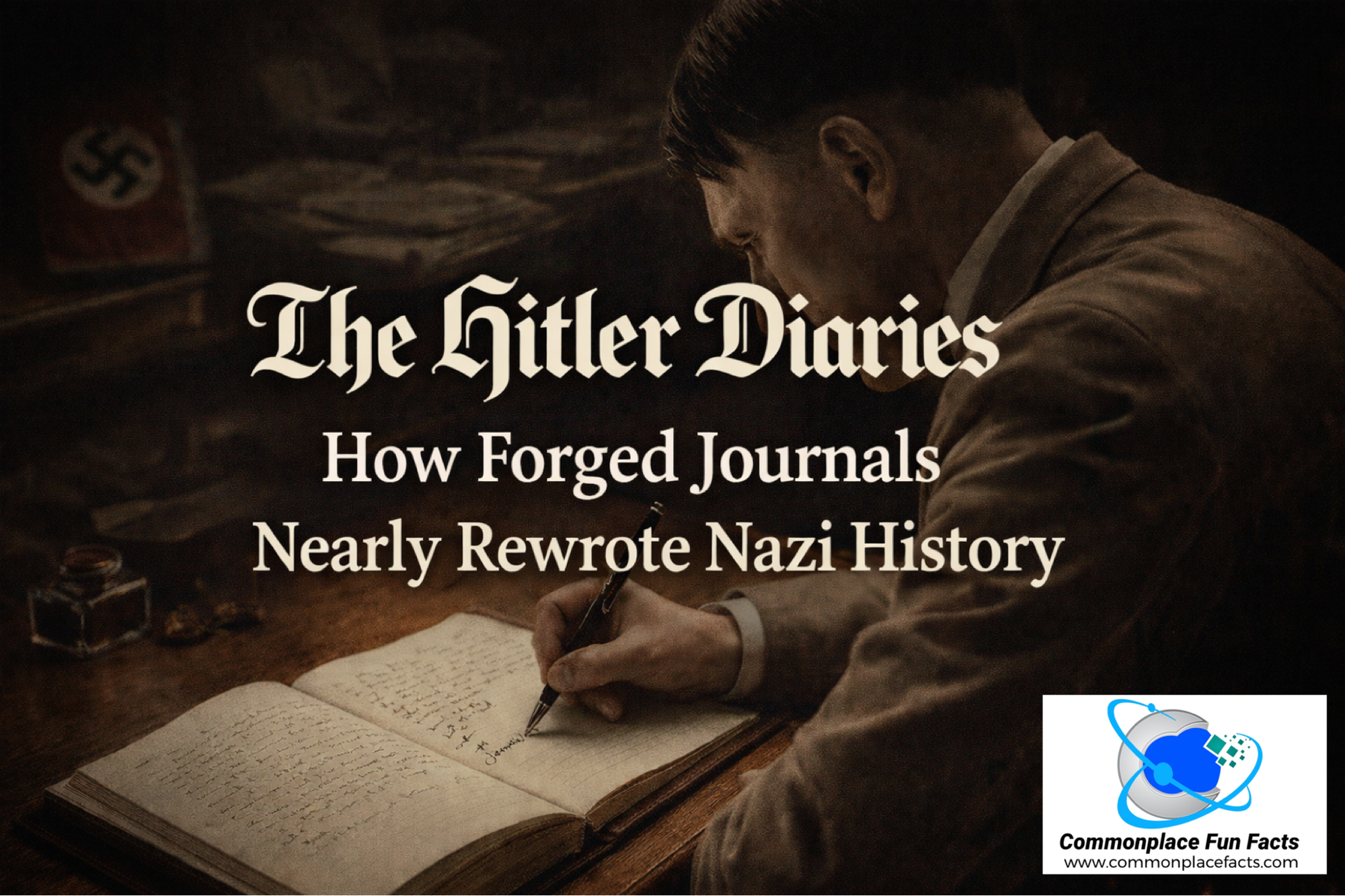
Picture Adolf Hitler alone at night. He is not doing what one might reasonably expect—sipping from a chalice of warm blood and reviewing his “How to Be Remembered as the Most Evil Person in History” checklist to see if anything needs tightening up. Instead, he is hunched over a desk, pen scratching across the page.
The world expects the usual—grandiosity, rage, opinions about racial superiority detectable from low Earth orbit—but instead he’s… emotionally torn. He laments anti-Semitic violence carried out “in his name.” He frets about Europe sliding into war too quickly. He complains about Eva Braun and relationship drama, as if the Führer has somehow wandered into the lead role of a very bad romance novel.
This, the world was told in 1983, was the real Hitler: a private, diary-confiding, sensitive soul trapped inside the body of a tragically misunderstood genocidal dictator.
It was a compelling image. It was also complete nonsense. If the Führer ever did keep such diaries, he took them with him, and they turned to ash as he was carried—without ceremony—into the deepest pit of hell.
The Hitler Diaries hoax is not interesting because it revealed something new about Hitler. History had already covered that ground thoroughly, in ink, blood, and fire. It is interesting because it revealed something uncomfortable about the people tasked with explaining him. Presented with a version of Hitler that felt complicated, marketable, and just different enough to justify a headline, editors and experts alike set skepticism gently to one side and told themselves they’d come back for it later. They did not. What followed was less a story about forgery than a demonstration of how efficiently a comforting lie can sprint past an inconvenient truth while the adults are busy admiring its packaging.
Contents
A Discovery Too Good to Question
In April 1983, the German magazine Stern announced that it had obtained dozens of handwritten diaries allegedly kept by Adolf Hitler. (Excerpts and scans of the “diaries” are available here.) These were not speeches, orders, or propaganda — the things Hitler actually left behind in industrial quantities. These were private journals. Intimate. Unguarded. Never meant for public view.

Which, historically speaking, is catnip.
Historians have a soft spot for diaries. They’re supposed to be where the mask comes off, where the author stops performing and starts thinking. A diary feels honest even when it isn’t, and that feeling alone can knock out skepticism faster than a free bar at an academic conference.
The origin story was suitably cinematic. The diaries had supposedly been pulled from the wreckage of a plane crash near the end of World War II, smuggled out of East Germany, and preserved in secrecy for decades. It was the kind of provenance that sounds thrilling if you’re in a hurry and implausible if you slow down long enough to ask follow-up questions — which, at that moment, no one was particularly eager to do.
Publishers rushed in. International newspapers secured rights to excerpts. Television crews warmed up their serious faces. This was framed not as a historical curiosity, but as a once-in-a-lifetime discovery that would force historians to rethink everything.
History, unfortunately, does not care how much you paid for exclusivity.
What the Diaries Claimed to Reveal
The contents of the diaries were, almost suspiciously, dramatic.
They portrayed Hitler as frequently exasperated by his own subordinates, irritated by displays of overt violence, and personally uneasy with some of the more visible expressions of anti-Jewish persecution. Kristallnacht, in particular, appeared not as a policy triumph but as an embarrassing mess that had gotten out of hand.
Quotes from the Hitler Diaries
- “The English are driving me crazy—should I let them escape [from Dunkirk], or not? How is this Churchill reacting?”
- “This man Bormann has become indispensable to me. If I had had five Bormanns, I would not be sitting here now [in the Berlin bunker].”
- “[Himmler is] living in another world—an ancient Germanic fantasy world. I’m beginning to think he’s out of his mind.”
- “How on earth does Stalin manage it? Always imagined that he had no officers left, but he did the right thing [in purging the officer corps]. A new command structure in the Wehrmacht is what we need, too.”
They also depicted a leader reluctant to go to war with Britain and France — a man who believed diplomacy had failed him, rather than the other way around. War, in this telling, was less a long-standing ideological goal and more an annoying scheduling conflict.
And then there were the personal notes. Health complaints. Mood swings. Domestic tensions involving Eva Braun. These passages did exactly what editors hope for and historians quietly dread: they made the subject feel textured. Complicated. Almost relatable, if you didn’t look too closely at the whole evil genocidal maniac part.
None of this exonerated Hitler, but it did something far more useful to the media ecosystem. It complicated him just enough to sustain endless commentary.
A monster who is simply monstrous is historically straightforward. A monster with private doubts can boost magazine circulation by 20%.
How Stern Got the Diaries (and What They Paid for Them)
Stern did not simply stumble across the Hitler Diaries lying around in an archive box. They were acquired the old-fashioned way: quietly, expensively, and with just enough secrecy to make everyone involved feel important.
The magazine worked through journalist Gerd Heidemann, who was introduced to the supposed source of the diaries via the shadowy world of Nazi memorabilia collectors. The story presented to Stern was that the diaries had survived the war after being recovered from a plane crash and then smuggled out of East Germany piece by piece. It was a provenance that relied heavily on gaps, urgency, and the assumption that no one would ask too many questions too loudly.
Stern proceeded to ask the one question that mattered most at the time: how much?
The answer was 9.3 million Deutsche Marks—approximately USD $3.6 million—a staggering sum in 1983, and not exactly small change today. This was not a casual expenditure. It was an institutional commitment, the kind that turns doubt into an inconvenience and skepticism into a threat to sunk costs.
Once that kind of money is on the table, the diaries stop being a hypothesis and start being an investment. And investments, as history repeatedly demonstrates, have a way of demanding belief long before they earn it.
Testing and Authenticity: How Not to Authenticate History
Of course, no one spends that kind of money unless they are sure they are buying the real deal, right?
One of the more darkly amusing aspects of the Hitler Diaries saga is how little actual testing occurred before the world was invited to gasp in unison. The early process was less “Is this real?” and more “Does this make a good headline?” which, in hindsight, is roughly equivalent to signing for a mysterious package labeled Ancient Roman Gold and asking questions later.
To be fair, Stern did attempt something that could loosely be described as verification. A handful of experts were consulted. A few pages were shown around. Opinions were solicited. Unfortunately, this was done in a way that prioritized speed and discretion over anything resembling rigor. In at least one case, an expert was asked to compare a diary page to handwriting samples that later turned out to be forgeries themselves.
This is not how authentication is supposed to work. This is how you convince yourself that something you already want to believe is probably fine.
The most famous endorsement came from historian Hugh Trevor-Roper, who initially concluded that the diaries were genuine. Almost immediately afterward—and notably at the press conference announcing the discovery—he reversed himself, publicly warning that the usual historical methods had been bypassed and that proper testing had not yet occurred.
This should have been the moment when everyone involved paused, took a breath, and convened another meeting to ask the question, “Are we sure about this?”
Instead, the machine kept moving.
History, unlike journalism, does not reward speed. It rewards waiting long enough to be correct.
A Small Problem With the Cover
Almost immediately, the diaries were found to have a problem. Several problems, actually, but one of them was visible before anyone bothered with microscopes.

On the front of the notebooks were the initials “FH.”
Not “AH.”
This was initially explained — with remarkable confidence — as a quirk of Gothic handwriting. Hitler, it was suggested, sometimes wrote his capital “A” in a way that looked like an “F.” This explanation works best if you do not test it against known examples of Gothic script, Hitler’s verified handwriting, or basic literacy.
In reality, Adolf Hitler was many things, but he was not confused about the first letter of his own name. In his authenticated correspondence, signatures, and marginal notes, he was remarkably consistent about that detail.
The real explanation turned out to be much simpler and much less romantic: the forger had purchased notebooks that were already embossed with decorative initials. Unfamiliar with the intricacies of Engravers Old English Font, he saw “FH” and thought it was “AH”. History, it turns out, can be derailed by office-supply constraints.
This should have ended the conversation immediately.
It was just the beginning.
How the Hoax Was Proven: Forensics, the World’s Least Funny Punchline
Once serious forensic testing began, the diaries collapsed with impressive efficiency. Not dramatically. Not tragically. Just… promptly.

This is the part of the story where romance gives way to paperwork. Ink can be tested. Paper can be tested. Adhesives can be tested. Manufacturing methods leave fingerprints, and the Third Reich did not have access to several of the very modern processes that had quietly wandered into the diaries’ construction.
Under laboratory scrutiny, the diaries began confessing immediately. The paper was wrong. The ink was wrong. The binding materials were wrong. Chemical markers appeared that did not exist in the 1930s or 1940s. Whatever these notebooks were, they were not wartime artifacts. They were recent objects wearing a costume.
The physical evidence betrayed the story with a level of enthusiasm rarely seen outside of courtroom dramas. The diaries did not fail in subtle ways. They failed in ways that could be demonstrated with microscopes, solvents, and a basic understanding of industrial history.
This wasn’t the first supposed Nazi document that was forged to change public opinion. Read “How a Forged Nazi Map Fooled Roosevelt and Helped Push America Toward WWII” for that story.
History, it turns out, is not written solely by the victors. It is also written by lab technicians with no interest in narrative momentum.
That was the final irony. The diaries had been treated like sacred texts until someone bothered to treat them like evidence. Evidence does not care about mystique, exclusivity agreements, or how much money has already changed hands. It asks one question and waits patiently for the answer.
The answer, in this case, arrived quickly.
What the Diaries Actually Were: Konrad Kujau and the Art of Selling People Their Favorite Lie
The diaries were forged by Konrad Kujau, a man who made money producing Nazi memorabilia for collectors—exactly the kind of ecosystem where authenticity is treated as a vibe rather than a fact. He did not need to create perfect historical artifacts. He needed to create artifacts that looked right at a glance and felt right to people who already wanted to believe.

Kujau produced modern notebooks, aged them, wrote in them, and crafted a persona around the documents. He was not a master historian. He was not a master chemist. He was, however, a gifted salesman.
He understood something profoundly important: the diaries did not need to be accurate. They needed to be plausible. They needed to say the kinds of things people could imagine Hitler saying in private—especially the kinds of things that would make the diaries feel revelatory.
That is also why, in hindsight, the diaries read suspiciously like a postwar defense of Hitler rather than the writings of Hitler in real time. They were fake documents created in a world that already knew the end of the story.
A real Hitler diary would not be written like someone afraid of how the History Channel will edit him.
How the World Got Duped (Not Because the Forgery Was Brilliant, But Because the Pitch Was Perfect)
The scandal did not happen in a vacuum. It happened in a media environment built for exclusives, competition, and speed. The diaries were a scoop that could be lost if you hesitated. That fact alone becomes a kind of psychological weapon. The pressure is never “be correct.” The pressure is “be first.”
The machine was moving. Once the machine moves, the human brain starts doing a strange thing: it treats momentum as evidence.
That is how a fake diary becomes “probably authentic.” Not because anyone proved it was real, but because so many people were acting like it must be.
Hitler did not fool anyone in 1983. A forger did. The press helped.
Fallout, Arrests, and the Trial That Became a Slapstick Comedy
Once the German government announced on television that the Hitler Diaries were forgeries, Konrad Kujau reacted with the calm rationality of an innocent man.
He immediately took his wife and his mistress to Austria.

To simplify logistics, he introduced the mistress to his wife as his cleaner, which is the sort of lie that tends to collapse faster than forged diaries with the wrong initials on the cover. A few days later, after seeing himself identified on the news as the forger—and learning, to his surprise, that Stern had paid roughly nine million Deutsche Marks for his handiwork—Kujau did what all confidence men eventually do: he phoned his lawyer, then phoned the Hamburg state prosecutor, and arranged to turn himself in at the Austrian–West German border.
We have been unable to determine whether he surrendered to authorities out of a delayed sense of moral responsibility or if he was trying to seek protection from his wife and mistress.
When police searched his house, they found several notebooks identical to those used in the diary fraud. This is what defense attorneys call “troubling.”
Kujau initially stuck to the same story he had told journalist Gerd Heidemann—that the diaries had come from shadowy East German sources—but his enthusiasm for the narrative waned rapidly once it became clear that Heidemann was still free and had kept a substantial portion of Stern’s money. After thirteen days in custody, Kujau abandoned subtlety and produced a full written confession, now claiming that Heidemann had known all along that the diaries were fake.
Heidemann was arrested that evening.
The investigation dragged on for over a year, and on August 21, 1984, the trial of Kujau and Heidemann finally opened in Hamburg. Both men were charged with defrauding Stern of 9.3 million Deutsche Marks. On paper, this was a serious criminal proceeding involving fraud, deception, and professional misconduct on an international scale.
In practice, it was something else entirely.
Observers quickly noted that the trial had the unmistakable energy of farce. One historian described it as a slapstick affair that managed to enrage the judge while amusing the rest of the world. The proceedings lasted until July 1985, and at times degenerated into open shouting matches between Kujau and Heidemann, each accusing the other of being the real villain of the story.
The atmosphere did not improve when one of the supporting magistrates overseeing the case had to be replaced after falling asleep during proceedings. Three days later, the court was treated to framed photographs of Idi Amin’s underwear, which Heidemann had apparently decided belonged on his wall. The judge was unimpressed. The gallery was delighted. Idi Amin, needless to say, offered no comment.
In the end, both men were convicted. Heidemann received a sentence of four years and eight months. Kujau received four years and six months. Judge Hans-Ulrich Schroeder noted, with barely concealed irritation, that Stern’s breathtaking negligence had persuaded him to soften the sentences. This is the judicial equivalent of saying, “I would be angrier if the adults in the room had been acting like adults.”
Heidemann was found guilty of stealing 1.7 million Deutsche Marks from Stern. Kujau was found guilty of receiving 1.5 million for producing the forgeries. And despite a lengthy investigation, a trial lasting nearly a year, and intense public scrutiny, at least five million Deutsche Marks simply vanished.
The money was never recovered. The diaries were conclusively fake. And the entire affair ended not with a grand moral reckoning, but with a judge, a sleeping magistrate, and a set of framed underpants quietly confirming what everyone already suspected.
History, it turned out, had been briefly rewritten—then immediately corrected—by people who were far less competent than they believed.
A Familiar Pattern: Dan Rather and the National Guard Documents
If the Hitler Diaries scandal feels uncomfortably familiar, that’s because it is. History did not retire this particular mistake after 1983. It merely updated the fonts.
Two decades later, in 2004, a strikingly similar drama played out in the United States when 60 Minutes II, anchored by Dan Rather, aired a report questioning George W. Bush’s service in the Texas Air National Guard. The story hinged on a small set of documents that appeared to show preferential treatment and pressure exerted on Bush during his military service.
Like the Hitler Diaries, these documents arrived bearing everything journalists are trained to find irresistible: apparent specificity, insider provenance, and the promise of settling a long-simmering historical argument just in time for a major political moment.
And, also like the Hitler Diaries, they fell apart almost immediately once people stopped admiring the story long enough to look closely at the paper.
In the National Guard case, amateur typographers and document analysts noticed something curious: the memos appeared to be produced using modern word-processing features—proportional spacing, kerning, superscripts—that closely matched Microsoft Word defaults. They looked less like 1970s military memos and more like something typed during a lunch break in 2004.
The comparison is not perfect, but the pattern repeats itself. In each case, journalists encountered documents that matched a story they already believed, and skepticism quietly stepped aside. The failure had nothing to do with ideology and everything to do with ignoring the most ordinary questions about how the documents could plausibly have been made.
Paper, ink, typefaces, formatting — the unglamorous mechanics of reality once again proved to be unforgiving critics.
The fallout was likewise familiar. CBS defended the story longer than it should have, circling the wagons around the narrative rather than the evidence. Dan Rather’s credibility suffered lasting damage, and the episode became shorthand for what happens when a newsroom falls in love with its conclusion before finishing the homework.
Why the Hitler Diaries Still Matter, Even Though They Are Trash
The forged diaries matter for the same reason counterfeit money matters: not because it is “real,” but because it reveals something real about the system that accepted it.
The hoax exposed how badly people wanted a new Hitler story—one with secrets and nuance and private vulnerability—because the public version of Hitler is almost too straightforward. The public version is uncomplicated evil. It leaves no room for intrigue. It leaves no space for the lazy comfort of “maybe it wasn’t exactly like that.”
The diaries offered that comfort. They offered an alternate Hitler: still authoritarian, still unpleasant, but somehow… less central to the worst crimes. Less enthusiastic. More conflicted.
That is not merely inaccurate. It is dangerous.
The Hitler Diaries remind us that forgery is not only about faking ink. It is about faking interpretation. It is about nudging the reader toward a story that benefits someone—financially, politically, emotionally.
In this case, the beneficiary was a forger who wanted money and a media ecosystem that wanted drama. The victim was truth.
Hitler, for once in his wretched life, was not the mastermind. He was the brand. Even in forgery, he served as a marketing tool.
Closing: The Diaries Were Fake. The Lesson Was Real.
The Hitler Diaries did not fail because they were badly forged. They failed because they were eventually tested. Until that moment, they succeeded brilliantly—not as historical documents, but as mirrors.
They reflected a version of history that powerful institutions found irresistible: a Hitler who was still vile, but intriguingly complicated; still responsible, but less central; still evil, but now equipped with inner turmoil and plausible deniability. It was not a new Hitler. It was a more marketable one.
The hoax worked because the conclusion came first. Once journalists and editors decided what the diaries must represent, the documents themselves were promoted from evidence to props. Skepticism was treated as an obstacle. Verification became a formality. Reality was invited to catch up later.
When reality finally arrived, it did so in the least glamorous way possible: with lab reports, microscopes, fonts, adhesives, and people whose job titles did not include the word “exclusive.” That is usually how these stories end. Not with a revelation, but with a correction.
The diaries are worthless as history. They are invaluable as a case study. They demonstrate how easily authority can be borrowed, how quickly momentum can masquerade as proof, and how eagerly institutions will accept evidence that confirms a story they already believe.
Hitler himself remains exactly where history has already placed him: a straightforward monster, exhaustively documented, requiring no secret notebooks to explain his crimes. The real cautionary tale belongs to everyone else—the editors, experts, and gatekeepers who briefly forgot that authenticity is not established by excitement.
The forged diaries promised to rewrite history. Instead, they reminded us of something far more useful: when a story feels too satisfying, too timely, and too perfectly aligned with what we want to believe, that is not the moment to lean in.
That is the moment to check the paper.
You may also enjoy…

The Donation of Constantine: How a Single Forged Letter Changed the Map of Europe
Discover the Donation of Constantine, the medieval forgery that shaped European politics for centuries, granting popes vast power until Renaissance scholars exposed the truth.

How a Forged Nazi Map Fooled Roosevelt and Helped Push America Toward WWII
In 1941, British intelligence created a forged Nazi map showing Hitler’s plans to divide South America—tricking Roosevelt into using it in a speech that helped sway U.S. opinion toward war. Discover how one fake map changed history.

The Great Moon Hoax of 1835: Two-Legged Beavers, Winged Moon Men, and One Seriously Salty Edgar Allan Poe
Explore the bizarre 1835 Great Moon Hoax that captivated readers with tales of lunar beavers and bat-men—and discover why Edgar Allan Poe thought it was all a rip-off of his own sci-fi satire.




Leave a Reply to cat9984Cancel reply