

The Christmas Truce of 1914: A Moment of Hope in a Time of Darkness
World War I was not supposed to last very long. When soldiers began lining up along the Western Front in September 1914, the prevailing wisdom—repeated often enough to sound reassuring—was that this would be a short, decisive affair. The men who marched off that summer and early fall were told, sometimes explicitly and sometimes through a shared national shrug, that they’d be home by Christmas. This was not so much a strategic forecast as it was a morale-preservation technique.
By December, that illusion had collapsed under the combined weight of trenches, mud, cold, and a war that had already settled into a grim routine of industrialized misery. The front lines had stopped moving, but the suffering had not. What was supposed to be a brief campaign had turned into a static endurance test conducted in knee-deep muck. The war was here, and it was not going away any time soon.
And then, briefly—and against all human logic and experience—it did.
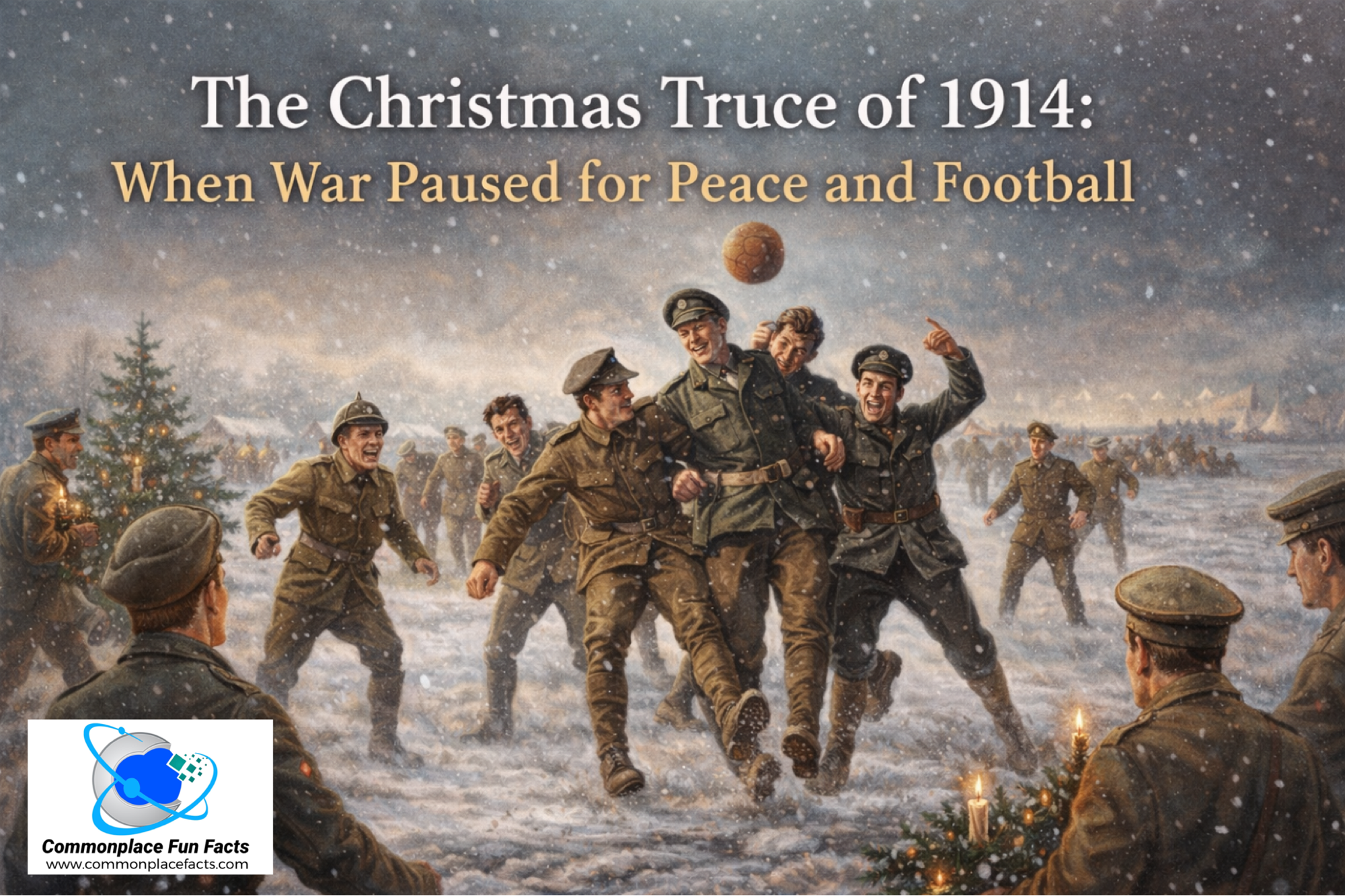
On Christmas Eve and Christmas Day of 1914, along portions of the Western Front, British and German soldiers did something that seems inconceivable to us and completely out of place on the field of war: they paused. They talked. They exchanged small gifts. In some places, they buried the dead together. In a few memorable spots, they kicked a football around in no man’s land—an area that, up until about five minutes earlier, had been reserved almost exclusively for dying.
This is the story of one of the most incredible moments of World War I — the Christmas Truce of 1914.
Contents
A War Built for Machines, Staffed by Boys
Calling these soldiers “men” is accurate in the way that calling a 19-year-old Second Lieutenant “sir” is accurate: technically correct, but missing the point. Many, if not most, were really boys—teenagers or at least in their early 20s—pulled out of schoolrooms, shops, farms, and factory floors and dropped into a landscape that looked like the moon but with more mud and worse weather.

War wasn’t natural to them. It had to be taught, drilled, reinforced, and then maintained by a steady supply of fear, discipline, and propaganda. Friendly competition, on the other hand, required far less training. You didn’t need a manual to understand a kickabout, a race, a dare, or a contest to see who could throw a ball the farthest. Those instincts came factory-installed.
That matters, because the Christmas Truce makes a little more sense when you remember who was down there in the trenches: not a boardroom of hardened military strategists, but exhausted and frightened young people who, under normal circumstances, would have no greater conflict in their lives than arguing about girls, wages, football clubs, or whether their friend’s haircut was a crime against nature.
Trench Life and the Collapse of Illusions
By December 1914, the war had already gone badly sideways. In just a few months of fighting, the great powers had managed to rack up millions of casualties—killed, wounded, missing, or captured—without accomplishing anything resembling a decisive victory. The grand opening moves had dissolved into a muddy stalemate stretching from the North Sea to Switzerland. Trench lines sat close enough together that soldiers could hear their opponents coughing, swearing, and occasionally singing. The enemy, it turned out, sounded distressingly familiar—and that only made the situation more unsettling.
Life in the trenches was monotonous, exhausting, and deeply uncomfortable. Men (and again, many of them were barely that) spent their days repairing parapets, bailing water, and trying to stay warm enough to keep their fingers attached. Nights brought shellfire, patrols, and the unsettling awareness that the people trying to kill you were, more often than not, just as cold and tired as you were.
In quieter sectors, informal “live and let live” patterns sometimes developed. Not friendship, exactly—more like mutual avoidance of extra misery. Don’t provoke unnecessary retaliation. Don’t turn a bad day into a worse one just to prove you can. War, at ground level, often looked less like grand strategy and more like the relationship you had with your first college roommate: someone you didn’t choose, whose personality was just close enough to yours to guarantee friction, and with whom the unspoken goal was simply to keep the total homicide count on your permanent record comfortably below one.
When Christmas arrived, for one brief moment, the similarities suddenly mattered more than the friction.
“You No Shoot, We No Shoot”
Accounts vary by unit and location, but the general shape of events is clear. On Christmas Eve, German soldiers in some trenches decorated their positions with candles and small Christmas trees—Weihnachtsbäume sent from home. They sang carols. British troops, surprised and more than a little suspicious, eventually responded in kind.

The words may have sounded strange—“Stille Nacht, heilige Nacht”—but the melody couldn’t be mistaken. The British soldiers answered in kind: “Silent Night, Holy Night.” If the diplomats and generals couldn’t find a way to talk to one another, the men in the trenches could at least manage to sing together.
What happened next shouldn’t have happened at all. There was no formal truce, no written agreement, and no parliamentary vote by any national authority. No official signal—just voices in the dark, followed by cautious gestures once it became clear that no one was shooting. Then came relieved and slightly uncomfortable laughter. Greetings. Jokes. Tentative offers. Promises not to shoot. Gradually, carefully, soldiers climbed out of their trenches. Hands were shaken. Cigarettes and food were exchanged. Someone produced a camera. Someone else produced alcohol, which has a long and distinguished history of either escalating conflict or accelerating trust-building exercises. Fortunately, in this case, it was the latter.
The most remarkable part is not that it happened everywhere—it didn’t—but that it happened at all. There were no orders authorizing it. In fact, there were plenty forbidding it. This was an unofficial ceasefire, assembled out of boredom, exhaustion, holiday sentiment, and a shared recognition that everyone involved was trapped in the same appalling situation.
No Man’s Land Turns Into a Temporary Town Square
Once the ice was broken, the activities were oddly ordinary. Soldiers swapped buttons, caps, tobacco, and small souvenirs. They showed one another photographs of families back home. In many areas, the truce was used to recover and bury bodies that had been lying between the lines for weeks. Some services were conducted jointly, in a quiet that must have felt almost unreal after months of gunfire.
It’s hard to overstate how strange that must have been. The day before, no man’s land was a killing zone. On Christmas, in some places, it became a public space. A sad one, a muddy one, but still a place where people could stand upright without immediately being punished for it.
And then there was the football.
About That Football Match
Before we go any further, a brief linguistic clarification is in order. We’re going to call this game football, partly because that’s what the men involved called it, and partly because in December 1914 the United States had not yet entered the war and therefore had not yet won the global right to rename things according to its own preferences. For readers in the United States, this is the sport you would recognize as soccer—no pads, no huddles, and absolutely no commercial breaks. For the staff of Commonplace Fun Facts, it is simply “Sportsball,” yet another of those weird rituals all the popular kids were doing while we were recataloging our comic book collection.
With the terminology out of the way, we can address the most famous claim associated with the Christmas Truce. The image of a match in no man’s land has become the shorthand version of the entire event. Like many good stories, it’s both true and slightly over-tidied. In some places, soldiers did kick a ball around. What it probably wasn’t, in most cases, was a regulation match with lines, referees, and a final score fit for a trophy presentation.

It was more like what happens when a bunch of young people—cold, bored, and desperate for anything that feels normal—find a ball and an open space and immediately agree, without a vote, that this is now the most important thing happening on Earth.
War had to be reinforced. A kickabout did not. That’s one of the quiet truths behind the Christmas Truce: violence was imposed; play was familiar.
Not Universal, Not Approved, and Not Repeated
It’s tempting to turn the Christmas Truce into a sweeping morality play where the entire Western Front becomes a single choir and everyone goes home holding hands. That is not what happened. Not every unit participated. Some sectors remained violent. In a few places, men were killed on Christmas Day. The truce was patchy, local, and dependent on the personalities and circumstances of specific units.
Officers were often deeply uncomfortable with what was happening, concerned—correctly—that once you’ve shared cigarettes and laughter with someone, it becomes harder to aim at them with enthusiasm. High command learned from the experience. In later years, strict orders were issued against fraternization. Holiday shelling and raids were sometimes scheduled quite deliberately to prevent any repeat performance of goodwill.
In a grim bit of institutional logic, peaceful behavior was officially discouraged until peace could be achieved the traditional way—by completely destroying the other side.
The war would only grow more bitter as it went on. (Read “The Glorious Folly of the Battle of the Somme: A Million Casualties for Six Miles” to see just how bad it could get.) The conditions that made the truce possible—a new war, lingering illusions, and a still-intact sense of shared culture—would not survive the years that followed.
A Different Age Entirely
The Christmas Truce feels unimaginable today, and that’s probably accurate. It belonged to a different age, one where war was still transitioning from something that was more personal—commanded and fought by those who were actually on the battlefield—to something managed by remote and impersonal systems. It also belonged to a world that—while hardly gentle—still ran on certain assumptions about personal honor and mutual expectation that now sound like folklore.
If you want a vivid example of that “different age” feeling, consider the story we covered in our article about Robert Campbell, the British prisoner of war who was granted parole by the Germans to visit his ill mother back home—on his honor—and then returned to captivity as promised. That is the same moral universe out of which the Christmas Truce arose, and it faded almost as quickly once the truce itself came to an end.
The Christmas Truce arose out of that era. It wasn’t a formal treaty. It wasn’t diplomacy. It was exhausted young people discovering, in real time, that the enemy had the same face structure and the same problem with frostbite. It worked because enough individuals expected it to work and behaved accordingly, at least for a day.
What the Truce Teaches (If We’re Willing to Learn It)
The Christmas Truce did not end the war. It did not even meaningfully interrupt it. Within hours, the guns were firing again, and the machinery of conflict kept grinding forward. Many of the boys who shook hands in no man’s land would later be killed by artillery, machine guns, gas, or the simple bad luck of being in the wrong place when history decided it needed more bodies.

But for a brief moment, the machinery of war stopped—not because of strategy or politics, but because the people inside it made a different choice. They recognized one another as human beings. They traded gifts and jokes instead of bullets. They took a space built for death and used it, temporarily, for something like community.
There’s a lesson in that, and it isn’t “war is easy to stop” or “everyone just needs to play soccer.” It’s something quieter and more unsettling: maybe the most effective way to resolve conflicts is not through war, and not even through competitive contact sports, but through the recognition that we share more in common than we do differences. Maybe the better option is to put down the weapons—physical or verbal—drop the hostility, and do something that reminds us we’re on the same side of being alive.
History rarely offers perfect solutions. What it sometimes offers—usually without planning or approval—is a moment when people remember who they are supposed to be. On a cold Christmas in 1914, that moment took the shape of a muddy field, a borrowed ball, and a group of exhausted teenagers who discovered that, for a little while, joy came more easily than hatred. That may not be enough to stop a war, but it is very much in keeping with the spirit of Christmas and its promise of peace and goodwill to all.
Learn more about World War I at the National World War I Museum and Memorial.
You may also enjoy…

The SS Meredith Victory Christmas Miracle: How a Cargo Ship Pulled Off the Greatest Humanitarian Rescue in History
A ship built for fewer than 100 people rescued nearly 14,000 civilians during the Korean War. The Christmas miracle of the SS Meredith Victory and the lives it saved.

Robert Campbell: The POW Who Voluntarily Returned to Captivity
Read about World War I Captain Robert Campbell — a POW who was released from captivity so he could visit his sick mother and who promised he would return.

A Heartwarming Royal Christmas Story: When a Queen and Future King Got Stuck in the Snow
Discover the charming royal Christmas story of Queen Elizabeth and her son, King Charles III, stranded in the snow during a memorable holiday adventure.





Leave a Reply to Commonplace Fun FactsCancel reply