
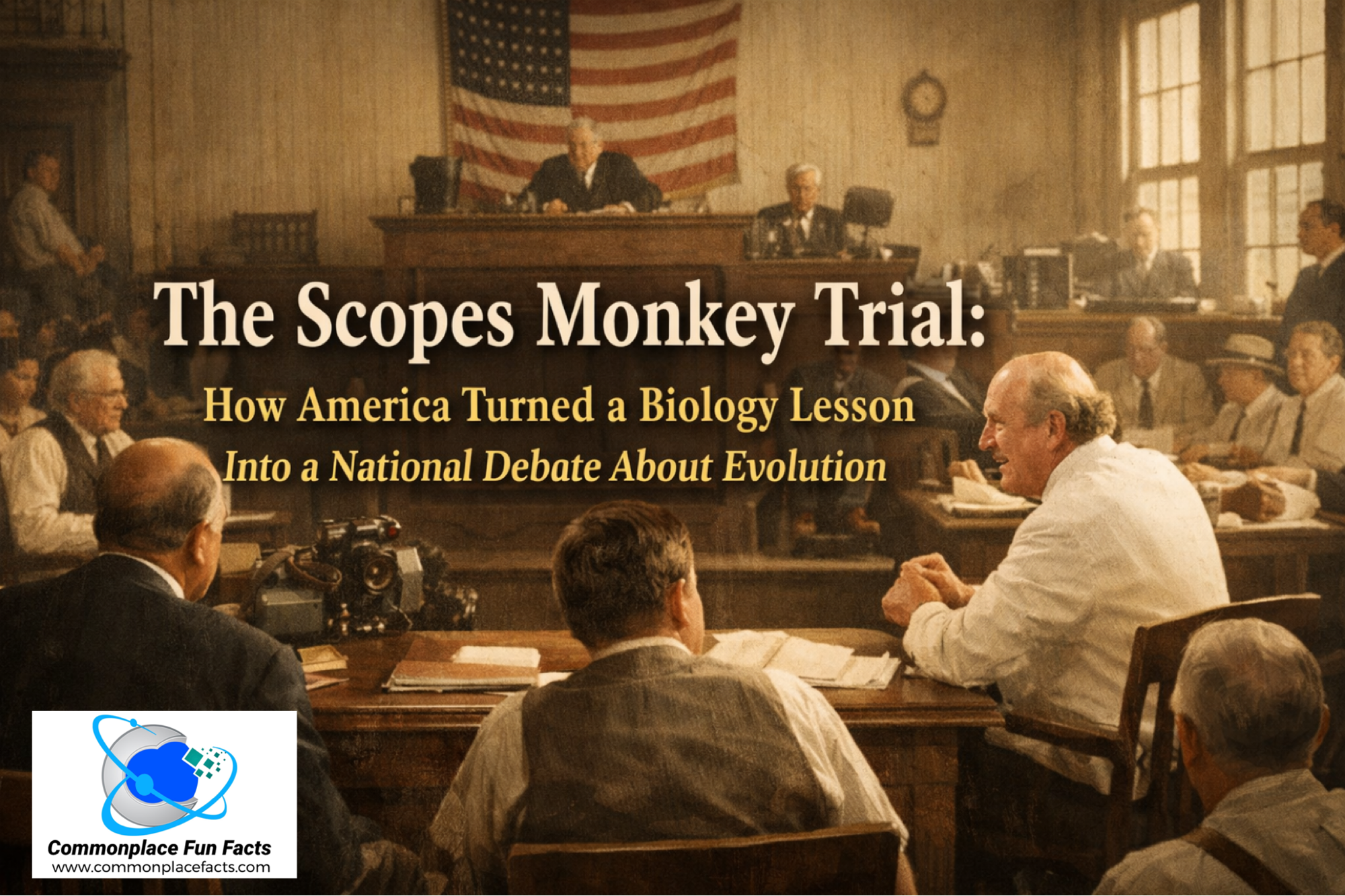

In July of 1925, the United States gathered around newspapers and radios as a small-town criminal prosecution took on an unexpectedly large symbolic weight. The formal charge was simple: a public school teacher was accused of violating a newly enacted state statute while teaching biology.
The implications, however, stretched far beyond one classroom in Dayton, Tennessee. The case drew in celebrity attorneys, thousands of spectators, and national media coverage usually reserved for wars, elections, and scandals involving people far wealthier than anyone present.
The result was the Scopes Monkey Trial—officially The State of Tennessee v. John Thomas Scopes—a case that became shorthand for debates about education, religion, science, democratic authority, and the role of the state in settling questions that were never going to stay confined to a statute book.
This is not a story with heroes and villains helpfully color-coded for easy identification. Nobody twirls a mustache, nobody single-handedly saves Western civilization, and nobody settles the argument once and for all. This is a guided tour of the Scopes Monkey Trial, the man and the competing ideas at the center of the controversy, how a deliberately chosen court case spiraled into a national spectacle, and why the version most people remember owes more to stage directions than to court transcripts.
Contents
The Law at the Center of the Storm: What the Butler Act Actually Did
The legal issue at the heart of the Scopes Trial was a statute passed by the Tennessee legislature in early 1925, commonly known as the Butler Act. (Read the full text of the law here.)
The law made it unlawful for teachers in publicly funded schools to teach “any theory that denies the story of the Divine Creation of man as taught in the Bible,” or to teach instead that humans descended from a lower order of animals.

This phrasing matters. The Butler Act did not prohibit all discussion of evolution as a scientific concept. It specifically targeted the teaching of human evolution in a way that contradicted the biblical creation account. Evolutionary processes involving plants and animals such as adaptation were not explicitly barred, nor was general discussion of scientific inquiry.
In practical terms, the law attempted to define a boundary: public school instruction could describe the biological development of life broadly, but could not present human origins in a manner inconsistent with a scriptural account of creation.
The penalty for violation was a fine of between $100 and $500 (about $1,850–$9,250 in 2025 dollars). There was no prison sentence and no provision for dismissing teachers from employment, though such consequences could follow indirectly.
The Butler Act reflected a legislative judgment that public education—funded by taxpayers and overseen by the state—should reflect certain widely held beliefs about human origins. Whether one agrees with that judgment or not, it followed a familiar principle: states regularly define curricular boundaries in public institutions, and those boundaries often reflect prevailing cultural, moral, or philosophical assumptions.
The law was enacted at a moment when textbooks, universities, churches, and public schools were all negotiating how modern scientific theories fit alongside longstanding religious teachings. Tennessee was not alone in addressing that question through legislation, but its statute soon became the most famous.
The Competing Ideas: What Was Actually in Dispute
The trial is often summarized as “science versus religion.” That serves as a convenient shorthand, but it’s really a very poor description.
The dispute was not over whether science mattered, nor whether religion belonged in private life. It was about how public education should handle theories of human origins, and who had the authority to decide what was taught to students.
On one side were supporters of evolutionary theory as it was being taught in early 20th-century biology textbooks. These materials described humans as part of a long biological continuum, shaped by natural processes shared with other forms of life. From this perspective, evolutionary theory represented a unifying scientific explanation grounded in observation, fossil evidence, and comparative biology.
On the other side were those who viewed biblical creation accounts as foundational not only to religious belief, but to moral, social, and philosophical understandings of humanity. For many, the concern was not that science existed, but that a particular account of human origins—taught in taxpayer-funded schools—conflicted with deeply held religious convictions.
Importantly, this was not a dispute between education and ignorance or ultimately about evolution or religion. Both sides believed education mattered deeply. They disagreed about what kind of education best served the public interest, how much authority science or scripture should hold in shaping civic instruction, and whether it was the family or the government that should be able to make the decisions about children’s education. This was not a new concept or conflict by any means. Read “Thomas Jefferson vs. the Department of Education: The Original Throwdown Over Who Gets to Teach the Kids” to see Thomas Jefferson’s concerns about centralized education policy and the danger of taking education decisions out of the hands of the local community.
The Butler Act represented one attempt—controversial even at the time—to draw a clear line. The trial that followed tested whether that line could be enforced.
John Scopes: How a Young Teacher Became a Test Case
John Scopes was not selected by fate or dragged unwillingly into history. He was identified, recruited, and agreed to serve as a defendant in what everyone involved understood would be a test case.

Scopes was 24 years old and taught at Rhea County High School in Dayton, Tennessee. His primary subjects were mathematics and physics, though he occasionally filled in for biology classes. He was popular with students and well liked in the community.
The key factor was the textbook.
Tennessee required public schools to use a state-approved biology text, Civic Biology, which included material on evolution, including the evolution of humans. This placed teachers in an awkward position: the curriculum required a book that contained material restricted by a newly passed law.
Local leaders in Dayton noticed the problem almost immediately: the state required schools to use a biology textbook that discussed evolution, while the new law made teaching certain parts of that same material a criminal offense. That contradiction didn’t require outside provocation to be noticed—it was sitting right there in the curriculum.
As debate turned to whether the law would ever be tested in court, the community of Dayton emerged as a willing venue rather than a reluctant battleground. When legal organizations later expressed interest in finding an appropriate test case, local figures worked with John Scopes to create one. His role was not to dramatize a classroom dispute, but to place the statute itself squarely in front of a judge and jury.
Scopes later acknowledged that he could not say with certainty exactly how the contested material had been presented in his classroom or whether he had even mentioned the word “evolution.” Those details mattered less than the structure of the case. The trial was never meant to examine a particular lesson. It was meant to examine whether the law could be enforced at all.
Why Dayton Wanted the Trial
Dayton did not become the site of the Scopes Trial by accident.
The town’s leaders saw an opportunity. Hosting a nationally significant legal case would bring attention, visitors, and economic activity to a small community that otherwise rarely appeared in national news.
Dayton’s participation should not be confused with a monolithic stance on evolution or religion. The town contained a range of views. What united its leaders was the recognition that the Butler Act created a case that would be litigated somewhere, and Dayton was willing—eager, even—to provide the stage.
This combination of civic boosterism, legal strategy, and cultural debate ensured that the trial would be public from the outset.
The Attorneys: Why This Was Never a Quiet Case
By the time opening arguments began, the Scopes Monkey Trial had quietly assembled what amounted to a legal convention disguised as a misdemeanor prosecution. The defense team alone included Clarence Darrow, Dudley Field Malone, John Neal, Arthur Garfield Hays, and Frank McElwee. The prosecution, directed by politician Tom Stewart, featured Herbert Hicks and Sue K. Hicks, Wallace Haggard, and two father-and-son pairings: Ben McKenzie and his son J. Gordon McKenzie, and William Jennings Bryan and William Jennings Bryan Jr.

This made the courtroom crowded with experience, ambition, and résumés long enough to require folding. In practice, however, nearly all public attention collapsed onto two figures. Whatever the official team rosters may have said, the trial was always going to be understood—and remembered—as Clarence Darrow versus William Jennings Bryan. Everyone else was present, active, and professionally competent, but they operated in a courtroom where the spotlight had been permanently bolted to the floor.
The imbalance was not accidental. Darrow and Bryan were already national figures, accustomed to large audiences and larger ideas. Their presence ensured that a local test case about a state education law would be narrated as something much bigger. Even personal history crept into the margins: Bryan had once spoken at Scopes’s high school commencement and later recalled that the future defendant appeared to be laughing during the address—a detail that has endured less because it mattered legally than because it felt irresistibly symbolic.

Bryan was one of the best-known Americans of his era: a three-time presidential nominee, former Secretary of State, and leading voice in progressive politics and religious activism. He supported the Butler Act as an expression of democratic control over public education.
From Bryan’s perspective, the issue was not hostility toward science or evolution. It was about whether public schools should teach theories that conflicted with the religious convictions of a majority of citizens. He argued that voters, through their elected representatives, had the right to define educational boundaries.
The defense was led by Clarence Darrow, one of the most famous trial lawyers in the country and not a man known for cultivating softness. His courtroom reputation was matched by a personal style that leaned toward pointed understatement, best captured in his own line: “I have never killed a man, but I have read many obituaries with great pleasure.”
Darrow approached the case as a matter of intellectual freedom. He argued that scientific inquiry required the freedom to explore and teach theories without legal restriction. He was joined by an experienced legal team, ensuring that the trial would be as much a public debate as a courtroom proceeding.
The Trial Itself: Law, Climate, and Logistics
The trial took place in July, in Tennessee, without air conditioning. That fact alone should tell you a lot about the mood inside the packed courtroom.
The courthouse quickly proved inadequate for both the heat and the crowds. At one point, proceedings were moved outdoors to a raised platform, transforming a criminal trial into something resembling a civic forum—or a three-ring circus.
Reporters arrived from across the country. Vendors sold souvenirs. The trial was broadcast live on radio, allowing Americans to follow the proceedings in real time.
Legally, the prosecution focused narrowly on the question of whether Scopes had violated the statute. The defense sought to challenge the law’s validity and meaning.
The judge restricted expert testimony on scientific matters, ruling that the jury’s task was not to decide whether evolution was correct, but whether the statute had been violated.
The Exchange Everyone Remembers
If the Scopes Trial had ended without Clarence Darrow calling William Jennings Bryan to the witness stand, it would still be historically important. It would not, however, be remembered with anywhere near the same intensity. The moment Darrow asked Bryan to testify about the Bible, the trial stepped out of the narrow lane of statutory interpretation and into something closer to public seminar—part theology, part philosophy, part endurance contest.

First of all, calling one of the trial attorneys as a witness is not the sort of thing that happens every day. In fact, it is usually something judges work very hard to prevent. Courts generally frown on attorneys stepping out of their roles as advocates and into the witness chair, because it tangles up the basic structure of a trial. A lawyer is supposed to zealously represent the interests of the client, not become part of the evidence.
There are practical reasons for this aversion. An attorney who testifies risks confusing the jury about what is argument and what is sworn testimony. Opposing counsel is placed in the awkward position of cross-examining someone who is also directing the case. Judges, meanwhile, are forced to referee a situation in which the normal lines between witness, advocate, and authority start to blur in unhelpful ways.
For those reasons, courts typically forbid the practice unless there is no reasonable alternative—and even then, they approach it with visible discomfort. That makes Darrow’s decision to put William Jennings Bryan on the stand all the more remarkable. It was not a routine procedural move. It was an intentional disruption of the trial’s normal mechanics, undertaken with full awareness that it was likely to produce consequences far beyond whatever answers Bryan might give.
Having Bryan take the stand was not an evidentiary necessity. The judge had already made it clear that the jury’s job was not to determine whether evolution was accurate or whether the Bible was correct, but whether John Scopes had violated the statute. Darrow knew this. Bryan knew this. Everyone in the courtroom knew this. Which makes what followed less a legal maneuver than a deliberate act of framing.
Darrow’s decision to put Bryan on the stand was meant to expose how religious texts were interpreted, understood, and applied—and whether a literal reading could comfortably coexist with scientific education. Bryan agreed to testify, confident in his ability to defend his views and perhaps equally confident that declining would appear evasive.
The questioning began with apparently simple ground-clearing.
Darrow: “You have given considerable study to the Bible, haven’t you, Mr. Bryan?”
Bryan: “Yes, I have, for about fifty years.”
From there, Darrow moved methodically, asking whether Bryan believed the Bible to be literally true.
Darrow: “Do you believe that the first woman was Eve?”
Bryan: “Yes.”
Darrow: “Do you believe she was literally made from Adam’s rib?”
Bryan: “I do.”
At this point, the exchange still resembled a confirmation of orthodox belief, which was not especially shocking to anyone present. Darrow then shifted the focus—not to challenge belief directly, but to probe interpretation.
Darrow: “Do you believe the Earth was made in six days?”
Bryan: “Not six days of twenty-four hours.”
This answer mattered. Bryan explained that the “days” described in Genesis could represent long periods of time, not literal calendar days. He had made this argument before and did not see it as a concession.
Darrow pressed further.
Darrow: “Have you any idea how long the days were?”
Bryan: “No; I do not.”
The courtroom response was immediate. Reporters seized on the exchange, not because Bryan had contradicted himself, but because the moment illustrated something larger: even a committed defender of Biblical authority acknowledged room for interpretation.
The questioning moved across familiar territory—Jonah and the whale, Joshua stopping the sun, the age of the Earth. Each exchange followed a similar pattern. Darrow posed a literal reading; Bryan responded that some passages were metaphorical, or that human understanding could not fully grasp divine action.
At one point, the tone sharpened.
Darrow: “Do you think about the things you read in the Bible?”
Bryan: “I think about them as much as I need to.”

It was not a doctrinal collapse or a courtroom knockout. Bryan did not abandon his position. What unsettled observers was the contrast in styles. Darrow questioned like a skeptic insisting on definitions. Bryan answered like a preacher comfortable with mystery.
That contrast, rather than any single answer, drove the moment’s impact.
Legally, the testimony had no staying power. The following day, the judge ordered it struck from the record. The jury was instructed to disregard it entirely. From a procedural standpoint, it never happened.
From a cultural standpoint, it happened so thoroughly that it swallowed nearly everything else.
Newspapers across the country treated the exchange as the heart of the trial. Editorial cartoons exaggerated it. Later plays and films reimagined it. Over time, it hardened into myth, often recast as a decisive defeat rather than what it was: a public examination of how Americans thought about knowledge, authority, and interpretation.
What makes the episode endure is not that it resolved the issue—because it didn’t—but that it made visible a disagreement that could not easily be reduced to right answers or wrong ones. The law would continue to speak in statutes and opinions. The argument itself would continue elsewhere, largely unchanged, simply borrowing new vocabulary as the decades passed.
Read the full transcripts of the trial here.
The Verdict and Appeal
The Scopes Monkey Trial lasted eight days, running from July 10 to July 21, 1925. That includes jury selection, opening arguments, testimony, and the now-famous Darrow–Bryan exchange that largely eclipsed everything else that happened in the courtroom. When the case was finally submitted to the jury, deliberations took approximately nine minutes. The verdict was guilty, and John Scopes was fined $100 for violating the Butler Act.
The speed of the verdict was not especially surprising. By the time the jury received its instructions, the legal question had been narrowed to a single point: whether Scopes had taught material prohibited by the statute. Broader questions about science, religion, or educational philosophy were not part of what the jury had been asked to decide.
The case did not end there. Scopes appealed his conviction to the Tennessee Supreme Court, raising several issues, including whether the Butler Act was constitutionally valid. The court, however, disposed of the case on much narrower grounds.
In its decision, the Tennessee Supreme Court ruled that the trial judge had improperly imposed the fine. Under Tennessee law at the time, only a jury—not a judge—was authorized to assess a fine in a criminal case. Because the judge had set the amount himself, the conviction could not stand.
Importantly, the court declined to rule on the broader constitutional questions raised by the appeal. The Butler Act itself remained untouched and fully in force until its repeal in 1967.
As a result, the most famous legal challenge to the statute resolved very little as a matter of law. The conviction was erased, but the underlying restriction on teaching certain material in Tennessee public schools remained on the books for decades, surviving the trial that had been expected—by supporters and opponents alike—to test it directly.
What the Trial Did—and Did Not—Settle
The Scopes Trial did not resolve the debate over evolution in public education. It did not establish constitutional boundaries, and it did not end legislative involvement in curriculum decisions.
Those questions would be addressed later, through additional court cases and changing cultural norms.
The Butler Act was repealed in 1967. Supreme Court rulings in later decades further clarified the limits of state involvement in prescribing religious doctrine in public schools.
After the Gavel: What Became of Scopes, Bryan, and Darrow
For a trial that looms so large in American memory, its principal figures did not remain permanently locked in the roles assigned to them by history. Once the cameras left town and the court record closed, all three men moved on—unevenly, but decisively.
John Scopes left Dayton shortly after the trial concluded. He never returned to teaching high school biology, and he did not devote his life to litigating education policy or touring the lecture circuit as a symbol of anything in particular. Instead, he went to graduate school, earned a degree in geology, and spent most of his professional life working in the petroleum industry.
For decades, Scopes lived with a reputation that vastly exceeded his own involvement in the classroom dispute that started the case. He remained intermittently connected to discussions about the trial—giving interviews, reflecting on events—but he never framed his own life as a crusade cut short. The role history assigned him was larger, louder, and far more permanent than the one he ever sought.

William Jennings Bryan did not live long after the trial ended. He died just five days after the verdict, while still in Dayton. The proximity of his death to the trial ensured that the two events would be linked in public memory, often in ways that oversimplified both.
Bryan left behind a political and rhetorical legacy that was already vast before the Scopes Trial occurred. He remained convinced that his position during the case was sound and that the issues at stake extended well beyond the courtroom. Whatever the later cultural verdict, Bryan viewed the trial not as a personal defeat, but as one chapter in a long-standing argument about democracy, education, and belief.
Clarence Darrow, by contrast, had years left to practice law and reinforce his reputation as the country’s most prominent defender of unpopular positions. The Scopes Trial became one of the cases most closely associated with his name, but it did not define the remainder of his career.
Darrow continued to write, lecture, and take on controversial legal matters. He never softened his skepticism about organized belief systems, nor did he pretend the trial had resolved the questions it raised. Like much of his work, his involvement in Scopes was less about final answers than about forcing those answers into the open.
In the end, none of the three men remained frozen in 1925. One quietly rebuilt a private career, one exited life almost immediately, and one carried forward much as he had before. The trial that permanently linked their names did not permanently shape their futures—but it ensured that history would remember them together, long after they had stopped thinking about one another at all.
Inherit the Wind (1960): The Movie That Replaced the Trial
For most people, the Scopes Monkey Trial is not something they learned from a history book or a court opinion. It is something they absorbed from the 1960 film Inherit the Wind, usually encountered in a classroom where the teacher needed to fill some time and the VCR was already plugged in.
The film version cemented the trial in popular memory far more effectively than the play ever did. With big stars, crisp black-and-white cinematography, and dialogue polished to a theatrical shine, it offered viewers a version of events that felt authoritative, complete, and emotionally satisfying. Unfortunately, it was also very comfortable rearranging reality to achieve those goals.
The cast alone gives the movie an outsized gravitational pull. Spencer Tracy plays the defense attorney, Frederick March plays the prosecutor, and Gene Kelly appears as the newspaperman chronicling the circus. Kelly’s presence is always slightly disorienting, if only because he famously does not dance in the film. This has confused generations of viewers who kept waiting for the heat wave to be broken by a sudden cloudburst and an iconic umbrella routine.
Supporting roles are filled out by faces that later became television fixtures. Dick York appears as the schoolteacher on trial, years before he became widely recognizable as the original Darrin Stephens on I Dream of Jeannie. Harry Morgan plays the judge, decades before an entire generation would come to know him as Colonel Potter on M*A*S*H. For many viewers, it is these familiar faces—encountered out of sequence—that make the movie feel oddly authoritative, as though history itself had a repertory cast.
The characters, however, are not presented under their real names. Clarence Darrow becomes Henry Drummond. William Jennings Bryan becomes Matthew Harrison Brady. John Scopes becomes Bertram Cates. The town of Dayton is renamed Hillsboro. These changes were deliberate and legally cautious, but they also allowed the film to reshape personalities and motives without being tethered too tightly to the historical record. (Read “Why Do Movies Insist that Similarities to Real People Are Purely Coincidental?” for more about this phenomenon.)
Drummond, for example, is written as a solitary, almost weary champion of intellectual freedom, despite the fact that Darrow was part of a large defense team and fully aware of the strategic limitations of the case. Brady is portrayed as rigid, bombastic, and intellectually cornered by the end of the film, a portrayal that flattens a far more complicated figure into something closer to an archetype.
The movie also compresses events, heightens conflict, and frames the famous courtroom exchange as a kind of decisive intellectual reckoning. The impression left on viewers is that something fundamental was resolved in that room—that a verdict of history, if not law, had been delivered.
In reality, the trial resolved very little. The conviction was overturned on appeal for procedural reasons. The statute remained in effect. The broader constitutional questions were left unanswered. None of that provides a particularly satisfying third act, which explains why the film quietly ignores most of it.
This does not make Inherit the Wind a failure. It succeeds brilliantly as cinema. It clarifies conflict, sharpens dialogue, and gives audiences a version of events with clear stakes and emotional closure. What it does not do is preserve the untidy ambiguity of the actual Scopes Trial.
The result is that many people believe they remember the trial itself, when what they really remember is Spencer Tracy and Frederick March arguing in a courtroom that exists somewhere between history and screenplay. The real trial, meanwhile, continues to sit just offstage—less elegant, less conclusive, and much more resistant to tidy endings.
A Trial That Was Supposed to Be Small
The Scopes Monkey Trial was never intended to carry the weight later placed upon it. It began as a narrow test of a specific statute, aimed at answering a limited legal question about what could be taught in a Tennessee classroom. A teacher was charged. A jury was empaneled. A fine was imposed. On paper, it was a very tidy little case.
What followed was something else entirely.
Once the trial attracted national attention, it stopped behaving like a court case and started behaving like a stage. Every procedural limitation became a symbol. Every answer was treated as a manifesto. By the time the jury returned after nine minutes of deliberation, the legal outcome was almost beside the point. The argument had already escaped the room.
The appeal resolved the case without resolving much else. The law stayed. The conviction vanished. Everyone went home insisting the real issue had either been decisively settled or catastrophically mishandled, depending on where they stood. This is a remarkably common outcome when courts are asked to referee disagreements that predate the statute books and outlive them.
Over time, the Scopes Trial acquired a second life—cleaner, sharper, and far more confident than the original. Plays, films, and classroom screenings supplied the decisiveness reality lacked. Characters were streamlined. Motives clarified. Endings improved. The messier truth, full of procedural caution and unresolved tension, proved harder to remember.
What remains useful about the Scopes Monkey Trial is not that it picked a winner. It didn’t. It is that it exposed how quickly education policy becomes a stand-in for deeper questions about authority, belief, and who gets to decide what counts as knowledge. Nearly a century later, those arguments are still being conducted with great enthusiasm, even if the vocabulary has changed and the microphones are significantly better.
The Butler Act is long gone. The courtroom is quiet. The jury went home almost immediately. The debate, however, appears to have skipped recess.
You may also enjoy…

The Murder of William Desmond Taylor: Hollywood’s First Great Unsolved Scandal
Hollywood’s first great unsolved scandal: the 1922 murder of director William Desmond Taylor, the stars pulled into the mystery, and the clues that still refuse to behave.

The Three Stooges: America’s Favorite Violent Idiots
A hilarious deep dive into the history of The Three Stooges—Moe, Larry, Curly, and beyond—exploring their slapstick comedy, changing lineups, and enduring cultural legacy.

Henry Ford for President? The 1923 Movement That Almost Put an Automaker in the White House
Explore the 1923 movement to make Henry Ford president—how the auto magnate outpolled Warren Harding and why his unlikely campaign suddenly collapsed.



Leave a Reply to cat9984Cancel reply