
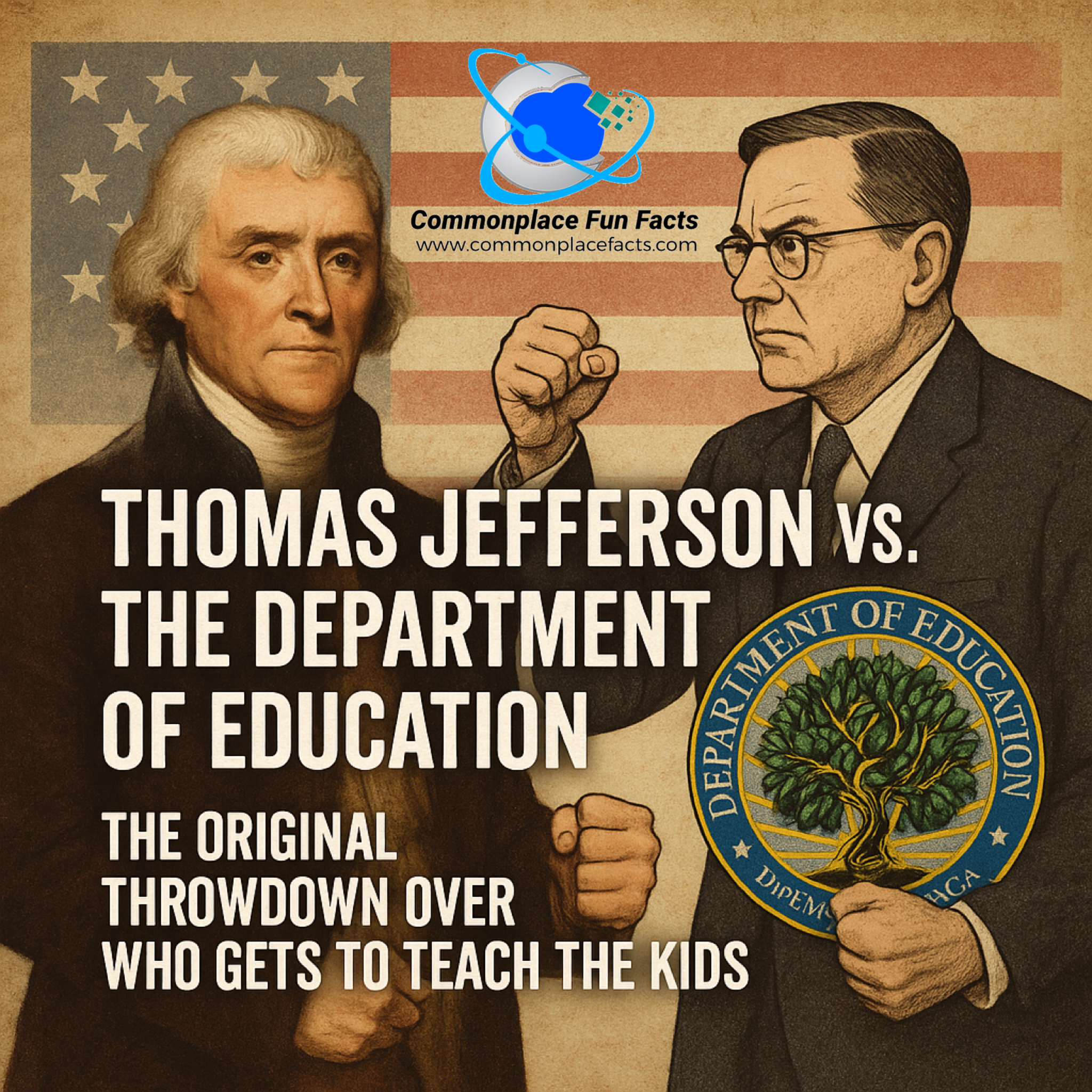

There’s a loud, messy, increasingly emotional debate raging across the country these days. It’s about public schools—specifically, who gets to decide what goes into kids’ heads once the bell rings. Should parents have a say in curriculum? Should local school boards bow to federal guidelines? And while we’re at it, should the Department of Education even exist, or should it be sent to that mythical land that supposedly exists where government programs go to die?
If you think this is a new phenomenon of the 21st-century culture war, guess again. Back in the late 1700s, Thomas Jefferson was already elbows-deep in this argument, long before X.com threads and school board shouting matches.
So let’s step back in time and see what Jefferson—America’s favorite wig-wearing Enlightenment junkie—had to say about education, liberty, and why the phrase “raked from the rubbish” was actually meant as a compliment.
Table of Contents
“Raking the Genius from the Rubbish” – Jefferson’s Educational Talent Show
Let’s rewind to 1776. While the rest of the colonies were busy declaring independence, dodging redcoats, and figuring out whether powdered wigs should be mandatory, Thomas Jefferson was in the Virginia House of Delegates doing what he did best: writing really long bills about big ideas. One of those ideas was revolutionary—literally. And no, we’re not talking about the Declaration of Independence, although that one gets all the fan mail. We’re talking about something Jefferson thought was even more important: a plan to overhaul education so thoroughly, it would’ve made Theodore Roosevelt’s plan to simplify the spelling of English words seem as trivial as switching up the color of the chalkboards.
Jefferson’s vision, drafted in a bill titled A Bill for the More General Diffusion of Knowledge (because he wasn’t into catchy titles), proposed dividing Virginia into bite-sized school districts, or “wards.” Each district would host a school teaching the basics: reading, writing, and arithmetic (no Common Core drama here). The idea was to make sure every child got three years of free education. Beyond that? Pay as you go. Unless, of course, you were a poor kid with exceptional brains.
As Jefferson explained in Notes on the State of Virginia, his plan was a genius-filtering funnel, designed to spot the brightest kids, no matter how empty their family’s coin purse might be:
“By this means twenty of the best geniuses will be raked from the rubbish annually, and be instructed, at the public expense, so far as the grammar schools go.”
So yes, Jefferson basically invented the academic Hunger Games—but with Latin verbs and long division instead of battle axes. These selected brainiacs would then proceed to grammar schools and, if they made the cut, to the hallowed halls of the College of William and Mary. Later in life, he swapped that out for his own creation: the University of Virginia, presumably because if you want something done right, you have to found a university and design the campus yourself.
Jefferson: Enlightened, Yes. Big Fan of Centralized Government? Not So Much.
Now, before you start thinking of Jefferson as the Founding Father of the modern public school system, slow your roll. While he believed education was essential for liberty—“If a nation expects to be ignorant and free… it expects what never was and never will be”—he was no fan of government micromanagement.
“To suppose that schools will be better managed by any authority of the government, than by the parents within each ward… is a belief against all experience.”
Translation: If you wouldn’t trust the government to run your farm or your corner store, why would you let them decide what your kids learn?

Jefferson envisioned a system that was very much decentralized. Local wards would call the shots. State governments? Thanks, but no thanks. And the federal government? Keep walking. He warned:
“What has destroyed liberty and the rights of man in every government which has ever existed under the sun? The generalizing and concentrating all cares and powers into one body…”
That one-body nightmare could be a czar in Russia, a monarch in France, or, heaven forbid, a school board with a state-wide or federal mandate. Jefferson preferred that the power stay with local parents who, unlike a bureaucrat hundreds of miles away, might actually know their kid’s name—and what they’re good at besides sticking gum under their desks.
Jefferson’s School Plan: Some Assembly (and a Local Vote) Required
In his later years, Jefferson made a few tweaks. By 1816, he decided that local voters should decide whether to establish a school at all. If they voted no? Well, let them live with the consequences:
“Put it to their vote whether they will have a school established… if they vote the proposition down, let them remain without one.”
That’s not indifference. That’s Jeffersonian tough love.
No to Compulsory Schooling, Yes to Literacy Tests for Voting
Modern public education leans hard on compulsory attendance. But Jefferson? He wasn’t on board. In fact, he asked aloud whether the state had the right to override parents on education decisions:
“Is it a right or a duty in society to take care of their infant Members in opposition to the will of the parent?”
His answer was blunt:
“It is better to tolerate the rare instance of a parent refusing to let his child be educated, than to shock the common feelings and ideas by the forcible transportation and education of the infant against the will of the father.”
Instead of mandatory schooling, Jefferson floated a more Enlightenment-approved motivator: no reading, no voting. Literacy, he argued, was a prerequisite for responsible citizenship. In 1814, he praised Spain’s new constitution for denying the vote to anyone who couldn’t read. And in America, he proposed a similar policy:
“Let every man who fights or pays exercise his just and equal right in their election, and let every man who reads be eligible for selection.”
The Mercer Mutiny and the Great Board of Education Rebellion
Jefferson’s fierce anti-centralization streak came to a head in 1817, when Charles Mercer proposed a statewide public school system… with a state board of education. Cue ominous music. Jefferson’s protégé, Joseph Cabell, cast the vote that killed Mercer’s plan dead in the Virginia Senate.
Jefferson’s Final Draft: No Free Rides Unless You’re Broke
Jefferson’s educational ideal evolved over time. Early on, he supported free elementary education for all (free) children. But by 1820, he made a fiscal pivot: Only paupers should get a free ride. Everyone else? Pay your tuition. Don’t worry, he did the math for us:
“To a county, this addition would be of about one-fifth of the taxes we now pay to the State, or about one-fifth of one per cent.”
Affordable? Yes. Government-run? Absolutely not.
Conclusion: Enlightenment With a Side of Local Control

Thomas Jefferson, for all his Enlightenment flair and talent for writing 3,000-word sentences, was not looking to build a national school system. He wanted smart citizens, not state-trained automatons. His educational vision wasn’t about molding minds into “republican machines,” but about empowering local communities to spot, support, and promote the best and brightest—without losing control to centralized authority.
In Jefferson’s world, liberty came not from bureaucracy but from books—and only if the school down the street was built with your vote, run by your neighbors, and funded without robbing the taxpayer blind. Call it DIY democracy with a chalkboard.
Today, the debate still rages. Should education be managed locally? By the state? By the feds? What do you think? Thinking, by the way, is something Jefferson certainly would have encouraged.
You may also enjoy…

Shakespeare’s Chair: How Adams and Jefferson Went on a Souvenir Hunt
Discover how John Adams and Thomas Jefferson found a souvenir from William Shakespeare’s chair. A story of diplomacy, history, and a bit of mischief!

Thomas Jefferson’s Moose Gift Was a Moot Point
When naturalist George-Louis Leclerc Buffon espoused his “theory of degeneracy,” he raised a few eyebrows and hurt the feelings of more than a few. His theory was that all species — including humans — living in the American colonies suffered because of the miserable conditions. As a result, all living things in the New World…

Reading, Writing, and Accordions: Education in North Korea
Due to its portability and ability to be carried during a march to a construction site or a “voluntary” day of hard labor in the fields, the accordion has been a favorite musical instrument for the people of North Korea. In fact, during the 1990s, all North Korean teachers were required to be able to…



Leave a Reply