
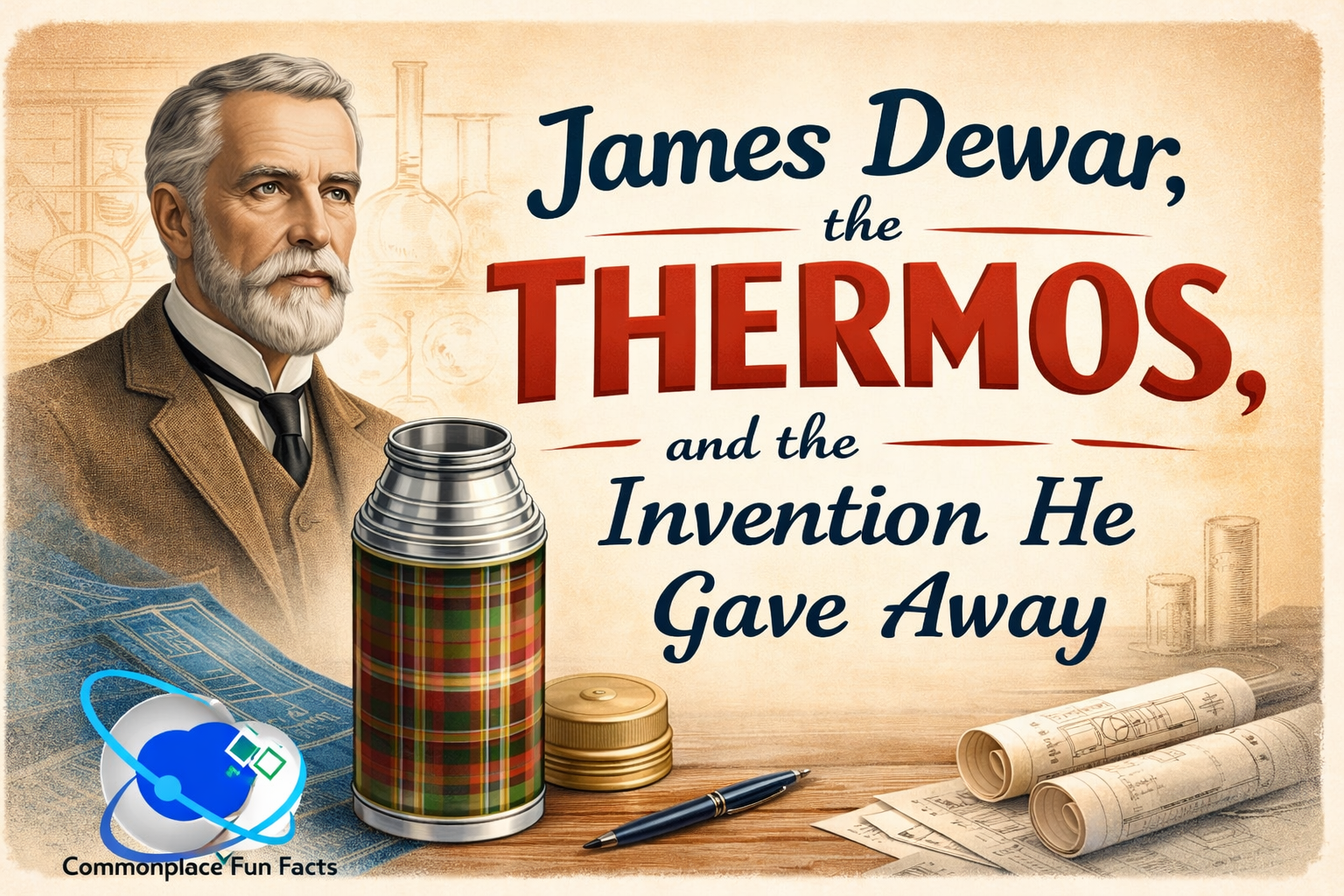

Every so often, history gives us a clean, satisfying morality play. A humble genius invents a miracle object. The miracle object changes the world. The genius is showered with wealth, acclaim, and a tasteful assortment of commemorative mugs.
This is not one of those stories.
This is the story of a man who invented the modern vacuum flask—the thing that keeps your coffee hot, your iced tea cold, and your road-trip sanity intact—and then watched other people make money off it after failing to patent it in time. It is also the story of how the word Thermos tried to remain a proud capital-T brand name and then, at least in the United States, got shoved into the linguistic gutter and forced to become a generic noun. And, because history loves irony, it’s a story of how the same gentle genius who keeps your soup hot also created a substance used to propel bullets, mortars, and other assorted instruments of destruction.
Welcome to the intriguing world of Sir James Dewar: a scientist who could keep cold things cold, hot things hot, and helped make explosives for the British Empire—all while history quietly handed the receipts to someone else.
Contents
Meet the Dewar Flask: A Laboratory Diva with Practical Side Effects
James Dewar was a Scottish chemist and physicist. In 1892 he developed what became known as the Dewar flask: a double-walled container with a vacuum between the walls, designed to reduce heat transfer. In plain English, it was a bottle so good at refusing to share heat with the outside world that it basically became the introvert of containers.

Dewar wasn’t trying to invent something for picnics. He was working with liquefied gases and cryogenic experiments—the sort of science where keeping things extremely cold and not allowing them to warm up is essential if you want to have a good day. The flask was made for research, not for camping dads and third-grade field trips.
He also didn’t patent it.
Those five words are a big deal. He didn’t skip the patent process because the patent office was closed for a plague week. He just… didn’t, and this omission would later become one of the more famous “whoops” moments in the history of intellectual property. The flask worked brilliantly, and because it worked brilliantly, other people immediately realized it could work brilliantly for money.
The Assistant (and the Casing): Reinhold Burger Turns Science into a Product
Enter Reinhold Burger. Burger was Dewar’s assistant and a skilled glassblower—meaning he was one of those crucial behind-the-scenes specialists who can turn a scientist’s idea into an actual physical object that doesn’t explode, leak, or fall apart when you look at it wrong.
Burger recognized something Dewar apparently did not: the lab flask had huge commercial potential if you made it less delicate, less laboratory-ish, and more “I want to carry soup on a train without scalding my pants.” Along with a partner, Albert Aschenbrenner, Burger developed a consumer-friendly version—essentially a vacuum flask protected by an outer casing so it could survive contact with normal human life.

And here’s the key difference between Dewar and Burger: Burger patented it.
The early 1900s saw patents secured for this domesticated vacuum flask concept (Thermos’ corporate history places this around 1903), and the product would soon be marketed under the name Thermos. Which, as brand names go, is extremely direct. “We are the hot-and-cold holding thing. Any questions?”
It would be neat if this were the part of the story where Dewar breezily waved away commercial concerns and returned to his laboratory, serenely indifferent to money. Reality, as usual, was messier. Once Burger and his partners began turning the vacuum flask into a successful consumer product, Dewar woke up to the fact that he created something lucrative. He attempted to assert his rights by suing. He lost. The courts were unmoved by the fact that he had invented the underlying concept. As we pointed out in “Who Invented the Telephone? The Messy Truth About Bell, His Rivals, and Impeccable Timing,” patent law is ruthlessly procedural and has little patience for being right too late. Dewar’s problem was not that he lacked genius or even indignation—it was that he had skipped the step where one actually files the paperwork. By the time he realized the invention had escaped the laboratory and entered the marketplace, the legal window had already closed.
Dewar’s Missed Fortune: The Most Academic Way to Lose Money
So Dewar invents a brilliantly useful technology. He does not patent it. His assistant and others patent commercial implementations and build a business around it. This is a scenario that makes intellectual property lawyers everywhere want to flood the airwaves with subliminal messages: “File the paperwork. File the paperwork. File the paperwork.”
Dewar certainly was not the first scientist to treat commercial value as an annoying distraction from real work. Many researchers have historically seen patents and profits as either vulgar or simply beside the point. Michael Faraday famously declined to patent his discoveries, reportedly bristling at the idea that science should be fenced in by ownership. Henri Becquerel never patented his work on radioactivity, leaving Marie and Pierre Curie to navigate its implications without legal protection. Even Nikola Tesla, who understood patents perfectly well, was notoriously cavalier about enforcing them, a habit that aged poorly once bills became due.
Unfortunately for Dewar, the market did not share his aesthetic sense. The market looked at the Dewar flask and said, “That would sell.”
And it did.
Thermos vs. thermos: The Brand Name That Became a Common Noun
Now we get to the part where language commits the ultimate corporate sin: it turns your brand name into a generic word.

“Thermos” wasn’t just a company name. It became the name in common speech for a vacuum flask. People said they were bringing “a thermos” the way they might say “a kleenex” or “a band-aid.” This is flattering in the way being immortalized is flattering—(unless your name is Shrapnel) right up until you realize it can destroy your trademark rights in some jurisdictions.
In the United States, this problem famously went to court. The gist, in plain terms, is that a brand can lose trademark protection if the public uses the brand name as the generic term for the product category. This is sometimes called genericide, which sounds like a metal band but is actually a legal nightmare.
In the Thermos case, courts concluded that “thermos” had become generic in the U.S.—meaning competitors could use the term descriptively to refer to vacuum flasks. Thermos could still use Thermos as part of its branding, but the word itself was no longer locked down as a uniquely owned label in American commerce.
That is the fate of many wildly successful brands. If your product becomes so iconic that people stop thinking of it as your brand and start thinking of it as the thing, you’ve succeeded in transforming the language, but you’ve failed at preserving the exclusive right to use that name. Congratulations, you won so hard that you lost.
A Note from the Commonplace Fun Facts Legal Office (affectionately known around here as the Office of Abandon All Hope, Ye Who Enter Here): To be clear: trademark outcomes vary by country and time period. The point is that the legal status of a product’s name can have a complicated afterlife, depending on the laws of a particular country.
Why Vacuum Flasks Work (Without Turning This into Physics Class)
Let’s briefly admire the basic genius of James Dewar’s invention, because it really is clever.

Heat moves from one place to another in a few main ways: conduction (direct contact), convection (movement of fluids like air), and radiation (infrared energy traveling through space). A vacuum flask attacks at least two of these at once. The vacuum between the walls eliminates most conduction and convection because there’s basically no matter there to transfer heat. Add reflective surfaces and you also cut down radiation.
The result is a container that can keep hot things hot and cold things cold far longer than any normal bottle has a right to. This is why your coffee stays hot during a winter commute and why your iced water stays cold while you pretend you enjoy hiking.
And Now, the Tonal Whiplash: Dewar Also Helped Invent Cordite
At this point you may feel like you understand James Dewar. He is the lab-coat guy who accidentally made your thermos possible and then declined to patent it. A mildly tragic, mildly funny lesson about missed opportunity.
Time for history to throw a chair.

Dewar wasn’t only involved in benign container technology. He also worked with Sir Frederick Abel on the development of cordite in 1889—a smokeless propellant used in ammunition. Cordite mattered because it represented a leap beyond older gunpowder-style propellants: it burned with far less smoke, which made it militarily useful and strategically important.
This means one man’s legacy includes both:
- A vessel that keeps your beverage at the desired temperature, and
- A chemical innovation that helped improve the business of firing projectiles at high speed.
Historians love to talk about the dual-use nature of science—how technologies developed for one purpose can be repurposed for others. Dewar gives us the reverse: one career producing inventions useful for both gentle domestic life and empire-scale weaponry. The same mind that helped make your soup stay warm also helped make the late 19th century a little more efficient at being the late 19th century.
So Who Deserves Credit for the Thermos?
This is where we do a little responsible historical bookkeeping.
Dewar invented the core concept: the double-walled vacuum flask used for insulating contents. That’s why the lab version still bears his name: the Dewar flask.
Burger and Aschenbrenner deserve credit for seeing commercial potential, developing a consumer-ready design (including protective casing), and navigating the patent and business world that Dewar apparently treated like an unpleasant dentist appointment.
And the Thermos brand—whatever you think about the capital-letter vs. generic noun drama—deserves credit for popularizing the product so thoroughly that “thermos” entered everyday speech.
If you want to be maximally fair, this is one of those stories where multiple people contributed to different layers of innovation: scientific invention, practical adaptation, and mass-market adoption. It’s a stack. The world runs on stacks.
The Moral of the Story (Besides “File the Paperwork”)
It’s tempting to turn this into a cautionary tale about patents and profits. Dewar didn’t patent his flask, and he didn’t benefit financially the way someone else did. In that sense, sure: protect your intellectual property.
But there’s another moral hiding in the foam of your coffee.
Dewar built something so useful that it escaped the laboratory and became part of daily life worldwide. That is a kind of success most people never get. The object became bigger than the inventor—so big that the brand name itself couldn’t stay proprietary, at least in the United States. When a thing becomes that ubiquitous, it stops belonging to one person in the cultural imagination, even if it once belonged to someone in a lab.
It’s also a reminder that history’s reward system is not moral. It is not fair. It is not even consistently logical. Sometimes the person who invents the thing doesn’t profit. Sometimes the person who markets the thing loses the right to the word for it. And sometimes the same scientist gives you both a thermos and cordite, because reality is weird and refuses to adhere to genre conventions.
So the next time you twist open a vacuum flask and release that tiny puff of temperature-controlled triumph, spare a thought for Sir James Dewar—brilliant, influential, and apparently the only man in history who looked at “invention that could change consumer life” and said, “Don’t bother me now; I’m busy.”
You may also enjoy…

Who Invented the Telephone? The Messy Truth About Bell, His Rivals, and Impeccable Timing
Who invented the telephone? A light-hearted deep dive into Bell, Gray, Meucci, patents, paperwork, and the messy reality behind a famous invention.

The Accidental Genius Behind Band-Aids: How One Clumsy Wife Helped Heal the World
Discover the heartwarming origin of Band-Aids—how a loving husband’s solution for his accident-prone wife became one of the most iconic medical inventions in history.

How the Microwave Oven Was Inspired By a Melted Candy Bar
Discover how a melted candy bar led to the surprising invention of the microwave oven.







Leave a Reply to cat9984Cancel reply