
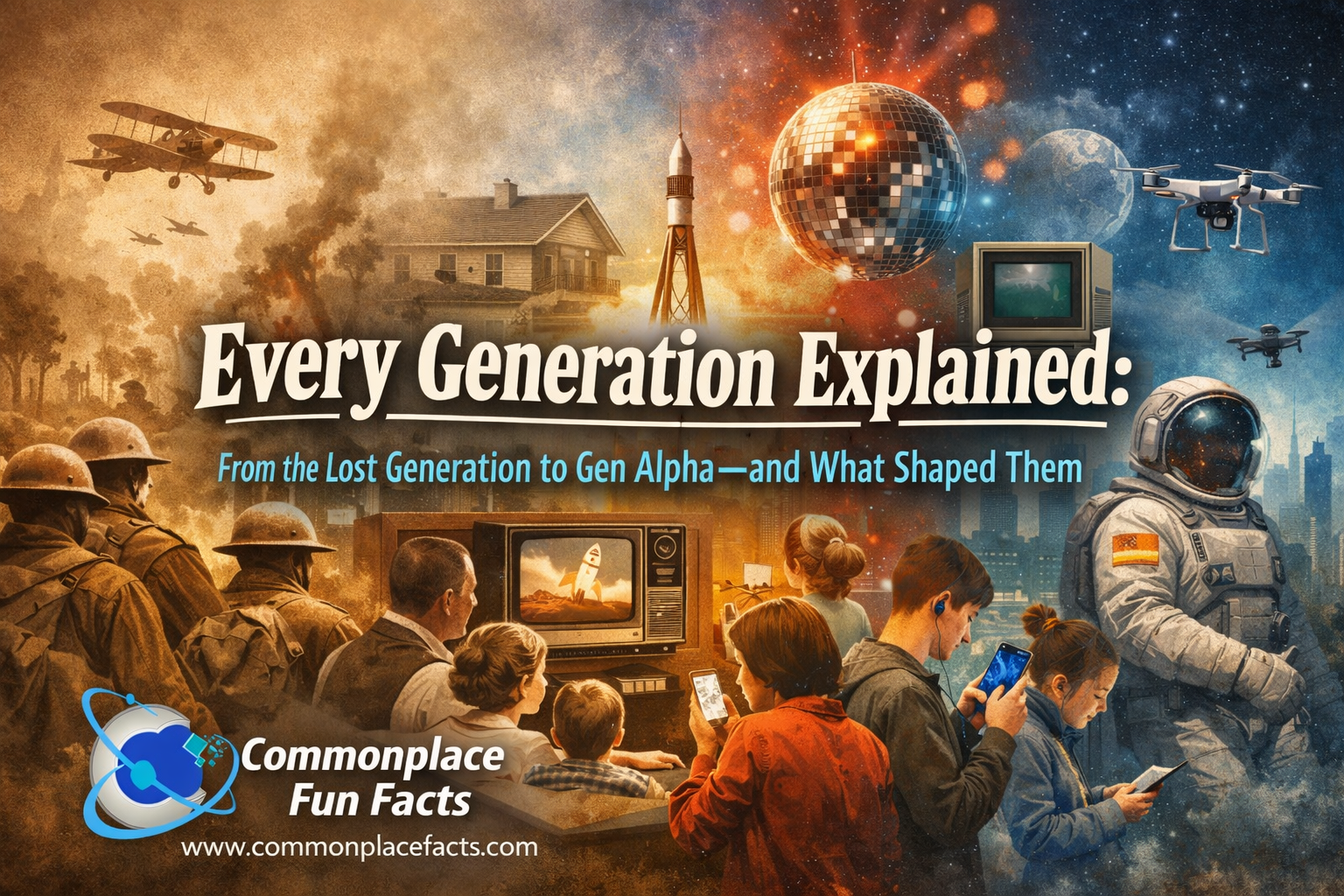

Every Generation Explained — Because Every Generation Thinks The Younger One Is Screwing Up
There are two eternal human truths.
First: everyone believes the people born after them are doing life wrong and need to learn some basic life lessons.
Second: everyone believes the people born before them had it easier, except for the parts where they didn’t, which we will acknowledge briefly and then immediately return to being annoyed about how hard things are for us.
For most of human history, this was handled the old-fashioned way: older people complained about younger people, younger people rolled their eyes, and everyone got on with the business of surviving winter, taxes, and whatever plague was trending that decade. Nobody needed a neat label. Nobody needed a birth-year bracket. Nobody stood up and said, “I’m sorry, but as a 14th-century Tuscan, I simply cannot relate to those late-1300s Florentines.”
And yet here we are, living in an era where you can’t buy a sandwich without somebody explaining that the way you hold your phone is “a generational thing.”
We have turned human beings into tidy demographic boxes, taped a label on each one, and then used those labels to explain everything from politics to parenting to why the office printer smells faintly of despair. It’s not entirely nonsense—shared historical experiences do shape people—but it’s also the kind of idea that gets dangerously confident very quickly. If you ever hear someone say, “All members of Generation _______ are like this,” you are hearing the opening line of a story that will probably end with a traumatic adventure involving walking to school through the Himalayas, barefoot, while foraging for food and developing character.
So: where did this habit come from? How far back does it go? And what are we really doing when we pretend millions of strangers share a personality because their mothers happened to be pregnant around the same time? Take a look at the generations in order, and see if the societal descriptions line up with your observations.
Contents
Before We Named Them: When “Kids These Days” Was Enough
People have always thought in “generations” in the literal sense—parents, children, grandchildren. But the modern practice of naming generations as big cultural cohorts is fairly recent. Ancient societies tracked time by rulers, wars, dynasties, famines, and religious eras. Nobody was out there carving “Millennial” into a stone tablet.
The shift happens when you get three things at once:
1) Massive shared events (industrialization, world wars, depressions) that hit enormous populations at the same time.
2) Mass media, which means people experience events together, talk about them together, and get shaped by the same soundtrack of headlines and propaganda.
3) Modern bureaucracy—censuses, demographics, economics, and marketing—because once you start counting people, the temptation to categorize them becomes overwhelming.
After World War I, writers and thinkers began treating age cohorts as something more than “young people” and “old people.” Not just different stages of life, but distinct groups formed by distinct historical forces. That idea gains momentum after World War II, when the birthrate does something so dramatic it practically demands a name. (If you were a government planning schools, housing, or anything at all, you didn’t need a philosophy seminar—you needed a calculator and a prayer.)
From there, the naming takes off. Journalists love it because it turns history into a story about characters. Sociologists love it because it turns mess into a model. Marketers love it because it turns individuality into a segment. And the rest of us love it because it provides a convenient explanation for why our cousin won’t stop posting photos of his lunch on social media.
The Lost Generation (Born Roughly 1883–1900)
The Lost Generation is one of the earliest modern “named” generations, and it didn’t come from a government report or a marketing firm. It came from writers. The label is tied to the post–World War I literary world—people who watched the old order crash into the trenches and came out the other side with a deep and permanent allergy to patriotic slogans.

These were men and women who grew up in a world still confident in progress, empire, and the general idea that civilization was improving. Then the Great War arrived and politely informed them that “progress” also includes machine guns, poison gas, and bureaucracy so powerful it can turn human beings into statistics without even breaking a sweat.
Commonly associated themes:
Defining moment: World War I and Prohibition.
Disillusionment. The sense that the old rules were either fake or dangerous.
Cynicism toward institutions. Not in the casual “ugh, politicians” way. In the more existential “the entire system is a paper costume worn by chaos” way.
Artistic experimentation. When your world stops making sense, you tend to stop writing like everything makes sense too.
Calling them “lost” can be misleading. They weren’t wandering around without a map. They knew exactly where they were. They just didn’t like it there.
The Greatest Generation (Born Roughly 1901–1927)
This is the generation shaped by two blunt instruments: the Great Depression and World War II. If the Lost Generation’s formative experience was watching ideals die, the Greatest Generation’s formative experience was watching scarcity move in and refuse to leave, followed by a global war that required mobilization on a scale hard to comprehend from the comfort of modern life.

They’re often described—later, with a kind of reverent nostalgia—as dutiful, stoic, disciplined, and community-minded. That’s not just sentimental storytelling. If you lived through the Depression, you learned quickly that stability is not guaranteed. If you lived through World War II, you learned that national events are not background noise. They can, in fact, walk into your kitchen and draft you.
Commonly associated traits:
Defining moments: Great Depression and World War II
Duty and sacrifice. Not as inspirational posters, but as basic expectations.
Institutional trust. When government and industry coordinate to win a war and rebuild afterward, you’re more likely to believe large systems can work.
Frugality. Sometimes praised as wisdom. Usually forged by circumstances (read “Cold Cash: What Three Winters of Financial Fear Taught a Generation” at In the Shadow of Yesterday to see how the institutional trust in government did not extend to trust in banks.
One important note: “Greatest Generation” is a name that gets applied after the fact, which means it comes with a built-in halo. It owes its nomenclature to Tom Brokaw’s book of the same name. Rarely does a generation get to choose its own name. History usually waits until you’re gone, then hands you a label based on what it feels like remembering you.
The Silent Generation (Born Roughly 1928–1945)
The Silent Generation is often described as cautious, conformist, and institutionally loyal—people who kept their heads down, played by the rules, and built stable lives inside stable systems.

And to be fair, if you spent your childhood watching the Depression and World War II play out, followed by the early Cold War and the general cultural message that saying the wrong thing could make your life very complicated, “staying quiet” starts to look less like a personality trait and more like an excellent survival strategy.
Their young adulthood played out in an era of strong social expectations: get a job, keep the job, behave, join the organization, don’t rock the boat, and for the love of all that is holy, do not embarrass the family in public.
Commonly associated traits:
Defining moments: Post-war boom and start of Cold War
Risk aversion. Which is what people call “wisdom” once they’re older and “fear” when they’re younger, depending on who’s judging.
Conformity and social cohesion. A premium placed on fitting in and keeping life orderly.
Loyalty to institutions. Companies, churches, civic groups—structures that promised stability and often delivered it.
They also get overshadowed in our modern storytelling. It’s hard to compete for attention between the epic narrative of World War II and the cultural fireworks of the 1960s. The Silent Generation tends to get remembered as the bridge between the “we sacrificed” era and the “we protested” era—quietly holding the bolts together while everyone else is writing the speeches.
Baby Boomers (Born Roughly 1946–1964)
Then comes the Baby Boom, which is less a generation and more a demographic event—the kind of population surge that makes planners sweat and baby food companies feel hope again.

These were children of the postwar world: a period marked (in broad strokes, with plenty of exceptions) by economic growth, expanding suburbs, increasing consumer culture, and the belief that tomorrow would probably be better than today. There were new highways, new appliances, and a strange national confidence that technology was not only helpful but morally upright.
And then, as Boomers hit adolescence and young adulthood, history walked in carrying a stack of disruptive paperwork: civil rights struggles, Vietnam, political assassinations, the Cold War’s permanent anxiety, and a cultural revolution that made previous social rules look suddenly negotiable.
This is where the stereotypes start to get loud and contradictory, because Boomers contain multitudes. They include the people who marched in protests and the people who wanted to stop the protests. They include the kids who grew up watching the Moon landing and the adults who later insisted the younger generations were “too sensitive.” They are, in other words, like every generation: a large group of individuals who are then summarized in headlines.
Commonly associated phenomena:
Defining moments: Vietnam, Civil Rights Movement, political assassinations, Moon landing
Postwar prosperity and expanding consumer culture. Not universal, but culturally dominant.
Mass television. A shared national narrative beamed into living rooms, creating common reference points on a scale previous generations didn’t have.
The 1960s as a turning point. Civil rights, cultural rebellion, and political trauma all folded into a single era that still sets the tone for arguments today.
Commonly associated traits (and why they’re complicated):
Optimism about progress. When you grow up in an era where living standards rise and institutions expand, it’s easier to believe the system is fixable.
Strong individualism. Partly cultural, partly economic—there was more room to imagine personal reinvention when the ladder felt climbable.
Comfort with hierarchy (later in life). Nothing tests your commitment to revolution like being handed a mortgage, a title, and a parking space with your name on it.
The Boomers are also the point where “generations” become a recurring public obsession. Once you’ve had one massive cohort reshape politics, culture, and consumer markets, the temptation is irresistible: you start watching the next cohort like it’s a sequel you’re determined to critique in real time.
And on cue, that’s when the next group arrives with a very different childhood, a very different relationship to institutions, and a default facial expression that can best be described as “politely unimpressed.”
Gen X (Born Roughly 1965–1980)
Gen X enters the story like someone who arrived early, discovered the snacks were gone, and decided not to make a fuss about it.

These were kids who grew up during economic uncertainty rather than expansion. They have memories of gas shortages, stagflation, and parents who seemed very concerned about bearing the sole responsibility of heating the entire neighborhood if the front door was left open. They may not have understood the nuances of economic shortages, but they grew up hearing that something was going on that prevented them from having every toy that was featured on Saturday morning cartoons. Many were latchkey children, not because their parents were cruel, but because two incomes were increasingly required and the cultural assumption had quietly shifted from “someone will be home” to “you’ll figure it out.” Divorce rates climbed, corporate loyalty weakened, and the Cold War and threat of nuclear annihilation loomed in the background like a permanent systems check that never quite resolved.
Gen X childhood was largely analog—bikes, landlines, television schedules you had to plan your life around—but adulthood arrived alongside personal computers, email, and the early internet. They are the hinge generation, fluent enough in technology to use it competently but old enough to remember when it wasn’t there, when it malfunctioned constantly, and how much it changed life.
Commonly associated traits:
Defining moments: Cold War, 1980s culture, emergence of personal computers
Skepticism toward authority. Institutions did not collapse dramatically; they downsized. Trust eroded quietly.
Self-reliance. Sometimes romanticized, sometimes simply required.
Irony and dark humor. When sincerity feels risky, humor becomes armor.
Pragmatism. Less “change the world,” more “how exactly is this supposed to work?”
Gen X is often overlooked in generational debates, largely because they did not insist on narrating themselves. They learned early that the safest path was to keep expectations manageable and backup plans plentiful.
Millennials (Born Roughly 1981–1996)
Millennials are the generation most people think they understand, despite repeated evidence to the contrary.

Millennials were raised during a period of relative optimism, encouraged toward education, collaboration, and self-expression, and then introduced to adulthood via 9/11, the Great Recession, and a labor market that treated stability as an optional add-on. They were also the first generation to fully integrate the internet into daily life, not as a novelty but as a basic operating system.
If Gen X learned not to trust institutions, Millennials were told to believe in them—right up until those institutions quietly failed to deliver on several large promises.
Commonly associated traits:
Defining moments: September 11 attacks, war on terror, Great Recession
High value placed on meaning. Work is expected to be more than survival. No real expectation that a job will be a long-term career.
Comfort with technology. Digital communication feels natural rather than disruptive.
Delayed milestones. Homeownership, marriage, and long-term job attachment arrive later, if at all.
Support for social equity and institutional reform. Not necessarily because of idealism alone, but because existing systems proved unreliable.
Millennials are often caricatured as entitled. A more accurate description is that they were given detailed instructions, followed them carefully, and then noticed the instructions had been printed on expired paper.
Generation Z (Born Roughly 1997–2012)
Generation Z is the first generation for whom the digital world is not an innovation but a baseline. They do not remember “going online.” They simply remember being online.

They grew up with smartphones, social media, and constant access to information, which also meant constant exposure to conflict, crisis, and curated perfection. Their adolescence unfolded against a background of political polarization, climate anxiety, and a pandemic that interrupted education and social development in ways still being understood.
Commonly associated traits:
Defining moments: COVID, online education, political extremism
High digital fluency. Technology is infrastructure, not entertainment.
High value placed on “Me” time. Work is viewed simply as something that has to be done to make it possible to do the truly important things.
Pragmatism. Lofty promises are met with immediate questions about feasibility.
Mental health awareness. Anxiety is discussed openly rather than hidden.
Fluid boundaries. Identity, careers, and relationships are viewed as adaptable rather than fixed.
Older generations sometimes describe Gen Z as fragile. Gen Z might argue they are simply realistic about the amount of incoming data they are expected to process before breakfast.
Generation Alpha (Born Roughly 2013–Present)
Generation Alpha exists primarily as a projection surface.

They are the children of algorithmic feeds, tablets, AI assistants, and parental panic articles written well in advance of actual evidence. Any confident statements about their personalities should be treated with caution and possibly a nap.
What can be said with confidence is that they are growing up in an environment where technology is deeply embedded, global culture is instantly accessible, and the pace of change is taken for granted rather than feared.
Every generation is accused of having a shorter attention span than the last. This accusation has been repeated for centuries and has never once stopped.
An Explanation for Nerds: Using Star Trek as Generational Sociology
If you have only the vaguest idea of what a Klingon is, why a warp core breach can ruin your day, or how Earth fits within the United Federation of Planets, you may want to skip to the next section. For the rest of you, here is a nerdy way that may help you grasp the generational differences by using Star Trek as a kind of cultural seismograph for generational change. This is very much a thing. It doesn’t cover every generation explained in this article. Not officially, not peer-reviewed in a lab coat sense, but absolutely in the “if you squint at it long enough, patterns emerge” sense. Which is, frankly, where most good cultural analysis lives.
Each major incarnation of Star Trek reflects the assumptions of the era that created it: what technology feels like, what authority looks like, what problems seem solvable, and what kinds of conflict feel urgent. The result is not a clean one-to-one mapping between shows and generations, but a remarkably consistent shift in emphasis as society’s relationship with progress changes.
The Original Series: Technology as a Miracle You Still Have to Explain
The original Star Trek arrives in the 1960s, when advanced technology is still something you marvel at. Computers fill rooms. Space travel is new. The Moon landing is either imminent or fresh in memory. The future feels fragile and astonishing.

Accordingly, the show spends a great deal of time explaining technology. The ship’s capabilities are impressive, and never taken for granted. The transporter is amazing. The computers are powerful but temperamental. A lot of plots revolve around technology breaking, being misused, or encountering something even stranger.
This fits neatly with a Greatest Generation / early Boomer worldview: technology is transformative, but dangerous; progress is real, but must be handled carefully by strong leadership. Captain authority is rarely questioned. Problems are often solved by cleverness, nerve, or a last-minute technical fix delivered with confidence.
The future is hopeful—but it still needs manual oversight.
The Next Generation: Technology as Infrastructure, Humans as the Variable
By the time The Next Generation arrives in the late 1980s, technology has faded into the background. Computers are everywhere. Automation is normal. The future is no longer about whether the machine works; it’s about how people behave once it does.
Replicators, holodecks, and near-limitless computational power are treated as mundane facts of life. Nobody stops the episode to explain how the ship functions. It just does. Instead, the drama moves inward: ethics, diplomacy, identity, trauma, and interpersonal relationships.
This is a profoundly Gen X moment.
The assumption is that the system exists and largely functions—but human judgment, trust, and moral reasoning are the weak points. Authority is still present, but it is negotiable. Captains deliberate. Officers debate. Conflicts are resolved through discussion as often as action.
Technology didn’t save us. It just gave us more complicated problems.
Later Series: Anxiety, Identity, and Systems Under Strain
As later iterations emerge, particularly those produced in the late 1990s and beyond, the tone shifts again. The universe becomes less stable. Institutions are questioned more aggressively. Characters wrestle with belonging, alienation, and competing loyalties.

This parallels Millennials and Gen Z sensibilities: high technological fluency paired with deep skepticism about the systems surrounding that technology. The question is no longer “Can we build this?” or even “How do we use this ethically?” but “Who controls it?” and “Who gets left out?” It’s much more about interpersonal relationships, rather than the technology and institutional structure that make the adventures possible.
Where earlier Star Trek assumed progress was linear, later versions worry it may be conditional—or reversible.
Why This Analogy Works (And Where It Breaks Down)
The reason Star Trek works as a generational illustration is not because the creators sat down with demographic charts. It’s because popular storytelling absorbs the unspoken assumptions of its time.
What feels worth explaining. What feels normal. What feels threatening. What feels fixable.
Those instincts shift as generations move through childhood, adulthood, and authority. Television doesn’t cause those shifts; it reflects them, often without realizing it.
The analogy breaks down if you push it too hard. Not every viewer of a given series belongs to the corresponding generation, and not every theme fits neatly into a box. But as a broad illustration of how cultural priorities evolve, it’s surprisingly effective.
The bridge of the Enterprise changes because the people imagining the future have changed. The stars stay the same. The concerns do not.
Which, in its own way, is a very generational problem.
Frequently Asked Questions About Generations (Asked by Everyone, Every Time)
Are these generational boundaries officially agreed upon?
No. Not even a little.
The birth-year ranges used for generations are approximations, not laws of nature. Different researchers, organizations, and writers shift them by a few years depending on what point they’re trying to make. Generations don’t begin at midnight on January 1, and babies born near the “cutoff” do not undergo an existential identity transformation.
If you are hovering between two generations and feel oddly detached from both, congratulations—you are experiencing statistical reality.
Are generational traits scientifically proven?
They are observed patterns, not diagnostic criteria.
Generational traits come from sociology, economics, and psychology, but they are broad tendencies drawn from large populations. They describe averages, not individuals. Using them to predict a specific person’s behavior is roughly as reliable as assuming everyone born under the same zodiac sign handles email the same way.
Why do different generations seem to disagree so much?
Because they grew up solving different problems.
Each generation responds to the economic, technological, and cultural pressures it encountered when young. Those solutions don’t always transfer well to new conditions. What looks like stubbornness is often an outdated survival strategy that once worked very well.
Is generational conflict worse now than in the past?
Probably not. It’s just louder.
Complaints about “the next generation” exist in ancient texts. The difference today is that social media, news cycles, and opinion columns ensure those complaints are broadcast constantly. Disagreement hasn’t intensified so much as it has been given a microphone.
Why do marketers and media obsess over generations?
Because it simplifies very large numbers of people.
Generations are convenient shorthand. They allow advertisers, commentators, and analysts to talk about behavior without addressing class, region, or individual context. This is efficient, but it also explains why the conclusions can feel reductive.
Is one generation objectively better than the others?
No. And also yes.
Each generation makes sense within its own historical circumstances and looks deeply confusing when removed from them. Most generational debates boil down to comparing survival strategies from different eras and deciding which one feels morally superior.
Will future historians think we got these generations wrong?
Almost certainly.
Generational labels age like milk. Over time, traits soften, contradictions become clearer, and narratives get rewritten. The generation you currently think is “ruining everything” will someday be remembered fondly for something you’re not noticing yet.
Does this mean generational analysis is useless?
Not at all.
Generational analysis is useful as a lens, not a verdict. It works best when it helps explain trends and worst when it is treated as a personality test. Think of it as a weather report for history: informative, incomplete, and never the full story.
What generation am I if I don’t identify with the one I was assigned?
You are a person.
Generational labels are descriptive tools, not identity mandates. If none of them feel quite right, that’s not a failure—it’s evidence that you have met more than five people in your life and encountered at least as many problems you have had to figure out.
History prefers clean categories. Humans rarely comply.
Why Generations Keep Fighting the Last War
Generational conflict follows a remarkably consistent pattern.
The older group believes the younger one is reckless, entitled, or misguided. The younger group believes the older one rigged the system, is too set in its ways, and refuses to admit it. Somewhere in the middle, someone is quietly trying to pay bills.
Each generation defines itself partly in reaction to the perceived failures of the previous one—while unknowingly inheriting many of the same constraints. Economic conditions change. Technologies change. Human behavior, frustratingly, does not adapt as fast as we would like.
This is why generational labels are both useful and misleading. They describe trends, not destinies. They flatten differences of class, geography, and culture into a single story that is easier to argue about than it is to prove.
Conclusion: Someday, They Will Blame You Too
Every generation is misunderstood in its youth, criticized in its prime, and gently romanticized once it becomes safely historical.
The Lost Generation was disillusioned. The Greatest Generation sacrificed. The Boomers transformed society and then argued about it for decades. Gen X rolled its eyes and figured out how to get the job done. Millennials asked why the instructions were incorrect and why no one asked how that made them feel. Gen Z asked why the system was on fire. Generation Alpha has not yet been asked anything, which should be enjoyed while it lasts.
Generational labels persist because they give us a story—a way to explain ourselves and our disagreements without admitting that history is messy and outcomes are uneven.
Eventually, your generation will be summarized in a paragraph by someone younger than you, and it will feel unfair.
This, too, is part of the tradition.
How well does your generation’s description describe you? What did we miss? Let us know in the comment section below or send us an email. Don’t worry—all of the staff are Gen X, Millennials, and Gen Z, so we know how to work that new-fangled electronic communication thingy.
You may also enjoy…

The Great Sea-Monkey Swindle: How Powdered Shrimp Fooled a Generation
Discover the bizarre true story of Harold von Braunhut, the man who sold Sea-Monkeys, X-Ray Specs, and a generation on powdered shrimp magic.

The Rise and Fall of Saturday Morning Cartoons: When Cereal, Toys, and Regulation Collided
Discover the rise and fall of Saturday morning cartoons—from cereal-fueled rituals and toy-driven plots to the regulations that pulled the plug. Relive the nostalgia and uncover the surprising history behind your favorite childhood shows.

The Glorious Folly of the Battle of the Somme: A Million Casualties for Six Miles
Discover the tragic absurdity of the Battle of the Somme, where over a million casualties gained just six miles of ground. A darkly humorous look at one of WWI’s deadliest—and most baffling—offensives.





Leave a Reply to sopantoothCancel reply