

For most of us, mornings begin with an alarm clock committing a small act of violence against the nervous system. A buzz. A beep. A noise specifically engineered to make you resent both technology and the concept of time. You flail, interact with the snooze button like a hostage negotiator, and eventually drag yourself upright, alive but unhappy.
On some mornings, you may feel as if your alarm clock was actively trying to kill you. Imagine that it actually does.
This is not hyperbole. This is not modern productivity rhetoric. This is the true story of Samuel Wardell, a 19th-century lamplighter from Flatbush, Brooklyn, whose alarm clock achieved what no smartphone alert ever has: it ended the morning problem permanently.
Contents
The Dark Art of Waking Up Before Modernity
Before electricity, caffeine delivery services, or the gentle tyranny of glowing rectangles on the nightstand, waking up on time was a logistical challenge. If you needed to be awake at a specific hour, you either trusted your body to cooperate—or you built something alarming enough to force compliance.
The earliest alarm clocks did not ease you into consciousness. They were blunt instruments. Bells rang. Levers tripped. Mechanisms clanged with all the subtlety of a blacksmith falling down the stairs. One early example only rang at a single fixed time: four in the morning. Not because four was special, but because that was when its inventor needed to get up. Everyone else could adjust their lives accordingly.
These weren’t consumer products so much as declarations of war on sleep. No snooze buttons. No customization. Just a promise: at this hour, you will wake up whether you want to or not.
When Ingenuity Meets Mild Recklessness

As people experimented with better ways to rouse themselves, creativity bloomed. Some devices used burning candles to trigger strings. Others employed falling weights or tilting mechanisms. The common theme was simple: gravity and noise are reliable, and human beings are not.
These devices were crude, but they were also clever. They worked quietly for hours, patiently waiting for the exact moment to intervene in your life. The goal was not comfort. The goal was compliance.
And then there were the people who looked at these inventions and thought, “Yes, but what if this were more… decisive?”
Enter Samuel Wardell, Professional Early Riser
Samuel Wardell was a lamplighter, which meant his job involved waking up before everyone else so that everyone else could stumble home safely later. Lamplighters worked odd hours and depended on strict schedules. Oversleeping was not an option. If you missed your shift, entire streets went dark.
Wardell solved this problem the same way many historically minded inventors did: by building a device that absolutely could not be ignored.

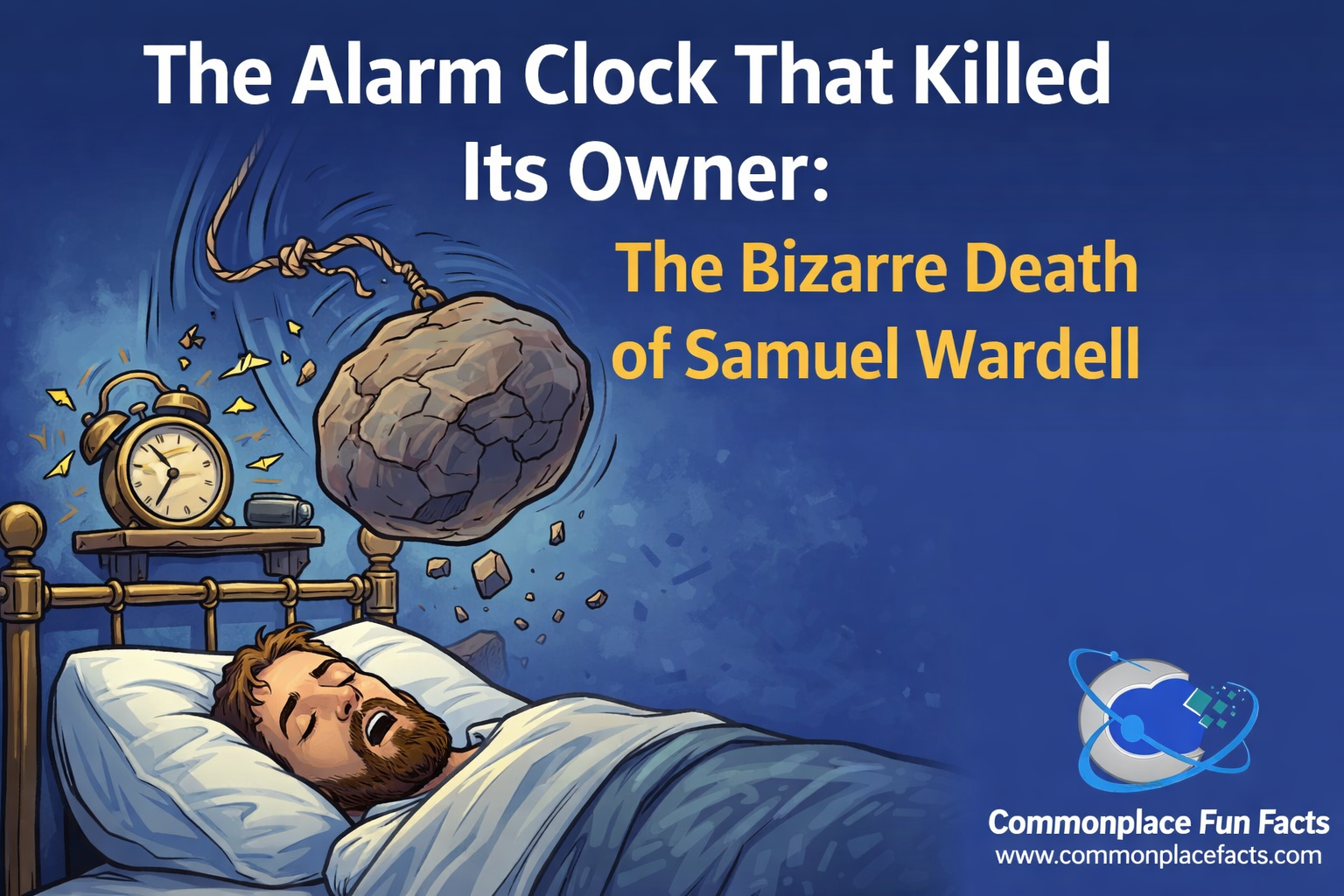
His solution was elegant in its simplicity and horrifying in its execution. He rigged his alarm clock to a cord, attached that cord to a ten-pound rock, and suspended the rock above where he slept. When the alarm triggered, the rock would be released. It would fall. It would crash onto the floor. The noise would wake him instantly.
This is the sort of invention that only makes sense in a world without safety regulations, warning labels, or anyone asking follow-up questions.
For a time, it worked.
And that is the most ominous sentence any historical anecdote can contain.
According to the January 8, 1886, edition of the Marion County Record, things took an alarming turn on Christmas Eve, 1885. Wardell hosted a party and rearranged the furniture in his room to accommodate guests. Chairs moved. Layouts shifted. The general geometry of danger changed. After the celebration, when things returned to quiet, Wardell forgot one crucial detail: he did not reset the position of his alarm apparatus.
The rock was no longer positioned to fall harmlessly to the floor.
The next morning, the clock rang. The mechanism released. Gravity, never one to hesitate, did the rest.
The alarm clock performed exactly as designed. Unfortunately, so did the rock.
Wardell did not wake up late that morning.
He did not wake up at all.
Alarm Clocks as Gadgets, and Gadgets as Tiny Menaces
Samuel Wardell’s alarm clock occupies a special place in the long and occasionally regrettable history of human invention: it worked perfectly while also being a terrible idea.

This is not unusual.
Alarm clocks have always attracted inventors who were a little too confident in their own judgment. Once you accept the premise that sleep itself is the enemy, many questionable design choices begin to look reasonable. Loud bells? Fine. Springs under mattresses? Sure. Machines that roll away screaming until you chase them? Disturbing, but defensible.
Wardell’s version simply pushed the logic to its extreme conclusion. Noise wakes people up. Falling objects make noise. Bigger falling objects make bigger noise. Therefore: gravity-powered menace.
In fairness, Wardell did not invent this idea in a vacuum. Falling-weight alarms had existed for centuries in gentler forms. Candle clocks tugged strings. Weights nudged sleepers. Wardell merely replaced “nudge” with “threat.”
The problem was not innovation. The problem was trusting yourself to remember, after a party, that a large rock was now suspended above your head.
The Morning Gravity Won
Accounts of Wardell’s death describe the aftermath in blunt terms: a fractured skull, an accidental release, and a mechanism behaving exactly as it was designed to behave.
No malice. No malfunction. No betrayal by the technology.
The clock rang. The rock fell. The lamplighter did not rise.
If this story feels absurd, it should. It is a perfect example of how humans often overengineer simple problems and then act surprised when physics refuses to negotiate. Gravity does not care that it’s Christmas morning. Gravity does not offer grace periods. Gravity does not read instruction manuals.
Wardell’s death was not the result of bad luck so much as excellent follow-through by natural law.
Why This Story Sticks
The reason Samuel Wardell keeps resurfacing in lists of strange deaths is not because his story is unique. It’s because it is painfully relatable.
Everyone has, at some point, trusted themselves to remember something important in the future and been deeply betrayed by that optimism. Everyone has set an alarm and forgotten why. Everyone has underestimated how efficiently their own bright ideas could turn on them.
Wardell’s story compresses all of that into a single, unforgettable moment. It is the ultimate reminder that if your solution to oversleeping involves heavy masonry, you may want to revisit the design phase.
A Small Catalog of Alarm Clock Aggression
Compared to Wardell’s device, most alarm clocks are remarkably benevolent. They merely irritate you. They do not attempt cranial reconstruction.

And yet, the lineage is clear. The four-in-the-morning-only alarm clock showed us early on that designers have never cared about user comfort. Candle alarms demonstrated that timing could be outsourced to combustion. Rolling alarms proved that humiliation is a valid motivational tool.
Wardell simply asked the unspoken question: what if waking up was not optional?
The Safer World We Now Enjoy
Modern alarm clocks use sounds, vibrations, and gentle increases in light. They do not use rocks. This is progress.
Phones may disrupt your sleep cycle and your sanity, but they rarely cause blunt-force trauma. Smart alarms may judge your sleep quality, but they do not punish you for hosting holiday gatherings.
In many ways, the greatest advance in alarm technology has not been precision or personalization. It has been restraint.
Lessons from a Lamplighter
Samuel Wardell set out to solve a real problem with the tools and knowledge available to him. He succeeded. Too well.
His story reminds us that invention is often a dialogue between ingenuity and caution—and that neglecting the second half of that conversation can have spectacular consequences.
So the next time your alarm clock goes off and ruins your morning, take a moment to appreciate what it is not doing. It is not releasing masonry. It is not testing gravity. It is not trying to kill you.
It is merely demanding that you wake up.
And thanks to Samuel Wardell, we know exactly how much worse that request could have been.
You may also enjoy…

Having Trouble Waking Up? Try A Weavers Larum
Learn how to make your own weavers larum, an ancient alarm system using a candle and a heavy object. Follow our simple, step-by-step guide to never oversleep again

The First Alarm Clock Only Rang at 4:00 A.M. — And It Changed How We Tell Time
In 1787, Levi Hutchins built the first alarm clock — but it could only ring at 4:00 a.m. Discover the quirky origins of the alarm clock, how it evolved from a single fixed-time bell to the customizable gadgets we rely on today, and what it says about humanity’s centuries-old war against sleep.

Expergefactor: Who Will Wake Up And Use This Word?
“Expergefactor.” Is it a super villain? A deadly game show? Find out the meaning of this fancy term that you encounter every single day.






Leave a Reply to sopantoothCancel reply