
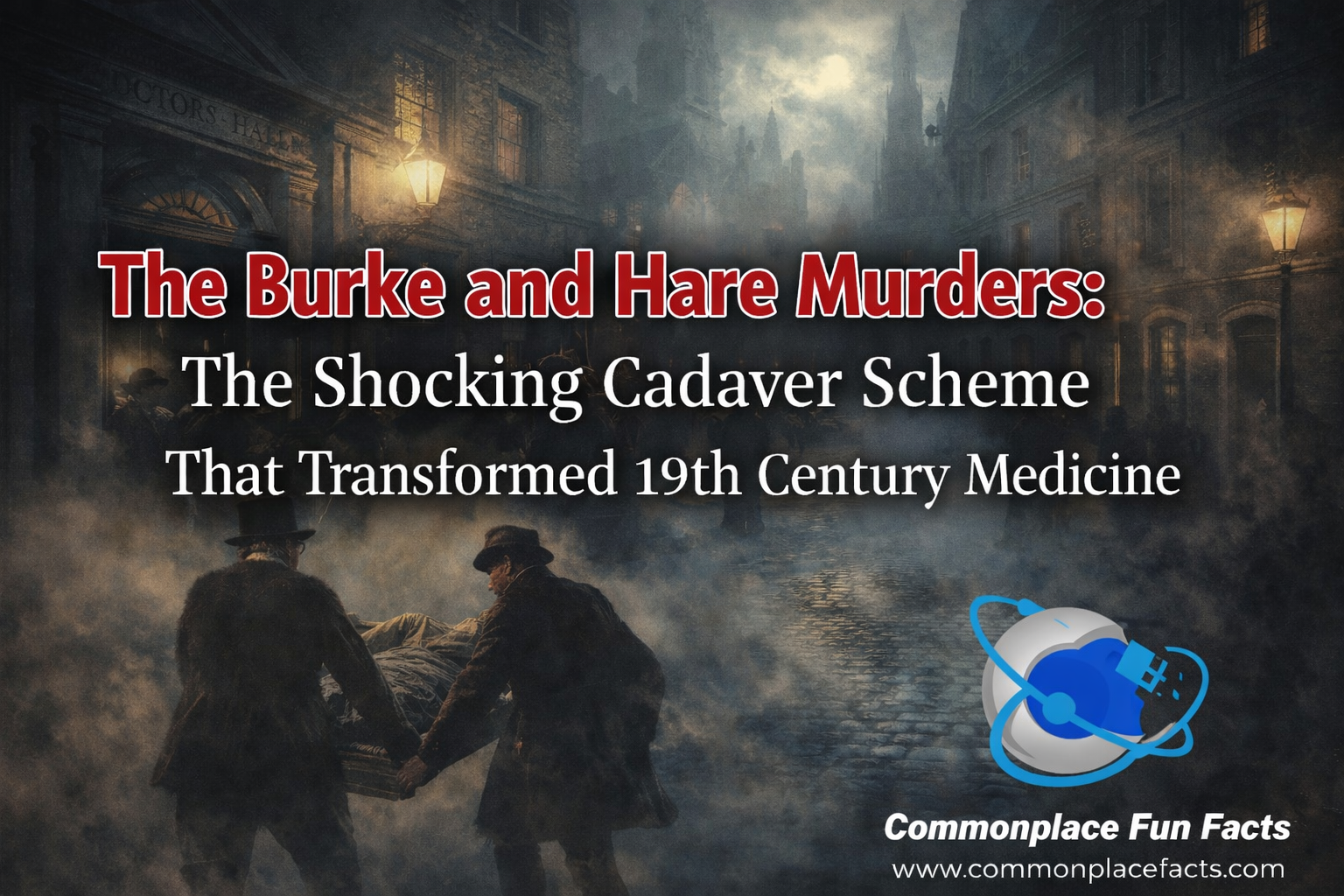

The Burke and Hare murders did not begin as a dramatic plunge into Gothic villainy. They began, as so many historical disasters do, with a shortage.
In the late 1820s, Edinburgh stood at the forefront of modern medicine. Its anatomy lectures were famous. Its professors were ambitious. Its students were eager to learn the inner workings of the human body in an era before antiseptics, anesthesia, or particularly delicate bedside manners.
With growing demand for cadavers but a shortage of legally available ones, stepped two men with a boarding house, flexible scruples, and an appreciation for market opportunity. The Burke and Hare murders were not crimes of passion. They were capitalism with a side order of homicide.
And for a brief, horrifying season in 1828, they turned Edinburgh’s body shortage into the creepiest business model imaginable.
Contents
When Medicine Had a Body Problem
They call it “practicing” medicine for a reason. It is not a static body of knowledge but an evolving craft refined through experiment, observation, and the occasional humbling mistake. Physicians and medical students advance by testing ideas, discarding failures, and building on what works. Ideally, those trials and errors are confined to patients who no longer have strong opinions about the outcome. Which explains why, for centuries, the medical profession has had a pronounced interest in the recently deceased.
Under British law in the early 19th century, the only bodies legally available for dissection were those of executed murderers. This worked fine when executions were common and medical schools were not. But by the 1820s, executions had declined while medical enrollment had not. The math grew awkward.
Doctors needed “fresh subjects.” Students needed hands-on experience. The dead, unfortunately, were not cooperating in sufficient quantities.
The basic economic principle of supply vs. demand made it inevitable that a secondary market would emerge.
Enter the Resurrection Men—professional grave robbers who helpfully exhumed the newly deceased and sold them to anatomy schools. It was illegal, but technically only the coffin and shroud counted as property. The body itself existed in a sort of legal limbo, as if even the law didn’t want to deal with it.
Across the pond, a similar shortage produced its own scandal when the body of John Scott Harrison was snatched from the grave. In “John Scott Harrison and Grave Robbery of the Only Man To Be the Father and Son of a President,” we explore how that macabre episode didn’t just shock the nation—it helped reshape American law.
Stealing corpses for medical science horrified the public—but not quite enough to inspire serious reform. That is, until even grave robbing proved insufficient to meet demand.
Which is where William Burke and William Hare entered the chat.
Burke and Hare: Two Gentlemen With Initiative
William Burke and William Hare were Irish immigrants who found themselves in Edinburgh’s West Port district in the late 1820s, a cramped and rough part of the city where lodging houses, laborers, and hard drinking were common features of daily life. Hare had been working in Britain for several years before settling in Edinburgh, where he lived in a boarding house owned by a woman he later partnered with. Burke, who had spent time as a laborer and soldier and had left a wife in Ireland, arrived in Scotland seeking work and eventually began living with Helen McDougal. The two men met through shared living arrangements and quickly formed a friendship built on proximity, temperament, and a mutual lack of fastidious moral hesitation.

Their partnership began not with murder but with rent collection.
On November 29, 1827, a lodger named Donald died of dropsy—just before he was due to collect a quarterly army pension, and while he still owed £4 in back rent. Hare lamented his loss. Burke saw potential recovery. They arranged for a coffin to be provided and paid for by the parish. Once the carpenter left, they quietly removed Donald’s body, hid it under the bed, filled the coffin with bark from a local tannery, and resealed it. After dark, they carried the corpse to Edinburgh University in search of a buyer. They were redirected to Dr. Robert Knox’s dissecting rooms at Surgeons’ Square, where Knox paid £7 10s for the body. As they departed, one of Knox’s assistants allegedly remarked that they would be glad to see the pair again if they had another to dispose of.
The transaction was smooth. The money was good. No questions were asked.
This is the point in the story where most people would step back and reconsider.
Burke and Hare leaned forward.
Disrupting the Death Industry
The line between opportunism and murder blurred quickly. In early 1828—most likely January or February—the first deliberate killing occurred. Many historians believe the victim was a miller named Joseph who had fallen ill with fever while lodging with Hare. Concerned that an infectious tenant would hurt business, Hare and Burke plied him with whisky. Hare suffocated him while Burke lay across his chest to stifle movement and sound. Knox paid £10. The method proved grimly efficient. Burke’s weight prevented the chest from expanding. There were no obvious marks. In an age before modern forensics, it was nearly undetectable.
This method became known as “burking.” It is rarely the goal in life to become an eponymous verb of this kind, but these guys seemed destined to make waves.
Within weeks, Abigail Simpson, a pensioner who supplemented her income by selling salt, was invited into the house and encouraged to drink heavily. Too intoxicated to leave, she was smothered on February 12, 1828—the only specific date Burke later remembered with certainty. Knox paid £10 and reportedly commented approvingly on how fresh the body was.
Another victim followed: a traveling Englishman from Cheshire who had fallen ill with jaundice while lodging with Hare. As with Joseph, illness made him inconvenient. He was suffocated and sold. Then came an elderly woman, encouraged to drink until unconscious and smothered in her sleep. Payment: £10.
In early April 1828, Burke encountered Mary Paterson and Janet Brown in the Canongate. After purchasing whisky, he invited them for breakfast but took them instead to his brother Constantine’s house. Paterson drank heavily and fell asleep at the table. A domestic argument distracted the household momentarily, but once privacy was restored, Burke and Hare suffocated her. Knox was pleased with the “specimen,” preserved her body in whisky for months before dissection, and paid £8.
The pattern accelerated. A Mrs. Haldane became drunk and was smothered in a stable. Her daughter followed months later. An elderly female lodger in May met the same fate. “Effy,” a cinder gatherer who scavenged scraps for resale, was lured in with whisky. Knox paid £10 for her body. Another woman, discovered too intoxicated to stand and being escorted home by a constable, was intercepted by Burke under the pretense of assistance—and never made it to her lodgings.
June brought a particularly grim episode: an elderly woman and her mute grandson were lodging at Hare’s house. The grandmother was killed first in the bedroom. The boy, sitting by the fire, was then carried to the same room and suffocated. Burke later admitted that this murder disturbed him more than the others; he was haunted by the boy’s expression. Their usual tea chest proved too small to transport the two bodies, forcing them to stuff the corpses into a herring barrel. Knox paid £8 each. On the journey, Hare’s horse refused to pull the load further than the Grassmarket, apparently just as conscious-stricken as Diocletian’s horse 1,500 years earlier. Unlike the Roman emperor, however, Hare did not pay attention to the horse’s hesitation and continued with his delivery.
Financial tension briefly divided the pair in late June after Hare secretly sold a body while Burke was away. They reconciled. In late September or early October, a washerwoman named Mrs. Ostler was invited in, intoxicated, and killed. Shortly thereafter, Ann Dougal, a visiting relative, was murdered in similar fashion. Both brought in profit—£8 or £10 depending on the corpse.
In November came one of the most notorious victims: James Wilson, an 18-year-old with deformed feet and a mental disability, known locally as “Daft Jamie.” Hare lured him with promises of whisky. Wilson resisted more than most victims; he was strong and not fully drunk. It required both men to overpower him. Knox’s students later suspected the identity of the body, but Knox denied recognition and quickly dissected it to prevent further scrutiny.
If you squint, you can almost see the outlines of a business model: steady supply, reliable buyer, efficient turnover, minimal overhead.
It was a start-up culture success story, if one ignores the homicide.
The Final Victim: The Conspiracy Unravels
The final victim, Margaret Docherty, was killed on October 31, 1828. Burke befriended her by claiming family ties in Ireland. She was brought to a lodging house under the pretense of kinship and drinking companionship. Two other lodgers grew suspicious. When left alone, they searched a bed layered with straw and discovered her body. Blood and saliva marked her face. Police were alerted.

In total, sixteen murders were attributed to Burke and Hare between late 1827 and October 1828. By Burke’s later admission, the killings were often committed while heavily intoxicated. He slept poorly, kept whisky beside his bed, and resorted to opium to quiet his conscience. Whatever guilt he felt, it did not stop him soon enough.
What began as a single act of corpse fraud became a structured procurement operation—steady supply, fixed pricing, reliable delivery. It was capitalism applied to mortality. Only when Margaret Docherty’s body was found under the straw did the business finally collapse.
Anatomy as Public Entertainment

To modern readers, anatomy lectures might conjure sterile rooms and hushed professionalism. In the 1820s, they were events. People paid to watch dissections. Curiosity and morbidity held hands and bought tickets.
Dr. Knox’s demonstrations were popular. He was charismatic. He was skilled. He had access to excellent specimens—remarkably fresh ones.
Some observers later suggested Knox must have known something was amiss. Others argue he preferred not to know, which is a subtler but still ambitious moral position.
Whether villain, dupe, or conveniently incurious academic, Knox represented an uncomfortable truth: demand drives supply. If you consistently purchase what appears on your doorstep without asking questions, you become part of the delivery process.
The Investigation: Science, Suspicion, and a Race to Court
Once Margaret Docherty’s body was discovered, events moved quickly. On November 3, 1828, warrants were issued for the arrest of William Burke, William Hare, their wives, and an associate named Broggan. Broggan was soon released, but the others were detained and separated. Their statements, unsurprisingly, did not align. Contradictions multiplied. The smell of something far worse than cadavers hung over the investigation.
A police surgeon examined Docherty’s body, after which two respected forensic specialists—Robert Christison and William Newbigging—were appointed to conduct a more formal evaluation. Their conclusion was sober but frustrating: she had probably been murdered by suffocation, yet the medical evidence could not definitively prove it. In other words, they were morally certain but scientifically constrained. In an age before modern forensic science, proving a murder without visible trauma was precarious business.
Despite the medical ambiguity, Burke and Hare were formally charged. Christison interviewed Dr. Robert Knox during the inquiry. Knox admitted that the two men had supplied him with bodies and claimed they had purchased corpses from poor lodging houses before burial claims were made. Christison later observed that Knox appeared “deficient in principle and heart,” but he did not believe the anatomist had technically broken the law. That distinction would prove legally decisive.

Police believed multiple murders had occurred, but without physical remains, building cases was difficult. Meanwhile, the public did not wait for evidentiary standards. Newspapers began publishing increasingly lurid accounts. Speculation flourished. Every missing person in Edinburgh was suddenly imagined to have passed through Tanner’s Close in a tea chest.
Witnesses stepped forward. Janet Brown identified clothing that had belonged to her missing friend Mary Paterson. A baker recognized James Wilson’s trousers being worn by Burke’s nephew. On November 19, authorities issued an additional warrant for the murder of Wilson. The pattern was no longer invisible.
The Lord Advocate, Sir William Rae, deployed a familiar prosecutorial strategy: if you cannot prove everything against everyone, break one and secure testimony. Hare was selected. On December 1, he was offered immunity from prosecution if he would testify fully about the murders—particularly that of Margaret Docherty. The deal extended to his wife as well. Hare accepted.
His confession detailed sixteen killings. With Hare prepared to serve as king’s evidence, formal charges were brought against Burke and Helen McDougal for the murders of Mary Paterson, James Wilson, and Margaret Docherty. Knox, shielded by Burke’s own statement to police that the surgeon had never encouraged murder, faced no criminal charges.
The court of public opinion, however, was less restrained. Edinburgh’s newspapers turned harsh. Broadsides portrayed Knox as a shadowy conductor orchestrating Burke and Hare’s grim performance. Rhymes circulated in the streets:
Up the close and doon the stair,
But and ben wi’ Burke and Hare.
Burke’s the butcher, Hare’s the thief,
Knox the boy that buys the beef.
By the time the case reached court, Edinburgh was no longer merely scandalized—it was electrified. The investigation had revealed not only murder, but an uncomfortably efficient supply chain sustained by legal loopholes, professional detachment, and the willingness of two men to treat human life as merchandise. What remained was to see whether the law could convert outrage into conviction.
The Trial: Christmas Eve Justice
The trial of William Burke began at 10:00 a.m. on Christmas Eve, 1828, before the High Court of Justiciary in Edinburgh’s Parliament House. If ever there were a festive way to spend December 24, this was not it. Christmas, however, was not recognized as a legal holiday in Scotland until 1958, so there was no reason to delay the proceedings.
The proceedings were presided over by the Lord Justice-Clerk, David Boyle, with three additional Lords seated beside him. By 9:00 a.m., the courtroom was already packed. Hundreds of spectators gathered outside. Three hundred constables were assigned to prevent disturbance, with infantry and cavalry on standby.
Burke and his partner Helen McDougal were tried together at first, which prompted immediate objections from Burke’s defense counsel. James Moncreiff argued that his client faced three separate murder charges, each unconnected in time and place, and that McDougal was not implicated in two of them. Hours were spent in procedural argument. Ultimately, the indictment was split. The prosecution, led by Lord Advocate Sir William Rae, elected to proceed first with the murder of Margaret Docherty — the one case for which they had a body and the strongest chain of evidence.

The testimony began. Fifty-five witnesses had been listed, including William Hare and Dr. Robert Knox. Not all were called. Knox himself, along with three of his assistants, never took the stand. One assistant, David Paterson, did testify, confirming that Burke and Hare had delivered multiple corpses to Knox’s surgery.
Then came the prosecution’s most critical witness: William Hare.
Taking the stand in the early evening, Hare calmly described the murder of Docherty. Under cross-examination, he placed primary responsibility on Burke, though he admitted assisting in transporting the body. He implicated McDougal in facilitating some aspects of the crime. When pressed about other murders, Hare refused to answer—legally entitled to silence beyond the scope of the charge at hand. His immunity deal ensured that his risk ended where his usefulness ended.
Margaret Hare followed him into the witness box, carrying their baby daughter, who had whooping cough. The infant’s coughing fits punctuated her responses, buying her moments to compose her answers. She professed poor memory and limited knowledge of events. Between medical ambiguity and selective recall, clarity remained elusive.
Two doctors closed out the prosecution’s evidence. Both suspected foul play in Docherty’s death. Neither could scientifically prove it. In modern courtrooms, that might have complicated matters. In 1828 Edinburgh, the jury had other evidence to weigh.
No live witnesses were called for the defense. That’s an unfortunate sentence, given the fact that this was a trial about murder and cadavers. What we mean is that pre-trial declarations from Burke and McDougal were read aloud, in place of in-person testimony. The prosecution summarized its case. At 3:00 a.m. on Christmas morning, Burke’s counsel began his final speech, speaking for two hours. McDougal’s defense followed at 5:00 a.m. The trial had run through the night. Legal endurance had replaced holiday cheer.
At 8:30 a.m. on Christmas Day, the jury retired. Fifty minutes later, they returned. Burke was found guilty of the murder of Margaret Docherty. Against McDougal, the jury delivered a Scottish verdict: “not proven.” It was neither acquittal nor conviction—just the legal equivalent of a raised eyebrow.
As he pronounced sentence, Lord Justice-Clerk Boyle added a flourish that history would remember:
“Your body should be publicly dissected and anatomized. And I trust, that if it is ever customary to preserve skeletons, yours will be preserved, in order that posterity may keep in remembrance your atrocious crimes.”
It was an extraordinarily symmetrical punishment. Burke had supplied bodies to anatomy. He would become one.
The Aftermath: Mobs, Skeletons, and Vanishing Villains
The courtroom drama may have ended on Christmas morning, but Edinburgh was only getting started.
Helen McDougal, having received the ambiguous verdict of “not proven,” returned home. The very next day she ventured out to buy whisky—a decision that suggests either remarkable courage or catastrophic miscalculation. An angry mob confronted her, furious that she had escaped conviction. Police intervened for her protection, removing her to a building in Fountainbridge. When the crowd laid siege, she escaped through a back window and fled to the main police station on the High Street. She attempted to see Burke one last time, but permission was denied. By the following day, she had left Edinburgh. History promptly lost track of her.
On January 3, 1829, perhaps sensing that public sentiment had already written his epilogue, Burke made another confession. Urged by clergy from both Catholic and Presbyterian traditions, he gave a far more detailed account of the murders and shifted considerable blame onto Hare. It was confession as clarification, or perhaps confession as final accounting.
Meanwhile, outrage simmered over Hare’s immunity. On January 16, a petition filed by James Wilson’s mother and sister begged the High Court to reconsider Hare’s release. The court deliberated and rejected it by a narrow margin. Justice, in this case, had been negotiated.
Margaret Hare was released on January 19 and headed for Glasgow, hoping to secure passage back to Ireland. While waiting for a ship, she too was recognized and attacked by a crowd. Police once again intervened, sheltering her before escorting her aboard a vessel bound for Belfast. Like McDougal, she disappears from reliable records soon after landing.
Burke, however, would not fade quietly into obscurity.
On January 28, 1829, he was hanged before a crowd estimated at up to 25,000 spectators. Windows overlooking the scaffold were rented for premium prices. Execution had become public theatre. In a twist so symmetrical it bordered on poetic, Burke’s body was delivered for public dissection on February 1. Professor Monro conducted the procedure in the university’s Old College anatomy theatre. Police were required to control the crush of students demanding entrance. During the two-hour dissection, Monro famously dipped his quill into Burke’s blood and wrote a note declaring that it had been penned in the blood of the executed murderer. Subtlety was not the mood of the day.

Burke’s skeleton was preserved and placed in the Anatomical Museum of the Edinburgh Medical School, where it remains on display. His death mask and even a book reportedly bound in his tanned skin are exhibited at Surgeons’ Hall. If there was any doubt about the court’s warning that his remains would serve as a permanent reminder, history erased it.
Hare’s exit was far less ceremonious. Released on February 5, 1829, police assisted him in leaving Edinburgh in disguise for his own safety. Even so, he was recognized along the way. In Dumfries, word spread quickly; a mob gathered. Stones were thrown. Street lamps were smashed. Authorities orchestrated another escape through a rear window and conveyed him to temporary jail protection. Before dawn, under militia escort, Hare was led out of town, deposited on the Annan Road, and instructed to proceed toward the English border. After that, he effectively vanishes from verifiable history. Rumors abound. Facts do not.
And then there was Dr. Knox.
Public opinion was unforgiving. Caricatures portrayed him as a sinister mastermind. An effigy of him was burned outside his house. Although an inquiry cleared him of legal complicity—finding no evidence that he had known murders were committed to supply his dissecting rooms—his reputation never recovered. He resigned his curatorship, gradually withdrew from Edinburgh’s medical establishment, and eventually left the city altogether. Knox continued lecturing elsewhere, but regulatory setbacks and professional isolation followed him. When he died in 1862, he carried with him a legacy permanently shadowed by the West Port murders.
The Burke and Hare affair did not end with the rope. It reshaped public outrage into legislative reform, culminating in the Anatomy Act of 1832. The law expanded the legal supply of cadavers for medical study, reducing the incentive for grave robbing and murder.
Reform, it turns out, often follows catastrophe wearing practical shoes and holding a pen.
In the end, Edinburgh kept its medical schools. Parliament kept its authority. Knox kept his freedom. Hare kept his life. Burke kept nothing except a skeleton in a glass case—an enduring exhibit in the strange intersection of science, law, and entrepreneurial horror.
The Burke and Hare Murders: A Business Case for Horror
There is a temptation to treat Burke and Hare as cartoon villains—mustache-twirling fiends skulking in candlelight.
The more unsettling reading is simpler.
They were practical.
They observed market conditions. They identified a buyer willing to pay generously. They optimized production methods to reduce visible damage. They met demand efficiently. They scaled.
This is not satire. It is economic logic unmoored from morality.
History is filled with such episodes. When laws create scarcity and demand persists, someone will step forward to bridge the gap. Sometimes that bridge is innovative. Sometimes it is lethal.
Burke and Hare simply pushed the logic to its darkest conclusion.
The Legacy of “Burking”

Their names entered folklore, broadsides, stage plays, and penny dreadfuls. “Burking” became shorthand for suffocating murder. Songs were written. Stories embellished the body count. Like many notorious criminals, they achieved the immortality they did not deserve.
Meanwhile, medical science marched forward.
Modern anatomy labs operate under layers of consent forms, regulation, and ethical oversight. Donors volunteer their remains for education. Transparency replaces secrecy. The system works better—not because humanity improved overnight, but because law and culture adjusted to earlier abuses.
Burke’s skeleton, displayed for generations, served as a grim reminder and perhaps an unintended public service announcement: regulatory reform sometimes arrives wearing bone.
The Burke and Hare Murders: The Lesson of Uncomfortable Economics
The Burke and Hare murders leave us with an uncomfortable truth wrapped in a cautionary tale.
Medical progress is rarely tidy. It advances through ambition, curiosity, experimentation—and occasionally through moral blind spots large enough to drive a tea chest through. Edinburgh wanted better doctors. Students wanted experience. Knox wanted specimens. Burke and Hare wanted cash. Place those motivations together in a city with weak regulation and strong demand, and you have yourself a cautionary case study in unintended consequences.
The villains were obvious. The incentives were quieter. The incentives are usually the more instructive part.
Medicine improved. The law adapted. Anatomy gained oversight. And Edinburgh eventually returned to being famous for its intellect rather than its cadaver-filled tea chests.
The Burke and Hare murders are, in the end, less a story about monsters than about markets. When shortage meets opportunity, someone will innovate. The only real question is whether the innovation improves the human condition—or gets anatomized in front of 25,000 people on a cold January morning.
You may also enjoy…

John Scott Harrison and Grave Robbery of the Only Man To Be the Father And Son of a President
Explore the true story of John Scott Harrison — the only U.S. president’s father and son — whose grave was robbed in 1878 in one of America’s most infamous historical crime cases.

What Happened to the Body of America’s First President? The Bizarre Tale of John Hanson’s Lost Grave
John Hanson, depending on who you ask, may have been the USA’s first president. His name, however, is largely forgotten. As if that weren’t enough, thanks to late 20th century grave robbers, even his body is missing. Find out the mysterious details in this intriguing article.

The Manhattan Well Murder: America’s First Murder Trial and the Legal Team-Up That Should Not Have Been
The true story of the Manhattan Well Murder—America’s first recorded murder trial—featuring Alexander Hamilton, Aaron Burr, and a verdict that shocked early New York.





Leave a Reply to Commonplace Fun FactsCancel reply