

There are many ways to run an empire.
You can inspire people with bold ideas. You can pass wise laws. You can build roads. You can give rousing speeches about unity and destiny and the sacred bond between the state and its taxpayers.
Or, if you are the Roman Emperor Diocletian, you can take the approach: “It’s my way or a bloodbath.”
Diocletian was not the sort of leader who believed in the therapeutic value of talking things out. He believed in control. He believed in order. He believed that the universe functioned best when it was divided into neat administrative units, each with a responsible official, a clear chain of command, and absolutely no one freelancing with rebellion.
And if you did any freelancing with rebellion—well, the empire had a customer service department. It was called the Roman army.
Contents
Alexandria: A City That Never Met a Calm Moment It Liked
Alexandria was not a small, quiet place where nothing ever happened except fishing and polite philosophical debate.
It was a loud, crowded, argumentative metropolis that had been important for so long it barely remembered what it felt like not to be. It was a city with layers: Greek foundations, Egyptian depth, Roman administration, and an extremely robust local tradition of causing problems whenever someone tried to tell it what to do.
This was a city that produced scholarship, commerce, and intellectual greatness—and also produced riots with the same enthusiasm most towns reserve for parades.
So when Alexandria decided to rise up against the emperor in the late 290s, it was not entirely out of character. It was just an unfortunate choice of timing and opponent. This was like deciding to prank a man who collects grudges as a hobby.
Diocletian: The Emperor Who Fixed Everything (By Breaking It Into Smaller Pieces)
Diocletian is one of those historical figures who makes you appreciate the modern concept of “work-life balance,” because he very clearly never heard of it and would probably have outlawed it if he had.

He came to power at a time when Rome had been chewing through emperors at an alarming rate. The third century had been a kind of imperial blender: short reigns, incompetent teenage rulers, violent transitions, and enough chaos that you could be forgiven for thinking the empire had been built on a foundation of wet bread.
Diocletian knew the empire needed stability if it was going to survive. He decided the best way to accomplish this would be to build a system so structured and so aggressively organized that it would require a permit to sneeze.
One person who learned the hard way about Diocletian’s ruthlessness—and, ironically, just how hostile his empire could be to normal respiratory activity—was Nicholas, the bishop of Patara. He would later be remembered as Saint Nicholas. Yes, that Saint Nicholas. Modern examinations of his remains suggest he suffered a badly broken nose, an injury widely believed to have been inflicted during Diocletian’s radical persecution of Christians.
The emperor split the administration. He multiplied rulers. He made authority redundant on purpose. If one leader fell, another would step in. If one region caught fire, the whole empire wouldn’t go up with it. It was a rational, managerial solution to a political world that had stopped behaving rationally generations earlier.
It was also, like many rational managerial solutions, extremely unpleasant for the people living under it.
Diocletian didn’t just want stability. He wanted a kind of mathematical stability—predictable, standardized, and enforced. Under his rule, the empire became more bureaucratic, more regulated, and more determined to pin everyone into the job, rank, and tax obligation that suited the state.
Rome had always demanded things from its subjects. Diocletian simply demanded them with spreadsheets.
A Siege Is Just a Long Argument Where One Side Has No Food
When Alexandria revolted, Diocletian did what an emperor does when a major city decides to test the concept of consequences: he went to Egypt and brought the consequences with him.
The revolt did not end quickly. Alexandria held out. There was a siege. There were months of waiting, maneuvering, and attrition—an extended period in which the emperor’s patience was not so much tested as actively vaporized.
By the time the city finally surrendered and opened its gates, Diocletian’s mood was far from forgiving or reasonable. He arrived in the emotional state of a man who has been stuck in traffic for six hours and has needed to use a bathroom for at least five of those hours. In his case, instead of traffic it was rebellion, and instead of honking he had legions.
The Order: Blood, Horses, and a Truly Ambitious Visual
The story goes that Diocletian entered Alexandria in a foul temper and immediately decided the city needed to learn what happens when you make the emperor spend his season besieging you.
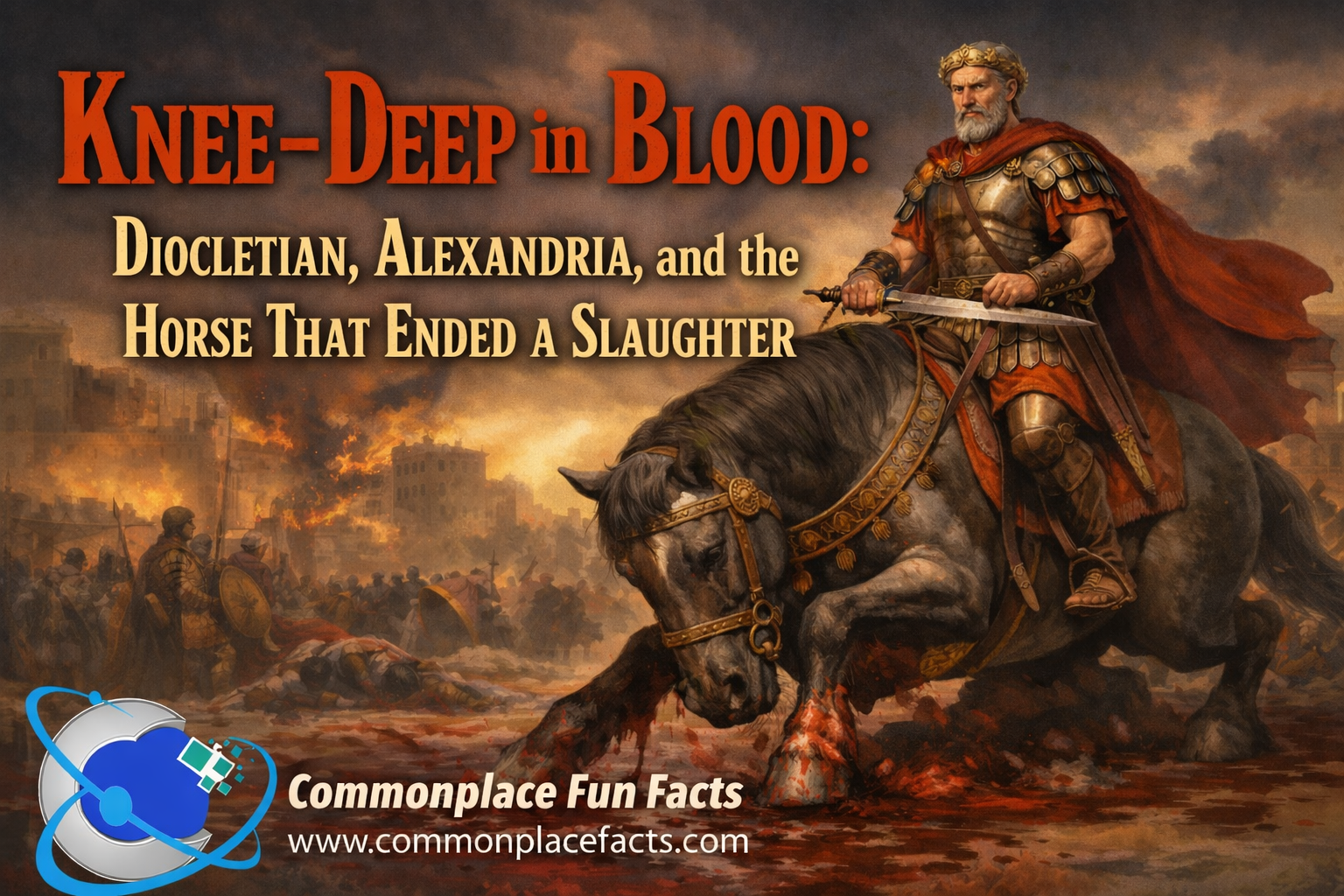
He ordered his soldiers to begin killing the citizens and not to stop until his horse was up to its knees in the blood of the Alexandrians.
It’s the kind of command that only makes sense if you are an emperor and you have spent your entire adult life surrounded by people who are not allowed to react the way normal humans would react to hearing it.

Genghis Khan, memorably, utterly obliterated the Khwarezmian Empire simply because his ambassadors had been insulted. Anyone can have a bad day, but when the bad day hits someone with absolute power, it can get messy very quickly.
When Diocletian ordered a literal bloodbath for Alexandria, it wasn’t intended as an invitation for a workshop. Nobody raised their hand. Nobody asked follow-up questions. The job was to nod, march, and attempt to fulfill the emperor’s oddly specific metaphor.
And here is where the story’s gruesome practicality becomes strangely important.
The population of Alexandria is often described as just under a million at the time. The average human body contains about a gallon of blood. Even if you adjust downward for dramatic ancient exaggeration, you still end up with an imperial rage plan that involves a lot of liquid.
In modern terms—because modern terms are how we process horror now—this is enough blood to fill an Olympic swimming pool and then casually add another half, as if you’re topping off a wading pool for a particularly disturbing birthday party.
Diocletian’s order was monstrous, but it was not, strictly speaking, unrealistic. If your goal is to create a nightmare tableau that will echo through the centuries, you could do worse than “knee-deep horse blood.”
The Horse Objects
Then, in the moment when the legions are sharpening their swords and preparing to turn Alexandria into a civic cautionary tale, the story takes a turn.

Diocletian’s horse—either overcome by the sight, the smell, the mood of the day, or the general fact that it did not sign up for imperial theatrics—went down on its knees and refused to get up.
That’s it. That’s the intervention. Not a prophet. Not a thunderbolt. Not an angel descending with a flaming sword and a strongly worded memo about mercy.
A horse.
The emperor saw this, interpreted it as an omen, and called off the massacre.
And just like that, Alexandria was saved by the most underappreciated hero of Roman history: an animal that, for reasons known only to itself, decided it was done standing up for this nonsense.
Gratitude, Statues, and the Lowest Bar for Civic Heroism
The story does not end with the horse returning to its feet and everyone awkwardly pretending none of this just happened.
According to tradition, the people of Alexandria were so relieved at their near miss with annihilation that they erected a statue of the horse. This is not entirely implausible. Alexandria loved monuments. It collected them the way other cities collect parking tickets. If something dramatic happened, the city’s first instinct was to commemorate it with stone, bronze, or something tall enough to cast a respectable shadow.

The idea of a city thanking a horse for saving it from imperial slaughter feels oddly appropriate for Alexandria. This was a place that had seen conquerors, philosophers, emperors, saints, schismatics, and more riots than could comfortably fit into a single century. By this point, expressing civic gratitude to a horse probably did not crack the top ten strangest things anyone had seen that year.
There is also a rich irony hovering over the city’s surviving monuments. One of Alexandria’s most famous Roman-era columns was erected in honor of Diocletian himself. So somewhere between legend and archaeology, the city managed to thank both the emperor who nearly destroyed it and the horse that stopped him.
If nothing else, it demonstrates an admirable ability to hedge one’s bets.
Devotional Habits: When Horses Appear to Find Religion
Centuries later, the Victorians would coin a wonderfully gentle euphemism for horses that frequently collapsed onto their knees. Such animals were said to have acquired “devotional habits,” because the posture resembled prayer.
Victorian culture excelled at this sort of thing. Where reality suggested joint problems, exhaustion, or age, the Victorians preferred symbolism. The horse was not worn down. It was pious. It was not failing physically. It was thanking its creator every twenty yards.
It is, admittedly, a charming image.
It is also deeply unfair to the horse.
The more likely explanation, then and now, is that the animal is tired, injured, old, or simply past the point where it wants to be involved in human drama. The knacker’s yard looms far larger in the horse’s future than the pearly gates.
Still, it is hard not to enjoy the thought that Diocletian’s horse possessed a moment of spontaneous theological reflection just in time to derail an imperial bloodbath.
Did This Actually Happen?
At this point, responsible history clears its throat.
The tale comes from later sources, not contemporary Roman historians. It may be embellished. It may be symbolic. It may be a story Alexandrians told themselves to explain why their city survived a siege that should have ended very badly indeed.
But here is the thing: the empire absolutely did suppress a revolt in Alexandria. Diocletian absolutely had a reputation for severity. Massacres absolutely happened. And ancient writers absolutely loved stories where omens, animals, or absurdly small moments stopped the gears of power at the last second.
So whether the horse truly fell, stumbled, collapsed, or merely wandered into legend after the fact, the story fits the emotional truth of the period even if its literal truth remains debatable.
And frankly, the Roman Empire does not lose much credibility by adding one more implausible anecdote to its already impressive collection.
Why This Story Lasts
The reason this story survived is not because it is tidy or provable. It survived because it is satisfying.
It takes one of the most powerful men in the ancient world, places him at the height of his rage, and then undercuts the moment with a horse refusing to cooperate.
It turns imperial terror into divine intervention. It suggests that history, for all its armies and edicts and grand strategies, sometimes hinges on powers much greater than those wielded by the political elites.
Civilization, Almost Lost to One Bad Day
Alexandria was spared not by negotiation or mercy, but by a combination of superstition and an animal’s limits. The city lived on to riot another day, argue another doctrine, and contribute another layer to human civilization.
If nothing else, the story reminds us that history is not only shaped by emperors and armies. Sometimes it turns because a horse, standing in the wrong place at the wrong time, decides it has had enough.
And if you ever find yourself on your own long, chaotic journey, occasionally dropping to your knees out of sheer fatigue, you are in good company.
Just try not to be responsible for the fate of a million people when it happens.
You may also enjoy…

Don’t Kill the Messenger — Especially if He Comes from Genghis Khan
If you’ve never heard of the Khwarezmian Empire, there’s a reason, and it’s Genghis Khan. More specifically, it’s because of a really bad choice to treat Khan’s messenger appropriately.

Homicidal Horses, Predatory Pigs, Robber Rats: Trials and Executions of Animals in Medieval Courts
These pages have documented many unusual stories and facts relating to capital punishment. Regardless of your personal views on the subject, it probably goes without saying that you assume we are talking about the execution of humans. For much of human history, capital punishment was no respecter of persons or species. Animal criminals, as well…

Juliana: the Heroic Great Dane With a Great Bladder
Learn about Juliana, the heroic Great Dane of World War II who defused a bomb with her bladder.





Leave a Reply