
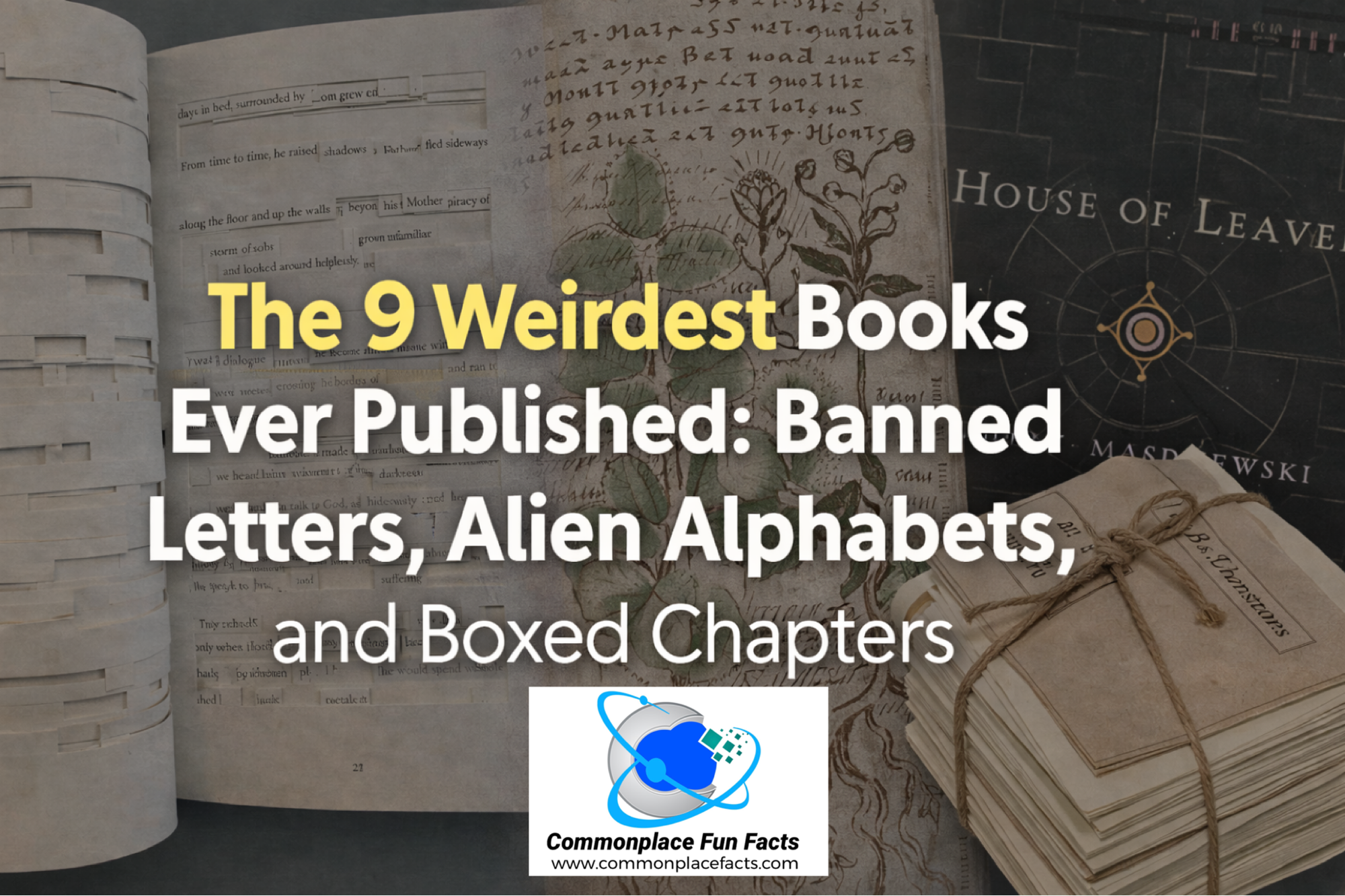

The Weirdest Books Ever Published: When Authors Looked at Normal Writing and Said, “No Thanks”
Most books behave themselves.
They show up with a normal cover. They contain words in a sensible order. They use letters the way letters have always been used, like responsible adults who pay their mortgage on time and don’t try to start a sentence with an unpronounceable noise.
And then there are the books we are discussing today.
These are the literary equivalent of a person arriving at a black-tie fundraiser wearing a cape and insisting the cape is historically accurate and “actually improves airflow.” These are books that don’t merely tell a story. They perform a stunt. They pick a rule of language, publishing, or reality itself and ask, very calmly, “What if we removed this and then drove the car anyway?”
Some of these experiments are brilliant. Some are exhausting. Some are both at the same time, which is a surprisingly common outcome when humans decide to become creative in a way that requires charts.
So, if you’re writing an article about unusual books—and you are, because your hobbies are clearly healthy—here is a curated tour of the weirdest volumes that have ever stared at grammar and format like they were optional suggestions.
NOTE: Many of the titles discussed below are accessible through Archive.org or Project Gutenberg. Links have been provided for those who want to sample these weird works for themselves.
Contents
1. Train from Nowhere: A Novel Without Verbs, Because Verbs Had It Too Good for Too Long
Michel Thaler’s Train from Nowhere (originally Le Train de Nulle Part) is famous for one simple reason:
It contains no verbs in its 233 pages.

Not “no action.” Not “few verbs.” None. Zero. A grammatical desert. If you’re the kind of person who enjoys sentence structure, this book will feel like walking into your kitchen and discovering someone removed all the appliances because they were “dominating the room.”
The core idea is that verbs are a kind of tyrant—engines of domination, forcing sentences into motion and hierarchy. Thaler wanted to “liberate” language by removing the part of speech responsible for doing things.
And that is the most French thing you’ll likely hear all week.
Without verbs, the prose becomes heavily descriptive. It leans on nouns, adjectives, and phrases that imply action without technically committing to it. The result is a long, steady glide through language that feels less like a story and more like an art exhibition where you are expected to nod thoughtfully and pretend you are not checking the exit signs:
(French): Quelle aubaine ! Une place de libre, ou presque, dans ce compartiment. Une escale provisoire, pourquoi pas ! Donc, ma nouvelle adresse dans ce train de nulle part : voiture 12, 3e compartiment dans le sens de la marche. Encore une fois, pourquoi pas ?
(English): What luck! A vacant seat, almost, in that compartment. A provisional stop, why not? So, my new address in this nowhere train: car 12, 3rd compartment from the front. Once again, why not?
Still, as a concept? It’s incredible. It proves a point: if you remove the engine from a car, you can still sit in it and make “vroom” noises. It just won’t get you to Cleveland.
2. La Disparition / A Void: A Novel Without the Letter “E”
If removing verbs feels ambitious, Georges Perec’s La Disparition (and the English translation A Void) is what happens when a writer turns language into a locked-room puzzle and then handcuffs himself to the furniture.
This novel is a lipogram, meaning it intentionally avoids a certain letter. Perec chose the letter “E.”

Which is, in French, roughly equivalent to writing a novel without oxygen.
It’s not a short work, either. It’s a full-length novel. And the plot itself revolves around disappearance and absence, which means the constraint is not just a parlor trick; it’s thematically welded into the story.
Then, in a feat of linguistic sorcery, the English translator produced A Void, also without the letter “E.” This is the kind of endeavor that makes you believe human beings can do anything, provided they are sufficiently stubborn and possibly mildly unwell.
Reading it is both impressive and uncanny. You become aware of “E” the way you become aware of your tongue when someone tells you not to think about your tongue. Suddenly, the alphabet feels like it has missing floorboards.
3. Gadsby: Another “No E” Novel, This Time With Extra Determination

Ernest Vincent Wright’s Gadsby also avoids the letter “E,” but unlike Perec, Wright did it in English first, back in 1939—long before word processors, spellcheck, or the ability to search your manuscript for forbidden letters like a modern wizard.
Legend has it Wright physically restrained the “E” key on his typewriter to prevent accidental betrayal.
This is either commitment or the beginning of a true-crime documentary.
The story itself is about civic improvement and a town’s revival. Which means the author performed an extreme linguistic stunt in order to deliver… a wholesome tale about community spirit.
That’s the literary version of running an ultramarathon to pick up groceries.
4. Tree of Codes: A Book That Is Literally Missing Pieces of Itself
Jonathan Safran Foer’s Tree of Codes is the physical version of a constraint-based experiment, and it is one of the few books that can legitimately be described as “beautiful” and “structurally unsettling” at the same time.

Foer created the book by taking an existing text and cutting words out of the pages—literally carving holes—so that the remaining words form a new story.
The pages become lace-like. Sentences float. Meaning appears in fragments. The book feels haunted by the text that used to be there.
It is, in other words, a novel as a paper sculpture. Reading it requires care, because you are handling what feels like a delicate archaeological artifact. It’s the only book that might be damaged by an aggressive sneeze.
Also, and this is important: the book makes absence visible. In most stories, what’s missing is conceptual. Here it’s physical. You can see the void.
5. House of Leaves: The Horror Novel That Makes You Rotate the Book Like a Perplexed Owl
House of Leaves, by Mark Z. Danielewski, is not just a strange book. It is a strange book that knows it is strange and actively wants to make you complicit.
The premise involves a house that is larger on the inside than the outside—an architectural impossibility that begins small and then escalates into an unsettling labyrinth.
But that’s only the start. The book is constructed as layered documents: a found manuscript, footnotes, annotations, and narrative threads that twist around each other like cables behind a television stand.
And then there’s the typography.
Text runs sideways. It spirals. It compresses into narrow columns like a hallway. It explodes into scattered fragments. At times you have to turn the book to continue reading, which is a clever way of making you physically reenact the experience of being lost.

This is a horror novel that does not merely describe disorientation. It hands you the disorientation and says, “Here. Hold this.”
The introduction explains, “Years ago, when House of Leaves was first being passed around, it was nothing more than a badly bundled heap of paper, parts of which would occasionally surface on the Internet.” Who knew that a bunch of scrap paper could go on to become a literary phenomenon?
People tend to either love it or decide they will never read a book that requires gymnastic movement again. Both reactions are reasonable.
6. The Unfortunates: The Novel That Arrives as a Box of Loose Chapters
B. S. Johnson’s The Unfortunates is a novel in a box.
Not metaphorically. Physically.
You receive a box containing separate sections—unbound, loose, and meant to be read in any order, except for the first and last, which are fixed. The idea is to replicate the way memory works: not neatly, not chronologically, but in sudden returns and sideways jolts.

It’s a book designed to be shuffled like a deck of cards, which is either inventive or an excuse for publishers to make librarians cry.
The subject matter—grief, friendship, the chaos of recollection—makes the structure feel meaningful rather than gimmicky. It’s a novel that insists the story is not just what happens, but how we remember what happened. And how memory likes to ruin your afternoon by showing up uninvited.
7. Finnegans Wake: A Book Written in Dream Language and Possibly Also in Spite
James Joyce’s Finnegans Wake is legendary, and not because it is easy.
It is not easy.
It is not even medium.
This book reads like a dream that learned to type. Joyce mashed together languages, invented words, layered puns, and built a text that behaves less like a narrative and more like a linguistic ocean you are expected to swim across while scholars on the shore shout encouragement and definitions.
Consider this brief excerpt:
“What then agentlike brought about that tragoady thundersday this municipal sin business? Our cubehouse still rocks as earwitness to the thunder of his arafatas but we hear also through successive ages that shebby choruysh of unkalified muzzlenimiissilehims that would blackguardise the whitestone ever hurtleturtled out of heaven. Stay us wherefore in our search for righteousness, O Sustainer, what time we rise and when we take up to toothmick and before we lump down upown our leatherbed and in the night and at the fading of the stars! For a nod to the nabir is better than wink to the wabsanti.”
Some people experience it as a masterpiece of experimental literature. Some experience it as being trapped in a crossword puzzle that hates them personally.
Both experiences can be true at the same time.
The best way to approach Finnegans Wake is to treat it like music rather than prose. You won’t understand everything. The point is that it creates a mood—an atmosphere of language in motion, like meaning seen through rippling water.
Or, if you prefer, like an entire book written in the voice of your subconscious at 3:00 a.m. after eating questionable cheese.
8. Codex Seraphinianus: The Encyclopedia From a Parallel Universe
The Codex Seraphinianus by Luigi Serafini is an illustrated encyclopedia of an alien world, complete with diagrams, classifications, and an invented script that looks believable enough to make you wonder if you missed an entire semester of extraterrestrial biology.
It is packed with surreal images: impossible creatures, bizarre machines, odd “scientific” charts. The writing is in a constructed, unreadable language. There is no confirmed translation. It is not a cipher you can crack with persistence and coffee. It is, as far as we know, purely aesthetic.

And somehow, it still feels like it means something.
This book taps into the specific human sensation of encountering something that appears structured and meaningful—but remains fundamentally inaccessible. It’s like finding a textbook from a civilization that clearly had strong opinions about taxonomy, but never bothered to loop you in.
People who love it tend to love it intensely. People who don’t will stare at it for five minutes and say, “So… it’s an art book that gaslights me.”
Again: both fair.
9. The Voynich Manuscript: The Ultimate “What Is This Even” Book
And then we reach the grand monarch of baffling books: the Voynich Manuscript.
This is a real medieval manuscript filled with drawings of strange plants, astronomical diagrams, bathing women in tube-like contraptions, and text written in a script that no one has conclusively decoded.

It has been studied by linguists, cryptographers, historians, hobbyists, and people who clearly enjoy suffering. Many have tried to solve it. None have achieved a solution that convinces the world.
There are theories:
- It’s an encoded text.
- It’s an invented language.
- It’s a hoax.
- It’s a medical/herbal manual from an obscure tradition.
- It’s the medieval equivalent of writing nonsense in a notebook so your younger sibling can’t read it.
What makes it irresistible is that it presents all the signals of meaning—structure, repetition, diagrams, apparent categories—without granting us the key.
It is the universe’s way of reminding us that mystery is not always a door we can open. Sometimes it’s just a door that exists. And it remains closed. And it has weird plants drawn on it.
See “Have the Mysteries of the Voynich Manuscript Finally Been Unlocked?” for more about this enigmatic book.
Why We Love These Books (Even When They Exhaust Us)
Here’s the thing about unusual books: they do not always deliver comfort.
Some of them feel like work. Some feel like puzzles. Some feel like the author dared you to keep reading and then left the room smiling.

But they all share a strange kind of optimism: the belief that language and storytelling are not finished.
Most of us grow up assuming books come in one basic shape. Pages. Chapters. Words. Plot. Beginning, middle, end. These authors looked at that template and treated it like a suggestion, not a law. They asked what happens when you cut out a letter, or a part of speech, or the very notion of reading in a fixed order. They turned the book into an object you interact with rather than a container you simply consume.
And yes, sometimes the result is a masterpiece. Sometimes it’s a fascinating mess. But even the messes are interesting, because they reveal the machinery of writing—how much we rely on structure, how much meaning depends on tiny linguistic choices, and how quickly our brains start pleading for mercy when you remove one letter from the alphabet.
In the end, these books remind us of something that is both annoying and true: creativity thrives under constraint.
It’s just that some people choose reasonable constraints, like “write every morning,” while others choose “remove the letter E and then write 50,000 words anyway.”
What can we say? We writers are a peculiar lot.
You may also enjoy…

Grawlix, Plewds, and Briffit: the Literary Language of Cartoons and Comic Strips
Ever hear of “grawlix” “briffit” “plewds” or “nittles”? Welcome to the weird world of comic strip and cartoon vocabulary.

14 Famous Books That Almost Had Different Titles
Discover the surprising original titles of famous books like The Great Gatsby, 1984, and To Kill a Mockingbird. Explore how these classics almost had very different names and the stories behind their title changes.

Weird Books for Curious Collectors
Some books are like unexpected party guests: wildly inappropriate yet hard to ignore. From “I Wish Daddy Didn’t Drink So Much” to “Cooking to Kill,” the titles are a wild ride through subjects ranging from cancer to butt cracks, leaving us to wonder if the publishers were just having a laugh. Explore these weird books…




Leave a Reply