
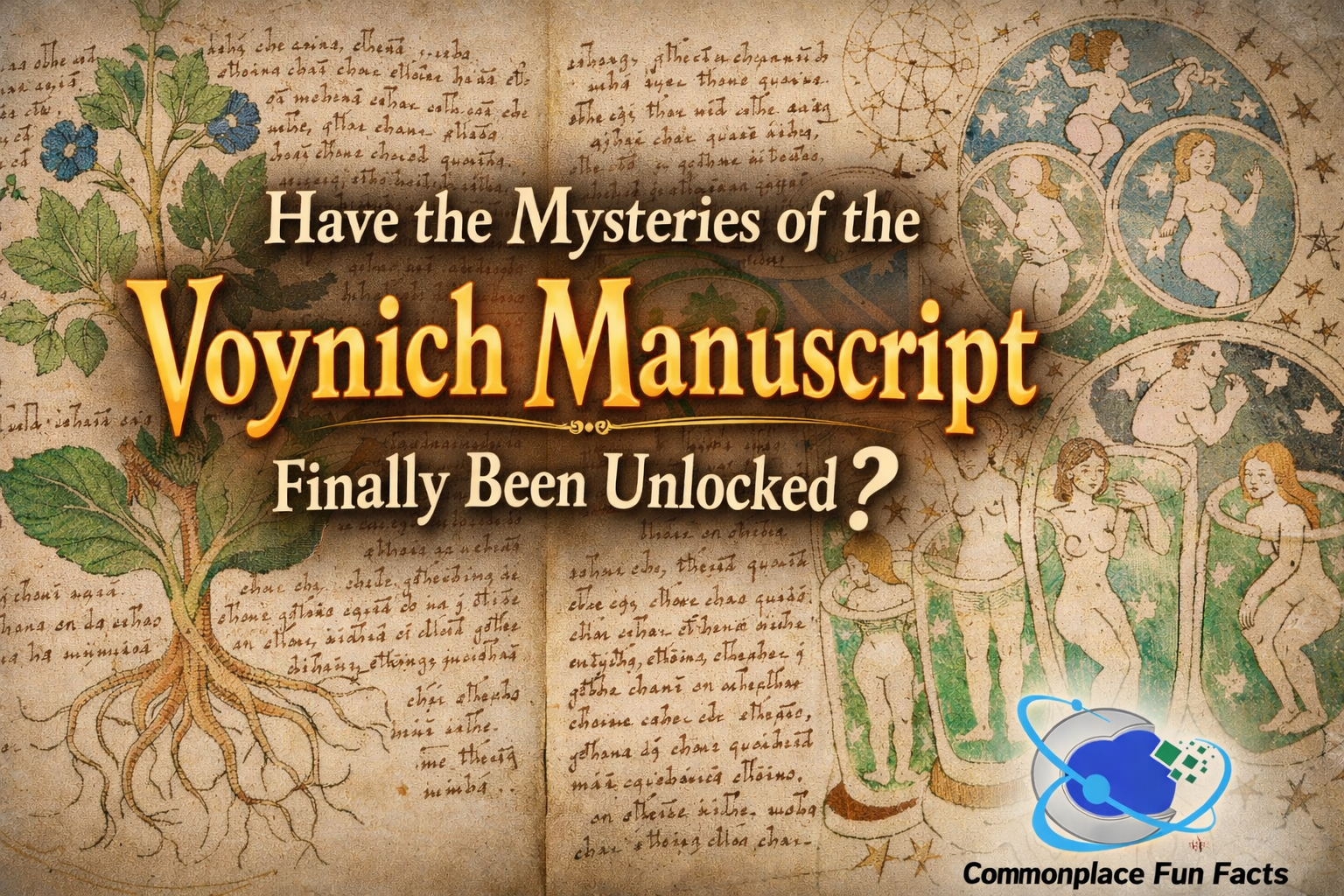

Somewhere in the 15th century, a person with excellent penmanship and questionable hobbies sat down with a stack of vellum and decided to ruin the next five centuries for cryptologists.
The result was the Voynich Manuscript, a book so baffling that it has resisted emperors, alchemists, historians, linguists, codebreakers, statisticians, and at least one guy with access to Google Translate.
Contents
The Book That Launched a Thousand Headaches
The Voynich Manuscript was created in Central Europe in the 1400s and consists of 246 pages of bound vellum. The author is unknown. The book’s name comes from Wilfrid M. Voynich, a Polish-American bookseller who acquired it in 1912 and promptly handed future generations a puzzle they did not ask for.
Like the Beale Ciphers (see “The Beale Ciphers: Do the Secrets of a Real Buried Treasure Exist in America’s Most Sacred Documents?”), the Voynich Manuscript has sparked countless theories and controversies over the years.
The manuscript first appears in documented history in the hands of Georg Baresch, a 17th-century alchemist in Prague who referred to it—without irony—as a “Sphynx” taking up space uselessly in his library. Baresch suspected it may once have belonged to Emperor Rudolf II. If that is true, the manuscript was already old enough at the time to be considered “vintage confusion.”
Plants, Stars, and Unsettling Bathtub Scenes
What makes the book extraordinary is not just its unreadable script, but its illustrations. Nearly every page is covered in botanical, astronomical, and scientific drawings in shades of green, brown, yellow, blue, and red.

The botanical section contains 113 plants that resemble nothing that has ever grown on Earth—or at least nothing we have successfully identified. Either the medieval author had access to a lost ecosystem, or he was freelancing with a quill.
The astronomical and astrological pages include radiating suns and moons, star charts, Zodiac symbols such as Taurus, Sagittarius, and Pisces, and, for reasons that remain unexplained, nude women emerging from pipes and chimneys. Medieval astronomy was clearly more flexible than modern textbooks let on.
There is also a biological section filled with miniature female figures—many with swollen abdomens—wading in greenish fluids while interacting with interconnected tubes and capsules. It looks less like a medieval medical text and more like someone’s fever dream after overindulging in monastery wine.
The manuscript also features cosmological medallions spread across fold-out pages, pharmaceutical drawings of medicinal herbs paired with colorful jars, and long pages of text that appear to be recipes, each marked with star-like flowers in the margins.
The Hoax Theory: Medieval Practical Joke?
Since the manuscript surfaced, experts have tried—and failed—to decode it. Over time, some scholars suggested the uncomfortable possibility that the whole thing might be an elaborate hoax.
Twentieth-century statistical analyses pointed out patterns in the text—too many doubled and tripled words, unusual clustering—that seemed suspicious. Perhaps someone in the 1400s simply invented a convincing-looking nonsense language and committed to the bit.
Others countered that forging such a complex book on expensive vellum would have required enormous effort and cost. If it was a prank, it was the sort that requires artisanal materials and long-term dedication. That is either impressive or deeply concerning.
Enter Alan Turing… and Eventually, Google
Among those intrigued by the manuscript was Alan Turing, the famed mathematician who helped break the Nazi Enigma code during World War II. Even he could not crack it. When you stump the man who defeated Enigma, you earn a certain cryptographic swagger.
Then a team of Canadian researchers decided to approach the mystery with 21st-century tools. In a study published in Transactions of the Association for Computational Linguistics, Bradley Hauer and Grzegorz Kondrak described using machine-learning algorithms to attempt a decipherment.
The Alphagram Hypothesis
The researchers proposed that the text might represent a vowel-less alphagram. That means the author removed the vowels from a word and then alphabetized the remaining letters. For example, “commonplace” would become cclmmnp. Elegant, maddening, and very on-brand for a medieval puzzle enthusiast.

To test their approach, they trained their algorithm on 380 translations of the United Nations’ Universal Declaration of Human Rights. After refinement, the system achieved a 97 percent success rate in identifying languages under these odd transformation rules.
So… Hebrew?
When they applied the method to the first ten pages of the Voynich Manuscript, the algorithm suggested that roughly 80 percent of the encoded words corresponded to Hebrew.
This was progress. Now they knew the language. Or at least most of it.
When a native Hebrew speaker struggled to make sense of the transformed words, the researchers turned to an assistant that never sleeps and does not demand tenure: Google Translate.
The first translated sentence appeared as: “She made recommendations to the priest, man of the house and me and people.”
It was not “Here is the secret of eternal life,” but it was undeniably sentence-shaped. In the botanical section, a 72-word sample produced translated terms such as farmer, light, air, and fire, all of which plausibly fit the illustrations.
Not So Fast
Before we declare victory, complications remain.
The algorithm only linked about 80 percent of the text to Hebrew. That leaves 20 percent potentially in another language—or in something else entirely. Even if Hebrew is correct, the manuscript would contain medieval Hebrew, not the modern usage reflected in current translation tools.
Cryptologists remain cautious. Pattern recognition can produce intriguing approximations that look meaningful without truly unlocking the structure of the underlying language. Machines are brilliant, but they are also extremely confident interns.
A Mystery That Refuses to Retire
The Voynich Manuscript has survived emperors, alchemists, world wars, professional codebreakers, and now artificial intelligence. Whether the Canadian team has genuinely cracked its code or simply uncovered an alluring statistical mirage remains to be seen.
Until then, the manuscript sits quietly in its climate-controlled home at Yale University, radiating smug mystery across half a millennium.
Somewhere, its anonymous author is either smiling in triumph or wondering why everyone is taking this so seriously.
You may also enjoy…


The Beale Ciphers: Do the Secrets of a Real Buried Treasure Exist in America’s Most Sacred Documents?
Discover the real-life buried treasure mystery of the Beale Ciphers, possibly linked to the Declaration of Independence. Explore historical facts, codebreaking legends, and modern theories behind this unsolved American enigma.

Kryptos: the Secret Code that Still Stumps the CIA
Can You Crack Kryptos? It should not be surprising that CIA Headquarters is home to some of the world’s biggest secrets. What may raise your eyebrows is the fact that one of its biggest secrets is on public display. At an agency that employs the best codebreakers in the world is an encrypted message written…




Leave a Reply