
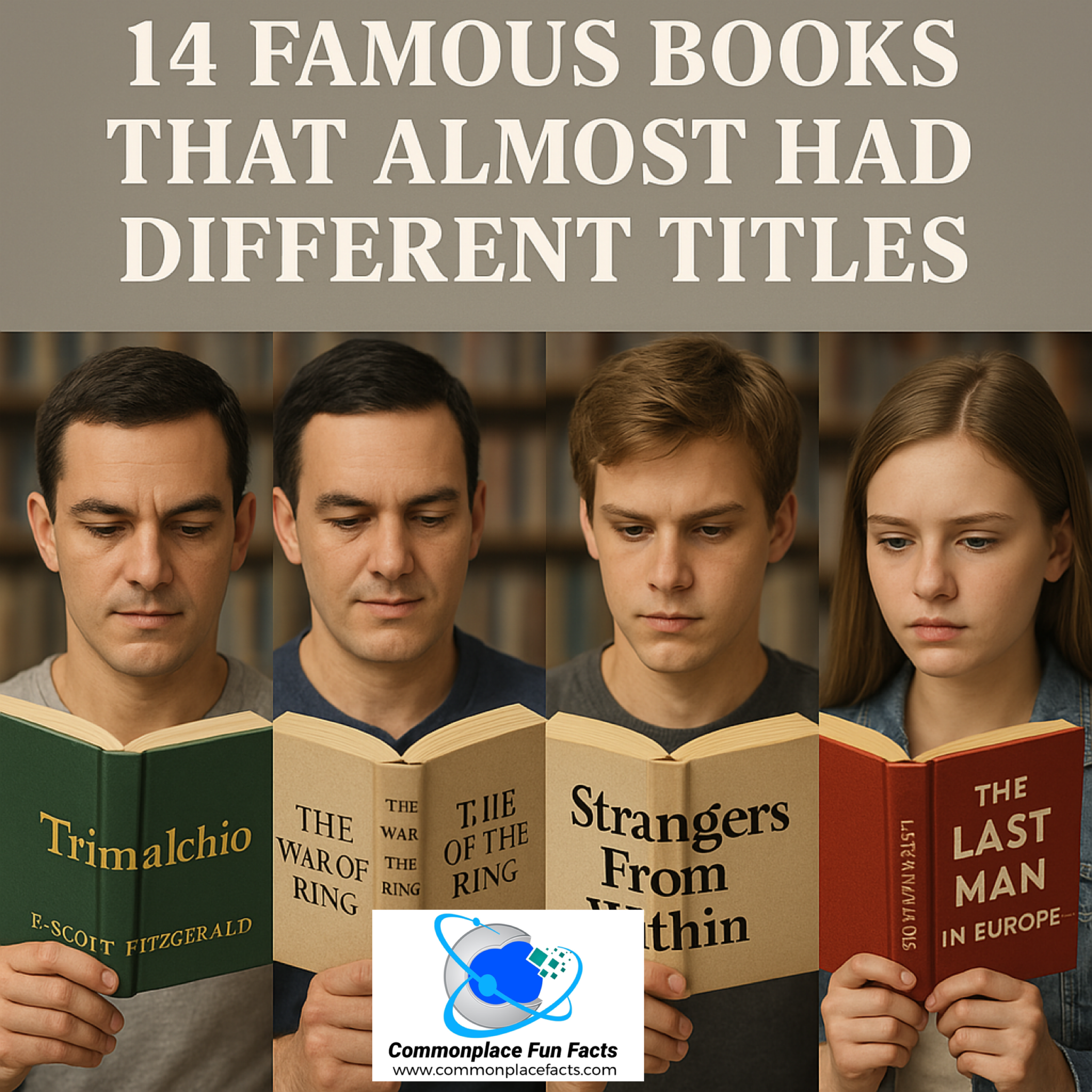

Roses — and Famous Books — By Any Other Name…
A rose by any other name may still smell as sweet, but slap the wrong label on that rose, and it might end up on the discount table instead of the bestseller list. This principle applies to flowers, baked goods, and—most importantly—famous books. After all, can you imagine a book ranking among the greats of classic literature if it had the title Trimalchio in West Egg instead of The Great Gatsby? How about Tom-All-Alone’s Factory That Got into Chancery and Never Got Out, instead of Bleak House?
Titles, like first impressions, are everything. They lure readers, set the tone, and offer a glimpse of the world that awaits between the covers. Yet, many of our beloved classics nearly stumbled out of the gate with titles that would have doomed them to the remainder bin. Let’s take a closer look at how a few famous books narrowly avoided the literary guillotine.
Contents
F. Scott Fitzgerald’s Trimalchio in West Egg
Fitzgerald had a knack for dazzling prose and tortured protagonists, but his talent for naming novels? Not so much. After considering over a hundred possible titles for his 1925 masterpiece, Fitzgerald finally settled on The Great Gatsby—but only after discarding his original pick, Trimalchio in West Egg. The reference to an ancient Roman party host might have been a clever nod to the lavish decadence of Jay Gatsby’s soirées, but it lacked the pizazz necessary to draw readers in. One can only imagine the bewildered expressions of casual bookstore browsers trying to decode what a Trimalchio was and why it mattered.
J.R.R. Tolkien’s The War of the Ring
Tolkien, who was almost turned off from writing altogether when he was told he couldn’t write about a “green great dragon”, initially considered calling his epic fantasy The War of the Ring, which would have highlighted the central conflict rather than the magical artifact that sets the entire adventure in motion. While accurate, the title lacked the mythic resonance and grandeur that The Lord of the Rings evokes. Fortunately, Tolkien recognized that a tale of Middle-earth needed a title that hinted at power, destiny, and adventure, and so The Lord of the Rings was born.
Peter Benchley’s The Jaws of Death
While he was employed at the White House, defying instructions from the President to leave his job, Peter Benchley worked on a breakout thriller about a hungry great white shark. Options included Leviathan Rising, The Shark, and A Silence in the Water. Yet, none of them quite captured the primal dread lurking beneath the surface. Pressed for time, they finally settled on a single, monosyllabic menace: Jaws. And just like that, Benchley turned a four-letter word into a cultural phenomenon.
George Orwell’s The Last Man in Europe
“1984” was almost saddled with the far grimmer title The Last Man in Europe. While Orwell’s original title certainly hinted at the novel’s desolate dystopian landscape, it lacked the punch and chilling finality that “1984” carries. Thankfully, Orwell opted for something that rolls off the tongue a bit easier and has since become shorthand for totalitarianism.
Charles Dickens’ Tom-All-Alone’s Factory That Got into Chancery and Never Got Out

Charles Dickens. A master of social commentary, satire, and…excessively verbose titles? Before settling on the elegantly bleak Bleak House, Dickens flirted with the unwieldy Tom-All-Alone’s Factory That Got into Chancery and Never Got Out. While it certainly captures the novel’s labyrinthine legal drama and the unending lawsuit of Jarndyce and Jarndyce, it reads more like a plot summary than a title. It’s a wonder Dickens didn’t scare away his audience before they even opened the book.
Jane Austen’s First Impressions
Pride and Prejudice was destined to become one of the most beloved novels in the English language, but Austen initially titled it First Impressions. While not entirely inaccurate—since Elizabeth Bennet’s initial misjudgments of Mr. Darcy are central to the plot—it lacks the bite and wit that Austen’s final choice carries. After all, Pride and Prejudice perfectly encapsulates the dual follies that ensnare the hearts of her protagonists. Ironically, Pride and Prejudice proved to make a better first impression than First Impressions.
Sinclair Lewis’s The Village Virus
Sinclair Lewis’s scathing critique of small-town hypocrisy, Main Street, almost debuted under the charmingly contagious title The Village Virus. While this might have worked for a medical thriller or a cautionary tale about pandemic paranoia, it didn’t quite capture the cultural malaise that Lewis dissected with surgical precision. Readers looking for a tale of rural discontent might have been misled into thinking they were about to embark on an epidemiological adventure.
Margaret Mitchell’s Pansy
Gone with the Wind, an epic tale of love, loss, and resilience during the American Civil War, almost found itself saddled with the title Pansy—the original name of its fiery heroine, later rechristened Scarlett O’Hara. While Pansy might have had a certain floral charm, it hardly conjures the image of a determined, headstrong woman who declares, “As God is my witness, I’ll never be hungry again!” Pansy O’Hara? Not quite the same gravitas.
Stephen Crane’s Private Fleming, His Various Battles
The Red Badge of Courage is a poignant meditation on the inner turmoil of a young soldier during the Civil War. But it almost marched into history under the significantly less gripping title, Private Fleming, His Various Battles. Nothing says “epic tale of heroism and cowardice” quite like a dry military report. Thankfully, Crane had a change of heart and opted for something that resonated beyond the battlefield.
John Steinbeck’s Something That Happened
Before it became Of Mice and Men, Steinbeck’s tragic tale of friendship and dreams was called Something That Happened. If you’re looking for a title that screams “vague shrug,” you’ve found it. It would be a good title for a book about a teenager who is desperately searching for an explanation to his parents about why the house is in utter disarray when they get home. Fortunately, Steinbeck took inspiration from Robert Burns’ poem “To a Mouse,” giving us a title that hints at the inevitable destruction of best-laid plans.
William Golding’s Strangers from Within
Before unleashing Lord of the Flies on unsuspecting readers, Golding briefly considered the much less ominous title Strangers from Within. While technically accurate—it is a story about boys stranded on an island descending into savagery—the original title sounds more like a self-help book about awkward family reunions.
Ironically, the actual plot reads an awful lot like some of our awkward family reunions.
Ray Bradbury’s The Fireman
Fahrenheit 451 almost went up in smoke under the uninspired title The Fireman. While descriptive, it lacked the symbolic weight of Fahrenheit 451, the temperature at which paper ignites. Fortunately, Bradbury did some quick research and found a title that burns a little brighter.
Joseph Heller’s Catch-18
Heller’s masterpiece was originally going to be called Catch-18, but when Leon Uris published Mila 18 around the same time, Heller’s editor suggested a quick numerical tweak. And just like that, Catch-22 was born—a term that now embodies impossible dilemmas everywhere.
Harper Lee’s Atticus
To Kill a Mockingbird almost emerged under the title Atticus, which would have put all the focus on the saintly lawyer at the expense of Scout’s coming-of-age narrative. While Atticus Finch certainly deserves his place in literary history, reducing the novel’s scope to one character would have robbed it of its broader exploration of racial injustice and moral complexity.
The Ones That (Thankfully) Got Away
These near-misses remind us that even the most brilliant writers occasionally need an editor to say, “Maybe we should sleep on that one.” Titles have the power to elevate or doom a book before a single page is turned. So next time you pick up a classic, spare a moment to thank the unsung heroes who steered those authors away from titles that might have landed their masterpieces in the bargain bin.
Because, let’s be honest, A Silence in the Water would never have kept us out of the ocean.
You may also enjoy…

The Famous Ship That Was Named By Mistake
One of the most magnificent passenger liners of the 20th century was the RMS Queen Mary. Its name became synonymous with luxury travel. Its name was also a mistake. Construction on the ship started in 1930. The Cunard Line wanted it to be the flagship of the industry, establishing the highest standards in all categories.…

The Idaho Name Hoax: How a Fake Name Became a State’s Identity
Did you know the Idaho name campaign was a hoax? Learn the fascinating history behind this made-up name and how it almost became Colorado instead!

Foreword, Preface, and Introduction: What is the Difference Between Those Extra Pages at the Front of Your Book?
Curious about the difference between the Foreword, Preface, and Introduction in books? Learn the purpose of these sections, their differences, and whether they’re worth reading. Perfect for book lovers!



Leave a Reply