


There are films that age well because time softens them.
There are films that age well because time proves them right.
And then there are films that age well because we finally catch up to how dangerous they were.
To Be or Not to Be belongs in that last category.
Directed by Ernst Lubitsch and starring Jack Benny and Carole Lombard, the 1942 comedy unfolds in occupied Warsaw, follows a troupe of actors impersonating Nazis, and includes extended jokes about Gestapo arrogance.
It premiered while World War II was still being fought.
Imagine pitching that today. Now imagine filming it while the outcome of the war was still uncertain.
This was not hindsight satire. This was humor in real time.
It is difficult to overstate how bold that was.
Contents
The Setup: Shakespeare, Warsaw, and a Terrible Audience Member
The premise is deceptively simple. A troupe of Polish actors in Warsaw specializes in theatrical melodrama. They are preparing to perform a satire titled “Gestapo” when Germany escalates its threats against Poland. The show is replaced with Hamlet. The company’s leading man, Joseph Tura (Jack Benny), steps onto the stage to perform the famous soliloquy: “To be or not to be…”
Unfortunately, one man keeps rising from his seat and leaving the theater during Tura’s speech. This man is a young RAF pilot, and he is not leaving because Shakespeare moves him beyond endurance. He is leaving because he is pursuing Tura’s wife, Maria (Carole Lombard), backstage.
Meanwhile, Europe descends into catastrophe.
When Hitler invades Poland, the theatrical troupe finds itself in the middle of a counter-espionage operation. Their talent for pretending becomes a survival strategy—stealing secrets, outwitting a Nazi spy, and bluffing their way out of occupied Warsaw. As if that weren’t complicated enough, Tura is forced to work alongside the young man who has the hots for his wife.
That collision—personal vanity, romantic jealousy, theatrical egos, and literal Nazis—should not work. It should feel grotesquely mismatched. Instead, Lubitsch makes it glide. The film pivots from drawing-room farce to espionage thriller to Shakespeare parody with an elegance that critics later described as “the Lubitsch Touch.” The touch was real: he could suggest more with a subdued scene than most directors could with a feature-length docudrama.
Ernst Lubitsch and the Art of Elegant Subversion
Ernst Lubitsch was German-born and had firsthand knowledge of what fascism looked like when it stopped being political theory and turned into national policy. He had come to Hollywood years earlier and built a reputation for sophisticated comedies full of sexual innuendo, social satire, and civilized mischief. His style wasn’t to scream. Instead, he insinuated.

When he turned his attention to Nazism, he applied the same sensibility. The villains in To Be or Not to Be are not portrayed as grand operatic monsters. They are petty. They are self-important. They are insecure bureaucrats of brutality.
Around the same time, across the Atlantic, C.S. Lewis was writing The Screwtape Letters and making a similar observation about evil’s modern wardrobe: “The greatest evil is not now done in those sordid ‘dens of crime’ that Dickens loved to paint. It is conceived and ordered (moved, seconded, carried, and minuted) in clean, carpeted, warmed and well-lighted offices by men with smooth cheeks and tidy desks.”
Lubitsch’s camera makes the same argument without theology. Tyranny, once stripped of its banners and bombast, looks less like Gothic horror and more like administrative vanity. There is something quietly subversive about reducing fascism to wounded egos and fragile pride. Fascism feeds on myth. Lubitsch gave it mockery.
Released Into Controversy
The film was shot in 1941 and released in March 1942, just months after the attack on Pearl Harbor. The United States had officially entered the war. News from Europe was grim. The occupation of Poland was not a hypothetical “what if?” nor was it a distant historical footnote. It was current events.

The reaction, at first, was icy.
Some critics accused the film of bad taste. Others wondered whether laughter had any place in stories about invasion and oppression. Bosley Crowther of The New York Times questioned whether the subject was appropriate for comedy at all: “It is hard to imagine how any one can take, without batting an eye, a shattering air raid upon Warsaw right after a sequence of farce or the spectacle of Mr. Benny playing a comedy scene with a Gestapo corpse. Mr. Lubitsch had an odd sense of humor… when he made this film.”
Lubitsch’s answer was simple: ridicule disarms tyrants. If you remove the aura, if you puncture the theatrical pageantry of power, you begin to shrink it. That idea now feels almost obvious. In 1942, it was incendiary.
The film was not a box-office disaster, but neither was it a runaway smash. It made about $2 million from a budget of about $1.4 million.
In terms of its effect on the public, it existed in a strange space—too sharp for pure escapism, too funny for solemn patriotism.
Carole Lombard: Comedy’s Last Bow

The film’s initial reception was further shadowed by tragedy. Carole Lombard, one of Hollywood’s great comic actresses, died in a plane crash on January 16, 1942—two months before the film’s release. She had been returning from a war bond rally.
To Be or Not to Be was her final completed film.
This altered how audiences watched it. Scenes intended as breezy flirtation took on elegiac undertones. Lombard’s quick timing and radiant confidence were no longer just performance—they were memory.
Lombard played her role in To Be or Not to Be with the kind of effortless bravado that made her one of Hollywood’s brightest comic stars. As Maria Tura, she played an actress whose vanity is only slightly smaller than her husband’s—and whose survival instinct is sharper than either of them initially realizes. Lombard gives Maria a dual edge: glamorous and self-aware, flirtatious yet calculating. She understands exactly how much her beauty influences the men around her, including a smitten young RAF pilot and a dangerously attentive Nazi officer. What might have been a shallow “leading lady” role becomes, in Lombard’s hands, a performance about performance itself. Maria is acting even when she is not on stage.
As the plot tightens and Warsaw falls under occupation, Lombard subtly shifts from breezy celebrity to quiet strategist. Her character becomes indispensable to the troupe’s increasingly audacious deception scheme. Lubitsch allows her to weaponize charm rather than abandon it. That tonal balance—comedy operating beside mortal danger—depends heavily on Lombard’s precision. She lands the farce without undercutting the stakes. In a film about actors pretending to be Nazis pretending to be actors, she never loses the audience.
Her chemistry with co-star Jack Benny is brilliant, and it’s hard to imagine any couple better paired. Beneath the flirtation lies a running marital contest over applause:
MARIA: You’re the greatest actor in the world. Everybody knows that, including you.
JOSEPH: Don’t be a prima dona.
MARIA: Whenever there’s a chance to take the spotlight away from me—it’s becoming ridiculous the way you grab attention. Whenever I start to tell a story, you finish it. If I go on a diet, you lose the weight. If I have a cold, you cough, and if we should ever have a baby, I’m not so sure I’d be the mother.
JOSEPH: I’m satisfied to be the father.
Jack Benny and the Comedy of Ego
Jack Benny’s Joseph Tura is, in many ways, the most brilliant element of the entire enterprise. Tura is vain. He is dramatic. He is deeply invested in his own theatrical importance. He bristles when anyone leaves during his “To be or not to be” soliloquy, even if Europe is collapsing.

This is not accidental. Lubitsch understood that mockery works best when it operates on all levels. The Nazis are foolish. Tura is foolish. Everyone is, in varying degrees, ridiculous.
It is easy to treat To Be or Not to Be as a bold political statement, a cinematic chess match between comedy and catastrophe. But for Jack Benny, it wasn’t theoretical. It was personal.
Before this film, Benny was America’s safe space. On radio, he was vain but harmless. Cheap but lovable. The kind of man who worried more about his age than the Axis powers. Audiences trusted him. Sponsors trusted him. He was comfortable.
Then he agreed to appear on screen dressed as a Nazi officer.
Friends reportedly urged him to turn it down. Sponsors were uneasy. The idea of a beloved Jewish comedian wearing the uniform of the regime persecuting Jews across Europe felt dangerous—commercially and emotionally.
And then there is the story that tells you just how close to the bone this decision cut.
When his father went to see the film and watched the opening scene—Jack in full Nazi regalia—he stood up and walked out of the theater in outrage. He could not bear it. His son, in that uniform? It was too much.
This was not marketing discomfort. This was generational pain. Jack’s father was a Jewish immigrant from Congress Poland (then part of the Russian Empire). The uniform on screen was not abstract villain costume; it was the symbol of the enemy of everything he held dear.
Fortunately, the story doesn’t end there. Jack persuaded his father to return and watch the movie properly, giving away a few plot spoilers in the process to let him know that the uniform was a force. Once his father saw the satire—once he understood the joke—he came to appreciate it. But the initial reaction matters. It tells you what Benny was risking.
He was not just gambling with his career. He was stepping directly into a symbol that represented fear for many Jewish families—including his own.
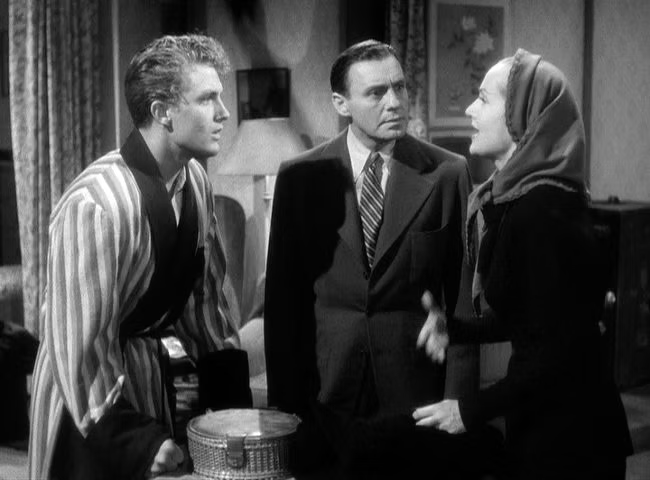
This sentiment is hilariously reflected in a scene where Tura returns home to discover that the young RAF pilot has been sleeping in his bed — and wearing his slippers. Before anyone can offer a sensible explanation, Maria bursts in announcing that she may have to kill a Nazi spy. Overwhelmed by the rapidly collapsing boundaries between marital crisis and geopolitical emergency, Tura attempts to demand clarification.
Instead, the pilot fires back: “Have you no patriotism?”
Indignant and offended in equal measure, Tura explodes:
“Now listen, you! First you walk out of my soliloquy, and then you walk into my slippers. And now you question my patriotism? I’m a good Pole. I love my country — and I love my slippers!”
And then, as if the emotional stakes needed increasing, tragedy intervened. Co-star Carole Lombard’s death two months before the film’s premiere was devastating to Benny. They were more than co-workers on a project. They were friends.
Up to that point, all of the promotional material assumed Benny’s name would take first place. He was the bigger celebrity, after all. Benny insisted, however, that Lombard’s name appear first in the film’s credits. In 1942 Hollywood, billing order mattered. It was ego currency. It was contractual territory. And Benny—whose comic persona was built around ego—quietly stepped aside.
This gesture is easy to overlook. It occupies no scene. It delivers no punchline. But it says something important about how he viewed the film after Lombard’s death. It wasn’t just a wartime satire anymore. It was a tribute.
By the time audiences laughed—hesitantly at first, then all at once—Benny was carrying more than a comic disguise. He was carrying familial tension, cultural risk, and personal grief. The uniform was not just costume. The performance was not just farce.
That weight is part of what gives the film its strange emotional electricity. Beneath the wit and timing, something else hums. It feels daring because it was daring. It feels vulnerable because it was vulnerable.
For Benny, To Be or Not to Be was not merely a clever script.
It was a risk taken in front of the entire world—at a moment when the world was on fire.
Before The Untouchables: Robert Stack in Lubitsch’s Farce
Robert Stack was still early in his career when he appeared in To Be or Not to Be, and the role marked a sharp turn away from the matinee-idol image he had been building. Cast as Lt. Stanislav Sobinski, the earnest RAF pilot hopelessly smitten with Maria Tura, Stack played youthful romanticism straight — almost painfully straight — against the inflated theatricality surrounding him. That was the joke. His sincerity becomes comic precisely because he believes everything so completely. In a film filled with actors pretending to be Nazis pretending to be actors, Stack plays the only man who is not performing.
The role did not instantly redefine his career, but it gave him early exposure in a sophisticated comedy under a major director at a time when Hollywood was still sorting out how to handle wartime narratives. Stack would later become far better known for stoic authority figures — most famously in The Untouchables and decades later as the trench-coated host of Unsolved Mysteries. Watching him here, young and romantically earnest, is like glimpsing the prototype before the casting settled. In Lubitsch’s carefully calibrated satire, Stack functions as both straight man and romantic accelerant — proof that even sincerity can be folded into farce.
The Audacity of Comedy During Catastrophe
There is a philosophical puzzle at the center of To Be or Not to Be: can laughter coexist with horror without diminishing it?
Lubitsch’s working theory appears to have been yes—but only if the laughter is aimed upward. The jokes never trivialize Poland’s suffering. They trivialize the occupiers’ self-seriousness. The Gestapo’s power is real; its mystique is not.
The film’s tone is almost paradoxical. It is light without being oblivious. It dances around the unthinkable without pretending it does not exist. The war intrudes. The stakes remain deadly serious.
This tonal balancing act is precisely why the film remains studied in film schools today. It refuses to sit neatly in a category.
Hollywood’s Warsaw
Of course, this was still Hollywood in 1941. The Warsaw on screen is constructed on soundstages. The cast is filled with European émigrés who had fled Nazism in real life. The performance of occupation carries a strange authenticity, even if it is filtered through studio sets.
There is an added layer of poignancy in knowing that some of the actors portraying Polish resistance figures had themselves escaped regimes not unlike the one being mocked onscreen.
Art was not just imitating life. It was processing it.
How It Is Viewed Today—Especially in Poland
Over time, critics began to reassess the film. What had been called tasteless came to be seen as daring. What seemed flippant began to look morally defiant.
It is when we look at its reputation in Poland that things become particularly interesting.

Poland’s relationship to WWII representation is serious, complex, and understandably protective. The occupation was not distant or hypothetical. It was catastrophic. Any artistic depiction of that period is weighed against memory, history, and national trauma.
In that context, To Be or Not to Be occupies an unusual space. It is not a Polish production. It is not solemn. It is a Hollywood comedy set during one of the darkest chapters in Polish history.
And yet, the film continues to be screened and discussed in Poland. It carries the Polish title Być albo nie być and appears in retrospectives and film societies. Contemporary Polish audiences and critics often acknowledge its tonal daring. Rather than viewing it as trivializing the occupation, many recognize the weaponization of humor against totalitarianism.
That said, the reception is not simplistic cheerfulness. WWII memory politics remain live issues in Poland. Artistic portrayals are evaluated carefully. The fact that To Be or Not to Be continues to circulate suggests that it has cleared a high historical bar.
Why It Aged Better Than Its Critics Expected
Time has clarified what 1942 critics could not fully see: the film was not trivializing horror. It was denying it theatrical grandeur.
Fascism, like bad theater, relies on spectacle. It choreographs symbolism, uniforms, and parades to create an illusion of inevitability. Lubitsch dismantled that spectacle by treating it as farce.
Audiences today, accustomed to satire aimed at every conceivable political figure, may not immediately grasp how radical that approach felt in 1942. At the time, the Nazis were not punchlines. They were advancing armies.
The film’s endurance lies in its refusal to surrender humor to fear.
The Cultural Afterlife

In 1983, Mel Brooks remade To Be or Not to Be, starring himself and Anne Bancroft. Brooks, whose own comedy career often revolved around lampooning dictators and authoritarian absurdity, paid explicit homage to Lubitsch while dialling up the broader humor.
The existence of the remake confirms the original’s lasting influence. The 1942 version established a template: theatrical disguise, mistaken identity, tyrants undone by their own pompous self-regard.
Even beyond its remake, the film has quietly shaped the tradition of mocking authoritarian figures. From late-night monologues to political satire programs, the notion that ridicule is a democratic act owes something to Lubitsch.
The Strange Power of Laughter
There is something almost metaphysical about satire in wartime. It suggests that tyranny, no matter how brutal, cannot monopolize meaning. It cannot control interpretation. It cannot prevent someone somewhere from laughing at its absurdity.
Lubitsch was not naïve. Laughter does not stop bullets. It does not liberate occupied cities. But it disrupts the mythology of invincibility. It reminds audiences that dictators depend on belief in their own inevitability.
Strip that belief, and something cracks.
The Final Word
To Be or Not to Be remains one of the most daring comedies ever produced in Hollywood—not because it is edgy in a modern, self-conscious way, but because it was genuinely risky at the moment of its release.
It fused theatrical farce with geopolitical catastrophe and somehow created a coherent whole. It survived initial critical chill. It outlived controversy. It became a touchstone for political satire. It remains programmed and debated, including in the very country whose wartime suffering forms its backdrop.
And it reminds us, quietly and persistently, that ridicule can be a form of resistance.
Joseph Tura begins each performance with Shakespeare’s existential dilemma: “To be or not to be…”
Lubitsch’s film answered with something braver than philosophy.
To laugh—or not to laugh—was the question.
In 1942, Lubitsch chose laughter.
History has largely agreed.
Watch the full film: To Be or Not to Be, directed by Ernst Lubitsch.
You may also enjoy…

The Jack Benny Program: How Silence, Timing, and Character Transformed American Comedy
The Jack Benny Program transformed American comedy using silence, timing, and unforgettable characters—proving that the loudest joke on radio could be saying nothing at all.

Kolberg: The Movie That Tried (and Failed) to Save the Third Reich and Probably Shortened the War
Discover the story behind Kolberg, Nazi Germany’s most expensive propaganda film. Learn how Goebbels’ ambitious WWII project became an epic failure.

Here’s Looking at You, Casablanca: The Accidental Magic of a Movie Classic
Discover the surprising history, unforgettable quotes, and behind-the-scenes chaos that made Casablanca a timeless movie classic. From Bogart’s improvised lines to fog machines and a fake piano player, this article reveals the accidental magic behind the legend.




Leave a Reply to cat9984Cancel reply