

There are certain technological breakthroughs that make perfect sense in hindsight. The light bulb. The automobile. The internet.
And then there is the barbed wire telephone.
This one requires a slightly different kind of mental adjustment.
Because at some point in the late 19th century, a group of very practical, very isolated Americans looked at a fence—specifically, a fence covered in sharp metal spikes designed to discourage both livestock and bad decisions—and concluded that it would also make an excellent communication network.
They plugged telephones into fences and started making calls.
This is much more than “good fences make good neighbors.” It introduces an entirely new twist on the idea: sometimes the thing meant to keep you apart becomes the very thing that lets you reach out and touch someone—preferably without also touching the barbs.
And in one of history’s more unexpected plot twists, it worked well enough to connect entire communities.
Contents
What Is a Barbed Wire Telephone?
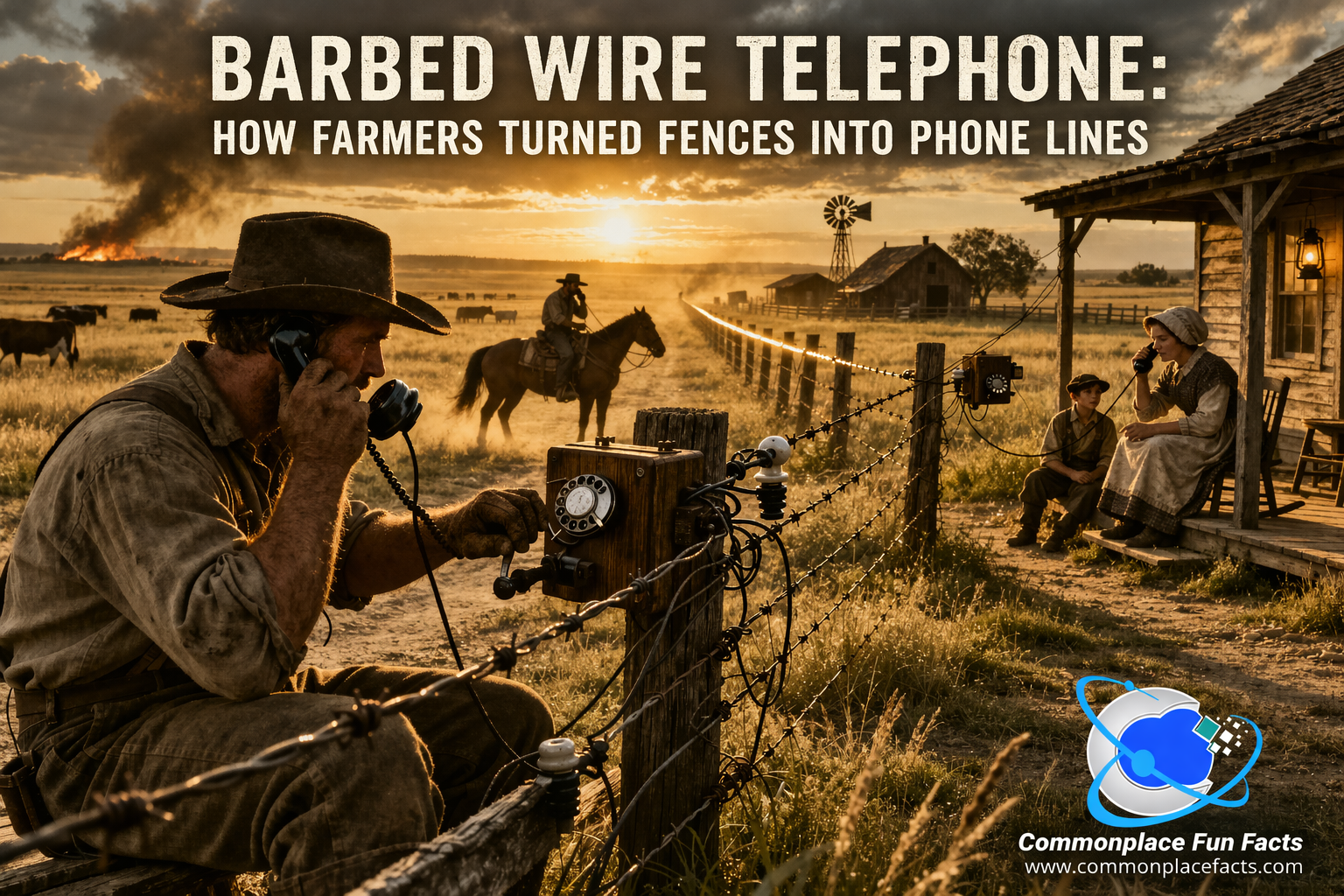
A barbed wire telephone was a makeshift communication system used in rural America in the late 1800s and early 1900s, where farmers transmitted voice signals through metal fence wires instead of dedicated telephone lines.
If that sounds like something that should not work, that is because it absolutely should not work—at least not according to anyone who prefers their infrastructure to involve planning, quality control, and reliability.
But rural Americans were not overly burdened by such concerns. Farmers, after all, have always shown a remarkable willingness to be innovative, frugal, and to think well outside the (telephone) box.
How the Barbed Wire Telephone Was Invented
To understand how this came about, we need to revisit two inventions that arrived within two years of each other, each minding its own business and having no expectation of being dragged into this story together.
The first was barbed wire, patented in 1874 by Joseph Glidden, who took a fairly simple idea—twisting wire with sharp barbs—and turned it into one of the most consequential tools in American history. It allowed farmers and ranchers to fence large areas of land cheaply and effectively, transforming the open range into a patchwork of enclosed property. The American West was, quite literally, stitched together with wire.

The second was the telephone, patented in 1876 by Alexander Graham Bell, who demonstrated that the human voice could be converted into electrical signals and transmitted over a wire. Early telephones were relatively simple devices, relying on basic circuits and batteries, but they opened the door to real-time communication over distance in a way that must have seemed borderline magical at the time.
Individually, these inventions made perfect sense. Together, they sound like the setup to a joke that ends with someone believing they can start a fire by urinating on an electric fence (for more information, see: my cousin from the big city whenever he visited the family farm). Yet the connection between them was surprisingly logical once you removed the assumption that infrastructure needed to be professionally designed.
By the late 1800s, barbed wire had spread across the Great Plains, creating miles upon miles of continuous metal fencing. At the same time, telephone companies were focusing almost exclusively on cities, where customers were closer together and profits were easier to justify. Rural customers, scattered across vast distances, were expensive to serve and therefore largely ignored.
This left farmers with a problem and, more importantly, with time to think about it. They already understood fences. They understood wire. They may not have fully understood the finer points of electrical engineering, but they understood enough to recognize that a metal wire stretched over long distances might be capable of carrying a signal.
So they improvised. They connected their telephones directly to the nearest fence and discovered that the signal traveled. It was not always clear, it was not always reliable, and it was certainly not what the inventors of either technology had in mind, but it worked well enough to be useful.
And in that moment—somewhere between practical necessity and creative problem-solving—the barbed wire telephone quietly came into existence.
How Barbed Wire Telephone Systems Worked
The setup was beautifully simple, which is usually a sign that something either works brilliantly or is about to cause a series of memorable problems. In this case, it did both.
A farmer would run a smooth wire from a telephone inside the house or barn to the nearest fence. That wire was attached—typically to the top strand—and the electrical signal traveled along the barbed wire to any other telephones connected to the same line. As long as there was a reasonably continuous stretch of metal, the message had a way of getting where it needed to go.
In some cases, a single fence line connected 20 or more homes, creating an entire communication network out of what had previously been a very effective way to keep livestock from exploring their options.
This was not a network designed by engineers in a lab. It was a network built by people who had fencing, basic tools, and a strong preference for solving problems immediately rather than waiting for someone else to solve them later.
That said, the system came with a number of complications, most of which could be traced back to the inconvenient fact that fences were originally designed for cattle, not communication. Fence lines did not run neatly across roads or rivers, which meant gaps had to be bridged with improvised wiring. Weather had a tendency to interfere with signals, sometimes turning conversations into a game of educated guesswork. And then there were the cows, who, having no formal training in telecommunications, occasionally disrupted service in ways that were both unpredictable and entirely on brand.
Despite all of this, the system worked well enough to become a widespread feature of rural life. It was not perfect, but it was practical, and in many cases it was the only option available—which, historically speaking, is often the exact combination needed for something to catch on.
How Barbed Wire Party Line Telephones Worked
If you are wondering how multiple households shared a single fence without descending into total chaos, the answer is that they managed to achieve something much more impressive: organized chaos.

These systems operated as what was known as a party line, a concept that is about as familiar to modern readers as a household with a single television that everyone agrees to watch at the same time. In a party line system, multiple homes were connected to the same circuit, meaning there was no such thing as a private line. Everyone was, quite literally, on the same wavelength.
When one person placed a call, every phone connected to that fence line rang. To bring at least a minimal level of order to the situation, users developed distinctive ring patterns so people would know who the call was intended for. One long ring followed by a short one might signal one household, while two short rings might indicate another. A continuous ringing pattern usually meant something urgent had happened and everyone should pay attention immediately.
This system worked surprisingly well, provided that everyone agreed to mind their own business and only pick up the phone when their signal came through. That agreement, while admirable in theory, did not survive prolonged exposure to human nature.
Eavesdropping quickly became a routine part of life. People listened in on conversations, sometimes out of curiosity and sometimes out of a perfectly reasonable desire to stay informed about what was happening in the community. News spread quickly, whether it involved weather, local events, or the kind of personal updates that would today be described as “not intended for public consumption.”
At times, the line even took on a more communal role. Some users would play music into the receiver or read the newspaper aloud, effectively turning the network into a shared source of entertainment. In that sense, the barbed wire telephone was not just a communication system; it was also a social network, a news service, and a neighborhood information exchange, all carried over a fence that was originally intended to keep cows from wandering off and making poor life choices.
Why Farmers Built Their Own Telephone Networks
The motivation behind all of this was not novelty. It was necessity, the kind that tends to produce creative solutions whether or not anyone has formally approved them.
Rural communities were often separated by miles of land, which meant communication was slow under the best of circumstances and dangerously slow under the worst. A message might require a long ride, good weather, and a willingness to interrupt whatever a neighbor was doing at the time. In an emergency, those delays could matter a great deal.
The barbed wire telephone offered a way around that problem. Farmers could report prairie fires before they spread too far, share weather updates that affected planting or harvest, coordinate work across large properties, and keep in touch with neighbors who might otherwise be little more than distant figures on the horizon.
Just as importantly, these networks made rural life feel less isolated. They created a sense of connection that had previously been difficult to maintain when distance was measured not in minutes, but in miles. Conversations that once required planning and travel could now happen with the turn of a crank and a bit of patience.
It turns out that even the most self-reliant individuals appreciate a good conversation, particularly when it does not involve saddling a horse, packing provisions, and committing a portion of the day to what is, at its core, a brief exchange of information that could have been handled in a few minutes if only someone had thought to plug a telephone into a fence.
The Most Connected Isolation in History
One of the more surprising facts about early rural communication is that, by 1912, farm households were in many cases more likely to have telephones than their urban counterparts.
This was not because rural areas were ahead of the curve in infrastructure planning. It was because they had quietly decided that infrastructure planning was optional. Systems like the barbed wire telephone allowed communities to build their own networks without waiting for a company to arrive, conduct a feasibility study, and eventually decide that the whole thing sounded expensive.
The result was a curious paradox. People living miles apart, separated by fields, fences, and the occasional stubborn cow, were often more connected to each other than people living in crowded cities. They could share news, coordinate work, and check in on one another with a level of immediacy that had previously been impossible.
They were isolated, but they were not alone. And in many cases, they were better informed about their neighbors than their neighbors might have preferred.
The Technical Side (Or, Why This Worked at All)
At its core, the barbed wire telephone worked because early telephone systems were remarkably simple, at least by modern standards. They relied on basic low-power electrical circuits powered by batteries, and as long as there was a continuous conductive path, the signal could travel from one point to another.
A long stretch of metal wire, even one originally intended to keep livestock from pursuing independent adventures, was sufficient for the job. In some setups, the system even used the ground as part of the return path, which simplified things further and reduced the need for additional wiring.
This simplicity made it possible for farmers to connect directly to existing fence lines without modification or specialized equipment. It did not require a degree in electrical engineering so much as a working understanding that electricity tends to follow metal when given the opportunity.
Which is a polite way of saying that if you had wire, you had a network, whether or not anyone had officially declared it one.
The Downsides (There Were a Few)
While ingenious, the system was not without its drawbacks, most of which became apparent shortly after someone tried to use it in less-than-ideal conditions.

Privacy was nonexistent. Conversations were shared by default, and the concept of a confidential call required either extraordinary discipline or a willingness to pretend that no one else was listening. Neither option proved especially popular.
Reliability was also an issue. Weather could interfere with signals, turning conversations into a series of educated guesses and optimistic interpretations. Fence lines could break, gaps could appear, and livestock—who had not been consulted during the design phase—could disrupt the system in ways that were both unpredictable and entirely consistent with their general approach to life.
Sound quality was variable, a term that in this context covered everything from “perfectly understandable” to “possibly Morse code, possibly a sneeze.” If too many people picked up their receivers at once, the signal could weaken to the point of uselessness, creating a situation that will feel familiar to anyone who has ever attempted to use Wi-Fi in a crowded airport.
Despite all of this, the system persisted, largely because the alternative was silence. For a network that cost almost nothing to maintain, it delivered enough value to make its shortcomings acceptable.
From Improvisation to Community Infrastructure
In some areas, these systems evolved from improvised solutions into something approaching organized infrastructure. Communities formed networks that covered large areas, and in certain cases, a central operator would be appointed to manage calls during specific hours.
This added a layer of coordination that made the system more efficient, even if it still relied on fences that had been designed with entirely different priorities in mind. Calls could be routed, messages could be passed along, and the network began to resemble a more traditional telephone system, albeit one with significantly more barbs.
What makes this particularly remarkable is that it functioned without the hallmarks of modern telecommunications. There were no corporate headquarters, no billing departments, and no customer service lines where you could spend an hour explaining that your connection had been disrupted by a cow.
It was, in many ways, an early example of a decentralized communication network, built and maintained by the very people who depended on it.
Why Barbed Wire Telephone Systems Disappeared
Eventually, formal telephone infrastructure expanded into rural areas, bringing with it clearer signals, greater reliability, and the novel concept of a private conversation. As these systems became more accessible, the need for improvised solutions declined.
Standardization and regulation also played a role, as informal networks gave way to organized telecommunications systems that were designed, installed, and maintained according to consistent guidelines. This had the added benefit of reducing the number of outages caused by weather, livestock, and creative wiring solutions.
Even so, the barbed wire telephone proved remarkably persistent. In some regions, it remained in use well into the mid-20th century, long after more conventional systems had become available.
Which means that somewhere, during the era of disco, someone may have been standing next to a fence, holding a telephone receiver, and having a perfectly normal conversation.
Frequently Asked Questions About Barbed Wire Telephones
What is a barbed wire telephone?
A barbed wire telephone was a rural communication system that used fence wire to transmit voice signals between homes instead of traditional telephone lines.
How did barbed wire phone systems work?
They worked by connecting telephones directly to metal fence wires, allowing electrical signals to travel along the fence and reach other connected phones.
Why did farmers use fences as phone lines?
Because telephone companies did not serve rural areas, farmers used existing barbed wire fences as a low-cost way to create their own communication networks.
When were barbed wire telephones used?
They were most common in the late 1800s and early 1900s, though some systems remained in use into the mid-20th century.
The Legacy of the Barbed Wire Telephone
At first glance, the barbed wire telephone seems like a historical curiosity, the sort of story that prompts a moment of amusement before being filed away under “things people used to do before better options existed.”
But it represents something more enduring than that.
It demonstrates that innovation does not always arrive fully formed from a laboratory or a corporate office. Sometimes it emerges from practical necessity, shaped by people who look at what they already have and ask whether it might serve a purpose beyond its original design. After all, a medical crisis—an outbreak of measles—helped give rise to the use of telephone numbers, so it seems only fitting that other chapters in the telephone’s story would be shaped by whatever problems people were facing at the time.
Barbed wire, a tool intended to divide land and control movement, became a means of connection. It linked neighbors, shared information, and helped build communities across distances that would otherwise have remained isolating.
It is much more than an example of “good fences make good neighbors.” It suggests something far more interesting: that, under the right circumstances, a fence can do both. It can mark the boundary between people, and at the same time become the thing that allows them to reach across it.
And in doing so, it illustrates one of the more reliable patterns in the history of technology. When faced with a problem, people rarely wait for the perfect solution. They find something that works, improve it as they go, and occasionally turn a livestock barrier into a communications network.
You may also enjoy…

Who Invented the Telephone? The Messy Truth About Bell, His Rivals, and Impeccable Timing
Who invented the telephone? A light-hearted deep dive into Bell, Gray, Meucci, patents, paperwork, and the messy reality behind a famous invention.

How Did a Measles Outbreak Lead to the Use of Telephone Numbers?
As events such as the COVID-19 outbreak affecting the ability to travel, many people are grateful for the option of picking up a phone, dialing a number, and being able to speak with people on the other side of the world. Surprising as it may seem, it was because of an infectious disease outbreak nearly…

First White House Phone Number: 1 Easy Way to Remember
Ever have trouble remembering your phone number? You wouldn’t if you had the first White House phone number.







Leave a Reply