
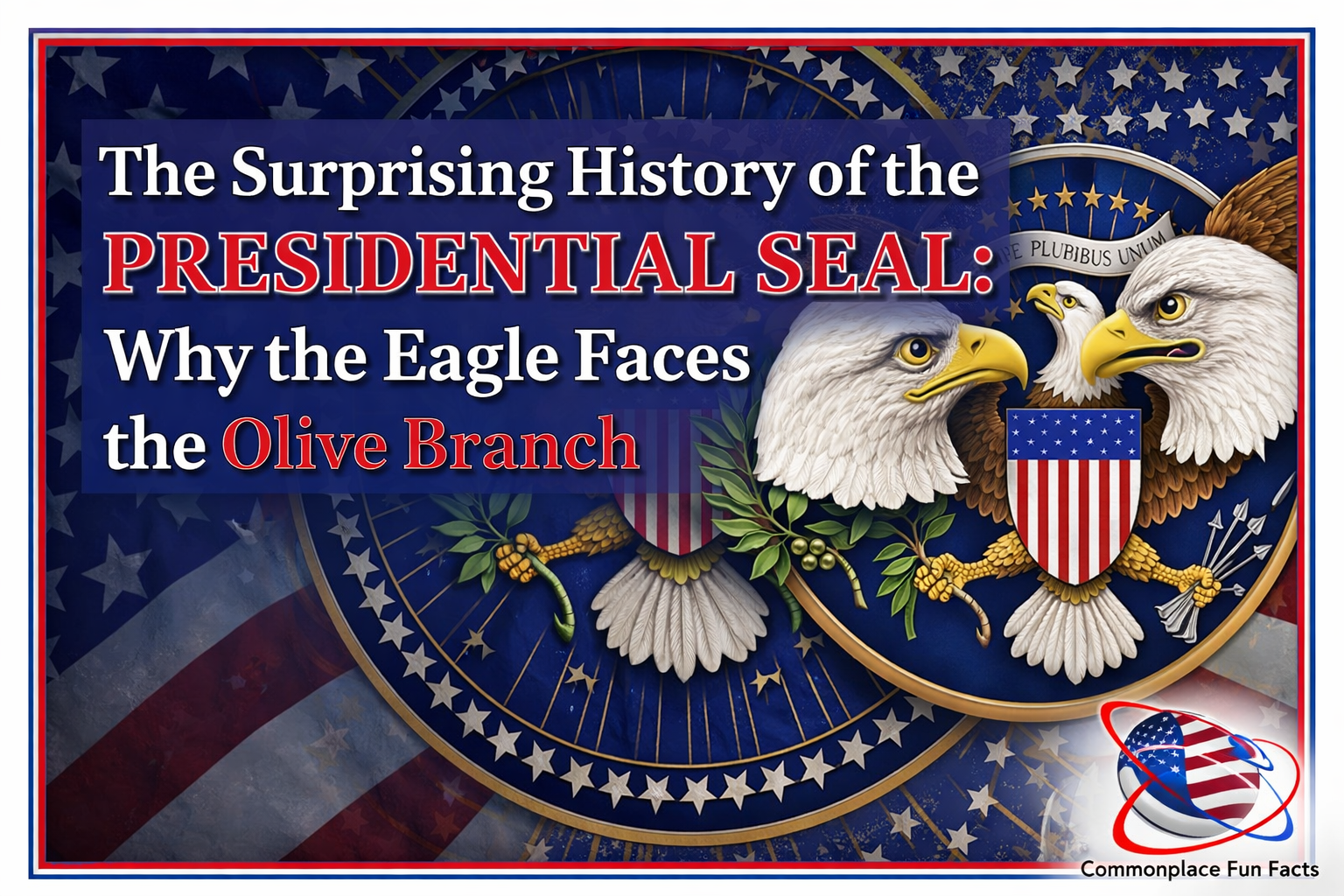

The seal of the president of the United States is one of those familiar symbols that most of us recognize instantly and almost none of us spend much time thinking about. It appears on podiums, documents, flags, lecterns, aircraft, carpets, walls, and the bath towels that important people swipe when they think no one is looking. It is so omnipresent that it has acquired the peculiar quality of background wallpaper for power. It is always there, staring nobly into the middle distance like a bird that has accepted both destiny and a full-time government job.
That bird, of course, is the American eagle, clutching an olive branch in one talon and arrows in the other. The symbolism is not especially subtle. The United States prefers peace, but it would also like everyone to know that it has a handy quiver of arrows, just in case we need to rumble.
What is less widely known is that the direction of the eagle’s head has faced different directions over the past 250 years, seemingly being undecided about its preference for olives or arrows. The bird’s view has been the subject of genuine presidential attention, formal executive action, and one of Winston Churchill’s better one-liners.
Before the eagle began signaling America’s philosophical preferences with the subtlety of a weather vane, the presidential seal itself was something of a work in progress. In its early years, it was less a fixed symbol and more a developing concept—proof that even a new republic sometimes needs a few drafts before settling on its official look.
Contents
Before the Bird Became a Branding Exercise
The history of the presidential seal is a little messier than one might think. The United States had a Great Seal from the early days of the republic, but the presidency did not immediately have one neat, fixed, universally standardized emblem. Early presidents used versions of arms and devices that drew heavily from the Great Seal, but there was no single official design locked down at the outset like some sacred national logo handed down from the mountaintop.

In other words, the early presidents were still figuring out what the office itself looked like before it had consistent graphic design. This is probably the most American thing imaginable.
The Great Seal, approved in 1782, established the core imagery: an eagle, a shield, an olive branch, arrows, and the motto E Pluribus Unum. That provided the symbolic vocabulary. What it did not do was instantly produce a permanent, legally precise presidential seal in the form people now know.
The eagle, of course, has been part of American symbolism from the beginning. While no particular eagle can claim to have sat for an official portrait for a seal, we do know that one bird managed to make his way onto the country’s money. Beginning in 1836, an eagle named Peter appeared on United States currency. If you have ever wondered what it takes for a bird to break into federal branding, Peter’s résumé is worth a look.
For much of the nineteenth century, presidential insignia evolved in a looser, more informal way. Designs appeared on invitations, stationery, and ceremonial objects, and they varied. The basic ingredients were recognizable, but the exact arrangement was not set in stone. It was more like a family recipe passed around between generations, with each one claiming theirs was the real version while quietly changing the seasoning.
How the Eagle Ended Up Looking the “Wrong” Way
The modern presidential seal took shape gradually, especially in the late nineteenth century. A significant step came during the administration of Rutherford B. Hayes, when a version of the presidential coat of arms appeared on White House invitations in 1877. That design is important because it served as a direct ancestor of the modern seal.

It also introduced the detail that would later become surprisingly important: the eagle was shown facing to its own left, which meant it was looking toward the arrows rather than the olive branch.
Now, this was not necessarily treated at the time as some dramatic policy declaration. No one was holding emergency cabinet meetings to discuss the bird’s neck angle. It seems to have been simply how the design was drawn. Yet once a symbol becomes familiar, people begin to read meaning into every line, flourish, and feather. That is how humans work. Give us an emblem and we will eventually build a mythology around it.
By the early twentieth century, the left-facing eagle had become the established look of presidential insignia. A 1916 redesign of the presidential flag under Woodrow Wilson kept the eagle facing the arrows. That visual arrangement became even more widely associated with presidential symbolism, and by then it had enough official weight that the direction of the bird’s gaze started to seem meaningful whether or not it had originally been intended that way.
Meanwhile, heraldry experts had a note. In heraldic tradition, the right side, known as dexter, is the position of honor. The eagle on a coat of arms would ordinarily face that direction unless a description specifically required otherwise. The presidential eagle, by facing left, was doing something slightly odd from a heraldic standpoint. This was not a constitutional crisis, but it did bother people whose professional lives involved caring very deeply about where symbolic animals were looking. Every civilization has such people. Thank goodness, frankly, because without them half our official symbols would probably be upside down.
Franklin Roosevelt Starts the Process
The changes that resulted in the version currently used began during the Franklin D. Roosevelt administration. Near the end of World War II, Roosevelt asked for a review of the presidential seal and flag. He and others, including heraldic specialists, considered whether the design should be updated and standardized in a more coherent and historically correct form.
Part of that discussion centered on the eagle’s direction. Since the bird on the Great Seal faced to its own right, and since heraldic custom favored that orientation, there was good reason to bring the presidential version into alignment. There was also an obvious symbolic advantage. If the eagle turned toward the olive branch, the presidency could project peace without surrendering any of the arrows. It was a diplomatic upgrade accomplished entirely through avian posture.
Roosevelt died in April 1945 before he could finalize the change. The task then fell to his successor, Harry Truman, who had inherited not merely a presidency but also a world that had become alarmingly complicated. World War II was nearing its end, the atomic age had arrived, and the United States was stepping into a role as a global superpower whether it felt entirely ready or not.
Under those circumstances, symbols mattered. Perhaps not as much as armies, elections, treaties, or industrial capacity, but they mattered. They expressed what a nation wanted to say about itself, especially when it stood at the threshold of a new era.
Truman Turns the Eagle Toward Peace
On October 25, 1945, Truman signed Executive Order 9646, which officially defined the coat of arms, seal, and flag of the president of the United States. This was the moment the design was standardized in the form that is essentially still used today.

The most famous change was the direction of the eagle’s head. Under the new design, the eagle faced to its own right, toward the olive branch in its right talon, rather than toward the arrows in its left. The symbolism was made explicit at the time: the nation was dedicated to peace.
That did not mean the arrows vanished. America was not turning into a giant Hallmark card. The arrows remained firmly in place, and there were thirteen of them, just as there had long been thirteen leaves and thirteen olives on the branch, echoing the original states and the nation’s foundational symbolism. The message was not disarmament. It was preference. The United States would like peace, thank you very much, but it had not become naive.
The redesign also added a ring of stars around the seal corresponding to the number of states in the Union at the time. In 1945, that meant forty-eight stars. Later, Alaska and Hawaii would require updates, but Truman’s version established the basic template still recognized today.
There is something almost charming about the fact that, amid the aftermath of the deadliest war in human history, part of the work of statecraft involved rotating a bird’s head so it looked at the nicer object in its collection.
Churchill Notices the Fine Print
The change to the presidential seal might have seemed like a small matter—just a slight adjustment in the direction of a bird’s gaze—but not everyone was content to let the symbolism sit quietly without comment. Enter Winston Churchill, who had made a career out of noticing when symbols and reality did not quite line up.

In 1946, during a conversation with President Harry S. Truman aboard a train, the newly redesigned seal came up. Truman explained the change with understandable pride: the eagle now faced the olive branch, emphasizing America’s commitment to peace. It was a tidy bit of symbolism, especially appealing in the uneasy calm that followed World War II.
Churchill listened, considered the matter, and then offered what may be one of the most efficient critiques of twentieth-century geopolitics ever delivered in a single sentence. He suggested that the eagle’s head ought to be placed on a swivel so that it could turn toward either the olive branch or the arrows as circumstances require.
Beneath the humor is a wry acknowledgment that nations may sincerely prefer peace, but history has a habit of interrupting those preferences with inconvenient urgency.
Churchill had, by this point, extensive experience with that problem.
His comment also quietly dismantled the comforting idea that symbolism can resolve complexity. It is one thing for the eagle to face the olive branch on paper. It is another thing entirely for a global power to operate in a world where peace and war remain permanently within reach. Posture, as Churchill understood, can shift far more quickly than official design.
The Myth That Would Not Die
At some point, Americans began repeating a story that the presidential seal changes in times of war. According to this tale, the eagle normally faces the olive branch during peace but is turned toward the arrows whenever the nation goes to war.
This is a wonderful story in the sense that it sounds dramatic, cinematic, and exactly like something a television writer would come up with after forty-five seconds of extensive historical research. It is also false.
There is no official wartime version of the presidential seal in which the eagle is turned toward the arrows as conflicts arise. The seal does not rotate based on current military engagements. No White House aide is dispatched to update government décor every time international relations become spicy.
The myth likely grew because the major redesign happened at the end of World War II, which encouraged people to imagine that the direction must have been linked to wartime or peacetime status. Popular culture helped this along, because fictional Washington loves nothing more than symbolic gestures of terrifying elegance. Real government, by contrast, tends to involve committee review, archival consultation, and someone asking whether procurement approved the fabric order.
Why the Seal Matters More Than It Seems
At first glance, all this may appear to be a lot of fuss over decorative art. Why should anyone care where the eagle is looking?
The answer is that official symbols are part of how governments present themselves to their own people and to the world. The presidential seal is not merely ornamentation. It appears in moments of authority, ceremony, crisis, persuasion, and national performance. It is a visual shorthand for the office itself.
That means even small design choices can carry meaning. Turning the eagle toward the olive branch in 1945 signaled that the United States, emerging from war and entering the uncertain architecture of the postwar world, wanted to define itself as peace-seeking rather than war-hungry. At the same time, keeping the arrows visible acknowledged that peace was not the same thing as passivity.
This was especially significant in the opening chapter of the Cold War. America was not retreating from global power. Quite the opposite. Yet it wanted that power clothed in a language of peace, order, responsibility, and legitimacy. The redesign of the seal fit neatly into that broader story.
It also helped that the revised version corrected the heraldic oddity of the left-facing eagle. In effect, the change made the design more traditional and more symbolic at the same time. It was both an aesthetic cleanup and a message.
The Seal Since Truman
Since Truman’s executive order, the central design has remained stable. Later administrations updated the number of stars to reflect the admission of Alaska and Hawaii, but the eagle has continued to face the olive branch. The neck has not, as far as anyone can tell, been mounted on Churchill’s proposed swivel.

The seal itself remains tightly controlled in its official use. The actual physical die is used for very specific purposes, particularly on presidential correspondence to Congress. What most people see in public settings are facsimiles on flags, podiums, vehicles, and assorted emblems of executive gravitas. Even so, the image has become one of the most recognizable insignia in the world.
It has also inspired endless imitation, parody, and appropriation. Political campaigns, television shows, satirists, and pop culture designers love to produce their own versions. This is perhaps inevitable. Once a symbol becomes iconic, everyone wants to borrow it to look important, mock importance, or sell T-shirts.
The real version, though, carries an unusually compact summary of American self-image: union, power, peace, war, national continuity, and the presidency as the visible face of all that complicated machinery.
A Bird, a Branch, and a Bunch of Arrows
The history of the presidential seal turns out to be about much more than a decorative eagle. It is about how symbols evolve, how myths attach themselves to official imagery, and how a change that seems tiny can reveal an entire philosophy of national posture.
Truman’s redesign did not transform the office of the presidency, end conflict, or eliminate the tensions of American power. What it did do was articulate, in one visual adjustment, the idea that the nation should face peace first. The arrows remained, because realism demanded them. The olive branch got the stare, because aspiration required that too.
Churchill’s remark remains the perfect final note because it refuses to let the symbolism become too self-satisfied. Yes, the eagle should face peace. That is noble. That is admirable. That is exactly what everyone hopes.
It would still be helpful, he suggested, if the bird could keep a the arrows at the ready.
Ironically, a government logo is probably the best description of sound foreign policy.
You may also enjoy…

47 Fun Facts About the Presidents
How much do you know about the 46 presidents of the United States? Here are some fun facts about the presidents to test your knowledge.

When the British Burned the White House and Nature Fought Back: The War of 1812’s Weirdest Day
Discover the fiery tale of the day the British burned the White House, Dolley Madison’s heroism, British mockery, a mythic tornado, and the truth behind the White House name. A wild chapter in U.S. history!

The Truman White House Renovations: The Ultimate Rental House Fixer-Upper
Explore the most extensive renovations ever done at the White House.


Leave a Reply