

There was a time when humanity looked at the atom—not with existential dread—but with the same excitement usually reserved for a new kitchen appliance. These were the days when consumers were introduced to such novelties as radioactive toothpaste, radium-infused over-the-counter remedies, and even children’s toys that contained uranium. And, in case anyone thought that enthusiasm might have limits, there were also experiments in which radioactive oatmeal was fed to children.
The heyday of this atomic enthusiasm was the 1950s, when optimism ran high, tailfins ran higher, and the future was expected to arrive any minute now, preferably powered by uranium.
Into this glowing (and mildly radioactive) optimism rolled one of the most ambitious—and improbable—ideas ever sketched onto a drafting table: the Ford Nucleon.
Yes, an atomic car concept. A nuclear powered car. A vehicle that promised to turn your daily commute into something that sounded suspiciously like a subplot from a science fiction film where things go… poorly.
Contents
What Was the Ford Nucleon?
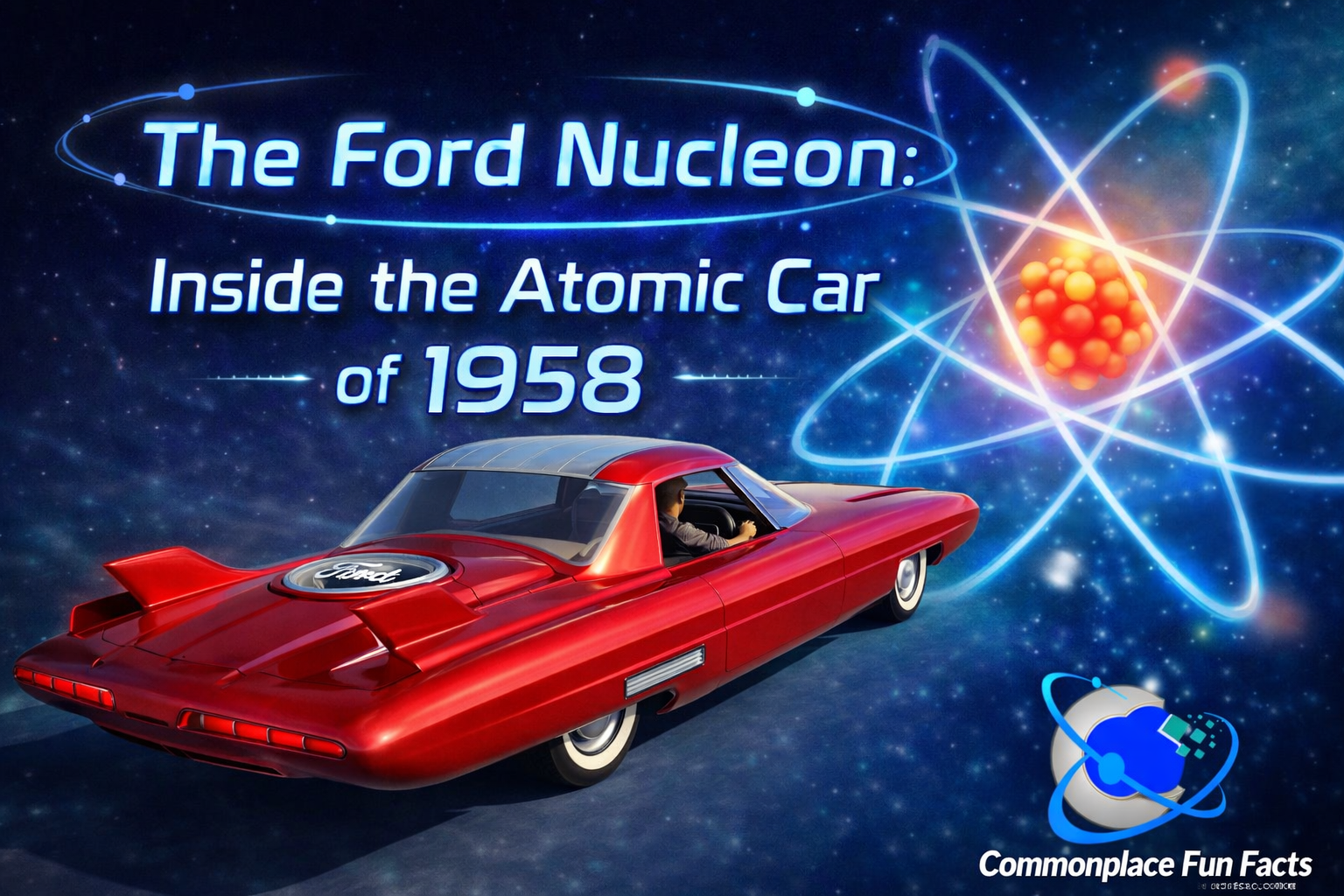
The Ford Nucleon was a concept car unveiled by Ford in 1958, at the height of America’s fascination with atomic energy. This was an era when nuclear power was not just a scientific breakthrough—it was a lifestyle aspiration.
People imagined atomic airplanes, atomic vacuum cleaners, and, apparently, atomic cars.
The Nucleon fit right in.

Rather than relying on gasoline, the Ford Nucleon was designed as a nuclear powered car that would use a small onboard reactor as its energy source. Ford’s promotional materials described the reactor as a removable “power capsule,” designed to be swapped out every 5,000 miles at specialized service stations.
Because nothing says “convenience” like exchanging uranium fuel rods between errands.
At the time, the idea was not treated as science fiction so much as an inevitability. Publications openly speculated that the Ford Nucleon might represent the “atomic car of the future,” reflecting a moment when nuclear power seemed destined to solve nearly everything.
The full-scale version was imagined at nearly 17 feet long, though the only version ever built was a 3/8-scale model just over six feet in length—roughly the size of a particularly ambitious coffee table. Consequently, there was no prototype quietly humming along on a test track somewhere. This was a concept car in the purest sense—an idea meant to showcase what the future might look like if physics and engineering decided to take a brief vacation together, leaving common sense behind to housesit.
How a Nuclear Powered Car Would Work
The Ford Nucleon’s design was based on the same basic principle as nuclear power plants: nuclear fission.

In theory, a compact nuclear reactor would generate heat, which would produce steam, which would drive a turbine, which would ultimately power the vehicle.
In practice, this raises several immediate questions, most of which begin with “How?” and end with “Are you serious?”
The proposed layout placed the reactor at the rear of the vehicle, behind the passenger compartment. The design featured an unusually long wheelbase and a cab-forward configuration, largely because the reactor—and its necessary shielding—needed space. Quite a bit of space.
Shielding, as it turns out, is not optional when dealing with nuclear energy. Without it, the driver’s commute might be short, but for reasons that had little to do with traffic congenstion and much more to do with shortened life expectancy.
Ford’s designers envisioned advances in nuclear reactor miniaturization that would make such a vehicle feasible. Unfortunately, this assumed a level of technological progress that has remained stubbornly out of reach.
Even today, the idea of safely shrinking a nuclear reactor to car-sized dimensions—while maintaining adequate radiation shielding—is less “engineering challenge” and more “enthusiastic thought experiment.”
Why the Ford Nucleon Was Never Built
The short answer is that the Ford Nucleon failed for the same reason we do not currently see spaceships powered by nuclear bombs: practicality.
The longer answer involves a combination of technical, economic, and safety challenges that proved insurmountable.
First, there is the issue of nuclear reactor miniaturization. Building a reactor small enough to fit in a car is one thing. Building one that is safe, stable, and capable of operating under the conditions of everyday driving—potholes, sudden stops, and the occasional aggressive merge—is quite another.
Next, there is the matter of radiation shielding. Effective shielding is not just heavy—it is astonishingly heavy. To safely contain a reactor small enough to fit in a car, engineers would likely need several feet of dense material such as lead, concrete, or specialized alloys. Modern estimates suggest that adequate shielding for a reactor producing even modest automotive power could weigh anywhere from 20 to 50 tons, depending on the design. In practical terms, that is the equivalent of bringing along another 3 to 7 elephants for your quick trip to the grocery store. Fuel efficiency would not so much decline as throw up its hands and say, “You’re on your own.”
Even if shielding and miniaturization could somehow be solved, there remained the problem of heat. Nuclear reactors generate enormous amounts of it, and a car-sized system would struggle to dissipate that heat without turning the vehicle into something closer to a rolling radiator.
Then there is infrastructure. The idea of swapping reactor cores every few thousand miles would require an entirely new network of highly specialized facilities, staffed by people who would presumably prefer not to glow in the dark.
Finally—and perhaps most importantly—there is public perception. Convincing people to trust a nuclear powered car would be a challenge under the best of circumstances. Convincing them to park it in their garage next to the lawn mower would be an entirely different level of persuasion.
The Risks of Atomic Vehicles
Even if the engineering challenges could be overcome, the risks associated with atomic vehicles would remain considerable.

Accidents, for example, would take on a new dimension. If you think strapping wings onto a Ford Pinto sounds like the setup for a special effect in an action movie, imagine what a crash involving a Ford Nucleon could mean. A minor fender-bender might become less about exchanging insurance information and more about apocalyptic nightmares.
There is also the issue of radioactive waste. Each reactor core would eventually need to be disposed of safely, adding another layer of complexity to an already ambitious concept.
Security concerns would not be trivial either. A vehicle powered by nuclear material presents risks that go well beyond theft or vandalism.
In short, the dangers of nuclear powered cars are not merely inconveniences. They are numerous, varied, and persuasive enough to keep the idea firmly in the realm of concept art and historical curiosity.
Could Nuclear Cars Exist Today?
The Ford Nucleon was not alone. During the 1950s and early 1960s, designers across the automotive world flirted with the idea of nuclear-powered transportation, treating the atom less as a hazard and more as an underutilized convenience.
This begs the question of whether modern technology might succeed where 1950s optimism fell short.
After all, we have made remarkable advances in energy efficiency, materials science, and alternative fuel vehicles. Electric cars, once considered impractical, are now a common sight. Hydrogen fuel cells continue to develop. Even autonomous driving has moved from science fiction to cautious reality.
So, could nuclear powered cars exist today?
The answer remains, for now, no.
While small modular reactors are being explored for industrial and grid-scale applications, the challenges of adapting such technology to a passenger vehicle remain significant. The issues of shielding, safety, cost, and public acceptance have not disappeared. If anything, they have become more clearly understood.
Compared to modern EVs, the Ford Nucleon looks less like a missed opportunity and more like an ambitious detour into a future that never quite materialized.
Legacy of the Ford Nucleon
The Ford Nucleon occupies a fascinating place in the history of nuclear cars and concept vehicles.
It stands as a symbol of the Atomic Age—a time when the possibilities of nuclear energy seemed limitless, and the risks were often treated as a problem for future engineers to solve.
Like many concept cars of the 1950s, it was less about immediate practicality and more about imagination. It asked a bold question: what if the future looked radically different from the present?

The answer, in this case, turned out to be: not quite like this.
Still, the Ford Nucleon remains one of the most memorable examples of retro futuristic vehicles and experimental car designs. It captures a moment when optimism, ambition, and a slightly casual attitude toward radiation combined to produce something uniquely unforgettable.
It did enjoy a second life in popular culture, most notably as inspiration for the nuclear-powered cars in the Fallout video game franchise. In that retro-futuristic world, vehicles like the fictional Chryslus Corvega boast “Atomic V8” engines, as if nuclear fission were just another optional upgrade package. The games, however, lean fully into satire: these cars have a tendency to explode into tidy mushroom clouds when damaged, briefly transforming a traffic incident into a Cold War teaching moment.
The Ford Nucleon may not have changed the way we drive, but it certainly changed the way we think about what is possible—and what is probably best left on the drawing board.
And for that, the atomic car concept has earned its place in history, quietly humming along in the collective imagination, where it is perfectly safe for everyone involved.
You may also enjoy…

Project Orion: The Wild Cold War Plan to Launch Spaceships with Nuclear Bombs
Discover the jaw-dropping history of Project Orion, the Cold War plan to propel spacecraft using nuclear explosions. Brilliant, bold, and utterly outrageous.

A Flying Ford Pinto: What Could Possibly Go Wrong?
As much as we enjoy the comforts provided by the 21st century, our biggest disappointment is the lack of flying cars. Every traffic jam brings daydreams of being able to push the “Vertical Takeoff and Lift” button on the dashboard and rising far above the tangled mess on the roads. Although there have been some…

Quaker Oats and the Chilling Truth Behind Its Radioactive Oatmeal Experiments
The Walter E. Fernald State School in Massachusetts was involved in a dark chapter of American medical research in the 1950s and 60s. Unknowingly, children became part of a covert Quaker Oats and MIT-funded study, ingesting radioactive oatmeal and milk intended to track nutrient absorption. This unethical experimentation was part of a broader trend during…



Leave a Reply