

Most Americans learn that the trouble between Great Britain and its North American colonies involved taxation, representation, tea, and an apparently inexhaustible supply of men willing to have their portraits painted while wearing uncomfortable wigs and stockings.
All of that is true. But before colonists dumped British tea into Boston Harbor, a group of New Hampshire lumbermen staged a considerably less elegant protest over pine trees.
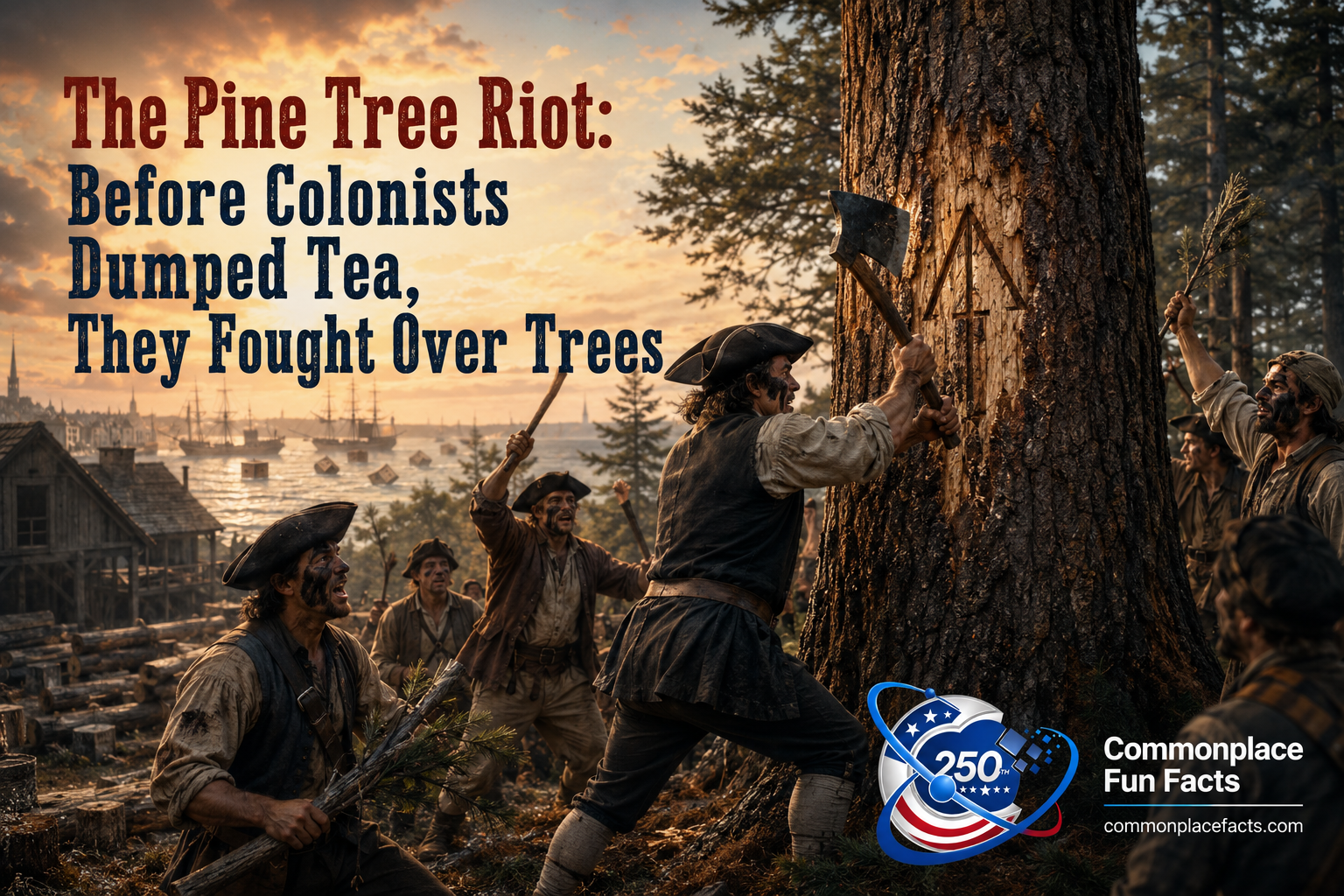
On April 14, 1772, several dozen men with blackened faces burst into a New Hampshire inn, overpowered the local sheriff and his deputy, beat them with clubs and tree branches, cropped their horses’ ears, sheared off their manes and tails, and drove the officers out of town.
Their grievance was simple: the king had claimed the best trees growing in New England, including trees standing on land the colonists believed belonged to them.
The incident became known as the Pine Tree Riot. It took place more than a year before the Boston Tea Party and nearly three years before the battles of Lexington and Concord. It did not begin the American Revolution by itself, but it demonstrated that royal authority could be resisted—and that New Hampshire lumbermen had developed a surprisingly firm position on unauthorized forestry management.
Contents
Why the British Empire Needed New Hampshire’s Trees
In the eighteenth century, Britain’s power depended heavily on the Royal Navy. Its ships protected British commerce, transported troops, defended colonies, attacked rival empires, and ensured that “Rule, Britannia! Britannia, rule the waves!” was more than an unusually catchy national boast.
Building those ships required enormous quantities of timber. A large warship needed wood for its hull, decks, spars, yards, and masts. The mainmast had to be especially tall, straight, strong, and flexible. It was not the sort of thing that could be assembled from leftover fence posts and an extra dose of British stiff upper lip.
By this time, much of England’s supply of suitable timber had been depleted. Britain could import mast timber from northern Europe, but wars and international rivalries made that supply uncertain. Depending on foreign countries for the material needed to build your navy is awkward, particularly when those countries may be among the people your navy is supposed to intimidate.
New England, however, had eastern white pines.
These trees could grow more than 150 feet tall. Their trunks were unusually straight, and their wood was relatively light, strong, and workable. A sufficiently large white pine could provide a single-piece mast for a major sailing vessel, avoiding the weaker joints created when several pieces of timber had to be fitted together.
To British officials, the forests of New Hampshire looked less like private property and more like a conveniently unguarded naval supply warehouse.
The King’s Broad Arrow
In 1691, the Massachusetts Bay charter reserved certain large pine trees for the Crown. The original provision applied to trees at least 24 inches in diameter, measured 12 inches above the ground, on land that had not already been privately granted.

Later laws expanded the system into other colonies and increased the number of trees subject to royal control. In New Hampshire, the restrictions eventually reached white pines as small as 12 inches in diameter.
Officials known as Surveyors of the King’s Woods traveled through the colonies identifying trees suitable for naval use. Once a surveyor selected one, he marked its trunk with three cuts resembling an arrow. This was the King’s Broad Arrow, a symbol used to identify property belonging to the Crown.
In practical terms, the mark said, “Yes, this tree is growing on your land. No, that does not make it your tree. Please direct further questions to a monarch living approximately 3,000 miles away.”
Colonists were expected to leave the reserved trees standing. Before cutting other large pines, they might also need an inspection and a royal license. Surveyors could inspect sawmills, mark suspicious logs for seizure, and expose violators to substantial fines.
The system interfered with nearly every part of colonial life. Settlers needed wood to clear farms, build houses, construct barns, make furniture, operate sawmills, and produce ships of their own. The law also deprived landowners and mill operators of some of their most valuable timber.
Not surprisingly, compliance was less than enthusiastic.
How to Make a King’s Tree Disappear
Colonists developed several methods for dealing with the Crown’s trees. The most straightforward approach was to cut them down and hope no one noticed.
Sawmill operators could also reduce large logs into narrower boards, making it harder to prove that the lumber had come from a prohibited tree. Wide floorboards became particularly desirable in New England homes. In some houses, unusually broad boards were supposedly called “king’s lumber,” which was less a tribute to the monarch than a quiet admission that the floor might constitute evidence.
Enforcement was difficult. The forests were enormous, officials were few, and local residents were often unwilling to assist an investigator who had arrived to confiscate their neighbors’ property.
There was also the practical problem of identifying a specific board as the former resident of a particular forest. Trees, once processed into lumber, are notoriously reluctant witnesses.
New Hampshire Had Already Rioted Over This Once
The Pine Tree Riot of 1772 was not New Hampshire’s first violent dispute over mast timber.
In 1734, Surveyor General David Dunbar attempted to inspect illegally cut timber at the Copyhold Mill in an area that was then part of Exeter. Local residents assembled, fired guns, and persuaded him that the inspection might be healthier if conducted somewhere else.
Dunbar later sent ten men to continue the investigation. They stopped at a tavern, where local residents disguised as Native Americans attacked and scattered them.
The confrontation became known as the Mast Tree Riot of 1734. It established two enduring New Hampshire traditions: hostility toward royal timber regulations and resolving administrative disputes at inns.
Governor Wentworth Begins Counting Trees
For many years, enforcement of the pine laws in remote parts of New Hampshire was inconsistent. That changed after John Wentworth became governor in 1766.

Wentworth was not uniformly hostile to the colonists, but he took the mast laws seriously. He ordered royal surveyors to inspect sawmills more carefully and collect the license fees and fines that previous officials had neglected.
During the winter of 1771–1772, Deputy Surveyor John Sherburn inspected mills along the Piscataquog River Valley. At six mills in Goffstown and Weare, he found large white pine logs measuring between approximately 15 and 36 inches in diameter.
Sherburn marked the logs with the Broad Arrow and ordered the mill owners to appear before the Court of Vice Admiralty in Portsmouth.
The mill owners hired attorney Samuel Blodget to represent them before Governor Wentworth. Blodget’s performance demonstrated that conflicts of interest were thriving in America well before the creation of mandatory continuing legal education.
Rather than persuade Wentworth to abandon the charges, Blodget accepted an appointment as a Surveyor of the King’s Woods. He then advised his former—or possibly still current—clients to pay the Crown.
The Goffstown mill owners complied. The men from Weare did not.
Enter Ebenezer Mudgett
One of the leading Weare mill owners was Ebenezer Mudgett, a name that deserves considerably more recognition than it has received. It sounds equally appropriate for a colonial rebel, a Dickens character, or a man who complains that the tavern has reduced the size of its meat pies.
After the Weare mill owners refused to settle, authorities issued a warrant for Mudgett’s arrest.
On April 13, 1772, Hillsborough County Sheriff Benjamin Whiting and his deputy, John Quigley, rode into South Weare to execute it. They found Mudgett late in the day.
Mudgett did not resist. He told the officers that he would meet them the following morning and provide bail. Whiting accepted the promise and released him.
The sheriff and his deputy then retired to Aaron Quimby’s nearby inn for the night, apparently believing they had successfully completed a routine day of colonial law enforcement.
This assessment would soon require revision.
The Town Holds an Informal Meeting
News of Mudgett’s arrest spread through Weare. Local men gathered at his house to discuss what should be done.
Some reportedly suggested helping Mudgett pay his bail. This was the moderate proposal and was therefore rapidly overtaken by the suggestion that they beat the sheriff and run him out of town.
Before dawn on April 14, a crowd assembled outside Quimby’s inn. Later accounts describe more than 20 men. A report published ten days later in the New Hampshire Gazette estimated the number at 30 or 40.
Many had blackened their faces with soot to conceal their identities. They carried clubs, switches, or branches cut from trees—a thematically appropriate choice of weapon, if nothing else.
Mudgett went to Whiting’s room and announced that he had brought bail. The sheriff, who was still dressing, reportedly told him that there had been no need to arrive before daylight.
At that moment, the disguised men rushed into the room.
A Very Unpleasant Bail Hearing
Whiting reached for his pistols and threatened to shoot the first man who approached. The crowd, possessing both numerical superiority and a flexible understanding of criminal procedure, overpowered him.

Some accounts say the attackers grabbed Whiting by his arms and legs and held him facedown while others beat his back with switches. A later history of Weare colorfully claimed that they intended to settle the account for the disputed trees on the sheriff’s bare back.
Whiting later said, “They almost killed me.”
Deputy Quigley received similar treatment. The contemporary newspaper account reported that some of the attackers entered the space above the officers and removed floorboards to help overpower them.
The Gazette described the officers as having been beaten “in a most Shameful Manner.” Colonial newspapers employed inconsistent capitalization rules but maintained commendable standards of editorial judgment.
Then They Went After the Horses
Having beaten the sheriff and his deputy, the rioters turned their attention to the officers’ horses.
They cut off the animals’ manes and tails and cropped their ears. The purpose was probably both symbolic and economic. A disfigured horse was less valuable, and forcing royal officers to ride away on visibly mutilated animals added humiliation to the assault.
The horses, it should be emphasized, had not participated in the enforcement of the pine laws and appear to have been entirely innocent of the matter. Whatever one thinks of royal timber policy, taking it out on the animals was a step too far. The horses had neither written the law nor marked a single pine tree.
Whiting and Quigley mounted the animals and rode toward Goffstown while townspeople jeered, shouted, and struck at them as they passed.
The king’s representatives had come to Weare to make an example of Ebenezer Mudgett. Instead, Weare made an example of them.
The Sheriff Returns With Reinforcements
Whiting did not simply ride home and reconsider his career choices. He sought help from local military officers, who organized an armed posse to arrest the rioters.
By the time the posse reached Weare, however, the suspects had disappeared into the surrounding woods. This was another disadvantage of attempting to enforce forest regulations against people who lived in a forest.
Authorities eventually arrested one participant, and eight men were ordered to appear in court: Ebenezer Mudgett, Timothy Worthley, Jonathan Worthley, Caleb Atwood, William Dustin, Abraham Johnson, Jotham Tuttle, and William Quimby.
They were charged with rioting, disturbing the peace, assaulting Sheriff Whiting, and acting against “the peace of our Lord the King, his crown and dignity.”
The indictment also stated that Whiting had been beaten and injured so severely that his life had been despaired of. In other words, these were not the eighteenth-century equivalent of jaywalking tickets.
The Court Discovers Mercy
The case came before the Superior Court in Amherst in September 1772. Four judges heard it: Theodore Atkinson, Meshech Weare, Leverett Hubbard, and William Parker.
There was a small historical irony in the presence of Meshech Weare. The town where the riot occurred had been named in his honor. He was now helping decide what punishment should be imposed upon its residents for beating the king’s sheriff.
The eight defendants pleaded guilty and submitted themselves to the mercy of the court.
The court fined each man 20 shillings—one pound in colonial accounting—and ordered them to pay court costs. Whatever its precise modern equivalent, it was remarkably gentle treatment for a masked assault on two law-enforcement officers and an unauthorized redesign of their horses.
The court had enforced the law just enough to maintain the outward appearance of royal government. It had not enforced it so vigorously that anyone in Weare would feel discouraged from doing something similar in the future.
Did the Pine Tree Riot Start the American Revolution?
The Pine Tree Riot did not single-handedly cause the American Revolution. Colonial resistance had already appeared during the Stamp Act crisis of 1765, and complaints about taxation, trade regulations, political representation, western settlement, military authority, and other issues had been accumulating for years.
Revolutions rarely begin with one clearly labeled opening event. There is usually no starting pistol, ceremonial ribbon cutting, or helpful official announcement that everyone should now begin overthrowing the government.

Instead, resistance grows through a series of confrontations in which people test how far the government will go, how much their neighbors will tolerate, and whether defiance produces punishment, concessions, or merely additional paperwork.
The Pine Tree Riot was one of those tests. It showed that colonists could organize against royal officers, use disguises to protect their identities, rely upon community support to evade arrest, and receive surprisingly mild treatment from local courts. Those same patterns would appear repeatedly as resistance to Britain intensified.
The excellent series at In the Shadow of Yesterday illustrates how that growing spirit of rebellion appeared differently from one colony—and sometimes one city—to another. In “Charleston: The First Tea Party and the Long Game of Revolution,” South Carolinians used public pressure and British customs procedures to trap the tea in a legal and commercial limbo. In “Philadelphia Tea Party: How to Outmaneuver an Empire,” overwhelming community opposition persuaded the tea ship to turn around and carry its cargo back across the Atlantic.
“The New York Tea Party: A City Divided” describes a less orderly form of resistance, in which street-level pressure and intimidation gradually displaced royal authority in a deeply divided city. Finally, “Calculated Crisis: The Boston Tea Party and Revolution” presents Boston’s destruction of the tea not as a spontaneous colonial tantrum, but as a deliberate escalation intended to force Britain into a confrontation.
Charleston used bureaucracy. Philadelphia used consensus. New York used the power of the crowd. Boston used carefully planned destruction. New Hampshire’s lumbermen had already contributed their own method: beat the sheriff with tree branches and send him home on a horse that had received an unauthorized haircut.
The tactics differed, but the underlying development was the same. Colonists were gradually ceasing to treat royal authority as something that had to be obeyed. Increasingly, it was becoming something to be obstructed, embarrassed, outmaneuvered, or openly defied.
The Pine Tree Riot also concerned more than trees. It raised a basic question about imperial power: Could the Crown claim a valuable natural resource located on land occupied, improved, or owned by a colonist?
To British officials, the mast laws were a reasonable defense policy. The navy protected the empire, and the empire needed masts.
To the people of New Hampshire, the policy looked like a distant government seizing the best part of their property, charging them fees to use what remained, and sending inspectors to search their businesses.
Both sides understood that the trees were valuable. They merely disagreed about whose trees they were.
Was the Pine Tree Flag Connected to the Riot?
The eastern white pine later became an important symbol of American resistance. Among the several flags used during the Revolutionary War was a white banner bearing a green pine tree and the words “An Appeal to Heaven.” Vessels operating under George Washington’s authority flew the design, and Massachusetts adopted a similar flag for its navy—because by then the pine tree had progressed from disputed lumber to full-fledged revolutionary branding.

The phrase came from the political philosophy of John Locke. When earthly authorities offered no remedy against tyranny, the oppressed could make an “appeal to heaven”—in other words, resist and leave the outcome to divine judgment.
It is tempting to say the flag grew directly out of the Pine Tree Riot. The connection is certainly appealing: the king claimed the pine, the colonists reclaimed it, and the tree became a symbol of resistance.
The documented history is less tidy. Pine trees had represented New England long before 1772, and no known contemporary account places the “Appeal to Heaven” flag at the Pine Tree Riot. The flag’s documented military use dates from 1775.
The riot and the flag are best understood as branches of the same tree rather than one being the confirmed source of the other. Both reflected the importance of the white pine and the growing conviction that Britain had taken its claims of ownership too far.
The Revolution Before the Revolution
The Pine Tree Riot has never achieved the fame of the Boston Tea Party. There were no ships, no harbor, no tea chests, and no future opportunity for schoolchildren to reenact it with cardboard boxes.
Instead, there was a tavern, a sawmill owner named Ebenezer Mudgett, a sheriff who made the mistake of accepting a promise to return in the morning, and a crowd of New Hampshire men who believed the trees on their land should not belong to a king across the Atlantic.
There were also several bewildered horses left wondering what they had done to deserve such indignities.
The riot did not declare independence. It did not create a new government or defeat a British army. It did something more modest but still dangerous: it demonstrated that royal authority could be defied without the sky falling, the colony collapsing, or the offenders receiving particularly serious punishment.
Once people discover that a government can be resisted, they sometimes begin wondering what else is possible.
The American Revolution may be remembered as a struggle over liberty, taxation, and representative government. But in Weare, New Hampshire, the road to independence passed through a pine forest—and the king’s sheriff left town on a horse with a truly regrettable haircut.
You may also enjoy…

How Benedict Arnold Built a Navy on Lake Champlain and Saved the Revolution by Losing
Before Benedict Arnold became America’s most famous traitor, he built a makeshift navy on Lake Champlain and helped save the Revolution by losing.

The Invasion of Quebec: When the American Revolution Tried to Make Canada the 14th Colony
Discover the forgotten 1775 invasion of Quebec, when American revolutionaries tried to turn Canada into the 14th colony—and nearly changed North American history.

The French Flour Wars: How Rising Bread Prices Nearly Sparked the French Revolution 14 Years Early
Before the French Revolution, rising bread prices sparked riots across France. Discover the Flour Wars of 1775 and how food shortages nearly toppled the monarchy.




Leave a Reply