
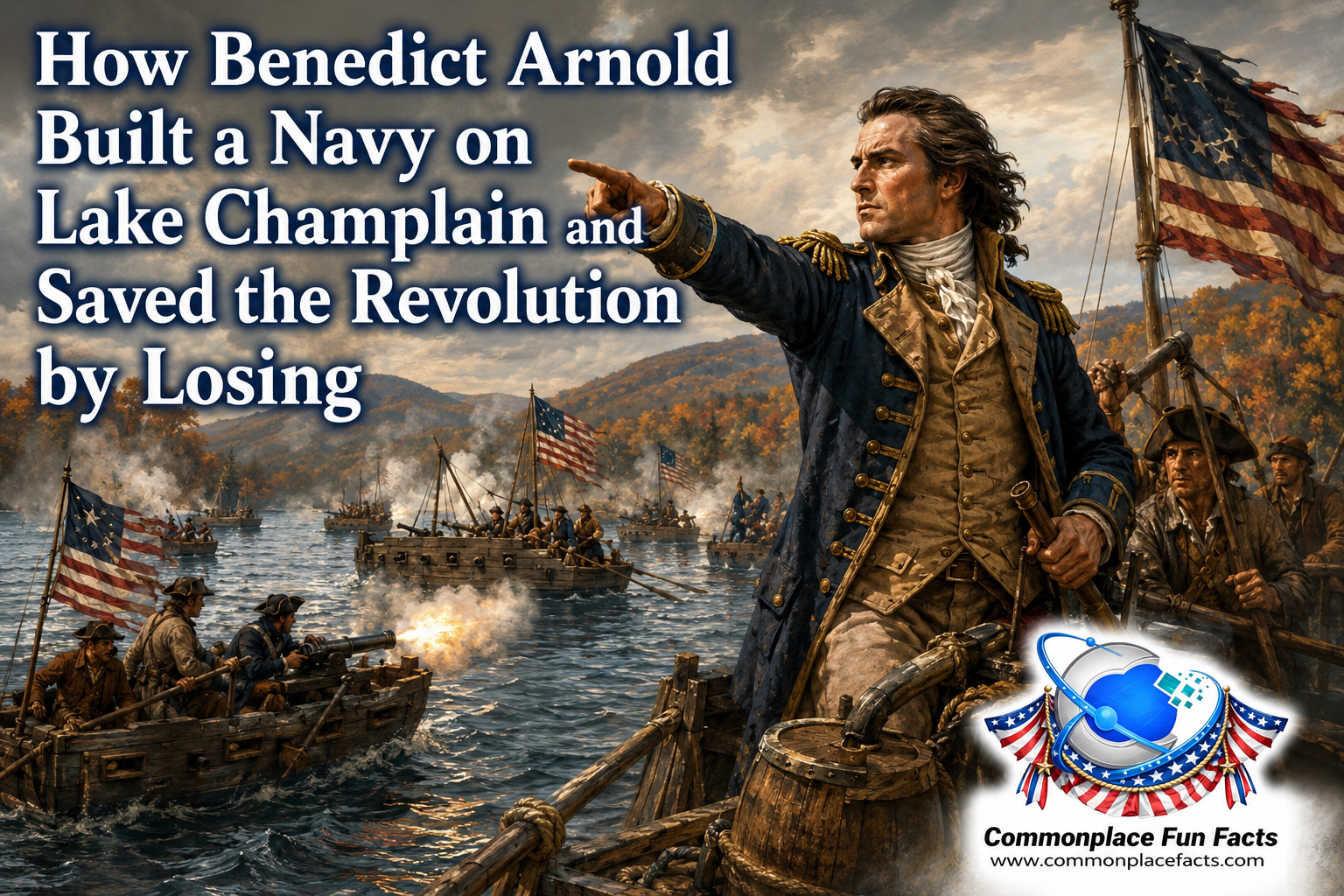

There are few things more American than solving a crisis with lumber, panic, and a committee that has no money.
In 1776, the American Revolution was still very much in the “let’s see if this works” phase. The Declaration of Independence had been signed, but the United States was less a fully functioning nation than a bold startup with terrible cash flow, several angry investors, and a business plan that depended heavily on the leaders not being hanged.
Meanwhile, the British had an idea. It was not a stupid idea, which was rude of them. They would move south from Canada, control Lake Champlain, push toward the Hudson River Valley, and cut New England off from the rest of the colonies. If successful, the Revolution might be split in half before it had time to become the sort of thing schoolchildren would one day pretend to be excited about during field trips.
Standing in the way was Benedict Arnold.
Yes, that Benedict Arnold. Before he became America’s most famous synonym for betrayal, treason, and “do not invite this man to the strategy meeting,” Arnold was one of the most energetic and capable officers in the Continental cause. Difficult? Absolutely. Ambitious? Like a raccoon in a bakery. But brave, aggressive, resourceful, and occasionally brilliant.
And in the fall of 1776, he built a navy on Lake Champlain out of forests, desperation, and whatever else was lying around.
Then he lost the battle.
And by losing it slowly enough, he may have helped save the Revolution.
Contents
The Back Door to the Revolution
To understand why anyone cared about Lake Champlain in 1776, we need to remember something deeply inconvenient about eighteenth-century North America: roads were often terrible.
Today, if you want to travel from Canada into New York, you can consult a map, complain about traffic, ignore the map, complain more, stop for snacks, and eventually arrive. In the 1770s, moving an army through the wilderness was more like dragging civilization behind you by the ankle.

Armies needed food, ammunition, artillery, tents, horses, tools, spare parts, and a depressing number of barrels. Moving all that through forests and muddy tracks was slow, exhausting, and an excellent way to discover that your military campaign had become a group camping trip with cannon.
Water changed everything. Lake Champlain formed a natural invasion corridor from Canada into the American interior. From the lake, British forces could threaten Fort Ticonderoga and the Hudson River Valley. If they pushed far enough south, they could link up with British forces moving from New York City and separate New England from the rest of the colonies.
That was the nightmare scenario. New England was a hotbed of rebellion, which is a polite historical way of saying that Massachusetts had been making British officials grind their teeth for years. Cut it off, isolate it, and perhaps the whole rebellion could be strangled before it matured into a proper national crisis with monuments, souvenir mugs, and people yelling about original intent.
The British knew this. The Americans knew this. Lake Champlain was not just a lake. It was a highway, a supply route, a military choke point, and a giant watery argument over the future of the continent.
Whoever controlled the lake controlled the tempo of the campaign.
Unfortunately for the Americans, the British already had one notable advantage in naval matters: they were the British.
Enter Benedict Arnold, Still on the Good-Guy Side of the Ledger
Benedict Arnold’s later betrayal has a way of swallowing everything that came before it. Mention his name and most people immediately picture treason, West Point, and a man whose reputation aged about as well as unrefrigerated seafood.

But before all that, Arnold was a genuine Revolutionary War hero. He had helped capture Fort Ticonderoga in 1775. That earlier capture of Fort Ticonderoga had already paid one enormous dividend for the Revolution. The fort’s artillery was later hauled through winter by Henry Knox in the famous “Noble Train of Artillery,” a feat involving oxen, sledges, frozen roads, and the sort of logistical optimism usually seen only in people moving a piano upstairs. Those cannons helped Washington force the British out of Boston, a story told by our friends at In the Shadow of Yesterday in “The Bookseller’s Cannons”.
By the time Arnold was building his Lake Champlain fleet, Ticonderoga had already become one of the Revolution’s most useful recurring characters. He had led an astonishingly miserable expedition through the Maine wilderness toward Quebec, because apparently the Continental Army had not yet discovered the phrase “reasonable expectations.” He was wounded, repeatedly frustrated by Congress, constantly offended by perceived insults, and still somehow effective.
Arnold was not a cuddly team player. He was more the kind of person you send into a crisis because he will either solve it or create a different crisis so dramatic that the first one feels neglected. But in 1776, the Americans needed exactly that kind of energy.
The invasion of Canada had failed. American forces had retreated back toward Lake Champlain. The British commander, Sir Guy Carleton, had a large army in Canada and wanted to move south. But he could not simply stroll down the lake while the Americans controlled it. He needed ships.
So did Arnold.
That set off one of the strangest naval arms races in American history: two sides building fleets on an inland lake in the middle of a wilderness war.
Building a Navy Out of Trees, Panic, and Insufficient Sailors
The American shipbuilding operation centered on Skenesborough, New York, now known as Whitehall. Whitehall likes to claim the title “Birthplace of the U.S. Navy,” which is the sort of historical claim that immediately causes several other towns, museums, and naval historians to begin clearing their throats.
The truth is wonderfully messy. The Continental Congress authorized the Continental Navy in October 1775. George Washington had already used armed vessels before that. Several places have plausible claims to early American naval glory. The United States, being not yet fully organized, apparently began its naval tradition the way it began many other traditions: with overlapping jurisdiction and people arguing about paperwork.
Still, what happened at Skenesborough was remarkable. Arnold and the Americans needed a fighting fleet, and they needed it fast. Shipwrights, carpenters, soldiers, and laborers worked at a frantic pace. Trees became timber. Timber became hulls. Hulls became gunboats, row galleys, schooners, and assorted floating experiments in optimism.
The work was not elegant. Much of the fleet was built from green wood, which is not ideal unless your long-term preservation plan involves sinking the vessel immediately and letting future archaeologists sort it out. The boats were crude, hurried, and practical. They were not built to impress admirals. They were built to slow them down.
Arnold eventually commanded a small fleet that included vessels such as the Royal Savage, Enterprise, Revenge, Liberty, Lee, Trumbull, Washington, Congress, and several gunboats with names like Philadelphia, New York, Boston, Jersey, and Spitfire.
It was a navy, technically. It floated. It had guns. It had commanders. It had crews. By the standards of emergency revolutionary procurement, that was practically a luxury yacht show.
The crews were another matter.
Arnold wanted men with maritime experience. What he received was a mixture of volunteers, soldiers drafted from the Northern Army, and men whose primary qualification may have been “standing nearby when someone needed a sailor.” In one of his less cheerful assessments, Arnold referred to his men as a “wretched motley crew,” which is both an insult and a surprisingly good name for an eighteenth-century punk band.
Many of the men were landsmen. Some had little or no naval experience. Others were expected to learn quickly, because nothing accelerates professional development like enemy cannon fire.
This was the American fleet: hastily built boats, inexperienced crews, limited supplies, and a commander who understood that the goal was not to defeat the Royal Navy in a fair fight. Fair fights are what people ask for when they are losing the unfair ones.
Arnold needed to make the British pay in time.
The British Bring an Actual Navy, Which Seems Excessive
While Arnold was assembling his homemade lake fleet, the British were doing what Britain did best: treating water as a place where Britain should be in charge.
At St. John’s, in present-day Quebec, the British began building and assembling their own Lake Champlain fleet. They had professional officers, better-trained crews, more resources, and the sort of institutional naval experience that comes from spending centuries looking at oceans and thinking, “Ours.”
The centerpiece was the Inflexible, a powerful vessel that had been constructed in pieces, transported, and reassembled for lake service. If Arnold’s fleet was built from desperation, the British fleet was built from logistics, money, and the imperial confidence of people who had never had to ask Congress for reimbursement.
The British also had gunboats, schooners, and support craft. Their fleet carried heavier guns and better crews. On open water, Arnold’s chances of victory were not merely poor. They were roughly akin to the chances of a pack of Cub Scouts winning a live-fire exercise against Navy SEALs.
So Arnold did not plan to fight on open water.
Instead, he chose the narrow waters around Valcour Island, off the western shore of Lake Champlain. More specifically, he positioned his fleet in Valcour Bay, between the island and the New York mainland. It was a cramped, awkward place for a naval battle, which was precisely the point.
The British advantage depended on bringing superior firepower to bear. Arnold’s position made that harder. The geography narrowed the fight. It limited maneuvering. It forced the British to engage on less comfortable terms.
Arnold was not saying, “I can beat the British fleet.”
He was saying, “I can make them have a very bad afternoon.”
Valcour Island: The Battle America Lost Usefully
The Battle of Valcour Island began on October 11, 1776. The British fleet sailed south along Lake Champlain, looking for Arnold. Because of his position behind Valcour Island, they initially passed him before realizing where the Americans were waiting.
This was one of Arnold’s better ideas. It forced the British to turn back and engage in the confined waters he had selected. That did not make the Americans stronger, exactly, but it did make British strength harder to use efficiently. In military history, this is called using terrain. In ordinary life, it is called hiding behind the trash can because the bigger kid has a stick.

The fighting was fierce. Arnold’s flagship, the row galley Congress, took heavy punishment. The Royal Savage, one of the larger American vessels, ran aground and had to be abandoned. The British captured and burned it. The gunboat Philadelphia was hit by British fire, took a shot below the waterline, and sank in the evening.
On paper, the Americans were clearly losing. In wood, smoke, splinters, blood, and lake water, they were also clearly losing. But the important word is “clearly,” not “quickly.”
Arnold kept his battered fleet in the fight. The Americans inflicted damage. They forced the British to work for every advantage. They turned what could have been a rapid sweep down Lake Champlain into a grinding engagement that consumed daylight, ammunition, and momentum.
By nightfall, Arnold’s fleet was badly damaged. Several vessels were barely able to continue. The British expected to finish the job the next morning.
That is when Arnold performed the eighteenth-century naval equivalent of slipping out the back door while the bill was being calculated.
The Escape Through Fog and Darkness
After the first day of battle, the surviving American vessels were trapped, or nearly so. The British fleet lay to the south, blocking the obvious route of escape. Arnold’s boats were damaged, his crews exhausted, and his prospects grim.

So he left anyway.
Under cover of darkness, aided by fog and poor visibility, Arnold’s remaining vessels slipped through the British line. Some accounts describe muffled oars, carefully controlled lights, and a silent nighttime movement past the enemy. Whether every dramatic detail grew in the retelling is hard to know, because history, like a fisherman, occasionally gestures with both hands when describing something that was probably smaller.
But the essentials are true: Arnold got much of his surviving fleet away from Valcour Bay during the night.
Imagine being a British officer the next morning. You go to bed thinking the rebel fleet is trapped. You wake up, look across the water, and discover that Benedict Arnold has vanished like a politician’s promise after Election Day.
The British gave chase. Arnold’s escape had not saved the fleet permanently, but it had bought more time. For two more days, the battered American vessels struggled south. Some were captured. Others were abandoned. The retreat became a slow-motion collapse, but even collapse can be useful if it happens in the enemy’s way.
Arnold finally ran several remaining vessels aground near Buttonmold Bay, on the eastern side of the lake. Rather than let the British capture them, he ordered them burned. Men escaped overland toward Crown Point and Ticonderoga.
It was not glamorous. It was not tidy. It was not a victory in the sense that anyone would want to put on a commemorative plate.
But it had done the one thing Arnold needed it to do.
It delayed the British.
The Most Important Thing Arnold Bought Was Time
By the time the British had defeated Arnold’s fleet and gained control of Lake Champlain, the campaign season was nearly gone. Winter was coming, and not in the convenient television sense where everyone has dramatic cloaks and theme music. Northern winters were real military obstacles. Armies needed shelter. Supply lines became harder. Movement became slower. Lakes froze. Roads became worse, which is impressive considering how bad they already were.
Sir Guy Carleton pushed as far as Crown Point but decided not to continue against Fort Ticonderoga that year. The British advance from Canada was postponed.
That postponement mattered enormously.
The British would try again in 1777, this time under General John Burgoyne. His campaign would move south from Canada, again aiming to control the route toward the Hudson Valley. But the Americans had gained time to prepare, regroup, and respond.
Burgoyne’s campaign eventually ended at Saratoga, one of the decisive turning points of the American Revolution. The American victory helped convince France that the rebellion had a real chance, which was useful because revolutions generally benefit from allies who have ships, soldiers, money, and a deep historical desire to annoy Britain.
This is why the Battle of Valcour Island deserves more attention. It was a tactical defeat but a strategic delay. Arnold lost the battle, lost much of the fleet, and retreated. Yet by forcing the British to spend precious time fighting for Lake Champlain, he helped keep the northern invasion from reaching its full potential in 1776.
Sometimes history turns on great victories. Sometimes it turns on making the other side stand around long enough for the weather to become a co-conspirator.
About That “First Navy” Claim
The Lake Champlain fleet is often described as one of the earliest American naval forces, and sometimes as part of the birth of the United States Navy. This is both true enough to be interesting and complicated enough to make historians adjust their glasses.
The Continental Navy had already been authorized in 1775. George Washington had armed vessels in service before that. Other ships and regions can make claims to early naval significance. If you ask, “Where was the U.S. Navy born?” you may receive several confident answers, each delivered by someone standing near a plaque.
Whitehall, New York, where Arnold’s fleet was built, proudly claims the title “Birthplace of the U.S. Navy.” Whether one accepts the claim without footnotes depends on how much one enjoys arguing over definitions, which is to say, whether one has ever met a historian.
But even if we avoid crowning a single birthplace, the Lake Champlain fleet was undeniably one of the most important early American naval efforts. It was built inland. It was assembled quickly. It fought a major engagement. It delayed a British invasion. It left behind shipwrecks that still tell the story nearly 250 years later.
For a navy made in a hurry by a rebellion still figuring out what countryhood was supposed to look like, that is not a bad résumé.
The Gunboat That Sank and Became a Museum Piece
One of the best parts of the Valcour Island story is that pieces of it still exist.

The American gunboat Philadelphia sank during the battle on October 11, 1776. It settled onto the bottom of Lake Champlain and stayed there for more than a century and a half, playing the historical version of hide-and-seek.
In 1935, the Philadelphia was raised from the lake. Today it is preserved at the Smithsonian’s National Museum of American History and is considered the oldest surviving American fighting vessel.
It is not a sleek warship. It is not a grand frigate with polished decks and heroic lines. It is a blunt, practical, 1776 gunboat built for a desperate campaign. It looks like exactly what it was: a floating wooden platform designed to carry guns, men, and a very fragile hope that the British would find the whole experience more troublesome than expected.
The Philadelphia is especially remarkable because it still bears evidence of the battle that sank it. The damage is part of the artifact. This is not merely a preserved boat. It is a crime scene with oars.
It gives the Valcour Island story a physical presence. You can talk about strategy, delay, empire, rebellion, and campaign seasons, but there is something different about looking at the actual wood that went into the water while the Revolution was still young enough to be considered a questionable life choice.
The Gunboat Still Sitting Upright at the Bottom of the Lake
Then there is the Spitfire.
In 1997, researchers from the Lake Champlain Maritime Museum discovered a Revolutionary War gunboat resting upright on the bottom of the lake. It was identified as Arnold’s gunboat Spitfire, one of the vessels from the Battle of Valcour Island.
The wreck is astonishingly well preserved. Cold, dark freshwater can be very kind to old wood, provided nobody decides to “help” by dragging it into daylight and turning it into a decorative patio feature. The Spitfire remains on the lake bottom, protected and studied as an archaeological treasure.
It sits there like a time capsule from the Revolution: mast, gun, hull, and all. It is hard to ask for a better historical prop. If a novelist invented an intact Benedict Arnold gunboat resting upright beneath Lake Champlain, critics would call it too convenient. History, being shameless, did it anyway.
The Spitfire also reminds us that Valcour Island was not an abstract tactical exercise. Men fought there. Boats shattered there. Some vessels burned. Others sank. The lake became both battlefield and archive.
Fun Facts About Benedict Arnold’s Lake Champlain Fleet
- The fleet was built in a hurry. The Americans had to create a fighting force on Lake Champlain quickly enough to block the British advance from Canada.
- Many of the crews were not experienced sailors. Arnold wanted men with maritime experience, but wartime recruiting often produces less “elite naval force” and more “who among you has seen a boat?”
- The Battle of Valcour Island was a defeat with strategic value. The Americans lost much of the fleet, but the delay helped prevent a major British advance in 1776.
- The gunboat Philadelphia survived as an artifact because it sank. It rested on the bottom of Lake Champlain until 1935 and is now preserved at the Smithsonian.
- The gunboat Spitfire is still underwater. Discovered in 1997, it remains upright on the lake bottom as one of the most remarkable Revolutionary War shipwrecks.
- Whitehall, New York, claims to be the birthplace of the U.S. Navy. This is historically interesting, locally beloved, and exactly the kind of claim that guarantees a footnote fight.
- Benedict Arnold was a genuine American hero before he became America’s most famous traitor. Which is inconvenient, but history rarely asks whether we are comfortable.
Benedict Arnold, the Hero We Wish Had Stopped There
Writing about Benedict Arnold is always awkward because his biography has a built-in spoiler. No matter how brave or useful he was in 1776, we know where the story goes. He will eventually betray the American cause, attempt to hand over West Point to the British, flee to the enemy, and secure his permanent place in American memory as the man whose name became a historical spit take.
That makes it tempting to treat everything Arnold did before the betrayal as merely prologue. But that is too simple. History is more annoying than that. Arnold really was brave. He really was talented. He really did fight hard for the American cause before he turned against it.
At Lake Champlain, he performed exactly the kind of service the Revolution needed. He recognized the strategic importance of the lake. He pushed shipbuilding forward. He chose good ground — or good water, if we are being fussy. He fought a superior force. He escaped when he could. He destroyed what he could not save. He bought time.
None of that erases the betrayal. But the betrayal should not erase the earlier service either.
Arnold is one of history’s uncomfortable reminders that people do not always fit neatly into the categories we prepare for them. Hero, villain, patriot, traitor — in Arnold’s case, the answer is “yes,” which is inconsiderate of him.
At Valcour Island, the future traitor helped preserve the future country he would later betray.
Why Valcour Island Deserves a Bigger Place in Revolutionary Memory
Valcour Island does not have the instant name recognition of Bunker Hill, Trenton, Yorktown, or Saratoga. It lacks a simple slogan. It is difficult to reduce to a clean patriotic poster. “Come Celebrate the Battle We Lost But Which Helped Delay a Larger Strategic Disaster” is accurate, but admittedly hard to fit on a mug.
But that is exactly why it is worth remembering.
The Revolution was not won only by dramatic victories. It was also sustained by retreats, delays, improvisations, stubborn defenses, and moments when exhausted people managed to make the British timetable worse. Valcour Island belongs to that category: not triumphant, not tidy, but important.
Arnold’s fleet did not stop the British forever. It did not destroy their army. It did not secure Lake Champlain for the Americans. It was battered, scattered, sunk, captured, and burned.
And yet, it mattered.
It mattered because timing mattered. It mattered because weather mattered. It mattered because geography mattered. It mattered because campaigns depended on supply lines and seasons, not merely courage and stirring speeches. The British could win the lake and still lose the year.
That is the genius of the Valcour Island story. It is not about victory in the obvious sense. It is about making defeat useful.
A Makeshift Navy, a Lost Battle, and a Revolution Still Breathing
In October 1776, Benedict Arnold’s little fleet on Lake Champlain faced a stronger British force and lost. That part is not in dispute. The Americans were outgunned, outsailed, and outmatched. Their vessels were sunk, burned, captured, or abandoned.
But the British lost something too.
They lost time.
And in 1776, time was one of the most valuable things the American cause could have asked for. Arnold’s improvised navy delayed the northern invasion long enough for winter to close in. The decisive British push would have to wait until 1777, when the campaign would end not in the destruction of the rebellion, but in the American victory at Saratoga.
So yes, Benedict Arnold lost the Battle of Valcour Island.
He also helped make sure the Revolution was still around to fight the next one.
Not bad for a navy built from trees, panic, and a commander whose résumé would later require some very heavy editing.
You may also enjoy…

The Invasion of Quebec: When the American Revolution Tried to Make Canada the 14th Colony
Discover the forgotten 1775 invasion of Quebec, when American revolutionaries tried to turn Canada into the 14th colony—and nearly changed North American history.

How Many Colonists Supported the Revolution?
How many colonists supported the Revolution? The answer is messier than the patriotic version involving flags, muskets, and convenient unity.

The Boston Massacre: An Argument Over an Unpaid Wig Triggered the American Revolution
How Did an Argument About an Unpaid Wig Trigger the Boston Massacre and the American Revolution? The greatest historical events can be triggered by the smallest of incidents. This is especially true of warfare. There is the bloody war that was fought over a bucket. Another war was fought over a pig. Still another was…



Leave a Reply