

February 30 is one of those dates that belongs in the same category as a square circle, an easy tax return, and a brief meeting that actually turns out to be brief.
It does not exist.
Except when it did.
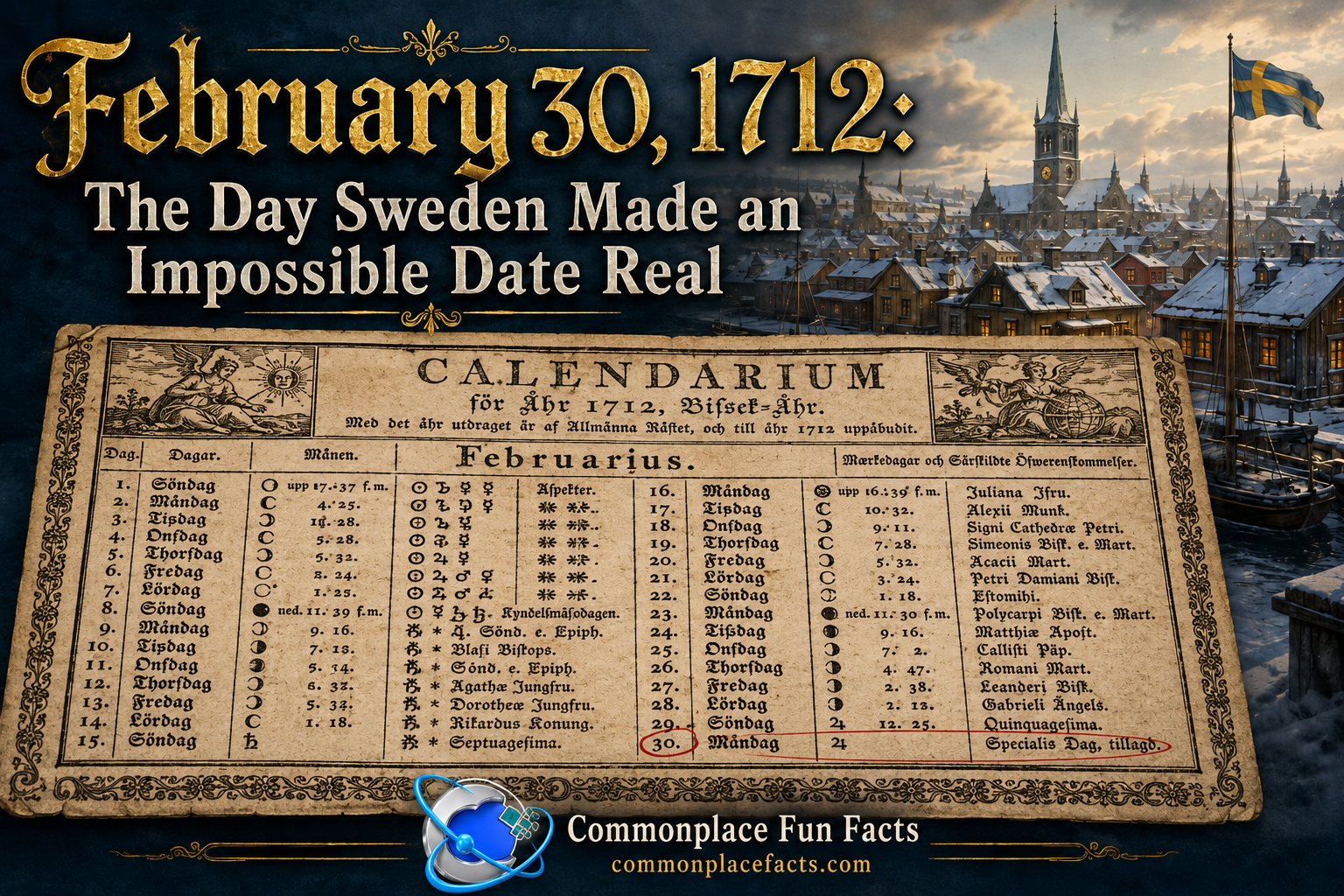
In 1712, Sweden officially had a February 30. It was not a printer’s error, a typo in somebody’s diary, or the desperate invention of someone who had forgotten an anniversary. It was a real date on the Swedish calendar, recognized by the government and used by ordinary people.
We know this because contemporary records survive. A Swedish almanac from 1712 actually prints a 30th day of February. Even better, a parish register records a couple getting married on that date.
The existence of February 30 was the result of Sweden attempting to modernize its calendar, getting distracted halfway through, accidentally creating its own calendar system, and eventually fixing the whole mess by adding a day that wasn’t supposed to exist.
In other words, it was a government project.
Contents
The Problem With the Julian Calendar
To understand how Sweden managed to manufacture February 30, we first have to blame Julius Caesar.
This is somewhat unfair, since Caesar had been dead for more than 1,700 years when the Swedes got themselves into trouble, but history is much easier when there is someone convenient to blame.

The Julian calendar, introduced under Julius Caesar, assumed that a year was 365¼ days long. That is impressively close to the actual solar year, but not quite close enough. The real figure is approximately 365.2422 days.
The difference is only about 11 minutes per year. That sounds harmless. Eleven minutes is roughly the length of time the stoplight closest to our house is stuck on red when we are running late for work.
Unfortunately, eleven minutes multiplied by centuries eventually becomes days.
By the sixteenth century, the calendar had drifted far enough away from the seasons to cause problems with the calculation of Easter. Pope Gregory XIII responded in 1582 with the calendar that now bears his name. The Gregorian calendar adjusted the leap-year rules so that century years such as 1700, 1800, and 1900 would not be leap years unless divisible by 400.
It also required countries adopting the new calendar to remove several dates from existence.
Under Gregory’s original 1582 reform, October 4 was immediately followed by October 15, eliminating ten calendar dates in one stroke. This sounds unsettling until you remember that nothing actually happened to the days themselves. The sun continued to rise. People continued to age. Rent remained due with its customary enthusiasm. Humanity merely changed the labels it attached to those days.
Sweden Has a Better Idea
Not every European country immediately adopted the Gregorian calendar. Because the reform came from a pope, Protestant countries were understandably reluctant to embrace it enthusiastically. Calendar reform had somehow become entangled with religion and politics, because even deciding what day it is can become controversial if enough governments are involved.
By the end of the seventeenth century, Sweden decided it really should get around to joining the Gregorian world.
But Sweden had a plan.
Instead of doing what other countries had done and simply deleting a block of dates, the Swedish government decided in 1699 to make the transition gradually. Beginning in 1700, Sweden would omit every leap day through 1740. Each skipped February 29 would move the country one day closer to the Gregorian calendar.
After forty years, everything would line up.
It was a wonderfully orderly plan, provided nobody forgot what they were doing at any point during the next four decades.
You can probably see where this is going.
For a While, Sweden Was Using a Calendar Shared by Nobody Else
The first step went according to plan. Under the Julian calendar, 1700 should have contained February 29. Sweden omitted it.
So far, so good.
The result was that Sweden was now one day ahead of countries still using the Julian calendar but remained ten days behind countries using the Gregorian calendar.
This was not necessarily a problem because the plan called for the difference to shrink gradually. Sweden simply needed to remember to skip February 29 again in 1704, 1708, 1712, and so forth.
Then 1704 arrived.
February 29 was not skipped.
Then came 1708.
February 29 was not skipped then, either.
There were some extenuating circumstances. The Great Northern War had erupted in 1700, pitting Sweden against a collection of enemies that included Russia, Denmark, and Poland. King Charles XII had substantially more urgent things occupying his attention than whether February had been given one day too many.
By 1709, the Swedish army had suffered its disastrous defeat at Poltava, and Charles XII ended up spending several years in Ottoman territory.
Somewhere amid the wars, armies, diplomatic crises, and general collapse of Sweden’s status as a great European power, the forty-year calendar transition failed to remain at the top of the national to-do list.
The unfortunate result was that Sweden remained stuck between calendars. It was not using the Julian calendar. It was not using the Gregorian calendar. It was using the Swedish calendar, which meant that meatballs were not the only Swedish things getting attention.
The Solution: February 30
By 1711, Swedish authorities concluded that the gradual conversion plan was causing more trouble than it was worth, so King Charles XII ordered Sweden to abandon the experiment and return to the Julian calendar. There was just one small problem: Sweden had already deleted February 29 back in 1700. To get back into step with the Julian calendar, the country needed to put that missing day somewhere.
Fortunately, 1712 was already a leap year. Sweden could therefore observe February 29 as usual and then add one more day to replace the one it had eliminated twelve years earlier.
Sweden therefore observed February 30.
And just like that, a date normally reserved for impossible deadlines and extremely optimistic appointment scheduling became official. The extra day restored Sweden to the Julian calendar, so when March 1, 1712, arrived, Sweden was once again using the same calendar as the other countries that had retained the old system.
As a result, the Swedish year 1712 contained 367 days. There are leap years, and then there are leap years that are clearly showing off.
The Almanac Actually Says “February 30”
This would already be a good historical oddity if we knew about it only from later historians, but we can actually look at February 30.

A surviving Swedish almanac for February 1712 shows thirty days in the month. At the bottom of the page appears the number “30,” accompanied by the Swedish word Tillökad, meaning “added.” There is also a weather prediction for the day: Snöö—snow.
Apparently whoever prepared the almanac was willing not only to recognize a date that normally does not exist but also to tell you what the weather would be when it arrived. Confidence is admirable.
Someone Got Married on February 30
If the almanac is not enough proof that February 30 was a genuine civil date, we can turn to a document generated by something even more persistent than the calendar industry: church recordkeeping. The parish register of St. Petri Parish in Ystad, preserved by Sweden’s National Archives, contains a marriage entry dated February 30, 1712.
The couple were Sven Hall and Elena Jäppdotter Duue, which raises an obvious question that the historical record, disappointingly, does not seem eager to answer: When did they celebrate their anniversary? February 28? March 1? Or did Sven spend the remainder of the marriage explaining that he technically had not forgotten their anniversary because their anniversary technically did not exist that year?
We can only hope Elena appreciated advanced calendrical arguments.
So What Date Was February 30, 1712?
This is where historical calendars begin behaving like something designed specifically to make genealogists cry. Swedish February 30, 1712, corresponded to February 29 on the Julian calendar and March 11 on the Gregorian calendar.

Depending upon where you were standing in Europe, therefore, the same sunrise could arrive on February 29, February 30, or March 11. Everyone was experiencing the same day; they were simply disagreeing quite dramatically about what to call it.
This is worth remembering whenever a historical document gives a date from an era when neighboring countries were using different calendars. A date may look perfectly precise while still requiring a footnote explaining what calendar the writer had in mind.
Calendar changes can produce even stranger effects when governments change more than the dates. That is why George Washington has two different, perfectly correct birth dates. When Britain and its American colonies reformed their calendar in 1752, they not only shifted dates forward by eleven days but also moved the legal beginning of the year from March 25 to January 1. Those two changes transformed Washington’s recorded birthday of February 11, 1731, into February 22, 1732.
Sweden Eventually Decided to Try This Again
Returning to the Julian calendar solved Sweden’s immediate problem, but it did not solve the original one: much of Europe was increasingly using the Gregorian calendar. So in 1753, Sweden tried again, and this time nobody proposed a forty-year transition plan. Sweden simply did what it could have done in the first place.
February 17, 1753, was followed immediately by March 1. February 18 through February 28 disappeared from the Swedish calendar, no February 30 was required, and Sweden finally joined the Gregorian calendar. Sometimes Plan B becomes much more attractive after fifty-three years of experimenting with Plan A.
Humans Have Never Been Able to Leave the Calendar Alone
Sweden’s adventure is unusual, but the urge to redesign the calendar is not. Later that century, revolutionary France decided that merely changing the government was insufficient and introduced a new calendar accompanied by decimal time. The French experimented with ten-day weeks, ten-hour days, and dates with names such as Manure Day, because revolutions apparently require strong opinions about both monarchy and manure.
In the twentieth century, George Eastman became an enthusiastic advocate of the International Fixed Calendar, with thirteen months of twenty-eight days each. Kodak continued using the system internally for decades, proving that the human desire to reorganize the calendar survives even after someone invents photography and presumably has other things to do.
Governments can also make dates disappear just as easily as they can create them. When Kiribati changed the time zones used by its eastern islands in 1995, residents there went directly from December 30, 1994, to January 1, 1995. December 31 never showed up for work.
February 30 Was Real Because Sweden Said It Was
There is something oddly profound beneath the silliness of February 30. Days are astronomical realities; dates are not. The Earth rotates whether anyone is keeping track or not, and it proceeds around the sun without checking whether this is Tuesday, Leap Day, Christmas, or the second Thursday after somebody forgot to update the calendar.
The names and numbers we attach to those days are human inventions, and governments occasionally demonstrate just how negotiable those inventions can be. Sweden did not create an extra rotation of the Earth on February 30, 1712. It simply took an ordinary day and attached a label to it that most calendars insist is impossible.
For one day, however, February 30 was every bit as real as February 28 or March 1. People went to work, records were written, an almanac predicted snow, and Sven Hall married Elena Jäppdotter Duue. Then midnight arrived, Sweden returned to the Julian calendar, and February 30 slipped back into the realm of imaginary dates.
So the next time someone offers to pay you back on February 30, do not immediately assume the date is impossible. Ask whether they mean Sweden, 1712—and then ask for the money now anyway.
You may also enjoy…

George Washington’s Two Birthdays: Why Both Dates Are Correct
George Washington was born on February 11, 1731—and February 22, 1732. Discover how Britain’s calendar change created George Washington’s two birthdays

The Unique and Iconic Kodak 13-Month Calendar: A Look At An Innovative Way to Measure The Days
Discover the fascinating story of the Kodak 13-month calendar, introduced by George Eastman in 1928. Learn why this innovative system lasted until 1989 and its impact on business efficiency.

North Korea: A Second-Century Kind of Country
Anyone who has seen satellite photos of North Korea at night and noted the absence of electric lights might conclude it is a country that is operating behind the times, but would you guess 1,911 years behind the times? In 1997 North Korea officially adopted the Juche calendar. It marks the years from the birthday…






Leave a Reply