

George Washington accumulated legends almost as efficiently as he accumulated titles. Did he have wooden teeth? No. Did he throw a silver dollar across the Potomac? Almost certainly not. Did he confess to chopping down a cherry tree because he “could not tell a lie”? That story was the handiwork of an enthusiastic biographer with a somewhat relaxed relationship with documentation.
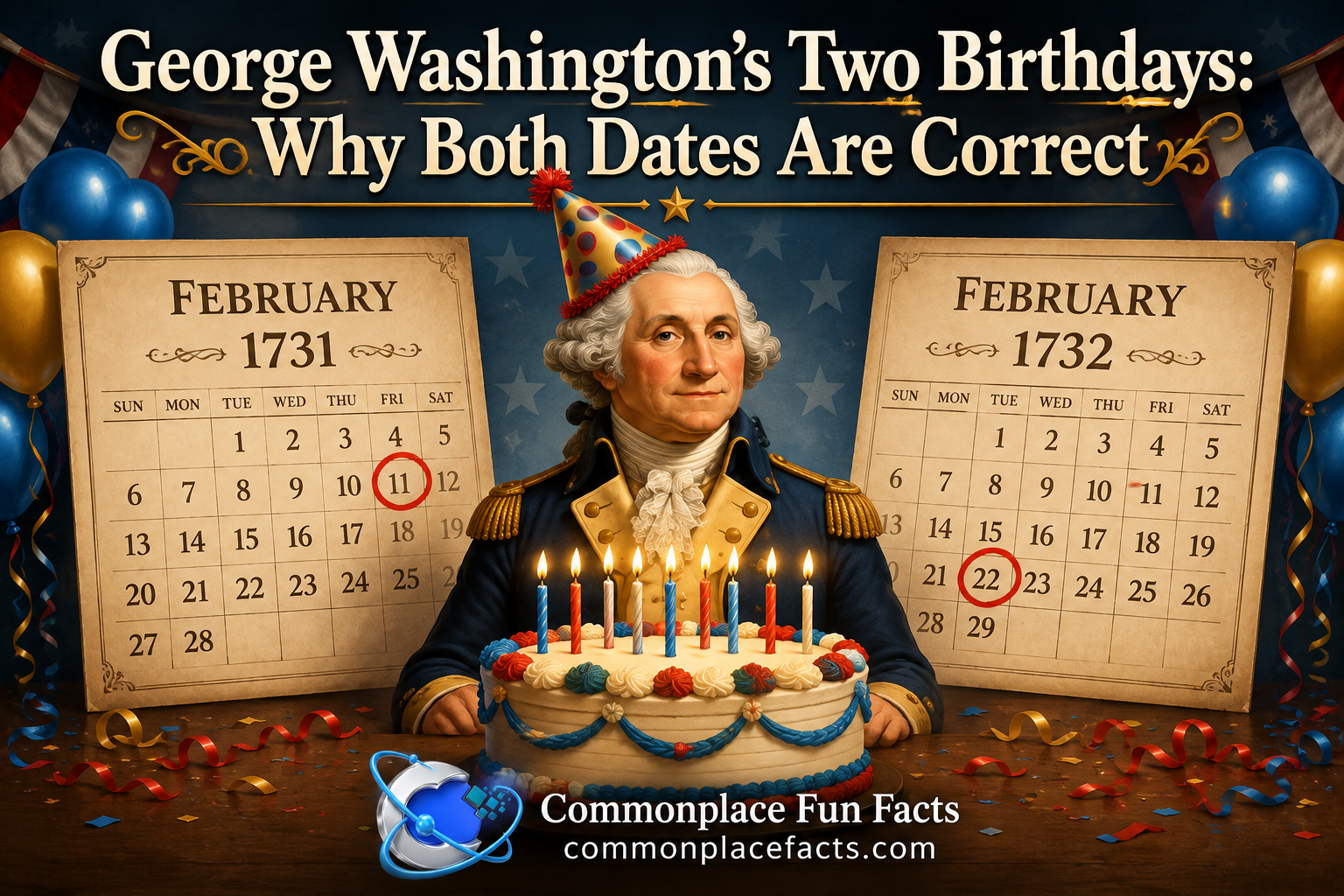
But one seemingly impossible claim about Washington is actually true: George Washington was born on February 11, 1731, and February 22, 1732.
No, his mother was not in labor for 376 days. George Washington’s two birthdays are the result of Britain changing both its calendar and the date on which it considered a new year to begin. To understand how the Father of His Country managed to acquire two perfectly legitimate birth dates, we have to go back 150 years before his birth and blame a pope, some astronomers, and several centuries of calendar drift.
Contents
The Julian Calendar Was Slowly Losing Track of Spring
The trouble began with the Julian calendar, introduced under Julius Caesar. Its basic assumption was that a year lasted 365¼ days, so every fourth year received an extra day. That was remarkably good for ancient astronomy, but it was not quite good enough.
The actual solar year is about 11 minutes shorter. Eleven minutes does not sound particularly threatening, but give an error enough centuries and it begins to develop ambitions. By the 16th century, the calendar had drifted about 10 days out of alignment with the seasons.
This was especially troublesome for the Church because the calculation of the date of Easter is tied to the spring equinox. A calendar that gradually moved the equinox was therefore more than a nuisance. It was an ecclesiastical scheduling problem, and those have a way of attracting committees.
Pope Gregory XIII Fixes the Calendar
In 1582, Pope Gregory XIII introduced what became known as the Gregorian calendar. The reform removed 10 days from the calendar and slightly changed the rules for leap years. Under the new system, years divisible by four are generally leap years, but century years are not unless they are also divisible by 400. Thus, 2000 was a leap year; 1900 was not. The U.S. Naval Observatory explains the distinction between the Julian and Gregorian leap-year systems.
The reform worked. Unfortunately, Europe did not respond by saying, “Excellent. We shall all change calendars immediately.” Catholic countries generally adopted the Gregorian calendar first, while Protestant countries regarded a calendar promulgated by the pope with roughly the enthusiasm one might expect.
England and its American colonies held out for another 170 years. Calendar reform, as it turns out, is one of those things everyone agrees is necessary right up until somebody proposes changing the calendar.
The Gregorian reform also figures into one of the traditional explanations for the origins of April Fools’ Day, although the evidence for that particular story is considerably shakier than the evidence concerning Washington’s birthday.
George Washington Is Born—Old Style

While Britain was still clinging to the Julian calendar, Augustine and Mary Ball Washington welcomed a son at their plantation on Pope’s Creek in Westmoreland County, Virginia.
The Washington family Bible recorded his birth as February 11, 1731/32, at about 10 o’clock in the morning. The double year was not indecision on the part of the person holding the pen. It reflected yet another feature of the British calendar that would soon complicate matters.
You can see the Washington family Bible record preserved by George Washington’s Mount Vernon.
Britain Had a Different Idea About When the Year Began
Today, January 1 seems like the obvious beginning of a new year. Eighteenth-century England begged to differ.
Although January 1 was commonly celebrated as New Year’s Day, England’s civil and legal year officially began on March 25. Consequently, January, February, and most of March belonged to what modern readers would think of as the previous year.
That is why historical documents sometimes give a year as something like “1731/32.” February 11 was officially in 1731 according to the English legal calendar, even though countries beginning their year on January 1 already regarded it as 1732.
So even before anyone started moving days around, George Washington’s birth date already required an explanatory footnote. The calendar was apparently determined to make things difficult for future historians.
Britain Finally Changes the Calendar in 1752
Parliament finally addressed the problem with the Calendar (New Style) Act 1750. The changes took effect in stages during 1752 and affected Britain and its colonies, including Virginia.
First, January 1 became the official beginning of the year. That converted Washington’s birth year from 1731 to 1732.
Then came the more dramatic adjustment. Because Britain was by then 11 days behind countries already using the Gregorian calendar, Wednesday, September 2, 1752, was followed immediately by Thursday, September 14.
September 3 through September 13 simply did not exist in Britain or its colonies that year. Presumably, anyone with an appointment scheduled during those days was invited to blame Parliament.
George Washington’s Two Birthdays: How February 11, 1731 Became February 22, 1732
Apply both changes to Washington’s original birth date and the mystery disappears.
Changing the beginning of the year from March 25 to January 1 turned February 11, 1731 into February 11, 1732. Converting the Julian date to its Gregorian equivalent then added 11 days, producing February 22, 1732.
That is why George Washington’s Mount Vernon lists both dates: February 11, 1731 under the Julian calendar and February 22, 1732 under the Gregorian calendar.
George Washington Even Had Two Consecutive Birthdays 376 Days Apart
The calendar change produced one final bit of chronological mischief.
Under the calendar then in use, Washington turned 20 on February 11, 1752. Britain adopted the Gregorian system later that year. Consequently, his next birthday—the date on which he turned 21—was February 22, 1753.
In other words, Washington’s 20th and 21st birthdays were separated not by the usual 365 days, but by 376 days on the calendar.
So George Washington really could claim two birth dates: February 11, 1731 and February 22, 1732. Both identify the same morning at Pope’s Creek. The difference lies entirely in how people numbered the days and years around it.
For a man surrounded by myths about cherry trees, wooden teeth, and impossible feats involving silver dollars, it seems appropriate that one of the strangest-sounding stories about him turns out to be true.
And if changing birthdays seems like an unusually complicated beginning to a life, it was hardly Washington’s last encounter with historical weirdness. At age 22, he managed to become involved in an incident that helped ignite a global conflict. Read about how young George Washington helped start the Seven Years’ War.
You may also enjoy…

The Unique and Iconic Kodak 13-Month Calendar: A Look At An Innovative Way to Measure The Days
Discover the fascinating story of the Kodak 13-month calendar, introduced by George Eastman in 1928. Learn why this innovative system lasted until 1989 and its impact on business efficiency.

France’s Brief Experiment With Decimal Time
The French Revolutionary Calendar, introduced during the Revolution, abolished traditional dates, aligning them with nature and decimal time. Emphasizing new agricultural names, it aimed to sever ties with the Church and monarchy. However, unpopularity due to confusion, labor complaints, and practicality led to its eventual abandonment by Napoleon in 1806.

Y2K: When We All Held Our Breath and Flipped Our Calendars
Discover the fascinating story of Y2K—how a two-digit date nearly caused global panic, what actually happened when the clocks rolled over to the year 2000, and why your microwave didn’t start a revolution.




Leave a Reply