
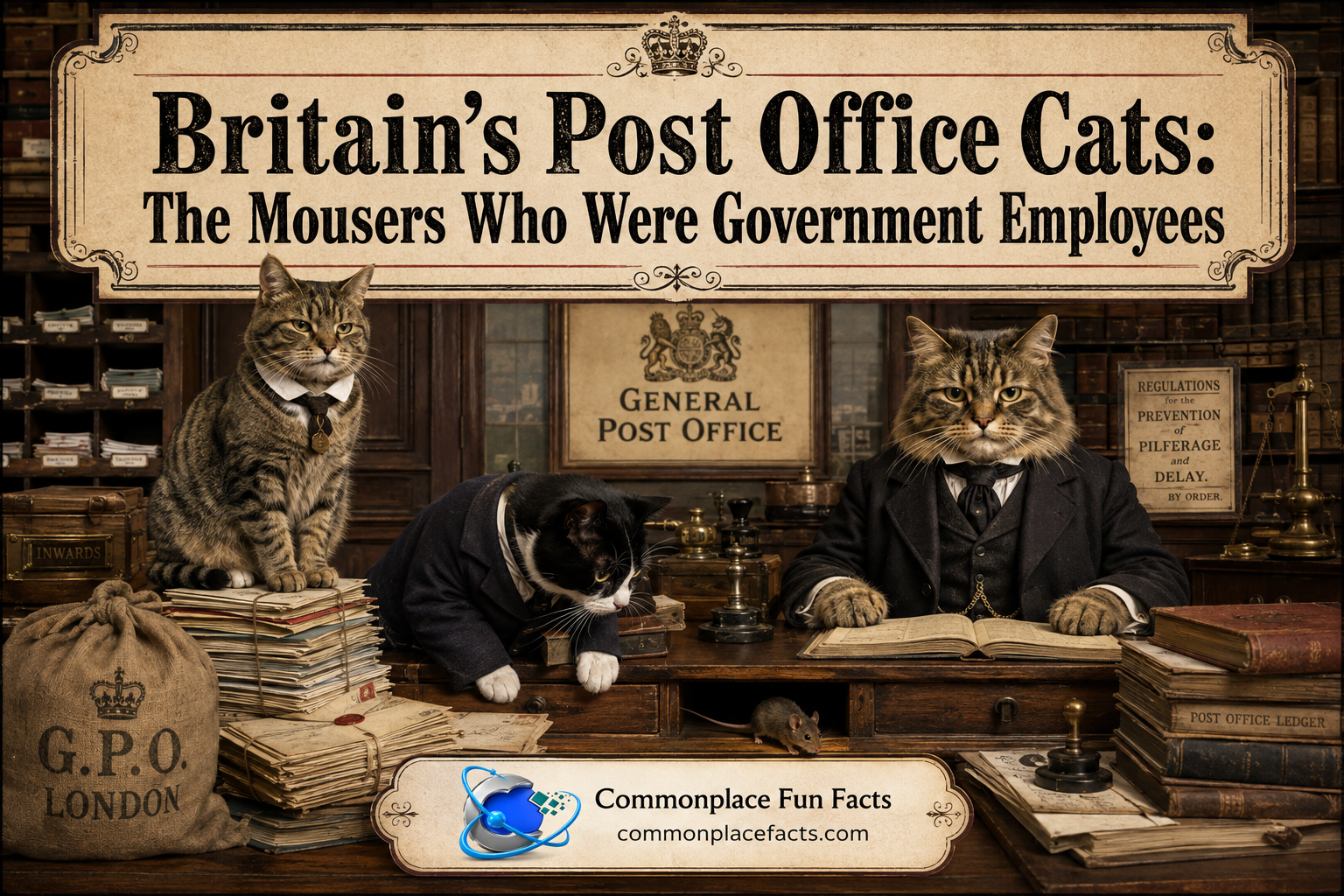

Government employment has always involved certain expectations. Show up for work. Perform the duties assigned to you. Avoid prolonged unexplained absences. Try not to sleep through most of the day.
Britain’s Post Office eventually discovered that the last two requirements could be troublesome when your employees were cats.
Beginning in 1868, the Post Office formally authorized cats to control mice in its buildings. These were not simply neighborhood felines who wandered in, found a comfortable sack of mail, and refused to leave. Money was officially allocated for the upkeep of post office cats. Their performance was reviewed, their compensation was increased, and their employment eventually became the subject of questions in the House of Commons.
By 1953, the matter had become sufficiently urgent that Parliament was discussing feline pay scales, maternity benefits, equal pay, absenteeism, and the apparent impossibility of establishing a productivity bonus for cats.
There are days when parliamentary democracy writes all of the material for us.
Contents
The British Post Office Had a Mouse Problem
The problem began with one of the oldest workplace disputes in history: management had property, mice wanted to eat it, and neither side appeared interested in collective bargaining.

In nineteenth-century London, the General Post Office handled an enormous volume of paper. That meant letters, mailbags, records, forms, and, in the Money Order Office, documents representing actual financial transactions. To a mouse, this was less a government department than an all-inclusive resort with complimentary nesting material.
The rodents chewed paper and damaged paid money orders being retained for administrative purposes. Officials tried traps and other conventional methods of pest control. The mice remained unimpressed.
On September 23, 1868, Frederic Rowland Jackson, Controller of the London Money Order Office, wrote to Post Office Secretary John Tilley proposing an escalation.
He wanted cats.
Jackson had already asked the resident porter to obtain three of them. He noted that institutions such as museums commonly provided an allowance for maintaining working cats and proposed two shillings per week for the care and feeding of his new anti-mouse task force.
Tilley approved the concept but not the budget.
Three Cats Were Hired on Probation
According to archival material preserved by The Postal Museum, Tilley authorized three cats for a six-month probationary period. He preferred females, wanted their performance evaluated, and approved only one shilling per week for their support.
One shilling.

For all three cats.
This distinction is worth making because the story is frequently retold as though each of the original cats received a one-shilling weekly salary. The archival record indicates that the original allowance was a single shilling for maintaining the three-cat workforce collectively. Smithsonian’s history of the Post Office cats likewise notes that the one shilling covered all three original cats.
The government also had an innovative approach to employee meals.
Tilley insisted that the cats not be overfed. They were expected to “depend on mice for the remainder of their emoluments.” In other words, part of the compensation package consisted of permission to eat the opposition.
There was also a performance incentive, although not the kind likely to appear in a modern employee handbook. If the mouse population did not decline within six months, Tilley warned that the cats’ maintenance allowance would be reduced.
This is an unusual motivational strategy. Most underperforming employees are not told, “If productivity does not improve, we will begin withholding lunch.”
Jackson replied the next day that Tilley’s directions had been communicated to the resident porter, James Tye, who would “no doubt find means to inform the cats upon what terms they are to be employed and what is expected of them.” No surviving record tells us whether the cats raised any objections.
The Cats Received Their First Performance Review
The arrangement worked.
On May 7, 1869, after the experimental period had run its course, the Post Office reported that “the cats have done their duty very efficiently.” The Cat System, as it was sometimes described, had passed its probationary review.
That made the original three felines something more interesting than ordinary mousers. Cats had undoubtedly lived and hunted in Post Office buildings before 1868, just as they had been controlling rodents in homes, warehouses, ships, farms, shops, and practically every other place humans stored anything edible. What changed in 1868 was the bureaucracy.
The government had formally approved expenditure for them.
There was an authorized number of cats. There was a budget. There was a probation period. There were performance expectations. There was a review of results.
The Victorian civil service had successfully bureaucratized the cat.
In 1873, the cats’ maintenance allowance was increased by sixpence per week. Their success also encouraged other post offices to maintain cats, although the amount spent on them varied from place to place.
That lack of national standardization would eventually produce a problem.
Or, more accurately, it would produce Parliament.
Were the Cats Employees or Just Expense Accounts With Whiskers?
Before we promote them all to the civil service pension scheme, there is a terminology issue worth clearing up.
Historical accounts frequently say the Post Office cats were “paid,” “salaried,” or “on the payroll.” That conveys the practical reality, but the original records generally speak of an allowance for their support or upkeep. The money was used to feed and care for the cats rather than handed directly to them on Friday afternoon in tiny envelopes marked PAY TO THE ORDER OF MITTENS.
That distinction becomes increasingly blurry as the institution develops. By the twentieth century, Post Office records and parliamentary debates casually used the language of wages, pay increases, wage freezes, and salaries. Officials plainly treated the cats as working animals whose maintenance was a legitimate departmental expense.
The cats themselves probably regarded the distinction between “salary” and “food allowance” as one of those strange human concepts that had no bearing on the important questions of whether the bowl was full and whether anyone had moved their chair.
The Great Post Office Cat Wage Crisis
By the early 1950s, Britain had recently survived a world war, was adapting to the reign of a new monarch, wrestling with postwar economic challenges, managing a global transformation of the British Empire, and confronting the growing tensions of the Cold War.
There was also the urgent matter of cat pay.
Newspapers began reporting in 1952 that Post Office cats had gone decades without a proper increase in their allowances. On March 18, 1953, Captain Lawrence Orr raised the matter during Question Time in the House of Commons.
Orr asked Assistant Postmaster-General David Gammans when the cat allowance had last been increased, how much the arrangement cost, and whether cats in Northern Ireland received the same rate as those in London.
What followed can be read in the official Hansard record of the House of Commons, which is useful because otherwise this entire exchange would sound like something invented while emerging from dental anesthesia.
Gammans reported that there was “industrial chaos in the Post Office cat world.”
Allowances differed among offices. Attempts to devise some sort of payment-by-results system had apparently failed, which is understandable. Establishing a mouse quota is easy. Getting a cat to care about the mouse quota is a separate branch of public administration.
Gammans further observed that the feline workforce could be “unreliable, capricious in their duties and liable to prolonged absenteeism.”
Anyone who has ever employed a cat will recognize this as an unusually fair performance evaluation.
Parliament Asked the Important Follow-Up Questions
The debate did not stop at basic compensation.
Captain Orr wanted to know why there were no Post Office cats in Northern Ireland. Gammans suggested that perhaps Northern Irish post offices simply did not have mice, thereby resolving the matter through the ancient governmental technique of confidently guessing.
Orr then asked what happened when a Post Office cat had kittens. Did the Department provide a family allowance?
There was no family allowance, Gammans explained, but local head postmasters had full discretion to provide a “maternity grant.” Another MP immediately asked whether the Department provided an adequate maternity service.
Gammans assured the House that it did.
Then Irene Ward, MP for Tynemouth, raised the obvious matter of gender equality. Did male and female Post Office cats receive equal pay?
Yes, Gammans said. Equal pay prevailed both in principle and in practice.
It is difficult to decide which part of this exchange is most wonderful: that Members of Parliament spent Question Time discussing maternity benefits for cats, or that Britain’s feline civil servants achieved formal pay equality while human women were still fighting over exactly the same issue.
The Cats Got Their Raise
Behind all the parliamentary comedy was an actual administrative question. Postmasters still had rodent problems, cats were still useful, and feeding them cost money.
The issue lingered for several years. In 1956, according to the Postal Heritage Trust’s archival history, head postmasters and telephone managers were authorized to spend 1 shilling 6 pence per week on the upkeep of a cat. Rising food costs soon pushed that to 2 shillings 6 pence, and by 1958 the authorized allowance had climbed to 3 shillings 6 pence.
There had been no feline strike, no picket lines, and apparently no organized delegation of cats marching on Whitehall. Nevertheless, the cats got the money.
Collective bargaining is considerably easier when your bargaining position includes control of the building’s mouse population.
Then Came Tibs the Great
The most famous Post Office cat was a large tabby named Tibs.
Tibs was born in November 1950 into what can only be described as a postal dynasty. His grandmother Minnie had been the official cat at Post Office Headquarters. After her death, one of her grown kittens—probably named Fluffy—continued the family business. Tibs was one of the next generation.
Apparently the British Post Office briefly operated a hereditary monarchy, except the monarch’s principal constitutional responsibility was killing mice.
Tibs lived in the refreshment club in the basement of Post Office Headquarters and eventually reached an impressive 23 pounds. During his 14 years of service, Postal Museum archival material credits him with keeping headquarters completely free of mice.
He also became a celebrity.
Tibs appeared at a “cats and film stars” party and was featured in the 1953 book Cockney Cats. When he died on November 23, 1964, the Post Office Magazine gave him an obituary under the headline “Tibs the Great is No More.”
Most government employees would be fortunate to receive such a sendoff.
Most government employees also do not weigh 23 pounds and live in a basement refreshment club, although statistical confirmation on that point has not been attempted.

Government and Cats Have a Surprisingly Long Relationship
The Post Office cats fit comfortably into a much larger tradition of humans putting cats close to positions of authority and then acting surprised when the cats become more popular than the people supposedly in charge.
Britain continues the tradition at the highest levels of government. Number 10 Downing Street has its own Chief Mouser, a position currently associated most famously with Larry, who has served at the prime minister’s official residence since 2011. Unlike the Post Office cats, Larry does not receive an official government salary, although room and board at one of the most famous addresses in Britain is not the worst compensation package ever negotiated.
Winston Churchill also contributed to Britain’s governmental feline tradition in a more personal way. His affection for an orange cat named Jock was so strong that when Chartwell became associated with the National Trust, Churchill requested that a marmalade-colored cat named Jock always be allowed to live comfortably at his former home. Generations of Jocks have since benefited from the arrangement, proving that getting remembered in a statesman’s final wishes is an excellent retirement plan if you can manage it.
Across the Atlantic, Americans found another route to feline public service. Stubbs became the honorary cat mayor of Talkeetna, Alaska, and remained the community’s famous figurehead for about two decades. Talkeetna is unincorporated and does not actually have an elected mayor, so Stubbs never possessed municipal authority. This did not stop him from enjoying greater name recognition than most actual mayors, which may tell us something uncomfortable about politics.
The CIA even tried putting a cat into national-security work through Project Acoustic Kitty, an experiment intended to turn a cat into a mobile listening device. That project demonstrated an important distinction between British and American approaches to feline government service. The British mostly asked cats to do what cats already wanted to do. The CIA tried giving one an assignment.
The British approach produced better performance reviews.
Blackie Was the Last Headquarters Cat
The Post Office cat tradition did not end with Tibs.
In April 1971, an unidentified female cat appeared in the basement of Post Office Headquarters and gave birth to five kittens. Four were placed in homes. The fifth, a black-and-white male named Blackie, was retained for official duty.
Blackie apparently justified the appointment. Postal records describe his mouse-catching skills as exemplary, and he even became something of a television personality after appearing on the BBC program Nationwide.
By 1983, officials were again arguing over feline compensation. Blackie and other Post Office cats were then receiving £1 per week. Following what the archival history describes as top-level negotiations, their pay was doubled.
A 100-percent raise is impressive under any circumstances.
Blackie had either developed exceptional negotiating leverage or somebody finally calculated how long it would take a human employee to catch a mouse using official procedures.
He died in June 1984. No cat has subsequently been employed at Post Office Headquarters.
Technology Finally Outsourced the Cat
The cats were not eliminated by downsizing, privatization, workplace automation, or a Treasury report concluding that each mouse could be removed more efficiently by a consultant charging £450 per day.
The problem was mailbags.

Traditional cloth mail sacks were attractive to mice, which could chew through them and apparently regarded the material as useful for nesting. As the Post Office replaced cloth bags with less rodent-friendly plastic versions, the mouse problem declined. Better pest-control methods also reduced the need for permanent feline employees.
The technology that had created the Post Office cat’s job eventually made it unnecessary.
After more than a century of government service, the cats had been rendered redundant by plastic.
There are worse ways for a public-sector career to end.
The Perfect Civil Servants, Apart From the Civil Service Part
The Post Office cat story is funny because the bureaucratic language is so wonderfully mismatched with the animals involved. Probation periods, maintenance allowances, productivity standards, wage freezes, maternity provisions, equal pay, absenteeism, and parliamentary oversight all sound perfectly normal until the employee under discussion abruptly jumps onto a windowsill and begins licking its leg.
But underneath the comedy was a thoroughly practical arrangement.
Rodents damaged government property. Cats were unusually good at controlling rodents. The Post Office recognized their usefulness and budgeted accordingly. When costs changed, officials adjusted the allowance. When Parliament wanted answers, a minister stood at the dispatch box and answered questions about the nation’s feline workforce with considerably more seriousness than the subject probably deserved and considerably more wit than government debates usually receive.
The arrangement lasted from the first formally appointed cats in 1868 until Blackie’s death in 1984—116 years in which generations of cats occupied an unlikely place somewhere between pest control, government employee, office mascot, and minor celebrity.
They were occasionally absent without leave. They resisted productivity-based compensation. They required food, housing, and maternity considerations. One became famous enough to receive a national obituary.
And after reviewing the historical record, Parliament itself reached perhaps the most important conclusion about the whole experiment.
Equal pay for cats was never in doubt.
You may also enjoy…

Meet 4 Famous Animals With Military Ranks (And Probably Outrank You)
The pets in our homes hold power over us, but some animals have achieved remarkable ranks and titles. Sir Nils Olav, a penguin, is a Knight of the Norwegian King’s Guard. Corporal Billy Windsor, a goat in the army, was demoted for unruly behavior but earned back his rank. Wojtek, a bear, and Fufu, a…

How a Cat Became Mayor of Talkeetna, Alaska (and Stayed for 20 Years)
Discover the true story of Stubbs, the cat who became the honorary mayor of Talkeetna, Alaska. Learn how this feline ruled for 20 years, charmed tourists, and left a paw print on political history.

Churchill’s Touching Bequest for a Marmalade Cat
How a Marmalade Cat Made an Impression on Winston Churchill When Winston Churchill donated his home to the United Kingdom’s National Trust, he did so with the request that there always be a marmalade cat named Jock, with a white bib and four white feet, in comfortable residence at the estate. The National Trust has…






Leave a Reply