
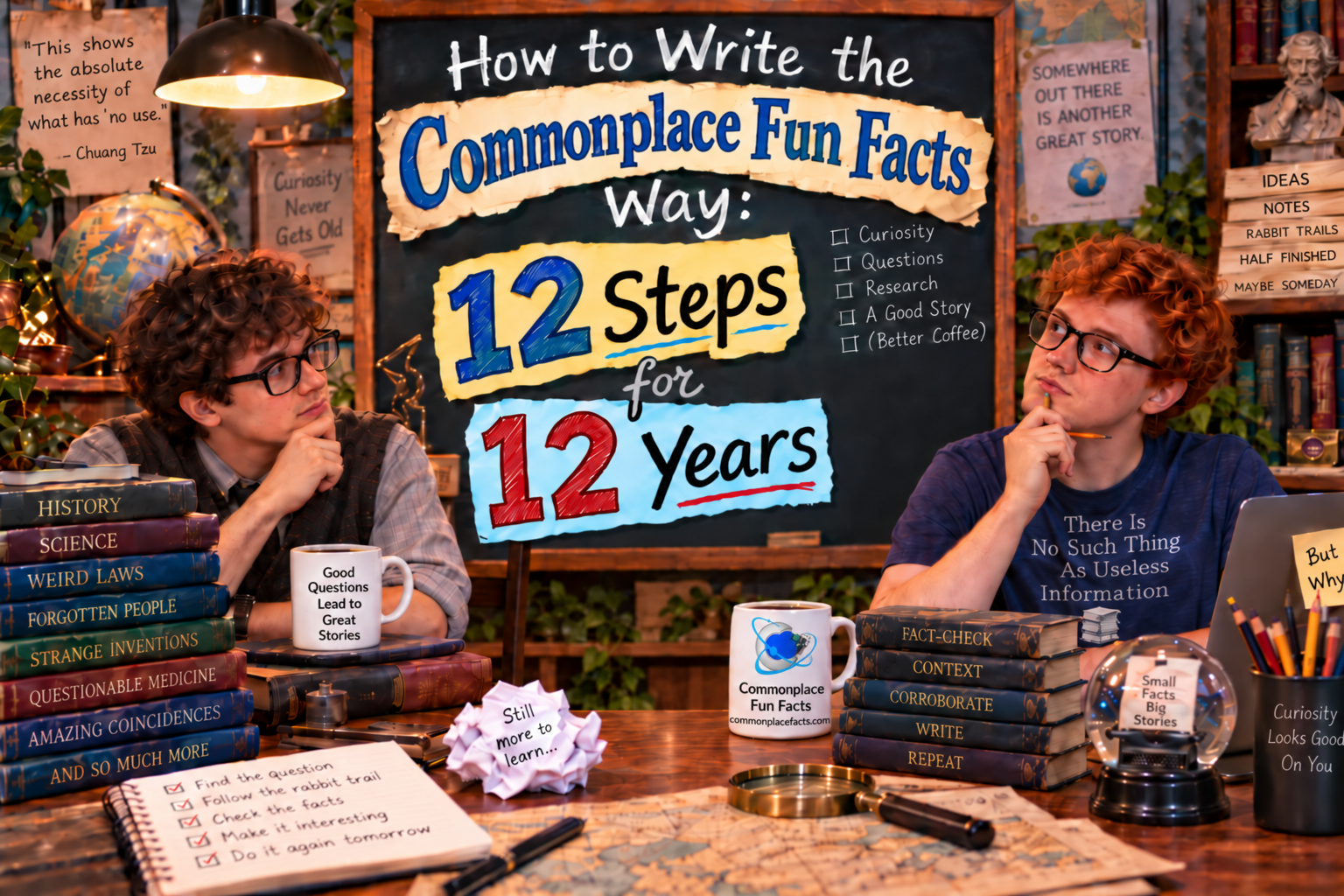

Today marks the twelfth anniversary of Commonplace Fun Facts.
For twelve years, we have been bringing you stories about strange history, weird science, peculiar language snippets, unusual laws, forgotten people, inexplicable inventions, questionable medical practices, astonishing coincidences, and the many occasions on which humanity was presented with several sensible options and confidently selected something else.
Over that time, one of the most common questions to come our way has been, “How do you decide what to write about?”
There is a temptation to offer an impressive answer involving an editorial calendar, market research, audience segmentation, strategic content planning, and perhaps a large conference room where serious people draw with colored markers on a whiteboard.
That would be dishonest.
The actual process is much closer to wandering through an intellectual flea market, spotting something peculiar on a table, and asking, “What is that, why does it exist, and how did anyone think this was a good idea?”
Welcome to How to Write the Commonplace Fun Facts Way. For reasons we choose not to contemplate too deeply, it’s a 12-step process. And no, the first step is not “admitting you have a problem.”
Contents
Step One: Collect More Ideas Than You Could Possibly Use
The first step in writing the Commonplace Fun Facts way is to maintain a large and steadily expanding collection of possible subjects.
Calling it an “ideas folder” makes it sound organized. In reality, it is a holding facility for historical incidents, scientific oddities, half-remembered anecdotes, reader suggestions, mysterious phrases, interesting people, and subjects that seemed compelling while scrolling through social media during a hastily gobbled lunch, but may not withstand the scrutiny of daylight.

At the moment, the ideas folder is less an editorial calendar than a holding pen for whatever happens to make us say, “Wait—what?” There are possible articles about strange Supreme Court cases involving tomatoes, dead chickens, and 95 barrels of vinegar; Rome’s urine tax and other ingenious ways governments have discovered to separate people from their money; Micronauts; the Smothers Brothers; great historical insults; funny aviation waypoints; obscure Founding Fathers; the Blair House; Vesna Vulović’s astonishing survival; letters of marque and reprisal; and the real Illuminati before conspiracy theorists gave it a much more exciting résumé.
We may eventually get around to B. F. Skinner, bubble science, porcelain, bizarre snowflakes, the origin of “googol,” regional dialects, the history of LEGO, Hanna-Barbera cartoons, The Far Side, James Cagney teaching Ed Sullivan how to impersonate James Cagney, singing cowboys, movie anachronisms, Sergeant Stubby, Dickin Medal recipients, Punxsutawney Phil’s forecasting record, famous Ad Council campaigns, the Great Seal of the United States, fictional corporations, fictional mansions, paradoxes, and an interactive version of Thomas Edison’s employment test.
We have also made room for such questions as why the British Constitution refuses to become one convenient document, whether Amway is a pyramid scheme, how the Pentagon Pizza Index became a thing, and why anyone thought it necessary to estimate the market value of Wayne Manor. In other words, there is no discernible editorial theme beyond: “That sounds interesting. We should look into that.”
Some of those will eventually become articles. Some will remain in the folder for years, periodically resurfacing like applicants who have not realized the position was filled in 2019. Others will be opened, examined, and returned to storage until we are emotionally prepared to learn everything there is to know about nineteenth-century button manufacturing.
“Where do you get your ideas?” This question is surpassed only by such gems as “You don’t have a lot of friends, do you?” and “Did you really think that shirt matches those pants?”
The answer—to the ideas question, that is—is that they come from everywhere.
From the beginning, many ideas have also come from family members. This has the advantage of ensuring a steady supply of topics and the disadvantage of teaching one’s children that every casual remark may result in a 2,500-word article with footnotes.
Someone mentions an odd expression over dinner, and immediately the questions begin.
Where did that phrase come from?
Is that story true?
Who was the first person to do that?
Why would anyone have wanted to?
And, most importantly, is there enough material here to justify disappearing into the internet for the rest of the evening?
One of the unexpected pleasures of twelve years of Commonplace Fun Facts has been the friends we have made along the way. Fellow bloggers and other incurably curious people have offered encouragement, shared discoveries, and reminded us that we are far from alone in believing that an obscure historical detail is a perfectly reasonable excuse for losing an afternoon.
We are especially grateful for our friends at In the Shadow of Yesterday, whose own excursions into overlooked corners of history have supplied both inspiration and more than a few “How did I not know about this?” moments. Over the years, this has become much more than a one-way exercise in publishing odd facts; it has become a conversation with people who share the dangerous habit of hearing an obscure historical detail and immediately deciding that the rest of the afternoon is now spoken for.
Many of our best ideas come from readers, and we are deeply grateful for that. Over the years, readers have sent suggestions ranging from “Here is a fascinating forgotten historical figure you should know about” to “I heard this strange thing once and have decided you should now devote several days to determining whether it is true.” There are also at least a couple of you who seem to think we exist to research your homework assignments. You know who you are. And don’t think we haven’t noticed that you’re treating us as a slower, snarkier version of ChatGPT.
Sometimes the suggestion becomes an article almost immediately. Sometimes it joins the ideas folder and waits patiently for months or years until the right moment arrives. And sometimes a reader sends a single sentence that opens a door to a subject we never would have thought to investigate on our own. That generosity has become an important part of Commonplace Fun Facts. Readers do not simply consume what appears here; they help shape what comes next.
Every suggestion, correction, question, and “Have you ever looked into this?” message is a reminder that curiosity is contagious, and that this site has become a shared expedition into the odd corners of strange history, science, language, and human behavior. We are enormously thankful to everyone who has taken the time to send an idea our way—and, in doing so, has occasionally destroyed an otherwise perfectly planned day of leisure.
Step Two: Ask, “What Would I Like to Learn About Today?”
The guiding question is usually not, “What subject will maximize engagement among our most desirable audience demographics?”

It is, “What would I like to learn about today?”
This is admittedly self-serving.
Commonplace Fun Facts is written with readers in mind, but it is also a form of recreational curiosity. Researching why a familiar expression exists, how an ordinary object was invented, or what possessed an otherwise respectable historical figure to behave in a spectacularly peculiar manner is fun. It is also a welcome departure from the everyday concerns that occupy most of life.
Some people relax by fishing.
Some garden.
Some watch television.
Some have friends.
We investigate whether ancient kings really had prophetic dreams involving enormous vines and continent-spanning floods of urine.
Everyone needs a hobby.
Writing about a subject we genuinely want to understand also makes it easier to communicate enthusiasm. Readers can usually tell when a writer is interested in the material. They can also tell when the writer is fulfilling an assignment titled “Ten Fascinating Facts About Commercial Drainage Systems” and has been quietly questioning every decision that led to this moment.
The best Commonplace Fun Facts subjects begin with genuine curiosity. They are things we want to know even if nobody else ever reads the finished article.
Fortunately, some of you usually do.
Step Three: Ask, “But Why?”
The earliest Commonplace Fun Facts articles were heavily inspired by the style of L.M. Boyd, whose syndicated newspaper column delivered a steady stream of brief questions, surprising answers, statistics, and trivia.

That format was wonderfully efficient. Here is an interesting fact. Enjoy it. We will now move on to another interesting fact.
Over time, however, we found ourselves wanting more.
Suppose we learned that an everyday object was invented by accident. That was interesting—but why did the accident happen? Who was responsible? What were they trying to invent? Did they recognize the importance of what they had created? Did someone else take the credit? Was there a lawsuit? Did the inventor die penniless while another man built a mansion and named a yacht after himself?
A fact may answer one question while creating six more.
That is where the Commonplace Fun Facts method really begins. We rarely stop at “Here is something unusual.” We want to know how it happened, why it mattered, what came before it, and whether the familiar version of the story bears any resemblance to reality.
The phrase that drives much of the site could be reduced to two words: “But why?”
Yes, people once believed that. But why?
Yes, that object has an unusual name. But why?
Yes, this famous person supposedly performed an astonishing feat. But why do all the earliest versions of the story appear seventy years after he died?
That final question leads us to the next essential part of the process.
Step Four: Ask, “Really? Are You Sure?”
Fun facts have a troublesome habit of being fun even when they are not facts.
The internet is filled with irresistible stories that have been copied, shortened, embellished, illustrated, turned into memes, and repeated so many times that skepticism begins to feel impolite.

Unfortunately, repetition is not evidence. It merely proves that a large number of people enjoyed the story enough to pass it along without checking. This means that researching an article frequently involves asking: “Really? Are you sure?”
Sometimes the answer is yes. The strange story is supported by contemporary records, reputable historians, scientific research, or other evidence.
Sometimes the answer is “Mostly, but several important details have been improved for dramatic effect.”
Sometimes it is “No, but the true story is even more interesting.”
And sometimes the answer is “Absolutely not. This appears to have originated with a man on Facebook who cited his uncle.”
When possible, we try to trace stories back to their sources. That may involve finding contemporary newspaper accounts, court records, scientific studies, old books, museum collections, government documents, biographies, or the original version of a quotation that has spent the last century being reassigned to Mark Twain.
The goal is not to drain the fun out of a story. It is to determine where the fun actually belongs.
Step Five: Never Ignore a Throwaway Detail
Many articles begin with a subject that appears to be merely an interesting side note.
Someone says, “Incidentally, the inventor was once arrested for impersonating a dentist.”
Most people accept this information, perhaps raise an eyebrow, and continue with the main subject.

We do not.
We say, “Wait. What?”
The original conversation is now over. The dentist impersonation has become the main issue.
Throwaway details are dangerous because they frequently open doors to much larger stories. A single sentence in a book may reveal an overlooked controversy. A minor character may turn out to have lived a far more interesting life than the famous person being discussed. An obscure footnote may contain the seed of an entire article.
The Commonplace Fun Facts approach is to pause whenever a detail causes us to say, “But wait. I want to know more about that.”
This is not always an efficient research technique. It is, however, how many of the best stories are found.
Step Six: Follow the Rabbit Trail
Noticing the stray detail is one thing. The next step is considerably more dangerous: following it.
An article may begin with a clear, manageable subject.
We will research the origin of a familiar toy.

Simple.
An hour later, we are reading about German educational theory, nineteenth-century urban playgrounds, municipal sanitation regulations, sand imports, child-development experiments, and a bitter dispute between two men who both claimed to have invented the bucket.
This is called a rabbit trail.
In more professional settings, it might be called “scope creep.” That phrase sounds disapproving, however, whereas “rabbit trail” suggests an adventurous woodland journey rather than a complete collapse of editorial discipline.
Rabbit trails are not necessarily a problem. Often, they reveal that the original subject is only one part of a much better story. The challenge is determining whether the unexpected material belongs in the article, deserves an article of its own, or has merely distracted us because human beings are remarkably susceptible to clicking links labeled “Personal scandal.”
Sometimes we begin confidently with one subject and end somewhere entirely different.
This is not getting lost.
It is discovering what the article was actually about. It illustrates our foundational theory that there is no such thing as “useless information” and that we are all connected in some way to a great web of history.
Step Seven: Take Anywhere from an Hour to More Than a Year
How long does it take to write a Commonplace Fun Facts article?
Anywhere from “not long” to “we’ll let you know if we ever get around to finishing it.”

The actual research and writing may require only a few hours. The rest of the schedule depends on how long it takes to get around to finishing it.
Some subjects immediately take hold. The research uncovers one intriguing detail after another, the structure becomes obvious, and the article practically writes itself.
Other subjects remain interesting but uncooperative. We know there is a good story in there somewhere, but it has hidden behind six contradictory sources and refuses to come out.
Those articles may sit unfinished for months. Eventually, some new fact, historical anniversary, reader question, or unexplained burst of enthusiasm brings them back to life.
Still others begin with great promise and gradually lose their appeal.
Currently, the oldest item in the hopper dates to December 20, 2020. It began as an interesting fact about penguins. Somehow, it developed into something about crows. At the moment, it is trying to decide whether a claim about lobsters having rainbow-colored blood is interesting enough to spin off into an article of its own, belongs in the existing hodgepodge of biological oddities, or is even true in the first place.
Just writing that paragraph has sucked most of the emotional energy out of us, which helps explain why the article remains in the “We’ll Get Around to It Later, Right Around the Time We Throw Out the Unmatched Socks That Have Accumulated Since College” folder.
We set articles like that aside, assuming we will find them interesting again later. Often, we do. Curiosity is seasonal. A subject that feels tedious today may become irresistible six months from now for reasons the human brain declines to explain.
Occasionally, an idea is abandoned altogether. We reread the notes and wonder why we ever believed the subject was interesting in the first place.
This is the editorial equivalent of finding something you purchased at a garage sale and realizing that the previous owner may have understood its value perfectly.
Step Eight: Add Structure Because the Search Engines Demand Tribute
Eventually, we discovered something called search engine optimization.
This was the revelation that writing an interesting article was not enough. The article must also contain headings, subheadings, descriptive titles, focus keywords, meta descriptions, internal links, external links, image descriptions, and enough structural guidance to ensure that both readers and machines understand what is happening.

This explains why modern Commonplace Fun Facts articles have tables of contents and carefully phrased subheadings.
The old approach was:
“Here is a strange story. Let us begin.”
The SEO-approved approach is:
“Here is a strange story, clearly identified by its primary keyword, organized under several helpful headings, and accompanied by a 155-character summary designed to charm an algorithm.”
This has been useful. The structure makes longer articles easier to navigate, and descriptive headings help readers locate the parts that interest them.
It has also created the peculiar modern experience of trying to preserve a natural sense of humor while ensuring that the phrase “history of the hula hoop” appears often enough to satisfy a machine without making readers suspect that the writer has suffered a neurological event.
It is the creative-writing equivalent of eating your vegetables so you can check the appropriate box on the food pyramid.
Step Nine: Occasionally Recycle Something That Deserved Better
Every so often, we revisit an older article that never attracted much attention.
This may mean the subject was not as interesting as we thought.

We generally reject that possibility.
Instead, we conclude that the article was published at the wrong time, had an ineffective headline, lacked useful subheadings, featured an uninspiring image, or was the innocent victim of an algorithm that failed to appreciate its greatness.
The article may then be expanded, reorganized, updated, given a new title, supplied with better illustrations, and sent back into the world.
This is not recycling in the sense of attempting to pass off old material as new.
It is more like rescuing a neglected historical figure, dusting him off, straightening his collar, and giving him another opportunity to impress the internet.
Sometimes it works.
Sometimes the internet ignores him again.
At that point, he has had two chances.
Step Ten: Accept That We Have No Idea What People Actually Want
We always try to think about what our readers will enjoy.
After twelve years, however, we must admit that we have very little ability to predict what that will be.

An article may involve days of research, a compelling story, excellent sources, carefully selected images, a strong headline, and a subject we are certain will fascinate everyone.
It receives seventeen views.
Another article may have been written quickly because we stumbled across an odd fact and thought, “Well, this is mildly amusing and won’t take long to write.”
It becomes one of the most popular things on the site.
Among the articles that have attracted far more attention than we ever would have confidently predicted are Scottish Sayings: When a Scot Asks if Your Cat Died, It Has Nothing to Do With Your Cat; Can You Identify the Only 3 Non-Rectangular Flags?; Why Does It Take 300 Pages to Prove 1+1=2? The Story Behind Principia Mathematica; Oak Island: A $50 Million Treasure Hunt—But How Much Has Been Found?; and The Forbes Fictional 15: Exploring the Wealthiest Characters in Fiction.
In retrospect, perhaps Scottish insults, mathematically excessive proofs, strangely shaped flags, imaginary billionaires, and a centuries-old hunt for treasure should have looked like obvious crowd-pleasers. They did not. This is why we do not have a Department of Predicting What Readers Want. Or, more accurately, why we have one but refuse to fund it.
There are patterns, but there are no reliable rules. Readers frequently surprise us, which is one of the pleasures of doing this.
Sometimes an article we nearly abandoned connects with thousands of people. Sometimes a subject we regard as one of the strongest pieces on the site sits quietly in a corner, waiting to be discovered by readers from the four countries that have never visited our site.
The unpredictability can be frustrating, but it is also liberating. Since we cannot reliably determine what everyone else wants to read, we may as well continue writing about the things we genuinely want to understand.
Step Eleven: Remember That Interesting and Entertaining Are Not Opposites
One other ingredient deserves to be mentioned: humor.
There is no particular reason that learning something should feel like taking medicine. History, science, language, law, and the rest of the subjects we wander into are filled with absurdities, ironies, unfortunate coincidences, spectacularly bad decisions, and human beings behaving exactly as human beings have always behaved. Ignoring all of that in the interest of sounding suitably educational seems like a terrible waste.

So we try to be funny.
That does not mean every paragraph needs a punchline, and it certainly does not mean altering the facts to improve the joke. The humor should come from the story rather than being stapled onto it afterward. Sometimes all that is required is to notice the obvious absurdity that a more solemn account passes over. If a historical figure has made an astonishingly poor decision, there is rarely any need for us to improve upon it. We merely need to stand nearby and point.
Humor also helps make complicated information approachable. A reader who would never voluntarily sit down with a scholarly article about radioactive contamination in Brazil might nevertheless become interested upon discovering that Herbie Goes Bananas somehow wandered into the story. Once curiosity has been awakened, the serious information has somewhere to go.
There are limits. We do not want a joke to distort the facts, trivialize genuine suffering, or turn a real person into a caricature merely because it makes for an easier punchline. Some subjects call for considerably less levity than others. The story gets to decide how funny the article should be.
Most importantly, the humor is not there to distract from the information. It is there to help the reader stay long enough to become interested in it.
Our goal is not merely for someone to finish an article thinking, “I learned something.”
We hope occasionally they will also think, “That was fun. What else have they got?”
Step Twelve: Remember That Someone Else Got There First
There is one thing we should probably make clear about Commonplace Fun Facts: almost nothing you read here represents a new discovery.

We are not excavating previously unknown Roman cities, identifying new species of beetles, deciphering lost manuscripts, or emerging from an archive to announce that Abraham Lincoln secretly spent the summer of 1857 working as a trapeze artist. If we ever uncover something genuinely unknown to historians, scientists, or scholars, it will almost certainly be by accident.
The subjects we write about have generally been studied before. Books have been written about them. Scholars have published papers. Museums have created exhibits. Newspapers have covered them. Somewhere, there is probably already a doctoral dissertation containing considerably more information than anyone has ever requested.
That means our job cannot simply be to find information elsewhere and repeat it here.
The challenge is to make you care about it.
A perfectly accurate fact can still be remarkably dull if it is presented badly. “In 1987, a discarded radiotherapy source containing cesium-137 caused a major radioactive contamination incident in Goiânia, Brazil” is information. But then you learn that the abandoned clinic was supposed to be guarded—and that the security guard failed to show up because he had taken his family to a special screening of Herbie Goes Bananas. While he was gone, two scavengers entered the building, hauled away the radiotherapy equipment, and unwittingly set in motion a chain of events that ultimately killed four people and exposed hundreds of others to radioactive material.
Suddenly, you are no longer merely reading about a nuclear accident. You have questions. How does a movie about a Volkswagen Beetle end up anywhere in the causal chain of a radioactive disaster? What was a cesium source doing in an abandoned building? And at what point does history decide that Herbie Goes Bananas has not already suffered enough reputational damage?
That is the part that interests us.
We are not trying to replace the historians, scientists, museum curators, archivists, journalists, and other researchers whose work makes these articles possible. Quite the opposite. Our job is closer to that of a tour guide who spots something everyone else is walking past and says, “You really need to look at this.”
Ideally, a Commonplace Fun Facts article leaves you knowing more than you did when you arrived, but it should also leave you wanting to know even more. Perhaps you follow one of our sources. Perhaps you buy a book about the subject. Perhaps you spend the next hour reading about some person whose name you had never encountered before today. Perhaps you follow a link, notice an unrelated sentence halfway down the page, and suddenly disappear down a rabbit trail of your own.
In that case, our work here is done.
The point is not merely to transfer facts from one part of the internet to another. The internet already has a remarkably efficient system for doing that, and much of it seems to involve copying the same questionable paragraph until nobody remembers where it came from.
We want to find the story inside the information. We want to explain why the strange detail matters, supply the context that makes it understandable, point out the parts that make us say “Really?” and, whenever possible, make the journey entertaining.
We may occasionally be the first to tell you about a subject, and if so, that’s cool. More importantly, we would like to be the reason you decided you wanted to know even more about it.
How to Write the Commonplace Fun Facts Way
So, after twelve years, that is the closest thing we have to a formula: collect too many ideas, follow the interesting ones, ask “But why?”, distrust anything that seems a little too perfect, chase the side roads, verify the facts, make the story worth reading, and try to leave the reader a little more curious than when they arrived.
It is perhaps fitting that, on our twelfth anniversary, the process has somehow worked itself out into twelve steps. We assure you this was not planned. If there is one thing twelve years of Commonplace Fun Facts should have established by now, it is that planning has never been the dominant force at work here.
What has remained constant is curiosity. There is always another odd detail hiding in a footnote, another familiar story that turns out not to be quite right, another historical figure who deserves to be remembered, and another perfectly ordinary object whose existence becomes deeply suspicious the moment someone asks, “Why is it like that?”

For twelve years, those questions have led us through strange history, science, folklore, law, language, popular culture, and some extremely questionable corners of human behavior.
We remain grateful that so many of you have chosen to come along. You have read, shared, corrected, suggested, encouraged, and occasionally sent us questions that consumed far more time than any of us anticipated. The site is better because of it, and considerably stranger.
There are still thousands of questions waiting to be answered, hundreds of unfinished ideas in the folder, and countless rabbit trails we have not yet followed.
We should probably get started.
You may also enjoy…

Benjamin Franklin’s Advice On Living and Writing
“If you would not be forgotten as soon as you are dead and rotten, either write things worth reading, or do things worth the writing.” — Benjamin Franklin

The Four Countries That Have Never Visited Commonplace Fun Facts—and What We May Have Done to Offend Them
Readers have visited Commonplace Fun Facts from 191 countries. Meet the four nations still holding out—and discover what may have offended them.

10 Years of Commonplace Fun Facts
On September 9, 2014, Commonplace Fun Facts was launched, and it has since grown into a family project primarily managed by the patriarch. The blog covers a range of topics, from history to science fiction, with a focus on presidential trivia, aviation, and language. Despite global readership, the team is yet to have visitors from…






Leave a Reply