
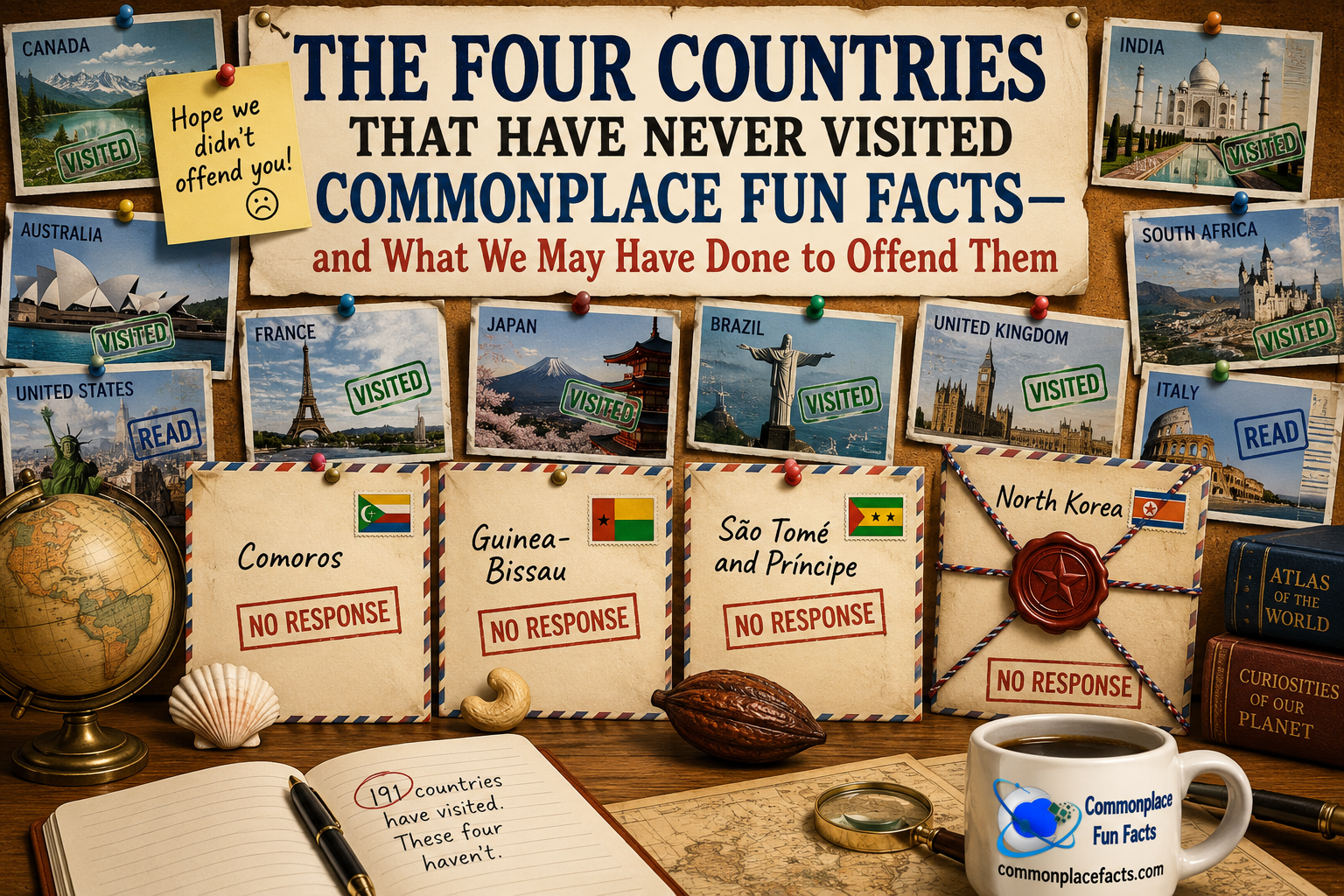

The Commonplace Fun Facts community is truly international. Since we began our quest to highlight fun, strange, and interesting facts, readers have arrived from almost everywhere.
We have welcomed visitors from the United States, the United Kingdom, India, China, Vatican City, Tuvalu, the Falkland Islands, and one person in St. Pierre and Miquelon who presumably finished reading the entire French-language internet and decided to see what else was available.
Our statistics record visitors from 230 different geographic locations. That number includes countries, territories, overseas departments, semi-autonomous regions, island dependencies, and the European Union—which is not technically a country but apparently browses the internet as one.
The United Nations has 193 member states, plus the two observer states represented by flags outside UN headquarters: the Holy See and Palestine. Comparing that 195-country roster with our visitor statistics reveals that readers from 191 of them have found their way to Commonplace Fun Facts.
Only four countries have never sent us a single visitor:
Comoros, Guinea-Bissau, São Tomé and Príncipe, and North Korea.
That naturally raises an uncomfortable question: What did we do?
In the case of three of them, we have no idea. In the case of North Korea, we have several ideas, all of which are preserved in searchable form on this website.
Contents
Comoros: The Perfume Islands Are Giving Us the Silent Treatment
Comoros is a small volcanic nation in the Indian Ocean, between Madagascar and the coast of Mozambique. It consists primarily of three islands—Grande Comore, Mohéli, and Anjouan—although the country also claims Mayotte, whose residents have repeatedly preferred to remain part of France.
This has produced a long-running diplomatic disagreement, because apparently even tropical islands can have complicated custody arrangements.

Its name is often said to derive from an old Arabic expression meaning the “Islands of the Moon.” The country is also known as the “Perfume Islands” because it produces vanilla, cloves, and ylang-ylang, the intensely fragrant flower whose oil appears in some of the world’s most expensive perfumes.
Consequently, it is entirely possible that someone in Comoros has encountered Commonplace Fun Facts indirectly. Perhaps one of our readers wore perfume containing Comorian ylang-ylang while reading an article about axe murders, toilet fun facts, or a jockey who won a horse race while dead. It is not the same as a pageview, but we will take what we can get.
Comoros remains heavily dependent upon exports of vanilla, cloves, and ylang-ylang, making the country considerably more pleasant-smelling than most of our interns.
Comoros is also home to Mount Karthala, an active volcano that dominates Grande Comore. It has erupted more than 20 times since the 1800s, possibly interfering with the internet-surfing plans of some prospective readers. Its summit contains an enormous caldera measuring roughly two miles by two and a half miles.
Even stranger creatures live beneath the surrounding waters. The deep volcanic caves off Grande Comore shelter coelacanths—ancient fish from a lineage stretching back more than 400 million years. Scientists once thought coelacanths had disappeared with the dinosaurs until living specimens began turning up and making the fossil record look premature.
Comoros is now regarded as an important stronghold of the coelacanth and may contain the world’s largest known population of the species.
Comoros, we sincerely hope we have not offended you. We have written about France, volcanoes, peculiar fish, and interesting island practices, but nothing that should have resulted in a nationwide boycott.
Please send one visitor. We will even try to behave while that person is on the site.
Guinea-Bissau: Perhaps Everyone Is Busy With the Saltwater Hippos
Guinea-Bissau sits on the western coast of Africa between Senegal and Guinea. After independence, it added the name of its capital, Bissau, to distinguish itself from the neighboring Republic of Guinea—and, as a bonus, from the world’s growing collection of other Guineas.

This was a sensible decision. There are four sovereign countries with “Guinea” in their names, and geography was already becoming difficult enough without requiring everyone to ask, “Which Guinea?” every five minutes.
The country’s most remarkable feature may be the Bijagós Archipelago, a group of 88 islands and islets scattered off the coast. Mangrove forests, mudflats, beaches, palm groves, and isolated woodlands make the archipelago an extraordinarily rich habitat for birds, crocodiles, manatees, dolphins, sea turtles, and hippopotamuses.
UNESCO designated the region a biosphere reserve in 1996.
The hippopotamuses are particularly noteworthy. On the island of Orango, hippos have adapted to a coastal environment and spend so much time in saltwater that UNESCO describes the Bijagós as the only place in the world where the species lives in seawater on an almost permanent basis.
Hippos are already large, territorial animals with surprisingly strong opinions about personal space. Giving them access to the Atlantic Ocean seems unnecessarily ambitious, but no one consulted us.
The islands are also among Africa’s most important nesting grounds for green sea turtles. UNESCO reports an annual average of more than 27,000 green-turtle nests between 2013 and 2017, with later totals sometimes rising far higher. Hundreds of thousands of migratory birds also pass through the archipelago. Some islands remain uninhabited or are considered sacred, helping preserve landscapes that have escaped the usual human impulse to improve nature by constructing a gift shop and charging $18 for parking.
Guinea-Bissau’s economy is overwhelmingly dependent upon cashews. Raw cashew nuts account for more than 80 percent of its exports, meaning there is a reasonable chance that anyone eating from a bowl of mixed nuts has had more contact with Guinea-Bissau than we have.
We cannot imagine what might have caused the entire country to avoid us. Perhaps the population is busy harvesting cashews, protecting sea turtles, and persuading hippos that international shipping lanes are not appropriate swimming areas.
Whatever the reason, Guinea-Bissau, the door remains open. We have no grievance against you. We are not even upset about having to research whether that hyphen belongs in your name.
São Tomé and Príncipe: A Whole Country Protected by UNESCO, Possibly From Us
São Tomé and Príncipe is a tiny island nation off the western coast of Central Africa. Its two principal islands are about 87 miles apart and form part of a volcanic chain.

Having just sorted out why Guinea-Bissau needed to distinguish itself from the world’s other Guineas, geography now provides another small complication. São Tomé and Príncipe sits in the Gulf of Guinea, which is not named for modern Guinea or Guinea-Bissau—neither country actually borders it. The name instead comes from the much broader historical region once known as Guinea.
Equatorial Guinea, however, really does border the gulf, so we would be remiss not to give a special shout-out to the source of the country’s one recorded view. We do not know who you are—or even whether you are one person—but statistically speaking, you are carrying the entire nation.
At only 372 square miles, São Tomé and Príncipe is Africa’s second-smallest sovereign country, exceeded in compactness only by Seychelles. It is also the smallest Portuguese-speaking country in the world. Its absence from our statistics is therefore somewhat understandable: with a population of roughly 240,000, there are only so many potential readers to go around. Still, Seychelles has managed to send us 30 recorded visitors, so clearly small island nations are capable of finding us when properly motivated. Our headline about the Bramah Challenge Lock may simply not yet have penetrated the São Toméan algorithm.
The islands were uninhabited when Portuguese explorers arrived in the late 1400s. Colonists established sugar plantations and later turned to coffee and cocoa, relying upon enslaved and coerced African labor.
By the early 20th century, São Tomé had become one of the world’s major cocoa producers and acquired the flattering nickname “the Chocolate Islands,” presumably from people who preferred not to discuss how the chocolate was being produced.
Cocoa and coffee remain important parts of island life, and São Tomé’s organic cacao has gained an international reputation.

The country’s scenery occasionally appears to have been designed by someone who thought ordinary tropical islands lacked sufficient drama. The most striking example is Pico Cão Grande, or “Great Dog Peak,” a narrow volcanic spire whose exposed rock rises more than 1,200 feet above the surrounding rainforest and reaches an elevation of about 2,175 feet.
It looks less like a mountain than the handle of an enormous stone sword driven into the island by an excessively theatrical giant.
The biological diversity is equally impressive. São Tomé Island alone supports approximately 1,200 plant species, including 148 found nowhere else. Its beaches provide nesting grounds for four species of sea turtles, while its forests shelter rare birds, reptiles, amphibians, and mammals.
In 2025, UNESCO designated São Tomé Island as a biosphere reserve. Combined with the existing reserve on Príncipe, that made São Tomé and Príncipe the first country whose entire territory falls within UNESCO’s World Network of Biosphere Reserves.
The whole country is now internationally recognized as an important place to balance human life with environmental conservation. We assume the decision to exclude Commonplace Fun Facts was coincidental, although it does seem suspiciously thorough.
São Tomé and Príncipe, we bear you no ill will. We admire your cocoa, your rainforests, your volcanic scenery, and your national commitment to making headline writers look up how to type accented characters.
Please visit. One click will do.
North Korea: We Know What We Did
Finally, we come to North Korea.

Unlike the other three countries, North Korea’s absence requires very little speculation. Ordinary North Koreans cannot freely access the global internet. Smartphone users are generally limited to a government-controlled domestic intranet, while actual internet access is reserved for selected officials, researchers, propaganda personnel, and state-sponsored cyber specialists.
Even so, it is possible that North Korean officials have encountered Commonplace Fun Facts. Our statistics may simply have recorded the connection through China, Russia, or wherever the relevant government office routed its traffic while compiling a file on us.
And there could very well be a file.
Over the years, we have written about:
- North Korea’s adoption of the Juche calendar;
- its announcement that archaeologists had discovered a unicorn lair;
- the fantastic stories circulated about the accomplishments of its leaders;
- the country’s tightly controlled internet;
- its intrusive and not-especially-smart smartphones;
- the persistent reports, rumors, and follicular anxieties surrounding supposedly government-approved hairstyles;
- a poplar tree that nearly started a war;
- reports of widespread accordion instruction; and
- the weird Godzilla rip-off made under the direction of a kidnapped South Korean filmmaker.
Taken individually, each article is merely an educational examination of a fascinating country.
Taken together, they look distressingly like a dossier assembled by someone with too much time and very poor diplomatic instincts.
We therefore understand why no visitor from North Korea has appeared in our statistics. The people who might enjoy the articles are not permitted to read them, and the people permitted to read them probably do not enjoy them.
Still, the invitation remains open. We welcome visitors from every country, political system, language group, and time zone.
We even welcome North Korean government officials, provided they refrain from hacking the website, kidnapping the editorial staff, or issuing a state-media announcement that the Supreme Leader personally invented fun facts.
We Are Waiting

For nearly 12 years, readers from 191 countries have visited Commonplace Fun Facts. Some arrived deliberately. Others came searching for answers to questions they probably regretted asking. A few undoubtedly clicked the wrong on the wrong link and have been trying to escape ever since.
Only four countries remain.
To Comoros, Guinea-Bissau, and São Tomé and Príncipe: We hope we have done nothing to offend you. We admire your islands, wildlife, history, culture, perfume, cashews, and chocolate. Please send someone over when convenient, and drop us a comment to sign our guestbook.
To North Korea: We also hope we have done nothing to offend you.
But, realistically, we probably have.
You may also enjoy…

The Great Australia Hoax Conspiracy: Is It Really a Country? Is It Just a Corporation? Is There Really a Land Down Under?
Is Australia a real country or just a corporate hoax? Dive into the bizarre Australia hoax conspiracy theories claiming Australia doesn’t exist—or that it’s actually a U.S.-registered business. Explore the facts, the myths, and the humor behind this wild claim. Read more!

Kiribati: The Country in All Four Hemispheres—and Tomorrow
Most countries are content to occupy one hemisphere. Some ambitious nations manage two. The Republic of Kiribati looked at this perfectly adequate arrangement and somehow ended up in all four. Its islands lie north and south of the Equator and east and west of the 180th meridian. That places parts of Kiribati in the Northern,…

The Kingdom the Mapmakers Forgot
1992 saw the birth of a new nation: the Kingdom of Torgu. If you happened to overlook this momentous occasion, don’t feel bad. The whole reason the new country sprang into existence was because of the people in charge of drawing the maps overlooked the area to begin with. The early 1990’s saw the birth…






Leave a Reply