
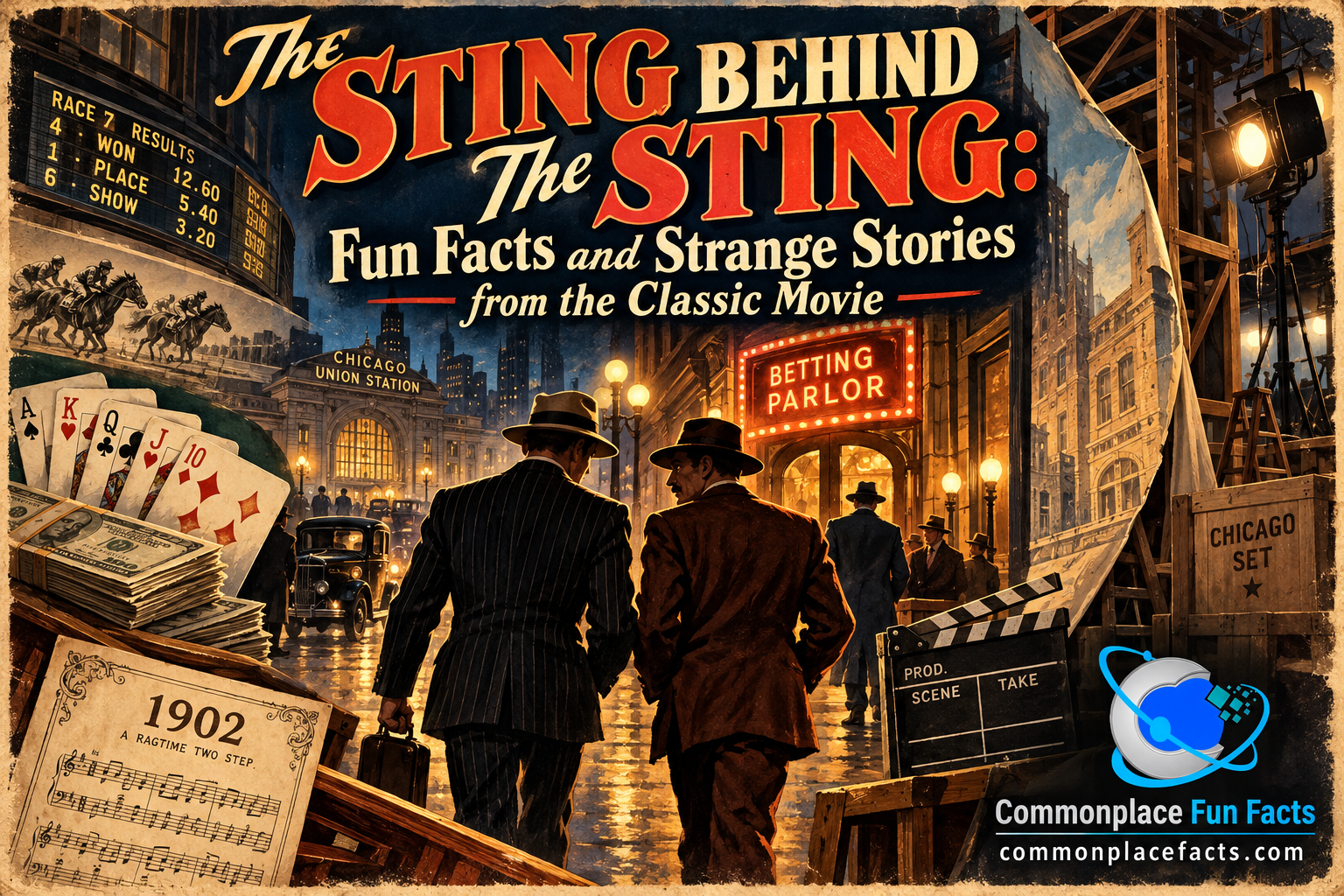

There is something wonderfully appropriate about the fact that almost nothing surrounding The Sting is quite what it appears to be.
The 1973 movie stars Paul Newman and Robert Redford as Henry Gondorff and Johnny Hooker, a pair of confidence men who assemble an elaborate operation to separate ruthless crime boss Doyle Lonnegan, played by Robert Shaw, from a considerable quantity of money. The audience spends most of the movie trying to figure out who is fooling whom, which characters are really who they claim to be, and whether anything happening on the screen can be trusted.
As it turns out, the same questions can be asked about the movie itself.
The sinister limp of the villain? Real injury. The wonderfully authentic-sounding period music? Historically wrong by several decades. The fictional master con man? Named after actual confidence men. Much of 1930s Chicago? California. And the screenplay about people taking things that don’t belong to them eventually became the subject of a real dispute about whether the writer had taken material that didn’t belong to him.
If George Roy Hill had arranged all of this deliberately, it would have been showing off.
Contents
The Sting Was a Second Helping of Newman and Redford
When The Sting arrived in theaters on Christmas Day 1973, audiences were already familiar with the chemistry between Paul Newman and Robert Redford. Four years earlier, director George Roy Hill had paired them in Butch Cassidy and the Sundance Kid, creating one of those screen partnerships that seems as though it must have produced a dozen movies.

It did not. Newman and Redford made only two films together.
That makes The Sting their second and final screen pairing, despite decades of occasional talk about finding another project. The fact that two movies were sufficient to establish them permanently in the public imagination as one of Hollywood’s great screen teams probably says something about charisma. Or lighting. Or the unfair advantages enjoyed by two men who had the looks of Paul Newman and Robert Redford.
The project began with screenwriter David S. Ward, who became fascinated with professional confidence men while researching another screenplay. Ward discovered an entire subculture of elaborate frauds, complete with specialized terminology, carefully assigned roles, and complex schemes that could require dozens of participants.
These were not men who sent badly spelled emails informing strangers that the Crown Prince of Nigeria urgently needed assistance transferring $14 million.
These people had standards.
The Fictional Con Men Had Some Very Real Ancestors
One of Ward’s research sources was linguist David W. Maurer’s 1940 book The Big Con, a study of professional confidence men based on interviews with people who actually practiced the trade. Maurer documented the vocabulary, structure, and psychology of elaborate scams known as the “big con.”
Among the real-life confidence men discussed in connection with this world were brothers Fred and Charley Gondorff. Ward borrowed the Gondorff name for Paul Newman’s character, Henry Gondorff.
The connection becomes even more interesting when you realize that the complex operation in The Sting follows many of the principles that made historical confidence games work. The victim, or “mark,” has to believe he has discovered an opportunity. Other participants play apparently independent roles. The environment is carefully controlled. Most importantly, the con works because the victim is encouraged to participate willingly.
That is the essential brilliance of the confidence game. A robber takes your money. A good con artist persuades you to hand it over and feel clever while doing it.
If that sounds intriguing, you might enjoy our stories about Victor Lustig, the man who sold the Eiffel Tower, Soapy Smith and his frontier empire of grift, and George C. Parker, who repeatedly sold property he did not actually own. History has never suffered from a shortage of people willing to monetize somebody else’s optimism.
The Movie About Con Men Ended Up in a Real Dispute About Who Took What
Here is where things become almost suspiciously appropriate.
After The Sting became a massive success, David Maurer alleged that Ward’s screenplay had relied too heavily upon The Big Con. According to the American Film Institute’s detailed production history, Maurer filed a complaint in 1974 arguing that his book had provided a substantial basis for the film.
Universal eventually settled the dispute for $350,000, although some contemporary reports gave the figure as $300,000. That might appear to settle the question of whether Ward had improperly borrowed from Maurer, except that it didn’t.
A panel of writers organized by the Writers Branch of the Academy later examined the matter and concluded that Ward had not plagiarized Maurer’s work. Ward maintained that The Big Con had been only one of many historical sources he consulted and that the screenplay itself was original. His writing credit remained intact, as did the Academy Award he had won for the screenplay.
Thus, a movie about professional deception inspired partly by a book about professional deception produced a dispute over whether one storyteller had improperly obtained something from another storyteller.
Somewhere, Henry Gondorff would have appreciated the symmetry.
Robert Shaw’s Limp Was Not Acting
Doyle Lonnegan is one of the great understated movie villains. Robert Shaw does not need to scream, throw furniture, or explain his childhood. He merely sits there radiating the sort of menace that suggests someone will shortly disappear and there will be no need for a second meeting.

His distinctive limp adds considerably to the character. It also wasn’t supposed to exist.
Shortly before filming, Shaw injured his leg while playing a racquet sport. Sources variously describe it as handball or racquetball, but the important point is that he hurt himself badly enough that walking normally was no longer among the available options. Rather than replace him or attempt to conceal the injury, George Roy Hill encouraged Shaw to incorporate the limp into Lonnegan’s character.
It works beautifully. The limp makes Lonnegan look like a man who has survived something unpleasant and remembers who was responsible.
The lesson, apparently, is that when life gives you a leg injury, threaten Paul Newman with it.
Paul Newman’s Character Wasn’t Supposed to Be Paul Newman
Henry Gondorff also changed dramatically before reaching the screen. Producer Michael Phillips later recalled that the character had originally been conceived as a much less glamorous figure, describing him as a “fat slob.” Ward remembered the conception somewhat differently, saying he had imagined someone more like Lee Van Cleef: older, tougher, and considerably less polished than Newman.

Either way, nobody’s first mental image was Paul Newman.
Then Newman read the screenplay and wanted the part.
At that point, Hollywood confronted one of its more manageable creative emergencies: “We have accidentally acquired Paul Newman. What should we do?”
The role of Gondorff was expanded and adjusted. Johnny Hooker, originally envisioned as much younger, also grew older once Redford entered the picture. What had initially been closer to a father-and-son relationship between the characters became the easygoing partnership audiences recognize today.
You can read Ward and producer Michael Phillips discussing the evolution of the film in their retrospective interview with The Guardian.
Robert Redford Didn’t Want a First-Time Director — and the Writer Lost His Shot
David S. Ward had optioned The Sting with the understanding that he would be allowed to direct it as his feature-film directorial debut. Robert Redford liked the screenplay but was considerably less enthusiastic about entrusting such a complicated story to a first-time director.
Redford later explained that the movie’s structure required someone exceptionally skilled behind the camera. With multiple levels of deception, characters playing characters, and an audience that must remain confused without becoming irritated, a small directing error could turn the whole thing from clever into incomprehensible.
George Roy Hill came aboard instead, and Redford signed on.
It was probably the correct decision. Hill’s achievement is easy to underestimate because the finished movie feels effortless. The audience understands exactly as much as Hill wants it to understand at any given moment, which is generally slightly less than it thinks it does.
Ward eventually got his opportunity to direct. Among his later directing credits was Major League, proving that losing control of The Sting did not condemn him to a lifetime of standing outside studios staring bitterly through the gates.
George Roy Hill Threw Away the Entire First Week
Experienced director or not, Hill did not nail everything immediately.
According to Ward, Hill looked at the footage from the first week of production, decided it wasn’t good enough, and reshot it. All of it.
That is an impressively expensive version of hitting Ctrl-Z.
The decision also tells you something about why the movie works. The Sting depends on tone and timing more than most films. It has to establish danger without becoming grim, comedy without becoming silly, and deception without causing the audience to give up and start wondering what is available at the concession stand.
Hill apparently decided that “close enough” was not close enough and started over. The resulting film won him the Academy Award for Best Director, which is a reasonably persuasive argument for occasionally admitting that your first attempt stinks.
The Music of The Sting Is Perfect — and About 30 Years Too Old
If there is one piece of music inseparably associated with The Sting, it is Scott Joplin’s “The Entertainer.” The jaunty ragtime melody is so thoroughly attached to the movie that it sounds as if it must have been playing from every saloon, train station, and betting parlor in 1936 Chicago.
It wasn’t.

Joplin composed “The Entertainer” in 1902. Ragtime’s great period of popularity came before World War I. The Sting takes place in 1936, when swing and big-band music would have been much more contemporary. As we explain in our article about how Scott Joplin’s “The Entertainer” went from a 1902 rag to a 1970s pop hit, the tune had already been around for more than seven decades by the time movie audiences encountered it in The Sting.
In other words, using Joplin for The Sting is roughly comparable to making a movie set today and using music from the early 1990s because it feels appropriately modern.
George Roy Hill knew this perfectly well. He simply didn’t care.
According to Hill’s account quoted in the AFI Catalog, his son played one of Joplin’s rags for him. Hill liked what he heard and contacted his friend Marvin Hamlisch about adapting Joplin’s music for the film. Historical chronology politely objected and was overruled.
It was an excellent decision.
The Wrong Music Helped Make Scott Joplin Famous Again
The strangest part is that this deliberate anachronism did more than make the movie memorable. It helped launch a major revival of interest in Scott Joplin and gave “The Entertainer” a second life that its composer could never have imagined.
Hamlisch’s arrangement became an unlikely pop hit. In May 1974, a composition written 72 years earlier reached No. 3 on the Billboard Hot 100, sharing chart territory with contemporary rock and pop acts that presumably had not anticipated stiff competition from a man who had died in 1917. The whole improbable journey—from Joplin’s original publication of the piece in 1902 to its sudden return to the charts—is told in greater detail in our article “Scott Joplin and ‘The Entertainer’: How a 1902 Rag Became a 1970s Pop Hit.”
The renewed attention extended far beyond one recording. Audiences began rediscovering Joplin’s work, recordings of his piano rags became popular, and the composer experienced the peculiar career development of becoming vastly more famous several decades after death.
In 1976, Joplin received a special posthumous Pulitzer award for his contributions to American music. The revival generated by The Sting was not solely responsible for his rehabilitation—scholars and musicians had already been working to restore Joplin’s reputation—but the film introduced his music to an enormous new audience and gave that revival a very substantial shove.
So the movie’s most famous historical mistake helped correct a much larger historical oversight.
We will allow it.
Much of Chicago Wasn’t Chicago
The Sting is set in Illinois and makes wonderful use of its Depression-era urban atmosphere. Some genuine Chicago locations appear in the movie, including Union Station and railroad facilities. Much of the “Chicago” audiences see, however, was assembled from locations around Los Angeles and Pasadena.
The Biltmore Hotel in Los Angeles appears in the film. Pasadena’s Castle Green and other Southern California buildings helped stand in for Midwestern locations. The supposed FBI headquarters was actually the Koppel Paint plant in San Pedro.
This is standard movie magic, but it feels particularly suitable here. The filmmakers constructed a convincing false Chicago in order to tell a story about men constructing convincing false realities.
Even the buildings were running a con.
Anyone interested in Hollywood’s long history of confidently presenting one thing as another may also enjoy our look at how Hollywood itself began as a proposed sober Christian community. The neighborhood did not remain entirely faithful to the original business plan.
The Movie Was Designed to Look Like a Memory of the 1930s
Hill was not actually trying to reproduce 1936 with documentary precision. He was trying to reproduce what audiences thought the 1930s looked like through old movies, magazines, and illustrations.
That distinction matters.
Artist Jaroslav Gebr created the illustrated chapter cards announcing “The Set-Up,” “The Hook,” “The Tale,” “The Wire,” “The Shut-Out,” and “The Sting.” The artwork deliberately resembles illustrations from The Saturday Evening Post. Cinematographer Robert Surtees used old-fashioned visual devices such as iris transitions, while the production employed muted colors and carefully selected period locations.

Even the Universal Pictures logo participates in the act. Instead of the studio’s contemporary 1973 logo, the film begins with a recreation of the Universal globe used during the 1930s.
The result is not so much 1936 as “1936, as fondly remembered by someone who saw it in a movie.”
That gives The Sting its peculiar timeless quality. It is a 1970s movie pretending to be a 1930s movie about men pretending to be people they aren’t.
Layers.
For another look at the cinematic world Hill was invoking, see our exploration of Hollywood before the Hays Code clamped down on movies in the 1930s.
A Gambling Expert Helped Make the Card Games Convincing
The production hired famed gambling authority John Scarne as a technical adviser. Scarne had spent decades studying cards, gambling methods, cheating techniques, and sleight of hand, and his expertise helped give the movie’s gaming sequences an air of authenticity.
You will sometimes encounter the claim that Scarne’s hands doubled for Newman’s during the famous poker game aboard the train. The AFI notes that modern sources make the claim, but the surviving documentation is less definitive than the story’s repeated appearance on trivia websites might suggest.
That is worth mentioning because movie trivia has a habit of improving with age. One person remembers something. Another repeats it. A third adds a detail. Twenty years later everyone confidently announces that Paul Newman had no hands and John Scarne performed all of his close-ups.
Scarne’s documented role as technical adviser is interesting enough without requiring any additional embroidery.
Paul Newman Apparently Stole Robert Redford’s Porsche — Sort Of
There was also some off-camera mischief between the two stars. According to co-star Ray Walston, Newman and Redford both owned Porsches and were possively attentive to them. Newman reportedly obtained Redford’s keys while his co-star was away, moved the car, and allowed Redford to believe it had been stolen.
It is exactly the kind of prank that becomes much funnier when both participants are wealthy movie stars and considerably less funny when performed on your coworker in the employee parking lot.
The story also fits the relationship audiences saw on screen: mutual affection expressed through the traditional male bonding ritual of causing the other person unnecessary distress.
The Sting Won Seven Oscars — and Then Oscar Night Got Weird
The Sting received ten Academy Award nominations and won seven: Best Picture, Best Director, Best Original Screenplay, Best Film Editing, Best Art Direction-Set Decoration, Best Costume Design, and Best Adaptation Score. Redford was nominated for Best Actor, the only acting Oscar nomination of his career.
Marvin Hamlisch had an especially productive evening. He won three Academy Awards that night: one for adapting Joplin’s music for The Sting and two for The Way We Were. The Academy records the feat as a new Oscar record at the time.
And then there was the streaker.
Shortly before the Best Picture presentation, photographer and activist Robert Opel ran naked across the stage behind co-host David Niven, flashing a peace sign. Niven recovered almost instantly and delivered his famous quip about the streaker revealing his “shortcomings.” The line is often remembered as a brilliant ad-lib, although later accounts suggest Niven may actually have prepared it in advance in case a streaker appeared. Moments later, Niven introduced Elizabeth Taylor, who presented Best Picture to The Sting.
Even at the Academy Awards, apparently, misdirection was part of the evening.
The Sting Became Part of American Film History
The movie was not merely an awards success. It became one of the major box-office hits of its era and permanently cemented Newman and Redford’s status as one of cinema’s great pairings despite the inconvenient fact that they stopped pairing after this.
In 2005, the Library of Congress added The Sting to the National Film Registry, recognizing it as a film worthy of permanent preservation. The Library specifically noted both its recreation of Depression-era Chicago and the revival of interest in Joplin’s music.
That seems appropriate because The Sting succeeds at something difficult: it makes an enormously complicated operation look simple. The plot contains fake identities, fake businesses, fake law-enforcement officers, counterfeit money, crooked gambling, staged murders, manipulated telegraph information, and enough double-crosses to require flowcharts.
Yet watching it never feels like homework.
The Greatest Con in The Sting Is the One Played on the Audience
The brilliance of The Sting is not merely that Gondorff and Hooker fool Doyle Lonnegan. The movie fools us, too.
We know we are watching a story about professional liars. We know that people are pretending to be other people. We know whole rooms are being constructed for the sole purpose of fooling one man. We have been explicitly warned, repeatedly, not to trust what we see.
And then the movie fools us anyway.
That may explain why the behind-the-scenes stories feel so perfectly suited to the finished product. Robert Shaw appears to be acting a limp, but isn’t. Joplin’s music sounds historically authentic, but isn’t. Chicago appears to be Chicago, but frequently isn’t. Gondorff appears entirely fictional, but carries the name of real confidence men. A movie derived from research into actual grifters gets accused of taking too much from the researcher who documented them.
Everything is one degree removed from what it appears to be.
That is also why The Sting remains so satisfying more than half a century later. Most movies surprise you once. The Sting spends two hours showing you precisely how confidence games work and then demonstrates that you have learned absolutely nothing.
Which, when you think about it, is one heck of a sting.
You may also enjoy…

Scott Joplin and “The Entertainer”: How a 1902 Rag Became a 1970s Pop Hit
Discover how Scott Joplin’s 1902 rag “The Entertainer” became a 1970s pop hit, plus surprising stories from the life of the King of Ragtime.

The Hollywood Accounting Scam: How Blockbuster Movies Make Millions but Lose Money
Discover how Hollywood accounting turns billion-dollar blockbusters into “losses.” Learn the tricks studios use to avoid paying profits and why hit movies often show no net income on paper.

Soapy Smith: The King of the Frontier Con Men
Jefferson “Soapy” Smith turned a simple soap scam into a criminal empire across Denver, Creede, and Skagway. Discover the true story of the Wild West’s most organized con man and his dramatic end during the Klondike Gold Rush.
Leave a Reply