

Most people encounter a government rulebook only when absolutely necessary. They find the relevant paragraph, decipher what appears to be a sentence written by six committees and a semicolon enthusiast, and then put the document away before it can cause further harm.
W. Reginald Bray was not most people.
In 1898, the young English accountant acquired a copy of the official Post Office Guide, a substantial handbook explaining the services, rates and regulations of the British postal system. Bray was already an enthusiastic collector of stamps and postmarks, but exactly what prompted him to read the guide so closely is unclear.
Then he started reading the regulations.
That was when things went wrong for the Post Office.
Or, depending on your perspective, very right.
Contents
Reginald Bray Decides Postal Regulations Are Actually Suggestions for Experiments
Willie Reginald Bray was born in 1879 and spent most of his life around Forest Hill in southeast London. Outwardly, there was not much about him that screamed, “This man is about to make a rabbit skull somebody else’s administrative problem.” He worked as an accountant, kept meticulous records and developed the respectable hobbies of stamp collecting, postcard collecting and obtaining postmarks.

The British Post Office made the mistake of publishing detailed rules.
The Great Britain Philatelic Society’s archive of British postal guides shows just how comprehensive these publications were. They explained domestic and international mail, postal rates, available services and the locations of post offices. They were reference books intended to tell the public what the Post Office would and would not do.
Bray saw something slightly different. He saw a list of challenges.
He later explained that his purpose was to test the ingenuity of postal officials and, if possible, defend them against accusations of carelessness. In other words, he was not merely trying to annoy the postal service. He was conducting experiments to see just how good it was.
Unfortunately for British postal employees, his experimental methodology consisted largely of asking, “I wonder if they’ll deliver this?” and then reaching for the nearest unsuitable object.
The Turnip Was Only the Beginning
Bray discovered that the postal regulations were surprisingly accommodating about what could enter the system. The rules even permitted live bees to pass by Letter or Parcel Post, provided they were sent in suitable cases and packed so as to avoid injury to postal employees or other mail. A normal person might have read that provision, thought, “Well, that’s interesting,” and continued with his day.
Bray began looking around the house.
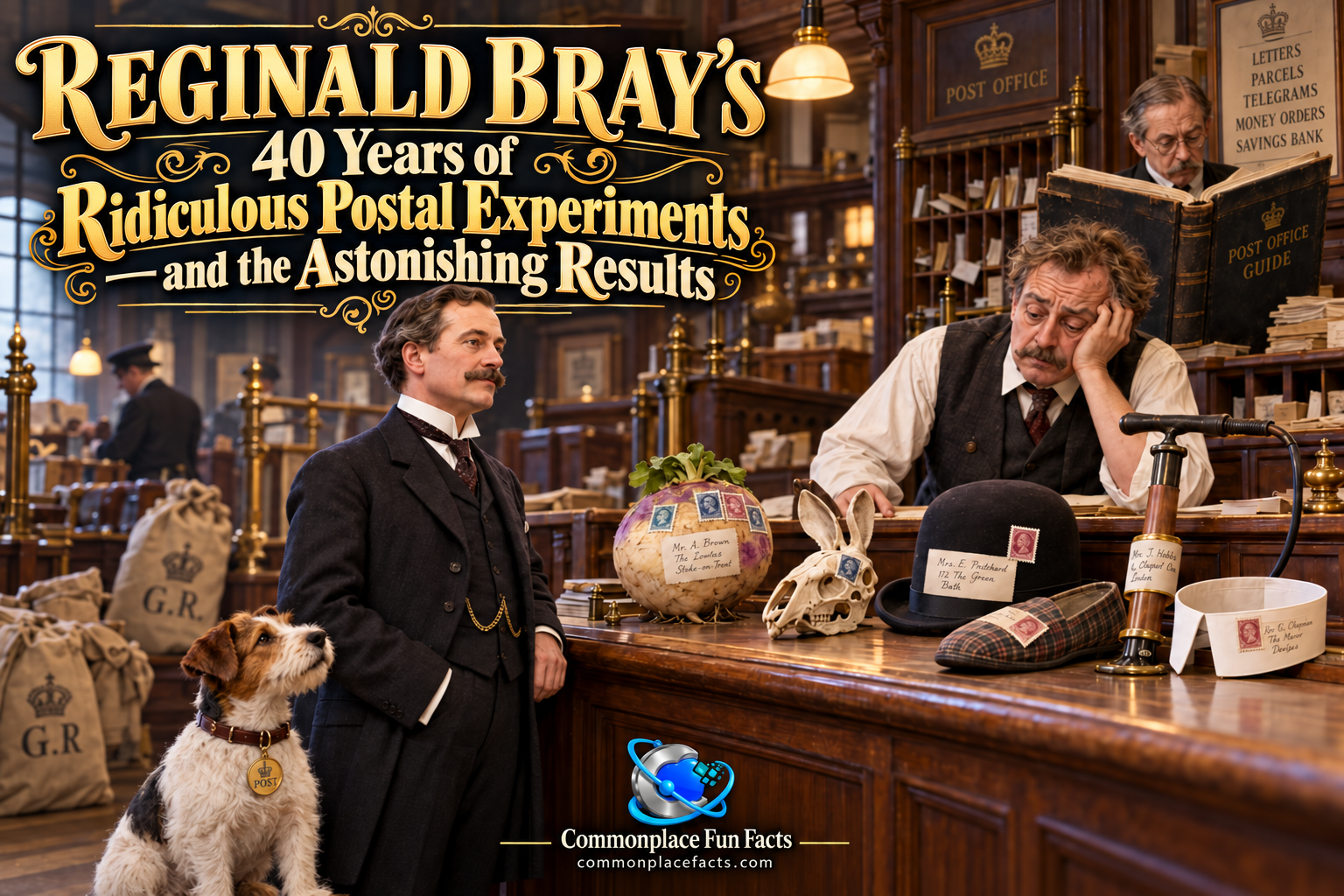
Over the years, he successfully sent an extraordinary assortment of objects through the British post, frequently without conventional packaging. Included among the many objects were a bowler hat, a rabbit skull, a slipper, shirt collars, his dog and a turnip. Presumably, there were some regular letters, as well.
The turnip was not placed safely inside a parcel. That would have defeated the purpose. Bray carved the name and address directly into the vegetable, attached the necessary postage and introduced it to the postal system in its natural state.
He also mailed a rabbit’s skull.
For that particular experiment, the address was written across the skull and postage stamps were attached directly to it. The object was apparently delivered, proving that somewhere in Britain a postal employee was handed the earthly remains of a rabbit and responded not with “What in the name of Queen Victoria is this?” but with the much more useful question, “Right, where’s it going?”
Bray also mailed seaweed, a clothes brush, a penny, a pipe and assorted other objects. The New Yorker‘s account of his exploits, describes an astonishing catalogue of items Bray persuaded the Post Office to process.
He was hardly the last person to discover that postal regulations sometimes permit things nobody in his right mind would have thought to prohibit. In the United States, a businessman later exploited Parcel Post rules to mail the bricks needed to construct an entire bank building in Vernal, Utah. The Hope Diamond, meanwhile, became the most valuable item known to have been shipped by U.S. mail.
Bray’s contribution was to approach the whole subject systematically. If an object could technically be mailed, he wanted to find out whether someone would actually deliver it.
Frequently, someone did.
Sometimes He Made the Address the Puzzle
Once simply mailing unreasonable objects became too easy, Bray began making the addresses themselves unreasonable.
Some postcards bore cryptic verses. Others provided incomplete descriptions. According to surviving examples described by The New Yorker, Bray used geographical coordinates, picture clues and vague instructions such as delivering a card to the resident nearest a particular rock.
On another postcard, he wrote the address backward. The Post Office successfully deciphered it.
One surviving 1899 postcard, described in the Postal Stationery Society Journal, was addressed simply to “Dentist” in Highbury Place, London, with a photograph of the intended recipient attached as additional guidance.
It arrived.
This is one of the more charming parts of Bray’s story. He was probing for the point at which the Post Office would fail, but his experiments repeatedly demonstrated how remarkably capable postal workers were at solving problems.
Modern mail-processing equipment prefers postal codes, standardized addresses and barcodes. Bray’s postal workers sometimes received what amounted to a Victorian escape-room clue attached to a penny stamp and apparently regarded this as sufficient information to proceed.
Then Reginald Bray Found Out He Could Mail a Human Being
Eventually Bray discovered a provision in the Post Office Guide that made all the turnips and rabbit skulls seem like warm-up exercises.

The regulations stated that a person could be conducted by an Express Messenger to an address upon payment of the appropriate mileage charge.
This was not quite the same thing as being wrapped in brown paper, covered in stamps and dropped through a letter slot. The Express Messenger service could essentially provide an escort who would accompany a person to a destination. Bray nevertheless saw the important point:
According to the regulations, a person could be delivered.
And Bray was a person.
He later claimed that he first used the service on February 8, 1900. Postal historian John Tingey, whose extensive research became the book The Englishman Who Posted Himself and Other Curious Objects, notes that no documentary proof of that first experiment is known to survive.
Bray apparently realized that a man interested in postal history ought to obtain somewhat better documentation of having become postal history.
So he did it again.
The Human Letter Goes Registered Mail
On November 14, 1903, Bray repeated the performance, but this time he used registered service and obtained documentation of the transaction. The surviving records make the second trip considerably easier to establish than his claimed 1900 experiment.
That episode helped earn him the nickname “The Human Letter.”
It also demonstrated why Bray was more interesting than the average practical joker. He was an accountant. Of course he kept the receipt.
Bray later repeated the human-delivery stunt in 1932. By then he had been experimenting with the postal system for more than three decades and had become sufficiently well known for his eccentricities that photographs and press coverage preserved the spectacle.
There was even a practical argument for the service. In discussing the human-delivery rule, Bray suggested that a parent could use the Post Office to have a child escorted safely to school. He noted, with characteristic amusement, that the child would not actually arrive covered in stamps and postmarks; a messenger would simply accompany the child to the destination.
He also told a story about using the service one foggy night when he could not locate a friend’s house. Rather than continuing to wander through the fog, Bray went to the Post Office and arranged to have himself delivered.
It is difficult not to admire the logic.
GPS would not become widely available for almost a century. Bray improvised by turning himself into a postal delivery.
No, Bray Was Not Literally Shipped in a Mailbag
This is where the story sometimes gets embellished.
Bray did not climb into a crate and travel through sorting offices like an exceptionally talkative package. The applicable Post Office service involved a messenger personally conducting someone to an address. Calling Bray “the man who mailed himself” is reasonable shorthand for what he did, and contemporary publicity certainly embraced the idea of the “Human Letter,” but the mechanics were less hazardous than the phrase suggests.
This distinction also separates Bray’s experience from genuinely dangerous cases in which human beings were transported as cargo. Henry “Box” Brown, for example, famously escaped slavery in 1849 by having himself shipped in a wooden crate from Richmond to Philadelphia. That was an act of extraordinary courage undertaken under terrifying circumstances, not an amusing exercise in regulatory interpretation.
Bray’s achievement was stranger in a different way. He walked into an ordinary British postal facility as a free adult, pointed to an official regulation and essentially said, “According to page whatever, I believe you are now required to post me.”
The Post Office apparently looked at the rule and concluded that, irritatingly enough, he had a point.
The Post Office Had Already Demonstrated a High Tolerance for Eccentricity
In fairness, Britain’s postal service was already accustomed to handling duties that might seem unusual today. Beginning in the nineteenth century, it even maintained officially supported cats to protect mail facilities from rodents. As we have previously explored, those Post Office cats received maintenance allowances, became the subject of parliamentary questions and occasionally underwent what amounted to government performance reviews.
A bureaucracy capable of establishing an official mouse-control budget for cats was perhaps unusually well prepared when Reginald Bray arrived carrying a turnip.
Still, Bray presented a special challenge because he was not trying to circumvent the rules. He was trying to obey them so enthusiastically that their outer limits became visible.
This is an important distinction. His experiments were less like vandalism and more like software testing conducted with postage stamps. Every object or improbable address was essentially a request: “You say the system works under these rules. Does it still work if I do this?”
Much of the time, the answer was yes.
Reginald Bray Reinvents Himself as the Autograph King
As Bray grew older, his fascination with the mail shifted from sending absurd things to obtaining signatures from interesting people.

Naturally, he approached this hobby with the restraint and moderation that had characterized his rabbit-skull period.
He wrote to thousands upon thousands of celebrities, politicians, military officers, athletes, actors, aviators and public figures asking for their autographs. According to the research archive devoted to Bray’s surviving postal material, he eventually accumulated more than 15,000 autographs and proudly styled himself “The Autograph King.”
He frequently selected postcards appropriate to the recipient. Politicians might receive images of Parliament. Sports figures received cards connected with their sport. Military officers were approached during conflicts that offered Bray opportunities to obtain signatures from participants while simultaneously accumulating unusual international postmarks.
The whole operation became another postal experiment, except this time the destination was fame itself.
Among the people represented in his collection were major actors, entertainers, soldiers and political figures. He obtained autographs from Gary Cooper, Laurence Olivier and Maurice Chevalier, among many others. His interests stretched across decades and continents.
Not everyone cooperated.
Even Adolf Hitler Eventually Asked Him to Stop Writing
Bray was persistent, a quality that had already been demonstrated by the fact that mailing one human being was apparently insufficient research.
Among the people whose autograph he sought unsuccessfully was Adolf Hitler.
Bray tried repeatedly. According to Tingey’s research, preserved correspondence shows that Hitler’s office refused him five times. After one rejection in 1934, Bray wrote again and pointed out the impressive political and military figures whose signatures he had already obtained.
This did not produce the desired result.
The final response from Hitler’s office informed Bray that the German leader was too busy and asked him to stop sending autograph requests.
There are not many circumstances in which irritating Adolf Hitler into sending what amounts to a cease-and-desist letter counts as a wholesome hobby, but Bray seems to have found one.
British royalty was similarly uncooperative. The royal household had a general policy against providing autographs to strangers, so repeated approaches to members of the Royal Family also failed. Bray nevertheless accumulated enough successful responses that his collection became extraordinary by any reasonable measure.
By the end of his life, more than 15,000 autographs testified to what can be accomplished when an accountant combines meticulous recordkeeping with an apparent inability to accept silence as an answer.
The Human Letter Becomes a Radio Personality

Bray did not keep his activities private. He displayed parts of his collection, wrote articles about postal curiosities and eventually appeared on BBC radio. He was featured on the BBC program In Town Tonight in 1935 and again in 1936. His identity as “The Human Letter” became sufficiently well known that W.A. & A.C. Churchman later included him in its 1938 In Town Tonight cigarette-card series, an example of which is held by the National Portrait Gallery.
He was interviewed for the BBC program In Town Tonight, where his identity as the Human Letter was exactly the sort of odd human-interest material the program favored.
By the 1930s, the young accountant who had once decided to test a government handbook had become a recognized eccentric. His hobby had lasted long enough to span enormous changes in communication. When Bray began his experiments in the 1890s, the letter remained a central technology of everyday life. By the time of his death in 1939, radio broadcasting and long-distance telephony had transformed communications, aviation had accelerated international mail and the world stood on the verge of another global war.
Bray was still posting things.
Bray Wasn’t Trying to Prove the Post Office Was Incompetent
Perhaps the most appealing aspect of Bray’s story is that he seems to have genuinely respected the system he tormented.
In his 1904 writing about postal curiosities, he explained that he wanted to test the ingenuity of postal officials and defend them from accusations that they were careless or neglectful. He devised deliberately difficult tasks, but every successful delivery was evidence in the Post Office’s favor.
That makes his experiments oddly affectionate.
Imagine spending years creating impossible assignments for a group of workers solely because you are confident they are clever enough to solve them. There are probably easier ways to show appreciation, such as saying thank you or bringing biscuits, but neither would have left behind a turnip covered in postmarks.
His surviving postal curios also preserve something that ordinary letters rarely show: the human intelligence inside a huge bureaucratic system. Somebody had to look at the backward address. Somebody had to identify the dentist from his photograph. Somebody had to determine which house was nearest the rock. Somebody had to pick up the rabbit skull, resist whatever immediate questions arose, and get it moving toward its destination.
The institution mattered, but individual postal workers made the tricks work.
More Than 30,000 Pieces of Postal Mischief
Bray continued his postal activities for decades. John Tingey’s research indicates that the combined total of his postal curios and autograph requests exceeded 30,000 items. Bray’s accountant instincts helped: he assigned identifying numbers to many pieces and maintained detailed records of his activities.

Unfortunately, much of the collection was dispersed after his death in 1939. Individual postcards, autographs and postal curios have since surfaced in private collections and auctions, allowing researchers to reconstruct portions of the story.
That work is still continuing. Tingey’s W. Reginald Bray archive catalogs surviving examples and seeks information about others that remain scattered around the world.
Somewhere in a box of old postcards may be another surviving relic of an accountant who once looked at the British postal system and wondered how much nonsense it could withstand.
The answer turned out to be quite a lot.
The Man Who Treated the Post Office Like a Brainteaser
Reginald Bray died in 1939 at the age of 60, but his peculiar experiments remain fascinating because they occupy an unusual territory between prank, hobby and genuine investigation.
He was not trying to steal postage. He was not trying to disrupt the system. He generally wanted to operate within the regulations and discover what happened when those regulations encountered circumstances their authors presumably never imagined.
Could you mail a turnip without wrapping it?
Apparently.
Could a postal worker determine an address from a picture?
Sometimes.
Could you send a dog?
Under the right service and rules, yes.
Could you mail yourself?
Technically, yes—and Bray had the paperwork to prove it.
Most of us read a regulation and ask, “What am I required to do?” Reginald Bray read one and asked, “What is the most ridiculous thing this permits me to do?”
Government regulations have rarely had a more attentive reader.
You may also enjoy…

How a Bank Became the Largest Item Mailed — The Wild 1916 Vernal Utah Case
Learn how a bank in Vernal, Utah became the largest item mailed.

Britain’s Post Office Cats: The Mousers Who Were Government Employees
Britain’s Post Office cats caught mice, earned maintenance allowances, passed performance reviews, and even became the subject of debate in Parliament.

The Chaco War: The Forgotten Conflict That Was Triggered By a Postage Stamp
A deeper look at the real causes of the Chaco War (1932–1935) between Bolivia and Paraguay — and whether a postage stamp was the spark.



Leave a Reply