

History has given us no shortage of wars with grand causes, sweeping consequences, and stirring speeches. There are wars fought over territory, ideology, independence, honey, eggs, and even emus.
And then there is the Iowa Cow War of 1931.
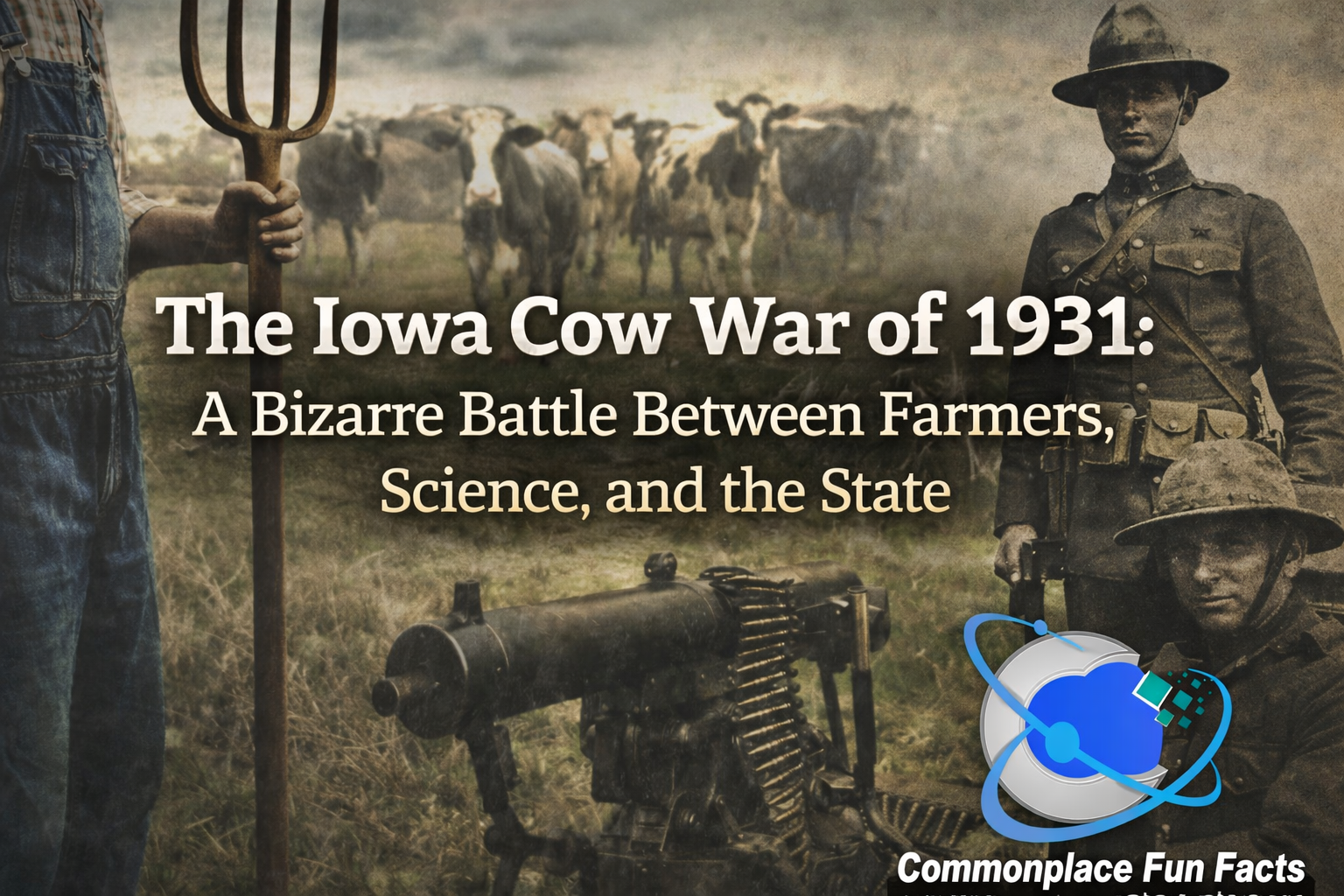
This was a conflict in which the State of Iowa deployed the National Guard—with machine guns—to ensure that veterinarians could safely perform tuberculosis tests on cows. Depending on your perspective, it was either a necessary public health intervention or the moment when things escalated just a touch beyond what anyone expected when they woke up that morning.
It turned out to be both.
As with many of history’s strangest episodes, it began with something perfectly reasonable and quickly spiraled into something that sounds like it was workshopped by a committee specializing in unintended consequences.
Contents
A Sensible Idea Meets the Great Depression
In the early 20th century, bovine tuberculosis was a serious problem. It could spread from cattle to humans, often through contaminated milk, and posed a genuine public health risk. The solution, from the government’s perspective, was straightforward: test the cows, identify the infected animals, and remove them from the population.
The plan was logical. It was scientific. It was, in theory, uncontroversial.

Unfortunately, it was also introduced during the Great Depression.
For farmers, cattle were not abstract units in a public health model. They were livelihoods, investments, and in many cases, the difference between surviving the year and losing everything. The state promised compensation for any cow that tested positive and had to be destroyed, but the payment was often only a fraction of the animal’s market value.
In other words, the government’s proposal sounded less like “we’re here to help” and more like “we’re here to take your most valuable assets and give you a polite discount in return.”
The Test That Launched a Thousand Arguments
The tuberculosis test itself became a focal point of suspicion. Many farmers believed that the test was not just ineffective but actively harmful. Rumors spread that it could cause healthy cows to become sick, lead to miscarriages in pregnant animals, and magically transform perfectly fine livestock into government-approved casualties.
From the farmers’ perspective, the situation looked less like disease prevention and more like a rigged system designed to justify killing their cattle.
It did not help matters that scientific explanations were, at the time, not universally trusted in rural communities. Germ theory, while well-established in medical circles, did not always carry the same weight at the local level—especially when it came attached to policies that cost money.
Enter Norman G. Baker, Professional Agitator (and Occasional Everything Else)
No story like this reaches its full, magnificent level of absurdity without a central character who appears to have taken a wrong turn out of an entirely different storyline and simply decided to stay. In the case of the Iowa Cow War, that role was filled—enthusiastically and with a certain theatrical flair—by Norman G. Baker.

Baker was not a veterinarian, nor was he a scientist, and he was certainly not what anyone would describe as a medical professional in the traditional, license-holding, “please don’t mix household ingredients and call it a cure” sense. What he was, however, is far more interesting and, depending on your tolerance for chaos, far more consequential.
Born in Muscatine, Iowa, in 1882, Baker built a career that reads less like a résumé and more like a sampler platter of early 20th-century ambition. He moved through roles as a vaudeville performer, inventor, entrepreneur, publisher, political candidate, and radio personality, all with a consistent underlying talent: persuading large numbers of people to believe things that did not always stand up particularly well to scrutiny. At one point, he made a considerable fortune promoting what he claimed was a cure for cancer, a treatment that, upon closer inspection, turned out to be less a breakthrough in medicine and more something that sounded like it might have been assembled in a kitchen with an optimistic attitude and a loose definition of science.
In short, Baker was not so much a specialist as he was a one-man traveling institution of confidence, the kind of individual who could sell certainty in uncertain times and do so with remarkable success.
What made him especially influential was his mastery of radio, which, in the early 1930s, functioned as the closest thing available to a direct line into the homes—and minds—of rural America. Through his station, KTNT, reportedly standing for “Know The Naked Truth,” a phrase that practically comes with its own raised eyebrow, Baker reached tens of thousands of listeners. These were people navigating the harsh realities of the Great Depression, already wary of economic threats and understandably suspicious of anything that might jeopardize what little stability they had left.
Baker positioned himself as their advocate, their watchdog, and, when necessary, their loudest voice of indignation. He directed his criticism broadly and with enthusiasm, dismissing doctors as incompetent or corrupt, portraying government officials as overreaching meddlers, and suggesting that universities and experts were part of a larger, conveniently vague conspiracy. He had a particular gift for taking complicated issues and reducing them to simple, emotionally satisfying narratives, preferably with clearly defined villains. Those villains, more often than not, were grouped together under the helpful and flexible label of “the establishment.”
When Iowa began enforcing mandatory tuberculosis testing for cattle, Baker recognized an opportunity that fit neatly into his preferred storyline. Through his radio broadcasts, newspaper ventures, and public appearances, he argued that the testing program was not a legitimate public health measure but rather a scheme, possibly orchestrated by meatpackers or other shadowy interests, to acquire cattle at artificially depressed prices. At the same time, he amplified existing fears about the test itself, promoting the idea that it could harm healthy animals and validating concerns that many farmers were already inclined to believe.
This was not a quiet or measured disagreement conducted in polite tones over coffee. Baker’s rhetoric was vivid, relentless, and delivered with the energy of someone who understood that volume and confidence can often substitute for evidence in the court of public opinion. He went after medical professionals, politicians, and institutions with a kind of verbal intensity that felt less like debate and more like a competitive sport, complete with a running commentary and a clear sense of who was supposed to win.
The progression that followed was almost textbook in its predictability. Skepticism hardened into suspicion, suspicion evolved into organized resistance, and resistance, given enough time and a steady supply of airtime, escalated into open confrontation. By the spring of 1931, what had begun as a technical dispute over livestock testing had been transformed into something much larger: a populist uprising fueled by economic anxiety, distrust of authority, and a steady stream of very confident misinformation.
Baker did not merely observe the Iowa Cow War from a distance or offer commentary from the sidelines. He helped shape the environment in which it unfolded, providing both the narrative and the momentum that allowed a policy disagreement about cattle to escalate into one of the more unusual standoffs in American history.
The Original Rural Rapid Response System
When veterinarians arrived at farms to conduct tests, they often found that they were not dealing with a single farmer.
They were dealing with several hundred.
Word traveled quickly through rural communities. A visit from state officials could trigger an impromptu gathering of neighbors, all of whom arrived with strong opinions and a willingness to express them.
This was, in essence, the 1931 version of a group chat—except instead of typing furiously, participants showed up in person, sometimes carrying farm tools and a general sense that this was going to be an event.
Diplomacy, But With More Projectiles
Initial confrontations were tense but manageable. They did not stay that way.
As resistance grew, so did the creativity of protest. Farmers expressed their displeasure by throwing rocks, mud, and eggs at officials. At least one report notes the use of chamber pot contents, which represents a level of commitment to the cause that is difficult to ignore and even more difficult to clean up afterward.
Negotiations, under these circumstances, were not always productive.
The Jailbreak That Nobody Had on Their Bingo Card
At one point, authorities arrested a farmer involved in the unrest. This might have been expected to calm the situation.
It did not.
A group of farmers gathered, confronted the authorities, and freed the man from jail. The conflict, which had already drifted far from its original purpose, now included elements of what can only be described as an agricultural jailbreak.
There are moments in history when escalation becomes unmistakable. This was one of them.
The Art of Not Being There
Not every farmer chose direct confrontation. Some opted for a quieter, more strategic approach.
One farmer, Jacob Lenker, was scheduled to have his herd tested. Rather than engage in a standoff, he sold all 21 of his cows before officials arrived.
When the veterinarians showed up, prepared for resistance, they found an empty barn.
It was a masterclass in conflict avoidance and a reminder that sometimes the best way to win a battle is to ensure there is nothing left to fight over.
From Dispute to “War”
The situation reached its peak in Cedar County, where hundreds of farmers gathered to resist testing efforts. They faced a much smaller group of law enforcement officers and veterinarians, but numbers were not the only factor in play.
There were clubs. There were improvised weapons. There were slashed tires and damaged vehicles. Tear gas was deployed.
At this point, the phrase “Cow War” stopped sounding like an exaggeration and started sounding like a reasonable summary.

When in Doubt, Send the National Guard
Governor Dan W. Turner eventually concluded that local authorities were not going to resolve the situation on their own.
His solution was decisive.
He deployed approximately 1,800 National Guard troops to the area.
They arrived with bayonets, trucks, and machine guns, establishing a military presence across rural Iowa. Patrols were set up along country roads. Strategic positions were secured.
The objective of this show of force was not to repel an invading army or defend a critical stronghold.
It was to make sure veterinarians could test cows.
History occasionally produces sentences that feel like they should not exist. This is one of them.
The Least Dangerous War in History
Despite the dramatic escalation, the Iowa Cow War was remarkably light on casualties.
Only one person was injured during the conflict, and even that was the result of a soldier accidentally shooting himself while cleaning his weapon.
Considering the number of people involved, the level of tension, and the presence of both armed civilians and military forces, this outcome borders on miraculous.
Compliance, Achieved Efficiently

Once the National Guard established control, resistance largely subsided. Veterinarians resumed their work, this time under armed protection.
Testing proceeded at an impressive pace, with thousands of cattle examined each day.
It turns out that while debate and protest can delay a process, the presence of a machine gun tends to focus attention in a way that encourages cooperation.
Science, Suspicion, and the Human Factor
The Iowa Cow War was not simply about cows or even about tuberculosis. It was about trust.
Farmers were asked to accept scientific explanations, economic losses, and government authority all at once, during a period of profound financial hardship. The result was a perfect storm of skepticism, resistance, and, eventually, confrontation.
From the state’s perspective, the policy was necessary and effective. From the farmers’ perspective, it was intrusive and costly. Both views contained elements of truth, which is often the case in conflicts that spiral beyond anyone’s original intentions.
The Aftermath: A Quiet Ending to a Loud Conflict
The “war” did not end with a treaty, a formal surrender, or a dramatic final confrontation.
It ended with a gradual return to normalcy.
The National Guard eventually withdrew. Farmers, for the most part, complied with the testing program. Bovine tuberculosis rates declined.
Life went on.
And somewhere in the historical record, Iowa’s brief moment of armed conflict over cattle testing settled into its rightful place among the more peculiar chapters of American history.
Why This Story Still Feels Familiar
It is tempting to view the Iowa Cow War as a quaint and slightly absurd relic of the past. It is, after all, difficult to take seriously a conflict that involves eggs, chamber pots, and a strategic deployment of veterinarians.
And yet, the underlying themes are anything but outdated.
Distrust of experts. Economic anxiety. The rapid spread of misinformation. The tension between individual livelihoods and collective well-being.
Change the details, update the technology, and you have a story that feels surprisingly modern.
Which may be the most interesting—and slightly uncomfortable—lesson of all.
You may also enjoy…

The Honey War of 1839: When Missouri and Iowa Nearly Went to War Over Honey
Discover the Honey War of 1839, the bizarre border dispute that nearly sparked a war between Missouri and Iowa over a surveying error and trees full of honey.

Cow Tipping 101: Myth-Busting the Moo
Discover the truth behind the myth of cow tipping! This humorous and fact-filled article explores the science, folklore, and pop culture behind one of rural America’s most enduring (and impossible) legends.

Rabbits: The Terror of Australia
Rabbits are so cute and cuddly that it is hard to imagine the word “terror” being associated with them. (NOTE: This would be news to Napoleon and Jimmy Carter, each of whom had horrifying encounters with rabbits, as detailed here.) Despite such rabbit horror fantasies as Night of the Lepus, and Year of the Angry…




Leave a Reply