
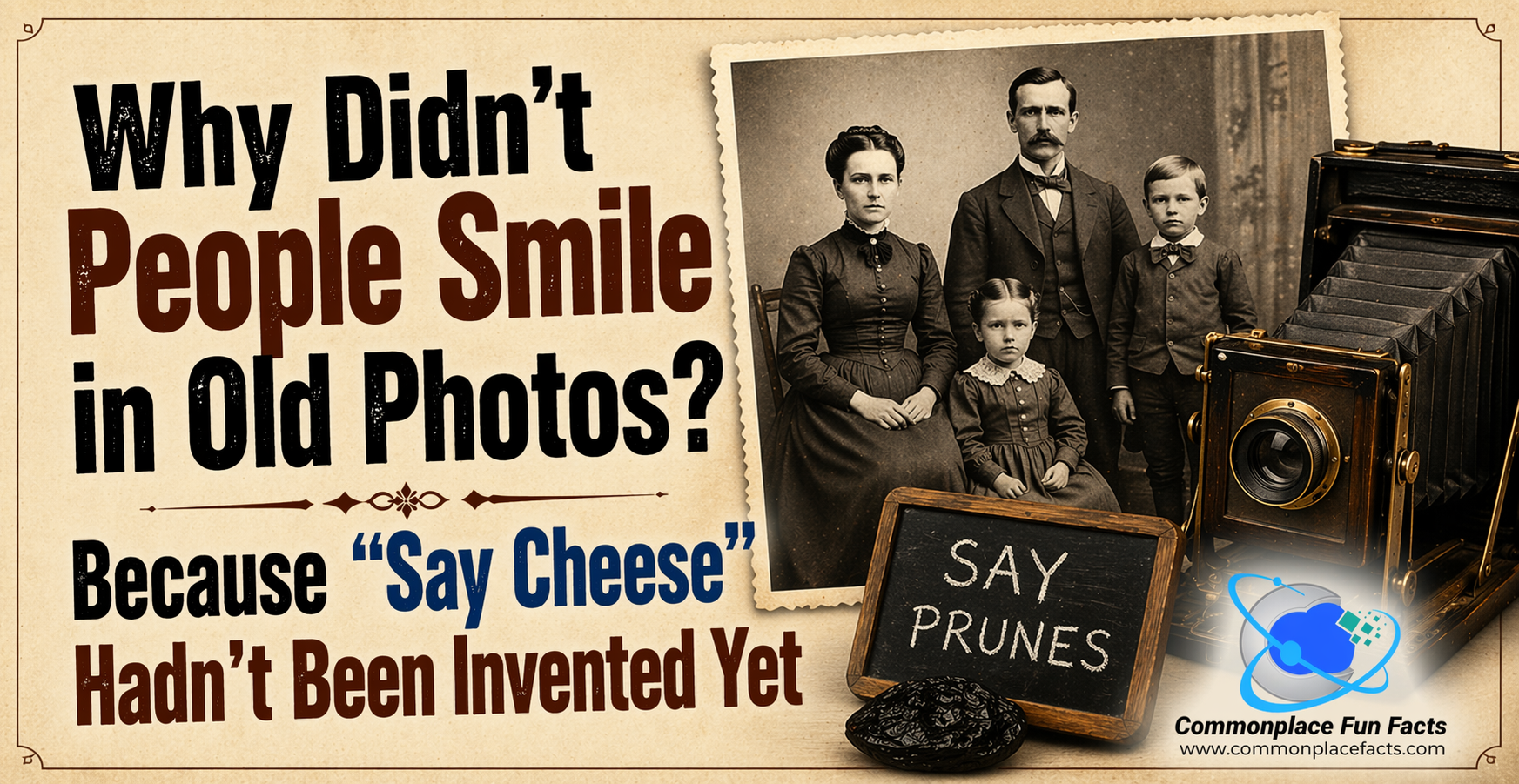

Why Didn’t People Smile in Old Photos?
Compare photographs from the late 19th century with those of today. Aside from the obvious differences, such as color and changes in fashion, there is one big difference that stands out: no one seemed to smile in the old days.
No matter the occasion, everyone in the old photographs looks dour, as if they had been weaned on a pickle. Maybe they were depressed about living in a world where color had not yet been invented. Perhaps they were a bit dour because boys were forced to dress in gender-ambiguous clothing, such as in the picture to the right. That could explain why they always look as if they have just eaten a big bowl of prunes.
Or it could be that prunes were very much on their minds.
Contents
Photography Was an Endurance Sport
Getting your picture taken used to be a pretty big deal — and ordeal. When the world’s first photograph, “View from the Window at Le Gras,” was taken in 1826, it took eight hours to capture the image. Louis Daguerre’s innovative daguerreotype photography came along in 1839 and substantially speeded the process. Even so, the first selfie, taken that same year, required the subject to sit still for an unconfortable amount of time. A clear photo required the subject to sit still for a minimum of 15 minutes.
If you have ever had to endure sitting for a group photograph where several people are waiting in line for their chance to snap a picture, or if your group includes a stubborn little man-cub who refuses to smile or look at the camera, you know that trying to hold a smile for more than a few seconds can be tiring. Imagine trying to retain that smile for 15 minutes.
Bad Teeth and Worse Incentives

Even the most jovial of people look pretty somber in those old pictures. Despite his nearly unmatched sense of humor, there is not a single photograph of Abraham Lincoln smiling.
It should also be noted that the 19th century is not fondly remembered for achieving the pinnacle in oral hygiene. George Washington lived in the days before photography, but he rarely smiled in public. By the time he was inaugurated as president, he had only one natural tooth remaining. Because of this, he was very self-conscious about his appearance.
Washington’s experience was not unique. When posing for a photograph that could survive for centuries, few would want to highlight a messy morass of moldy molars.
Say “Prunes,” Not “Cheese”
The United Kingdom’s first portrait photographer, Richard Beard, found a way to get his subjects in the right mood for a photo. It was in the 1840s that he discovered that telling people to say, “Prunes” would do the trick. He wanted their mouths to be as small and refined as possible. This made it easier to hold the facial expression long enough to capture it photographically. It also fed into the Victorian etiquette that the mouth and outward expressions of emotion be carefully controlled in public settings.
How Kodak Changed Everything
Advances in photography eventually negated the need to sit still for long periods. People also started taking much better care of their teeth. Even so, the custom of looking dour for photographs persisted well into the 20th century.
You can thank Kodak’s development of the personal camera for making modern photographs appear so much happier. When Kodak offered inexpensive and easy-to-use cameras for the public, consumers were not immediately persuaded. Society was accustomed to thinking that photography was a complicated process best left to professionals.
In an effort to convince the public that anyone could be a photographer, Kodak developed an elaborate educational campaign. The company circulated flyers and printed advertisements to let folks know that they need only point the camera and push a button. Kodak’s technicians would do all the fancy stuff such as developing the film and processing the prints.
To further emphasize its point, Kodak encouraged magazines such as Life to use candid photos taken by non-professionals. For the first time, the public started to see photographic representation of life outside of the photo studio. The photographs taken of people who were not posing showed the subjects to be relaxed and — wonder of wonders — smiling.
From Prunes to Cheese (and Beyond)
The realization that it was possible to look natural and happy in a photograph coincided with the explosion of the popularity of personal photography. Gone were the days of photographers demanding their subjects say, “Prunes.”
Less clear is why people say, “Cheese” today when getting ready to be photographed. The purpose, of course, is to encourage the subject’s mouth into a smile, but no one knows who started this practice.
Some cultures, such as Japan, have adopted the “cheese” tradition for smiling, but others use words in their language to achieve the effect. French-speaking cultures, for example, say, “ouistiti,” which translates as “marmoset.” Germans use “käsekuchen” (cheesecake). In Bulgaria, it is “zele” (cabbage).
The Dour Look Lives On
Although the “prunes” custom is gone, the practice of looking utterly dour and appearing as if the subject wishes to be doing anything other than sitting for the photograph is still alive and well. Just look at the pictures of the boys in any junior high school yearbook.
You may also enjoy…

Optograms, Spirit Photos, and Fritz Angerstein, the Killer Who Couldn’t Escape a Snapshot
Discover the bizarre history of optograms and spirit photography, and how they collided in the shocking 1924 Fritz Angerstein murder case. Pseudoscience, ghosts, and forensic failure await.

Time Travel Claims: The Wildest Stories, Photos, and Legends People Still Swear Are Real
Explore the strangest time travel claims in history—from mysterious photographs and alleged time slips to viral legends like John Titor, the Man from Taured, and the Versailles encounter. A humorous deep dive into stories people still swear are real.

How Sony Accidentally Created a Camera That Could See Through Clothing
In 1998, Sony’s Handycam featured advanced night vision technology intended for wildlife filming. However, it unintentionally became popular for voyeurism, as a cheap filter transformed it into a camera that could see through clothing. Following media exposure, Sony faced a public relations crisis and recalled 700,000 units to avoid association with privacy invasion.



Leave a Reply